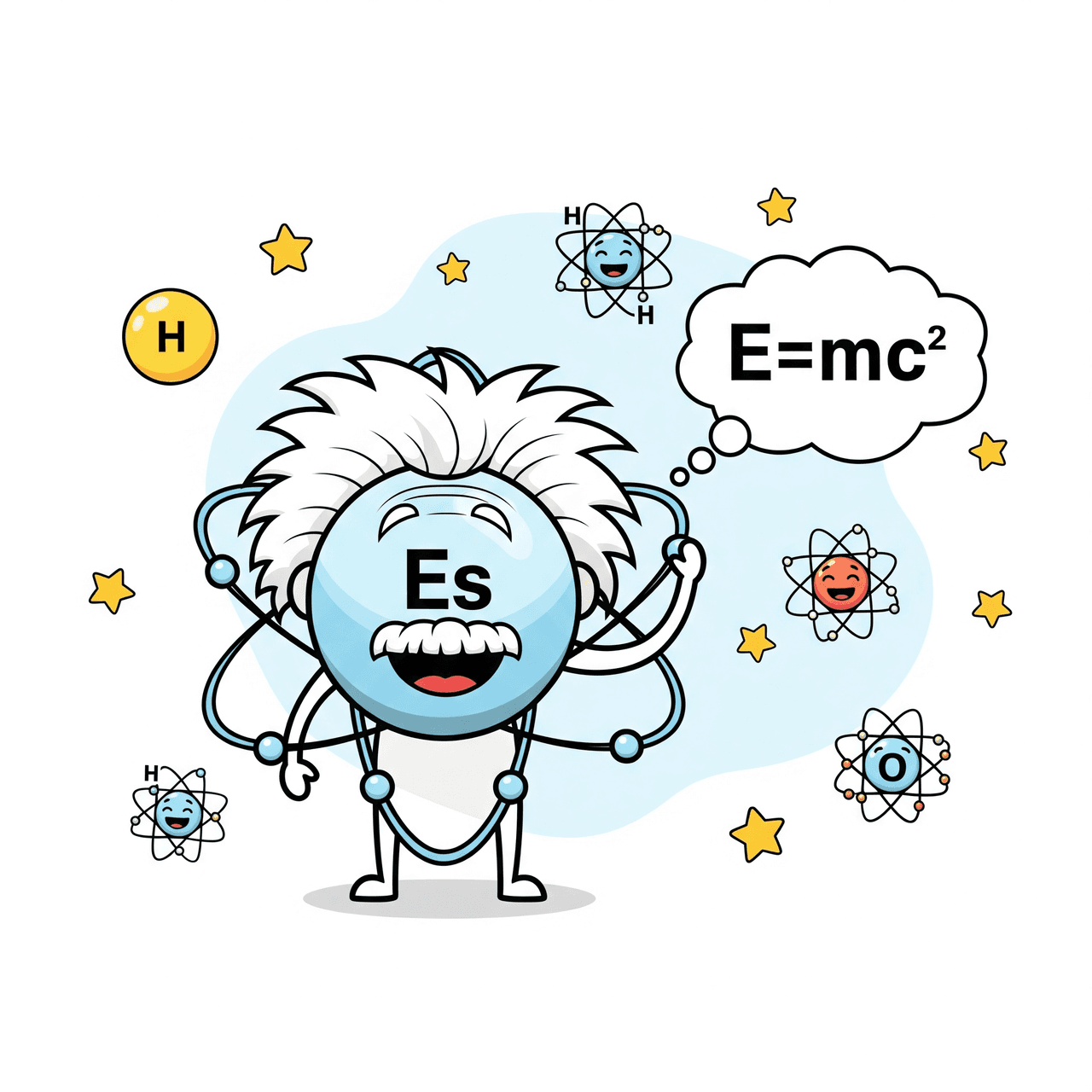




What is Einsteinium?
Einsteinium is an artificial element belonging to the actinide group in the periodic table. It does not occur naturally; it can only be produced during nuclear explosions or in specialized laboratories. It is named after the renowned scientist Albert Einstein.

(Generated by Artificial Intelligence.)
Discovery and Name
Einsteinium was discovered in 1952 as a result of reactions involving uranium and other elements. It is named after the famous physicist Albert Einstein. This name was given to honor Einstein’s immense contributions to science.
Properties
The symbol of einsteinium is Es and its atomic number is 99. Its atomic weight is approximately 252 u. It was first discovered during the initial hydrogen bomb tests in 1952. Due to its high radioactivity and short half-life, it is known only through scientific research.
Physical Properties
This element is a shiny, silvery-white metal. Its density is estimated to be approximately 8.8 g/cm³. Detailed physical properties are known only in limited form due to the extremely small quantities that can be produced.
Chemical Properties
Einsteinium is a member of the actinide series and typically forms compounds in the +3 oxidation state. Its intense radioactivity makes its study and storage very challenging.
Where Is It Used?
Einsteinium has no applications in daily life or industry. The main reason is its extreme rarity and danger. However, scientists have used this element to synthesize new elements. For example, mendelevium (Md) was produced using einsteinium.
Significance
Einsteinium provides important insights into atoms and energy. This enables scientists to develop new technologies and better understand the secrets of nature.