



What is Lenz's Law?
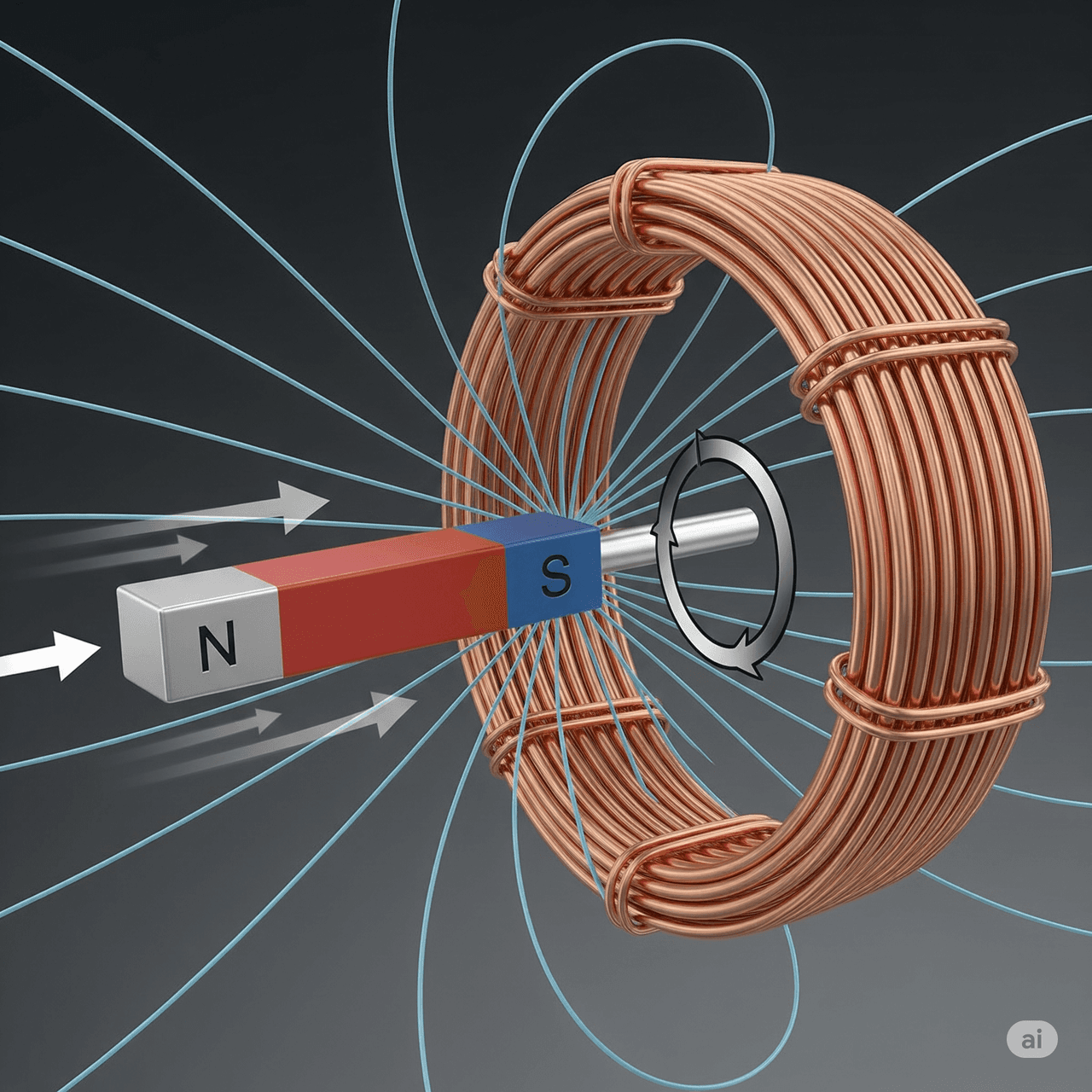
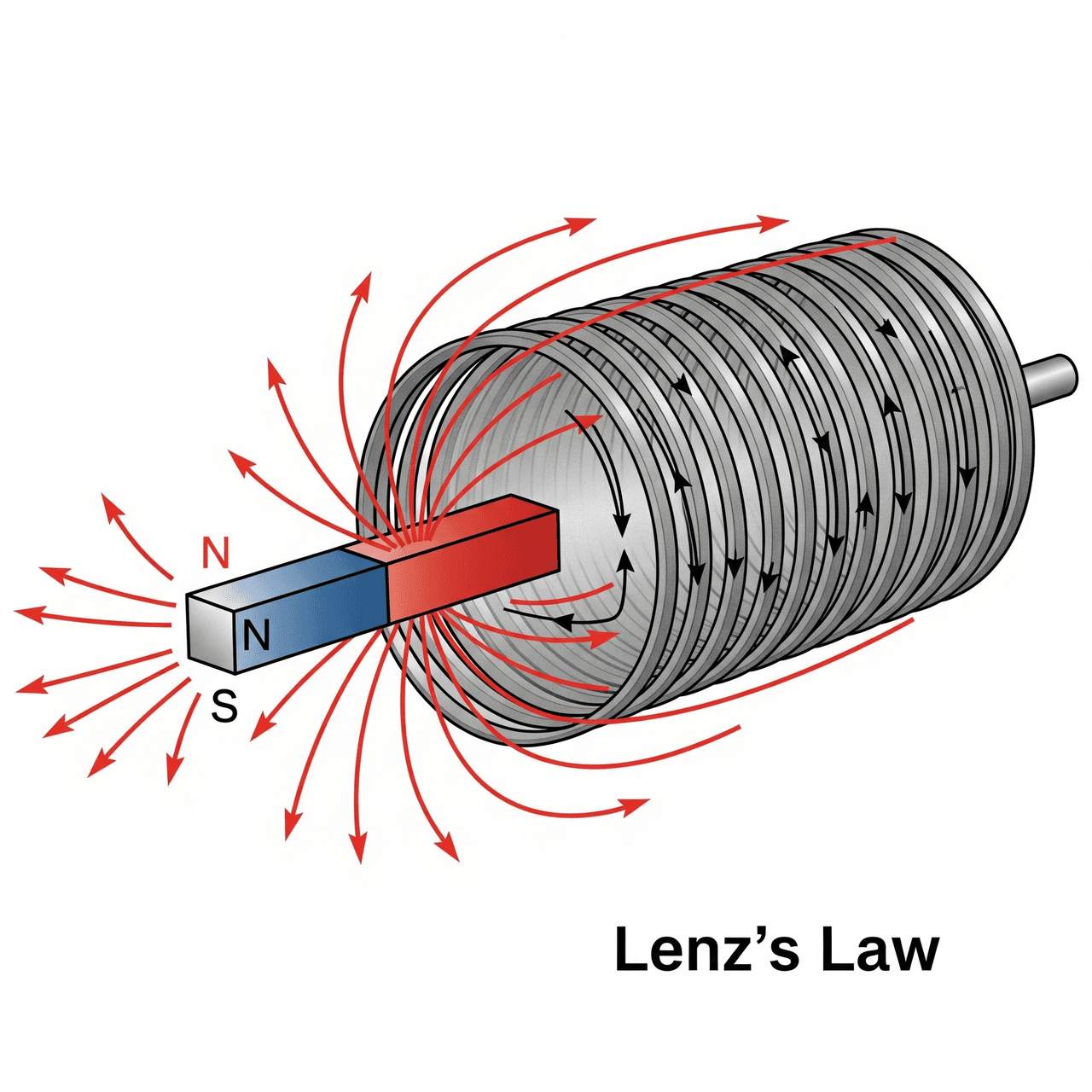
Lenz’s Law states that the current induced in a conductor by a changing magnetic field arises in a direction that opposes the change causing it. In other words, if the magnetic flux changes, a “reaction current” is generated in the conductor, and this current attempts to reduce the change through its own magnetic field. This principle determines the direction of electromagnetic induction and expresses nature’s tendency toward equilibrium.

(Generated by artificial intelligence.)
Who Discovered It?
The law was formulated in 1834 by the German physicist Heinrich Lenz. Building on Michael Faraday’s 1831 experiments on electromagnetic induction, Lenz established the rule for the direction of the induced current. Thus, the knowledge that “a current is induced” was supplemented by the principle that “the direction of the current opposes the change.”
Basic Principle
When you move a magnet toward a coil of wire, a current is induced in the coil, and the magnetic field produced by this current opposes the approach of the magnet. When you move the magnet away, a current is again induced, but this time the coil generates a field that resists the motion away. The faster the change and the greater the change in magnetic flux, the higher the induced voltage and current.

(Generated by artificial intelligence.)
Relationship to Conservation of Energy
Lenz’s Law is fully consistent with the conservation of energy: if the induced current supported the change, the system would effectively generate energy from nothing. In practice, however, when you push or pull a magnet toward or away from a coil, you perform mechanical work, which is converted into electrical energy and often into heat. Thus, the process is explained without violating any physical law.
Mathematical Expression
Faraday’s Law gives the induced electromotive force (emf) as ε = − dΦ_B/dt; the negative sign represents Lenz’s Law, that is, the direction of opposition. For a coil with many turns, this becomes ε = − N · dΦ_B/dt, where N is the number of turns; the magnetic flux Φ_B is the appropriate directional integral of the product of the field and the surface area. The sign convention, together with directional rules such as the right-hand rule, is used to determine the actual direction of the current.
Eddy Currents and Their Consequences
Changing magnetic fields induce closed-loop currents, known as eddy currents, within solid metal masses. These currents, in accordance with Lenz’s Law, produce magnetic fields that oppose the change, resulting in a braking effect and often heating. This phenomenon is observed in many technical contexts, from electromagnetic brakes to unwanted thermal losses.
Applications
Generators convert rotational motion into changing magnetic flux, inducing voltage in a conductor; Lenz’s Law determines how the induced current behaves under load. In transformers, the changing flux in the primary circuit induces a voltage in the secondary circuit in the opposite direction; material selection and geometry are critical in design to minimize losses. In electric motors, the principles of changing flux and opposing fields work together.

(Generated by artificial intelligence.)
Observation Through Experiment
When you drop a magnet through a copper tube, it falls slower than normal; because eddy currents induced in the tube generate a magnetic field opposing the fall, creating an “invisible brake.” In the jumping ring experiment, a changing flux in a coil induces a current in an aluminum ring with a field opposing the change, causing the ring to be propelled upward—again, a consequence of the principle of opposition to change.
Losses and Solutions in Engineering
Since eddy currents cause undesirable thermal losses, transformer and motor cores are made from thin laminated sheets. This reduces the area available for closed-loop currents to circulate, thereby minimizing losses. In design, material conductivity, magnetic permeability, and operating frequency are evaluated together.