


This article was automatically translated from the original Turkish version.
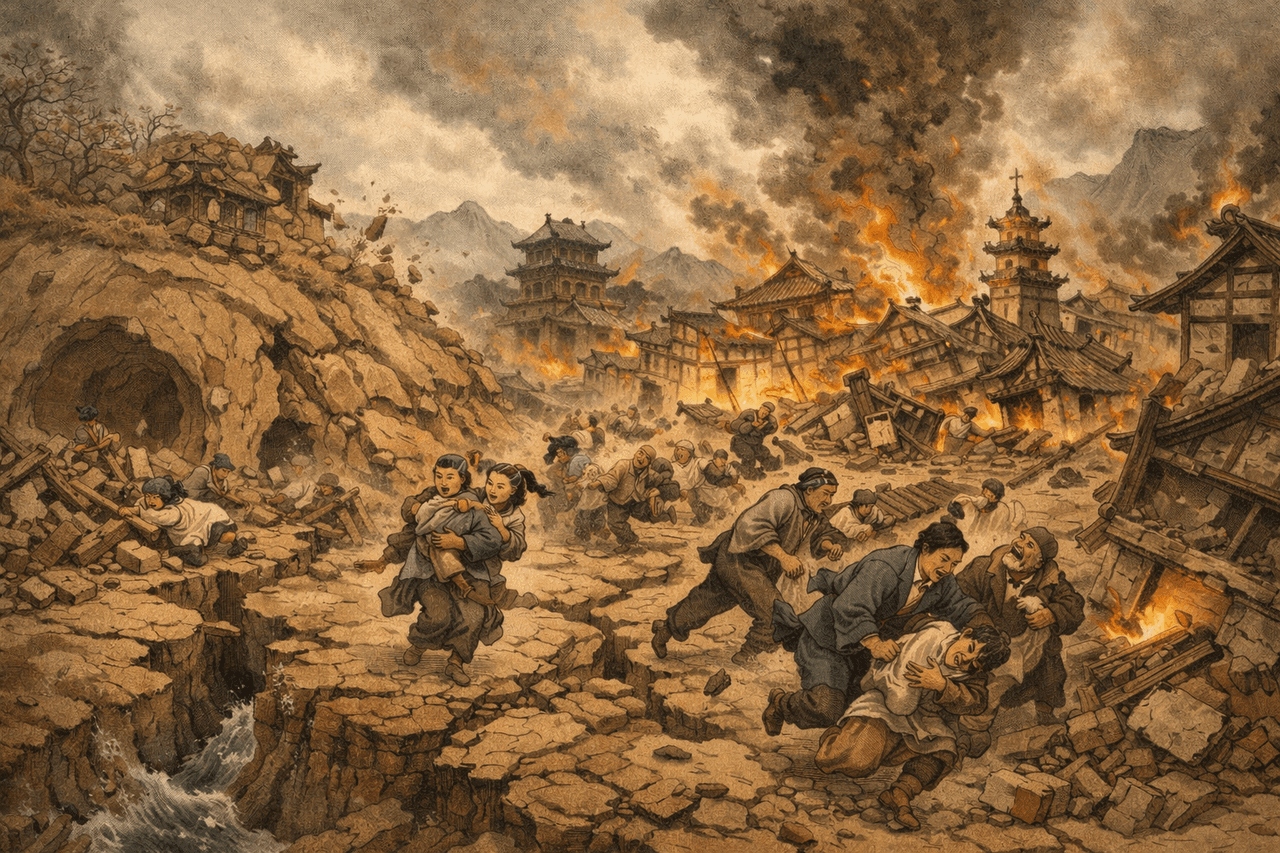
1556 Şensi Depremi (Yapay zeka ile oluşturulmuştur)
Date(s) | 23 January 1556 | ||||||||
|---|---|---|---|---|---|---|---|---|---|
Country | China (Ming Dynasty) | ||||||||
Magnitude of the Earthquake | 8.0 to 8.3 | ||||||||
Institutions Providing Aid and Intervention | Ming Empire Central Administration, Local Governorates and Inspectorates | ||||||||
Main Affected Regions | Shanxi, Henan, Gansu | ||||||||
On January 23, 1556, an earthquake with a magnitude of 8.0 to 8.3 occurred at midnight local time in Shaanxi Province. It is the deadliest seismic disaster ever recorded in human history. The tremor, which took place during the Ming Dynasty, destroyed an area of approximately 800 kilometers encompassing Shaanxi, Shanxi, Henan and Gansu provinces, with Huaxian County as its epicenter.
According to Chinese official annals, approximately 830,000 people lost their lives due to the earthquake and subsequent secondary disasters. This massive loss of life makes the Shaanxi earthquake the deadliest in world history.
Modern seismological studies and high-resolution topographic analyses estimate the earthquake’s magnitude to be between 8.0 and 8.3.【1】 The rupture generated a surface fault approximately 70 to 90 kilometers long along a normal fault line at the foot of the Huashan Mountains. Geological investigations have confirmed that vertical displacements of up to 8 to 11 meters occurred locally during this rupture.
The region lies within the Weihe Graben basin, affected by complex tectonic movements between the Pacific and Eurasian plates. This basin has exhibited one of the most destructive examples of intraplate normal faulting mechanisms.
The earthquake permanently altered the region’s geographical structure. Historical records indicate that mountains shifted position, rivers changed course, and roads were completely obliterated. In some areas, liquefaction of the ground caused black water, sand, and mud to erupt from beneath the surface.
The primary seismic and architectural reasons for this extraordinary loss of life are as follows:

Visual Depicting the Shaanxi Earthquake (Generated by Artificial Intelligence)
The Shaanxi earthquake did not merely cause structural destruction; it triggered massive changes in the region’s hydrogeological structure. Intense soil liquefaction was observed in the alluvial deposits of the Weihe Graben basin.
As a result of sudden fluctuations in groundwater levels, new water sources emerged in some areas while centuries-old wells dried up. Changes in riverbeds and landslides blocking river channels led to the formation of temporary dams, which subsequently caused sudden floods in the days following the earthquake.
The earthquake occurring in January, during the coldest period of winter, left homeless populations exposed to freezing conditions. Following the disaster, the lack of shelter, damage to agricultural land, and disruption of logistical networks caused a large proportion of survivors to perish in the subsequent months due to famine and epidemics.
The Ming administration described the scale of the earthquake as “an event without precedent since the beginning of time.”【2】 Imperial officials dispatched to the region issued decrees offering tax exemptions and food aid to survivors, and recorded the event on stone stelae by officials such as Wang Pan, transforming it into a historical record for future generations.

Representative Visual Depicting the Impact of the Shaanxi Earthquake (Generated by Artificial Intelligence)
Following the Shaanxi earthquake, the Ming Dynasty’s administrative machinery mobilized rapidly. Immediately after the tremor, governors and inspectors of the affected provinces (Shaanxi and Shanxi) submitted official “palace memorials” to the Ming Emperor detailing the disaster. These reports described not only the destruction of buildings but also extraordinary geological phenomena such as shifting mountains and altered river courses.【3】
In response to these reports, the imperial center issued an Imperial Edict, appointing high-ranking officials to travel to the region to assess the disaster and affirm the state’s presence. Their primary responsibilities included organizing rituals to appease the gods according to the era’s official disaster protocol, delivering emergency food aid to survivors, and canceling tax debts of the affected population. These administrative decisions were documented by the official Wang Pan and inscribed on stone stelae to inform the public.

Visual Reflecting the Impact of the Shaanxi Earthquake on China (Generated by Artificial Intelligence)
The Shaanxi earthquake, with its estimated 830,000 fatalities, disrupted the socio-economic equilibrium of the Ming Dynasty. The total collapse of settlement structures—particularly the loess caves—challenged the limits of traditional state intervention, and the region’s reconstruction took years. However, this massive natural event initiated a new tradition within Chinese administrative systems: the systematic recording of pre- and post-earthquake natural anomalies (subterranean noises, groundwater level changes). This marked a transition from “perceptual knowledge” to “phenomenological research” in seismology. Thus, the 1556 Shaanxi earthquake is not merely recorded in history as an act of destruction, but also as a turning point in which the state began to develop institutional memory for responding to disasters.
Feng, Rui, and Yuxia Wu. "Research on History of Chinese Seismology." *Earthquake Science* 23, no. 3 (2010): 243–257. https://doi.org/10.1007/s11589-010-0720-z.
Hao, Ping. "Several Strong Historical Earthquakes During Ming and Qing Dynasties and Their Effects to Local Reconstruction at Southern Shanxi Province, North China: Insight from the Chinese Literature." *Natural Hazards Research* 3 (2023): 598–607. https://doi.org/10.1016/j.nhres.2023.11.009.
Lei, Shengxue, Richard Walker, Yanbao Li, Ji Ma, Ben Johnson, Qi Ou, Chia-Hsin Tsai, Changyun Chen, Xijie Feng, and Liangxin Xu. "Surface Ruptures from the 1556 Huaxian Earthquake, North China, Measured Using High-Resolution Topography: Implications for Large Magnitude Normal-Faulting Earthquakes in Continental Interiors." *Quaternary Science Advances* 18 (2025): 100270. https://doi.org/10.1016/j.qsa.2025.100270.
[1]
Hao, Ping. "Several Strong Historical Earthquakes During Ming and Qing Dynasties and Their Effects to Local Reconstruction at Southern Shanxi Province, North China: Insight from the Chinese Literature.", Natural Hazards Research 3 (2023): 598–607.
[2]
Rui Feng ve Yuxia Wu, "Research on History of Chinese Seismology." Earthquake Science 23, no. 3 (2010): 243–257
[3]
Rui Feng ve Yuxia Wu, "Research on History of Chinese Seismology." Earthquake Science 23, no. 3 (2010): 243–257

1556 Şensi Depremi (Yapay zeka ile oluşturulmuştur)
Date(s) | 23 January 1556 | ||||||||
|---|---|---|---|---|---|---|---|---|---|
Country | China (Ming Dynasty) | ||||||||
Magnitude of the Earthquake | 8.0 to 8.3 | ||||||||
Institutions Providing Aid and Intervention | Ming Empire Central Administration, Local Governorates and Inspectorates | ||||||||
Main Affected Regions | Shanxi, Henan, Gansu | ||||||||
No Discussion Added Yet
Start discussion for "1556 Shaanxi Earthquake" article
Seismic and Geological Data
Scale of Destruction and Physical Effects
Soil Liquefaction and Hydrogeological Changes
Earthquake-Induced Secondary Disasters
Official Records of the 1556 Shaanxi Earthquake
Imperial Edicts and Official Reporting Procedures
Disaster Management and Socio-Economic Consequences