


This article was automatically translated from the original Turkish version.
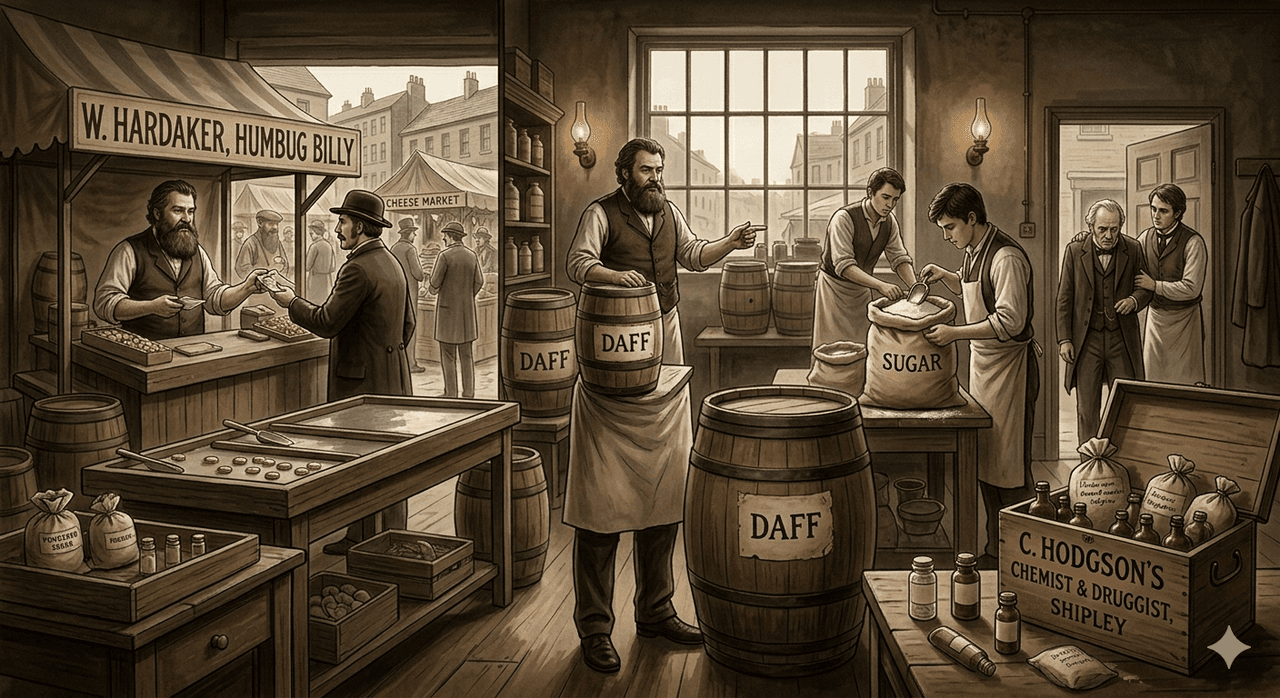
1858 Bradford Sugar Poisoning (generated by Artificial Intelligence.)
Location | West Yorkshire Bradford | ||||||||
|---|---|---|---|---|---|---|---|---|---|
Root Cause | Mixing arsenic with 'daff' (plaster dust) used as a substitute for sugar | ||||||||
Intermediate Product | Mint lozenge | ||||||||
Toxic Substance | Arsenic trioxide | ||||||||
Number of Patients | More than 200 | ||||||||
Number of Deaths | Approximately 20 (Official records) | ||||||||
Event Type | Mass Food Poisoning | ||||||||
History | 30–31 October 1858 | ||||||||
1858 Bradford Sugar Poisoning was a mass food poisoning incident in Victorian England, caused by the accidental addition of large quantities of arsenic trioxide to a batch of mint lozenges under preparation. The event, which occurred in the city of Bradford in West Yorkshire, resulted in approximately 20 deaths and over 200 illnesses. The widespread practice of “adulteration”—the fraudulent mixing of food products—driven by high sugar prices at the time, formed the fundamental context for this tragedy.
The incident began when William Hardaker, a confectioner operating a stall at Bradford’s Green Market and known locally as “Cheating Billy,” ordered mint lozenges from wholesaler Joseph Neal. To reduce production costs, Neal routinely substituted real sugar with a harmless filler known as “daff” or “daft,” composed of plaster, powdered chalk, and calcium sulfate. On 18 October 1858, one of Neal’s employees was sent to Charles Hodgson, a chemist in Shipley, to purchase 12 pounds of “daff.” However, due to Hodgson’s illness, his untrained assistant William Goddard mistakenly delivered 12 pounds of arsenic trioxide instead, selecting it from unlabeled containers stored side by side in the warehouse. The identical white powdered appearance of both substances and their storage without labels directly caused this fatal confusion.【1】

A Visual Depicting the Development of the 1858 Bradford Sugar Poisoning Incident (Generated by Artificial Intelligence)
The poisonous substance obtained from the pharmacy was used by Joseph Neal’s confectioner, James Appleton, in the production of the mint lozenges. During production, Appleton himself became ill after exposure to the chemical, but this was not recognized as a warning sign. The finished lozenges, which appeared darker and duller than usual, were initially met with hesitation by William Hardaker.【2】
Immediately after consumption of the sweets, sudden deaths began occurring, particularly among children, accompanied by symptoms of "severe vomiting, abdominal pain and diarrhea." On the early morning of 31 October 1858, the first victim, nine-year-old Elijah Wright, died. At the time, medical knowledge misinterpreted the cause of death. Surgeon John Roberts attributed the violent vomiting and convulsions to cholera, a common disease in Victorian England with similar symptoms.【3】 Shortly afterward, 14-year-old Joseph Scott of Railroad Street fell violently ill and died before his father could summon a doctor. Initially, no correlation was drawn between these deaths, and each case was treated as an isolated infectious illness.【4】
The true cause of the deaths was identified in the afternoon of 31 October by Dr. John Henry Bell, who was visiting the Burran family on Jowett Street. The lifeless bodies of five-year-old Orlando Burran and his three-year-old brother John Henry, along with four other family members suffering severe illness, drew his attention. Learning that the family had consumed mint lozenges purchased that morning from William Hardaker’s stall, known as “Cheating Billy,” Dr. Bell suspected a poisoning rather than an epidemic. Samples were sent to the expert chemist Felix Marsh Rimmington for analysis.【5】

A Visual Depicting the Process of the 1858 Bradford Sugar Poisoning Incident (Generated by Artificial Intelligence)
Once the source of the poisoned sweets was identified, the Bradford police were thrown into panic. Investigations revealed that William Hardaker, the stall owner, had also consumed the sweets and was now critically ill in bed. It was also discovered that Hardaker had sold approximately 1,000 lozenges (five pounds) in a single day.【6】 With thousands of potential victims in the city, an emergency was declared.
In the late evening, police officers dispersed through Bradford’s streets, ringing bells and shouting, "Do not eat the sweets, they are poisonous!" to alert the public.【7】 The following day, local newspapers and posted notice boards published lists of the dead and those in critical condition.
Following the incident, chemist Charles Hodgson, his assistant William Goddard, and confectioner Joseph Neal were arrested on charges of manslaughter. At the York Assizes in December 1858, all defendants were acquitted on the grounds that the tragedy was an unintentional accident and a “chain of unfortunate oversights.”【8】 However, the court’s ruling provoked widespread public outrage and exposed the inadequacy of legal regulations preventing dangerous substances from being added to food products. This legal gap paved the way for the enactment of the Adulteration of Food and Drink Act of 1860 and the Pharmacy Act of 1868.【9】 In particular, the 1868 Act restricted the sale of poisonous substances to licensed pharmacists and imposed strict labeling requirements.
The Bradford sugar poisoning was a manifestation of the unregulated food market created by industrialization and rapid urbanization in Victorian England. High taxes on sugar pushed producers toward fraudulent methods such as the use of “daff,” creating a hazardous environment for public health.【10】 Indeed, the demand for such dangerous fillers declined after the sugar tax was abolished in 1874.【11】 Today, this incident retains its place in medical and legal history as a pivotal event in the development of consumer rights and public health policy.
Johnson, Ben. “Dying for Humbug: The Bradford Sweets Poisoning, 1858.” Historic‑UK.com. Accessed March 4, 2026. https://www.historic-uk.com/HistoryUK/HistoryofBritain/Dying-for-Humbug-the-Bradford-Sweets-Poisoning-1858/
Lauren, Potts. "The Halloween sweets that poisoned Bradford" BBC. Accessed March 4, 2026. https://www.bbc.com/news/uk-england-leeds-67067171
Matthews-Jones, Lucinda. "Lauren Padgett, ‘A Fatal Mistake’: The Bradford Lozenge Poisoning, 1858" JVC. Accessed March 4, 2026. https://jvc.oup.com/2015/11/01/lauren-padgett-a-fatal-mistake-the-bradford-lozenge-poisoning-1858/
Paul David. “The Bradford Sweets Poisoning of 1858.” On‑Magazine.co.uk. Accessed March 4, 2026. https://www.on-magazine.co.uk/yorkshire/history/bradford-sweets-poisoning-1858/
[1]
David Paul, “The Bradford Sweets Poisoning of 1858.” On‑Magazine.co.uk, Access date 4 March 2026. https://www.on-magazine.co.uk/yorkshire/history/bradford-sweets-poisoning-1858/.
[2]
Potts Lauren, "The Halloween sweets that poisoned Bradford" BBC. Access 4 March 2026. https://www.bbc.com/news/uk-england-leeds-67067171.
[3]
Potts Lauren, "The Halloween sweets that poisoned Bradford" BBC. Access 4 March 2026. https://www.bbc.com/news/uk-england-leeds-67067171.
[4]
Potts Lauren, "The Halloween sweets that poisoned Bradford" BBC. Access 4 March 2026. https://www.bbc.com/news/uk-england-leeds-67067171.
[5]
Potts Lauren, "The Halloween sweets that poisoned Bradford" BBC. Access 4 March 2026. https://www.bbc.com/news/uk-england-leeds-67067171.
[6]
Lucinda Matthews-Jones, "Lauren Padgett, ‘A Fatal Mistake’: The Bradford Lozenge Poisoning, 1858" JVC, Access 4 March 2026. https://jvc.oup.com/2015/11/01/lauren-padgett-a-fatal-mistake-the-bradford-lozenge-poisoning-1858/.
[7]
Potts Lauren, "The Halloween sweets that poisoned Bradford" BBC. Access 4 March 2026. https://www.bbc.com/news/uk-england-leeds-67067171.
[8]
Lucinda Matthews-Jones, "Lauren Padgett, ‘A Fatal Mistake’: The Bradford Lozenge Poisoning, 1858" JVC, Access 4 March 2026. https://jvc.oup.com/2015/11/01/lauren-padgett-a-fatal-mistake-the-bradford-lozenge-poisoning-1858/.
[9]
Lucinda Matthews-Jones, "Lauren Padgett, ‘A Fatal Mistake’: The Bradford Lozenge Poisoning, 1858" JVC, Access 4 March 2026. https://jvc.oup.com/2015/11/01/lauren-padgett-a-fatal-mistake-the-bradford-lozenge-poisoning-1858/.
[10]
Ben Johnson, “Dying for Humbug: The Bradford Sweets Poisoning, 1858.” Historic‑UK.com, Access 4 March 2026. https://www.historic-uk.com/HistoryUK/HistoryofBritain/Dying-for-Humbug-the-Bradford-Sweets-Poisoning-1858/.
[11]
Ben Johnson, “Dying for Humbug: The Bradford Sweets Poisoning, 1858.” Historic‑UK.com, Access 4 March 2026. https://www.historic-uk.com/HistoryUK/HistoryofBritain/Dying-for-Humbug-the-Bradford-Sweets-Poisoning-1858/.


1858 Bradford Sugar Poisoning (generated by Artificial Intelligence.)
Location | West Yorkshire Bradford | ||||||||
|---|---|---|---|---|---|---|---|---|---|
Root Cause | Mixing arsenic with 'daff' (plaster dust) used as a substitute for sugar | ||||||||
Intermediate Product | Mint lozenge | ||||||||
Toxic Substance | Arsenic trioxide | ||||||||
Number of Patients | More than 200 | ||||||||
Number of Deaths | Approximately 20 (Official records) | ||||||||
Event Type | Mass Food Poisoning | ||||||||
History | 30–31 October 1858 | ||||||||
No Discussion Added Yet
Start discussion for "1858 Bradford Sugar Poisoning" article
Development of the Incident and Contamination Process
Production and Distribution Phase
Epidemiological Investigation and Intervention
Legal Proceedings and Judicial Outcomes
Socioeconomic Context and Historical Legacy