


This article was automatically translated from the original Turkish version.
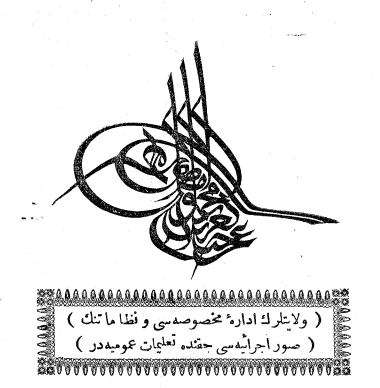
Special Administration of the Vilayets...
Type(s) | Nizamname | ||||||||
|---|---|---|---|---|---|---|---|---|---|
Announcement Date | 1867 | ||||||||
Precursor | 1864 (Danube) Vilayet Nizamnamesi | ||||||||
Successor | 1871 İdare-i Umumiyye-i Vilayat Nizamnamesi | ||||||||
Number of Articles | 22 | ||||||||
The 1867 Vilayet Nizamnamesi is a 22-article regulation issued to extend and apply across the entire Ottoman Empire the provincial administration reforms initiated by the 1864 Tuna Vilayet Nizamnamesi. Through this regulation, the four-tier administrative structure composed of vilayet, sancak, kaza, and köy was standardized throughout all provinces; the authority and responsibilities of governors and other administrative officials, as well as the duties of provincial councils, were clearly defined.
The 1867 Vilayet Nizamnamesi is an expanded version of the first Vilayet Nizamnamesi of 1864, refined based on practical experience gained during its implementation. The regulation contains detailed provisions governing the administrative, financial, judicial, and municipal services of the vilayet system. It consists of a total of 22 articles and a concluding section titled “Hâtime”; the articles are classified into three main chapters. The first chapter addresses the organization of civil administration, councils, and courts; the second chapter covers the procedural handling of legal cases by provincial councils and the judicial system; the third chapter is devoted to regulations concerning policing, municipal services, financial affairs, urban planning, education, industry, agriculture, and settlement.
The 1867 Vilayet Nizamnamesi was issued in response to needs and shortcomings identified during the implementation of the 1864 Vilayet Nizamnamesi. The 1864 regulation had established a four-tier administrative structure in the Ottoman provinces comprising vilayet, sancak, kaza, and köy; however, three years of practical experience revealed the necessity for new regulations to clarify duties and powers, harmonize inter-institutional operations, and strengthen the modern administrative framework in the provinces. In this context, the 1867 Nizamnamesi preserved the foundational principles of the previous regulation while elaborating on the responsibilities of administrative, financial, judicial, and municipal institutions, adding new articles to introduce more comprehensive and practical provisions in areas such as provincial councils, policing, municipal services, education, industry, agriculture, and the settlement of refugees. The text was published within the book titled Vilayetlerin İdare-i Mahsusası ve Nizamatının Suver-i İcraiyesi Hakkında Talimat-ı Umumiye in Hijri 1284 (1867). Copies of the book were distributed to all vilayets, aiming to enhance both central authority’s oversight and the effectiveness of local administration.
First Article: Each vilayet consists of multiple sancaks; each sancak consists of multiple kazas; each kaza consists of multiple nahiyeler and villages. The administration of the vilayet is entrusted to a vali, each sancak to a mutasarrıf, each kaza to a kaymakam, and each nahiye to a müdür. The vali is the primary addressee and responsible party for all matters arising within the vilayet; marriage and financial affairs of the vilayet fall under the vali’s jurisdiction. Kaza kaymakamları and nahiye müdürleri operate under the authority of the mutasarrıflar. Mutasarrıflar report directly to the vali, kaymakamlar to the mutasarrıflar, and müdürler to the kaymakamlar.
Second Article: Financial affairs of the vilayets are managed by the defterdar at the central level and by the muhasebeci in locations subordinate to the sancak. The financial responsibilities of the vali and mutasarrıflar are determined through the defterdar and muhasebeci. The principles governing these duties have been established by a special regulation, and the existing rules remain fully in force.
Third Article: The first task in each vilayet is to organize kazas and nahiyeler and establish memleket meclisleri. Within a sancak’s administrative boundaries, kazas are classified into three categories according to their conditions and needs: those leading in civilization, society, and trade are classified as first class; those more orderly in administration are classified as second and third class. Places not possessing kaza or kasaba status are considered nahiyeler. Subordinate areas of the sancak are determined based on distance and location; after smaller kazas are attached to larger ones, temporary ihtiyar meclisleri are elected in the centers of those designated as nahiyeler. In this structure, kaymakamlar of third-class kazas and nahiye müdürleri receive salaries proportional to their duties. Monthly allowances for nahiyeler are determined according to their conditions and locations, and their records are sent to the relevant ministry. Elections for local councils are held in the central vilayet, sancak, kaza, and köy. The right to vote is preserved for all subjects, and care is taken to ensure elections are conducted properly.
Fourth Article: Administrative documentation in the central and subordinate areas of the vilayets must be organized. Each vilayet’s documentation will be managed by a dedicated yazı işleri memuru. The manner in which these duties are to be performed is detailed in the accompanying tarifname, and must be carried out strictly in accordance with its provisions.
Fifth Article: As specified in various articles of the Vilayet Nizamnamesi, courts responsible for legal cases in vilayets are divided into four tiers. The first tier consists of ihtiyar meclisleri in villages; these handle minor personal legal matters resolvable through conciliation. The second tier comprises de’âvî meclisleri in kaza centers; these handle cases that cannot be resolved by village ihtiyar meclisleri and pertain to their respective kasaba. The third tier consists of temyiz-i hukuk meclisleri in sancak centers; these handle cases arising from crimes and ordinary civil matters and review cases unresolved by kaza de’âvî meclisleri. The fourth tier consists of temyiz-i hukuk vilayet meclisleri in vilayet centers; these handle both minor and major cases and, as per their duties, adjudicate serious criminal accusations.
Sixth Article: Legal cases are divided into two categories: those concerning property and personal rights, and those concerning public order. The hearing of these cases is strictly contingent upon a formal petition submitted by the plaintiff or a report issued by a police officer. No case will be accepted without a petition or report, and referral of cases to councils or courts without proper procedure is prohibited.
Seventh Article: Procedures for accepted cases are categorized according to their nature. For example, if an individual is arrested for acts against police or municipal authorities and requires trial, or if a state official must be summoned or interrogated, such matters are briefly reported by police or administrative officers to the relevant authorities. In the vilayet center, reports are submitted to the vali or his deputy; in kaza and sancak centers, they are submitted to the mutasarrıf or kaymakam. Disputes between individuals are likewise submitted to the courts via petitions from the plaintiffs.
Eighth Article: Legal cases that fall under the jurisdiction of şer’iyye courts are referred to the şer’iyye judge. If the parties involved are not Muslim, their disputes are also referred to the appropriate courts.
Ninth Article: The adjudication of legal cases concerning the government follows the previously established rules. Judgments in matters involving offenses against the state or against non-Muslims are issued by the fasl-ı hüküm authority. Since such cases concern the public law of the state, they are referred to the relevant councils, and enforcement of judgments will proceed according to proper procedure.
Tenth Article: Cases brought against government officials are immediately and publicly investigated by senior officials—namely, in order of rank, the vali, mutasarrıf, and kaymakam. If the investigation necessitates referral to a court, the case will be heard by the temyiz-i hukuk and de’âvî meclisleri.
Eleventh Article: Cases arising from commerce and partnerships are exclusively under the jurisdiction of commercial courts. Appeals against judgments rendered by commercial courts in sancak and kasaba centers within the vilayet center are heard by the meclis-i ticaret in the vilayet center. Appeals or retrials of judgments from commercial courts in subordinate areas before ordinary civil courts or councils are not permitted.
Twelfth Article: Among the public duties of vilayets are the following: first, revenue collection and land registry matters under civil and financial administration; second, the maintenance of public order and security by the zabtiyye forces; third, the construction of public infrastructure such as roads, bridges, and streets. Additionally, the provision of municipal services, protection of state property, tax collection, recovery of overdue debts, and fulfillment of public needs are included within this scope. Necessary regulations are enacted to facilitate these tasks, obstacles encountered in implementation are removed, and their proper execution is ensured.
Thirteenth Article: Land registry and land matters involve the regulation of two vital elements that form the foundation of public wealth and commerce. Since these matters are supported by specific regulations, it is essential to implement measures and initiatives that serve the interests of both the state and the public. Therefore, the application of newly established principles falls within the scope of public duties.
Fourteenth Article: The second component of civil administration, zabıta affairs, constitutes the principal force for public security, tasked with safeguarding the property, lives, honor, and dignity of the population. This vital duty is carried out through the enforcement of government orders and the actions of zabtiyye forces. The structure and operations of this class have been previously defined, and the zabtiyye organization in Rumeli has been standardized across other regions, as in the vilayets of Halep and Suriye. The first duty of zabtiye is to maintain public security according to police procedures; the second is to protect state property and apprehend criminals. However, assigning all three duties to a single entity is problematic; therefore, inspection and revenue collection functions have been separated from zabtiye and assigned to distinct classes, with their duties regulated by separate instructions. In areas where zabtiye is not yet organized, the existing zabtiyye forces will be redistributed among the three duties, and their salaries will be restructured according to rank.
Fifteenth Article: As stated in the fifteenth article of the 1278 (1861–62) temporary general instruction, in cases where banditry increases and existing zabtiye proves insufficient, temporary zabtiye personnel may be recruited. Captured criminals are interrogated and judged by temyiz-i hukuk and cinayet meclisleri; if their guilt is established, execution or other penalties are imposed as deemed necessary. After completion of these procedures, mazbata and istintaknameler are sent to Bâb-ı Âlî.
Sixteenth Article: The third component of public duties concerns imarât and ıslahât-ı mülkiye. Detailed plans for infrastructure projects required by each vilayet include roads and bridges, crossings (maâbir), agricultural and industrial activities, afforestation, and the cleaning and opening of rivers and lakes. Necessary measures will be taken to implement these projects; roads and afforestation will be supervised by engineers, and public participation in these works will be encouraged.
Seventeenth Article: Mekâtib-i umûmiye (schools) are under the supervision of the vilayet administration and inspected by müfettiş-i hukûk. Although rüşdiye schools have been opened in villages and towns, priority will be given to improving sıbyan mektepleri and establishing new schools in areas lacking any educational institution. Encouraging children to pursue education, motivating parents and relatives to support this goal, and utilizing revenues from charitable endowments for this purpose are important duties of the government.
Eighteenth Article: The development of industry is essential for increasing the wealth of the region. In the Tuna Vilayeti, children will be trained in industrial schools, clothing and footwear will be provided by the vilayet, and industrial sectors and factories will be established. Necessary instructions will be implemented, and public participation in such initiatives will be encouraged.
Nineteenth Article: Farmers and agricultural producers who borrow money or pledge their harvests will be treated in accordance with regulations established by the state. To prevent hardship among the population, interest rates and loan conditions will be set in compliance with the nizamname, and provisions will be enforced to protect the producer’s property.
Twentieth Article: The execution of tanzifat (cleaning) duties and the fulfillment of local sanitation needs are responsibilities of the mültezimler. A portion of taxes collected from land surveys will be allocated by the state to cover municipal cleaning expenses. In each town, a belediye meclisi will be established to support urban development through these revenues and other forms of assistance. Since the benefits of this practice have been demonstrated in the Tuna Vilayeti, efforts will be made to gradually organize these councils in accordance with the regulation.
Twenty-First Article: Population growth is a requirement of the state’s civil administration; however, certain proposals regarding marriage and union procedures in the provinces have been observed to discourage marriage. Therefore, regulations promoting marriage will be carefully considered, and action will be taken in accordance with the attached tenbihname. The same diligence will be applied to the execution of wills.
Twenty-Second Article: One matter requiring attention is the settlement of nomadic tribes that are receptive to civilization, as well as the resettlement of Çerâkese (Circassian) refugees. The settlement of refugees has been determined by special instruction and has been found beneficial both for the refugees themselves and for the state and the country. Therefore, settlement efforts will proceed with full determination, and oversight will be provided to ensure the completion of agricultural and commercial activities by Circassian refugees.
These are the implementation measures and the levels and qualities of important duties to be carried out by the vilayets. The regulation of procedures and the determination of firm implementation must be based on practical experience. Within the framework of previously established principles, necessary innovations will be introduced according to local needs, and consultations will determine which parts of existing procedures and instructions should be modified or maintained. The primary guiding principle will be to prioritize actions that serve the interests of the state, the country, and its subjects.

Special Administration of the Vilayets...
Type(s) | Nizamname | ||||||||
|---|---|---|---|---|---|---|---|---|---|
Announcement Date | 1867 | ||||||||
Precursor | 1864 (Danube) Vilayet Nizamnamesi | ||||||||
Successor | 1871 İdare-i Umumiyye-i Vilayat Nizamnamesi | ||||||||
Number of Articles | 22 | ||||||||
No Discussion Added Yet
Start discussion for "1867 Vilayet Nizamnamesi" article
Proclamation of the 1867 Vilayet Nizamnamesi
Articles of the Nizamname in Modern Turkish
First Chapter: Organization of Civil Administration, Councils, and Nizami Courts
Second Chapter: Procedure for Handling Legal Cases by Provincial Councils and the Transfer of Cases
Third Chapter: Levels of Public Services and Measures Concerning Policing and Municipal Reforms
Hâtime (Conclusion)