

This article was automatically translated from the original Turkish version.
The 2025 Nobel Prize in Economics has been awarded for research that explains how economic growth has become sustainable through technological innovation. The prize has been conferred upon three economists—Joel Mokyr, Philippe Aghion and Peter Howitt—for their pioneering work examining the long-term nature of economic development the driving force of technological progress and the interaction between knowledge accumulation and institutions. The award was announced by the Royal Swedish Academy of Sciences on 13 October 2025.
The prize has been awarded for contributions toward explaining “innovation-based economic growth.” Joel Mokyr has demonstrated through historical analysis the preconditions for sustainable growth driven by technological advancement. In their 1992 work Philippe Aghion and Peter Howitt provided a formal growth model within a general equilibrium framework to explain the mechanism of “creative destruction” in which new and superior products displace older ones from the market.
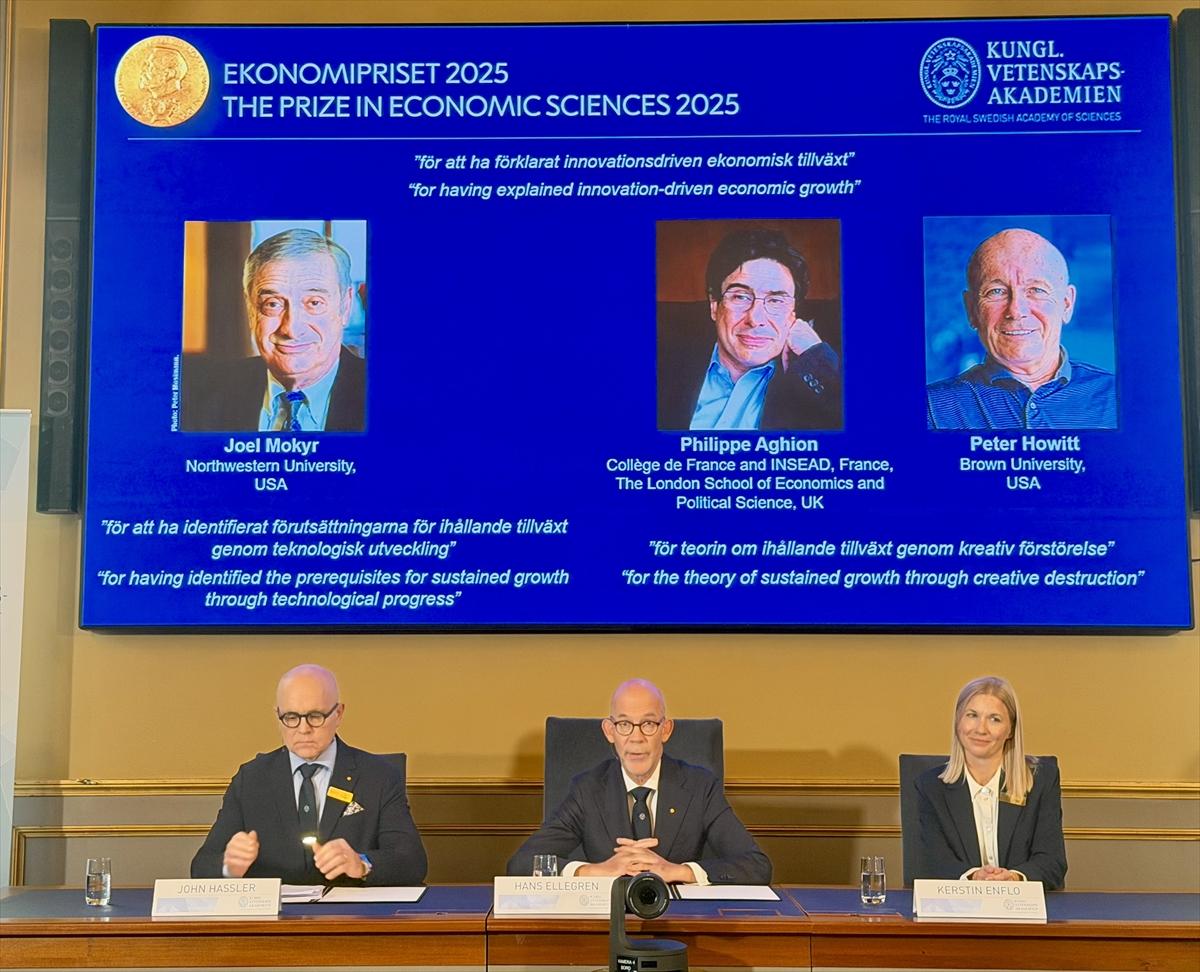
The recipients of the 2025 Nobel Prize in Economics were announced at a press conference held at the Royal Swedish Academy of Sciences (Anadolu Agency)
Mokyr’s work offers an information-based framework explaining why the Industrial Revolution emerged and became entrenched in specific regions. According to him technological progress rests on two types of knowledge:
Mokyr showed that during the Enlightenment a feedback mechanism developed between these two types of knowledge and that technological progress accelerated as standards of experimentation and measurement became widespread. The interaction between knowledge production and craftsmanship laid the groundwork for the emergence of the Industrial Revolution particularly in England. Mokyr also demonstrated that innovations can be constrained by resistance from entrenched interest groups and that institutional openness to change accelerates technological progress.
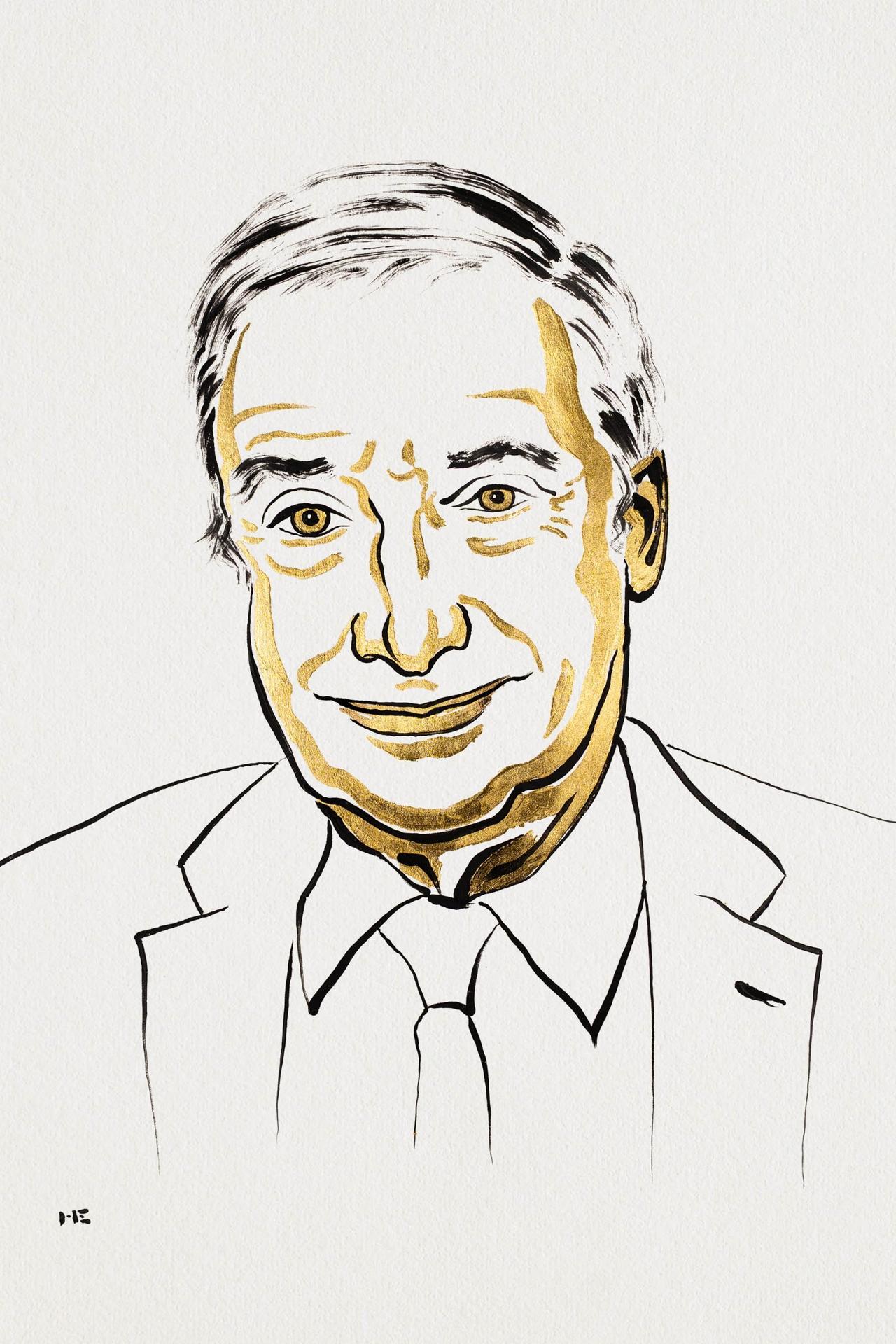
Illustration of Joel Mokyr (The Nobel Prize)
Aghion and Howitt’s 1992 model explains how economic growth is sustained through micro-level innovations. In the model firms gain temporary monopoly rents by producing higher quality products; however these advantages are eroded as new inventions emerge. This cycle is termed “creative destruction.” The model formally analyzes the impact of firms’ R&D activities competition and government policies on growth within a balanced equilibrium structure.
Two key mechanisms have been identified in their research:
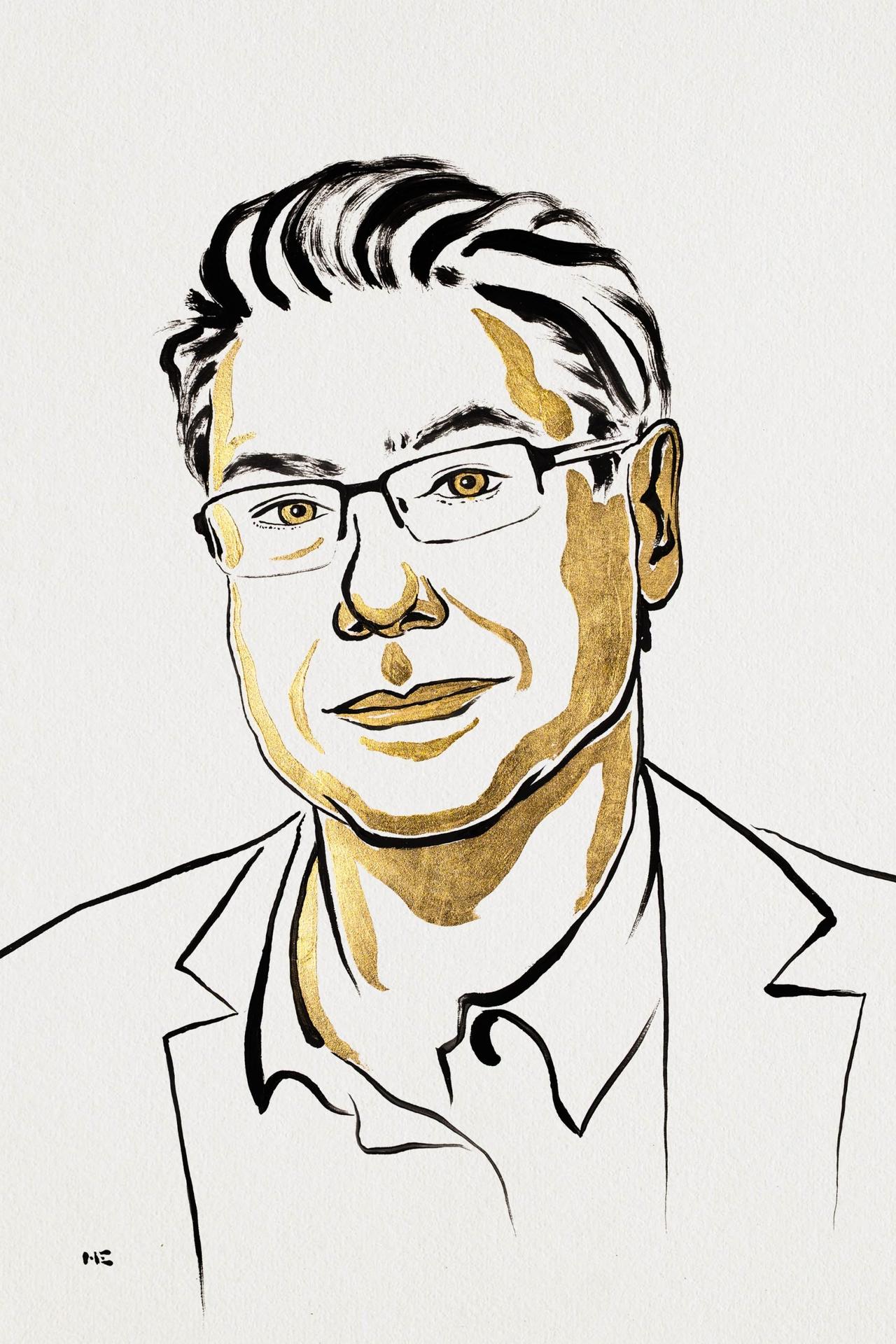
Illustration of Philippe Aghion (The Nobel Prize)
The balance between these two effects informs how policymakers should design R&D subsidies and competition regulations. Aghion and Howitt’s framework demonstrates that firm entry and exit and reallocation of labor are natural components of long-term growth.
The 2025 Nobel Prize in Economics was announced at a press conference held in Stockholm by the Royal Swedish Academy of Sciences. The announcement emphasized that the prize was awarded for work that conceptually and historically clarifies how technological innovation ensures the durability of economic growth. The Economics Prize the final award of Nobel Week was established in 1968 by the Sveriges Riksbank in memory of Alfred Nobel and is not among the five original prizes stipulated in his will.
The award ceremony will be held on 10 December 2025 at the Stockholm Concert Hall. At the ceremony the laureates will receive a gold medal a diploma and a monetary prize.
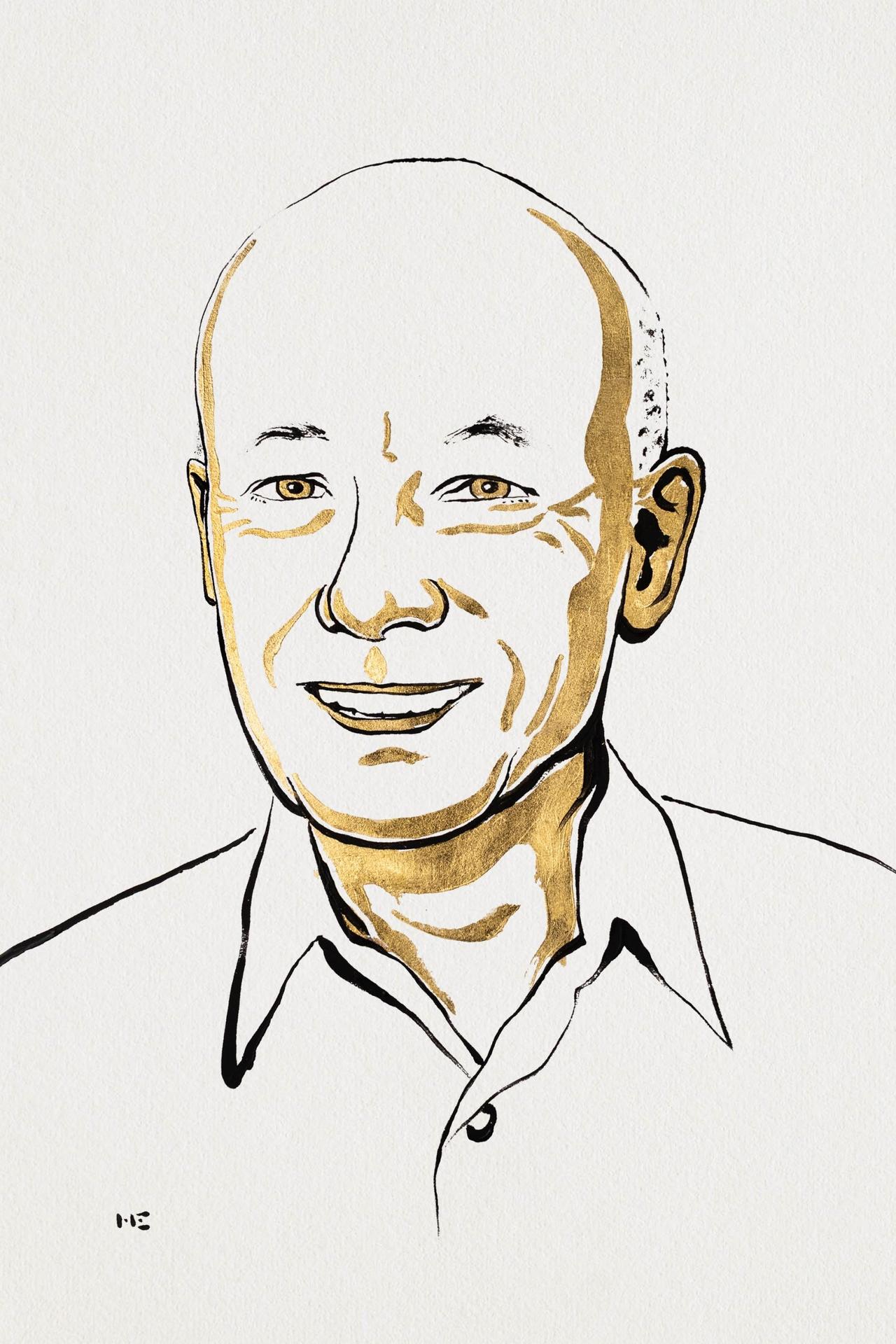
Illustration by Peter Howitt (The Nobel Prize)
Joel Mokyr was born in 1946 in Leiden, the Netherlands. He completed his graduate and doctoral studies at Yale University. He is a professor of economic history at Northwestern University and also holds a professorship at Tel Aviv University. His expertise lies in economic history and technological change.
Philippe Aghion was born in 1956 in Paris, France. He received his undergraduate education in mathematics at Paris-Saclay University. He earned his PhD in economics from Harvard University in 1987. He is affiliated with the Collège de France and INSEAD, and serves as a professor at the London School of Economics and Political Science. His research focuses on growth theory, competition policy, and the economics of innovation.
Peter Howitt was born in 1946 in Canada. He completed his undergraduate studies at McGill University. He earned his master’s and doctoral degrees at the University of Western Ontario. He is a professor of economics at Brown University. His research has focused on macroeconomic growth models, R&D processes, and labor market dynamics.
Al Jazeera. "Trio to share economics Nobel for work on innovation-driven growth." Accessed October 13, 2025. https://www.aljazeera.com/news/2025/10/13/trio-to-share-economics-nobel-for-work-on-innovation-driven-growth
Anadolu Ajansı. "2025 Nobel Ekonomi Ödülü'nü Joel Mokyr, Philippe Aghion ve Peter Howitt kazandı." Accessed October 13, 2025. https://www.aa.com.tr/tr/ekonomi/2025-nobel-ekonomi-odulunu-joel-mokyr-philippe-aghion-ve-peter-howitt-kazandi/3715772
Nobel Prize. "All Nobel Prizes 2025." The Nobel Prize Official Website. Accessed October 13, 2025. https://www.nobelprize.org/all-nobel-prizes-2025/
Nobel Prize. "Press Release: Prize in Economic Sciences in Memory of Alfred Nobel 2025." The Nobel Prize Official Website. Accessed October 13, 2025. https://www.nobelprize.org/prizes/economic-sciences/2025/press-release/
Reuters. "Trio win 2025 Nobel economics prize for work on innovation and 'creative destruction'." Accessed October 13, 2025. https://www.reuters.com/world/mokyr-aghion-howitt-win-2025-nobel-economics-prize-2025-10-13/
The Royal Swedish Academy of Sciences. "Scientific Background to the Sveriges Riksbank Prize in Economic Sciences in Memory of Alfred Nobel 2025." The Committee for the Prize in Economic Sciences in Memory of Alfred Nobel. Accessed October 13, 2025. https://www.nobelprize.org/uploads/2025/10/advanced-economicsciencesprize2025.pdf

No Discussion Added Yet
Start discussion for "2025 Nobel Prize in Economics" article
Scope and Rationale of the Prize
Scientific Contributions
Joel Mokyr’s Contributions
Philippe Aghion and Peter Howitt’s Contributions
Announcement and Ceremony
Short Biographies of Award Winners
Joel Mokyr
Philippe Aghion
Peter Howitt