


This article was automatically translated from the original Turkish version.
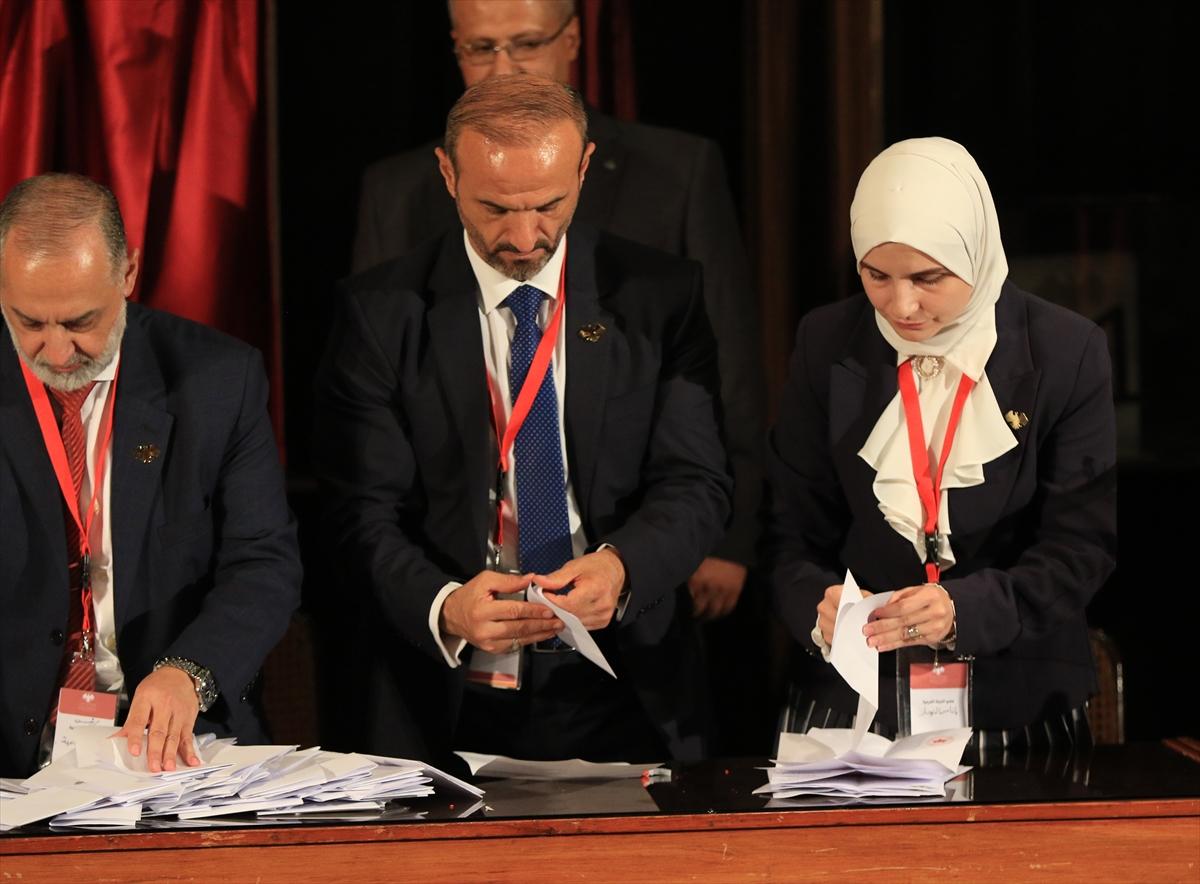
Syrian People's Council Elections - (Anadolu Agency)
Syrian People's Council Elections (2025)
History | 2025-10-05 | ||||||||
|---|---|---|---|---|---|---|---|---|---|
Number of Seats | Vacant (Suwayda/Raqqa/Hassake): 13 To be determined by presidential appointment: 70 Selected: 140 Total: 210 | ||||||||
Number of Candidates | 1570–1578 | ||||||||
The 2025 Syrian People’s Council elections were the first legislative body elections held in the country following the overthrow of the Bashar al-Assad regime in December 2024. The elections took place on 5 October 2025 under the administration of interim President Ahmed al-Shara.
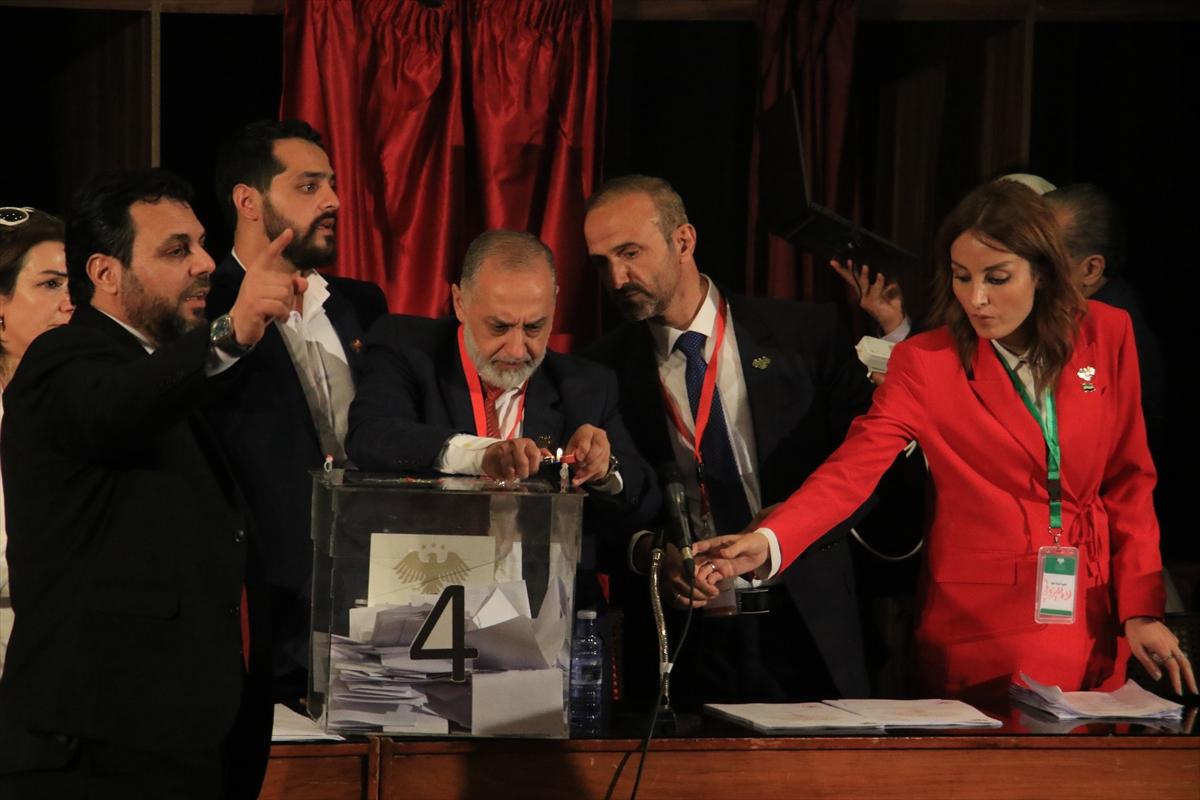
2025 Syrian People’s Council Elections, 5 October 2025 – (Anadolu Agency)
The new council consists of 210 seats. The elections were conducted under an indirect representation system rather than direct popular vote. This method was adopted due to the absence of reliable population records nationwide and the inability to include millions displaced by the civil war in the electoral process.
The 2025 Syrian People’s Council elections were conducted under a mixed system based on indirect representation. The total number of seats in the People’s Council was set at 210. Of these, 140 seats were determined by electoral colleges established in electoral districts, while 70 seats were reserved for appointment by President Ahmed al-Shara.
A “High Committee for People’s Council Elections” was established to oversee the electoral process. The committee organized electoral districts at the provincial level and appointed subcommittees for each district. In densely populated provinces such as Damascus and Aleppo, these subcommittees were expanded to include up to nine members.
The electoral college system was based on the principle that approximately 6,000 to 7,000 electoral delegates would cast votes. These delegates were selected by local commissions according to criteria defined by the High Committee and participated in voting to determine their district’s candidates.
Members of the People’s Council were elected for a term of 2.5 years. During the interim legislative period, the council was expected to carry out responsibilities including overseeing the constitutional reform process, approving new laws, and preparing the state budget. It was also announced that the council would have the authority to determine the composition of the body tasked with drafting the new constitution.
Draft quotas for the representation of women, persons with disabilities, and professional groups were prepared under the legal framework. According to these drafts, 20 percent of electoral delegates were to be women, 3 percent were to be persons with disabilities, and the remainder were to consist of professionals and local opinion leaders. These quotas were not made legally binding.
Candidates seeking to participate in the elections were selected through local committees monitored by the High Election Committee. The committee evaluated candidacy applications and ultimately approved 1,570 candidates to run. Some sources reported the number as 1,574 or 1,578.
The proportion of female candidates was announced at 14 percent. Although the draft election law anticipated increased representation for women, persons with disabilities, and professional groups, these provisions were not implemented in practice. The majority of candidates were independents; no political party lists participated in the elections, as all parties had been dissolved following the fall of the regime.
The highest concentration of candidates was observed in the provinces of Damascus, Aleppo, and Homs. Candidate profiles included former local administrators, civil society representatives, academics, and individuals who had participated in post-war reconstruction efforts.
The High Election Committee imposed specific restrictions on candidacy oversight and campaign activities during the electoral process. As political campaigning was not permitted nationwide, candidates limited their personal outreach to local meetings and media channels.
Eligibility to participate in the electoral process was restricted solely to representatives within the electoral colleges. Consequently, no direct popular vote was held, and the electorate was confined exclusively to these delegates. The selection of delegates was based on local population records and professional distribution.
Voting commenced on Sunday, 5 October 2025, at 09:00. Voting operations were conducted across 11 provinces. The elections were held in 50 electoral districts nationwide, excluding the provinces of Suwayda, Raqqa, and Hasakah. The duration of voting varied according to district density; in some areas it concluded at 12:00, while in others it was extended until 16:00.
The National Library building in Damascus held symbolic significance as a voting center. The voting process there was observed by international monitors, diplomatic mission representatives, and media personnel. Turkey’s interim envoy to Damascus, Burhan Keroğlu, along with the ambassadors of Palestine and Yemen and a delegation from Jordan’s Independent Election Commission, were present at the center. The Jordanian delegation included Commission Member Jihad al-Munni and Deputy Secretary-General Muhammad al-Haniti.
Chairman of the High Election Committee, Muhammad Taha al-Ahmed, stated that voting was conducted simultaneously in all 50 districts and that secret ballot booths had been installed at each center. The committee announced that after voting concluded, ballot boxes would be opened under the supervision of observers and that the count would begin on the same evening.
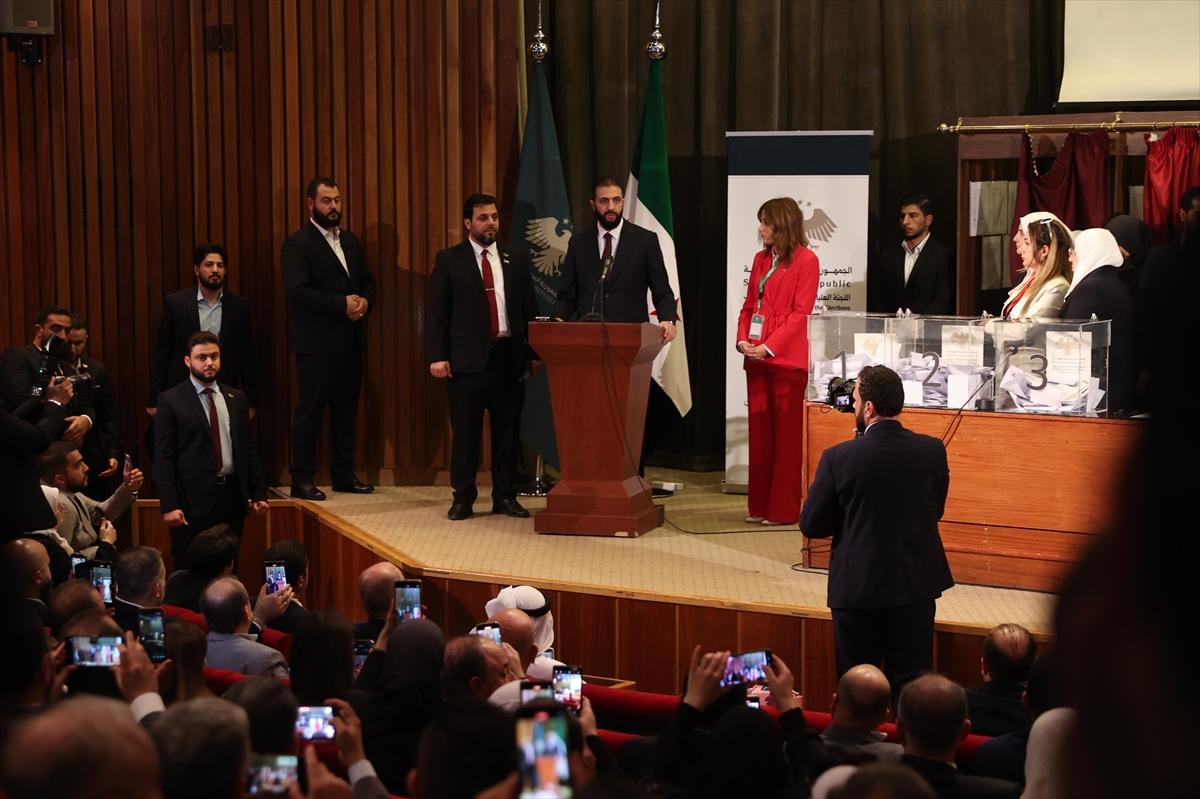
Syrian President Ahmed al-Shara visits the voting center established at the National Library in the capital Damascus during the first People’s Council elections since the fall of the Assad regime, 5 October 2025 – (Anadolu Agency)
On election day, President Ahmed al-Shara visited the National Library voting center in Damascus to observe the process. Al-Shara stated, “Syria’s development cannot be achieved by individuals alone; it is the result of collective effort.” He noted that many laws and budget proposals remained suspended and that the People’s Council needed to elect deputies capable of enacting them.
Al-Shara emphasized the significant responsibilities facing the deputies, saying, “Critical duties await them, including ensuring the functioning of laws and overseeing the government.”
Observers were present at voting centers to monitor the elections. International diplomatic delegations recorded that the process was conducted transparently and that voting proceeded largely as planned.
On the evening of election day, the High Committee for People’s Council Elections announced that the vote count would begin and confirmed that voting hours had been extended in major cities such as Damascus, Aleppo, and Homs due to high turnout.
The vote count began on the evening of 5 October 2025, immediately after the closure of polling centers. High Election Committee spokesperson Nevvar Najm stated that vote counting was conducted simultaneously across all provinces. In a statement published via its Telegram channel, the committee announced that the period for challenging election results would remain open until the end of business hours on Monday, 6 October 2025. Final results were scheduled to be announced between 6 and 7 October 2025.
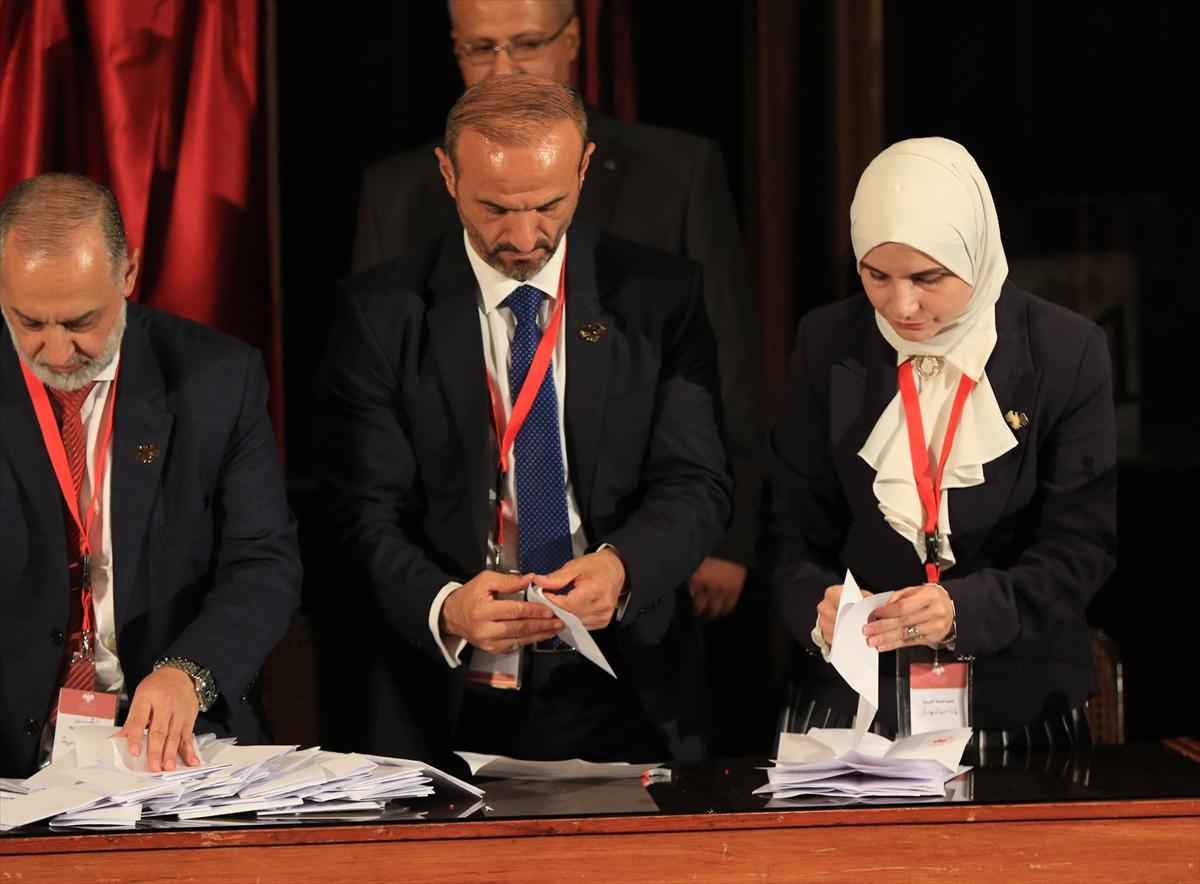
2025 Syrian People’s Council Elections, 5 October 2025 – (Anadolu Agency)
On the morning of 6 October, preliminary results were made public in accordance with High Election Committee Decision No. 66. According to these results, 127 members of the People’s Council had been elected. The remaining 70 seats would be appointed by President Ahmed al-Shara. Thirteen seats remained vacant as no elections were held in the provinces of Suwayda, Raqqa, and Hasakah.
After the completion of the vote count, High Election Committee Chairman Muhammad Taha al-Ahmed stated, “Ballot papers from each district were counted under the supervision of observers and submitted to the respective committees.”
Al Jazeera. "Everything You Need to Know about Syria’s First Post-Assad Elections." Al Jazeera. Accessed October 6, 2025. https://www.aljazeera.com/news/2025/10/5/everything-you-need-to-know-about-syrias-first-post-assad-elections
Al Jazeera. “Syria counts votes after indirect election for first post-Assad parliament.” Accessed October 6, 2025. https://www.aljazeera.com/news/2025/10/5/syrian-electors-vote-in-indirect-polls-for-first-post-assad-parliament
Anadolu Ajansı. "Syria to Hold 1st Post-Assad Parliamentary Elections on Oct. 5." Accessed October 6, 2025. https://www.aa.com.tr/en/middle-east/syria-to-hold-1st-post-assad-parliamentary-elections-on-oct-5/3694249#
Anadolu Ajansı. “Suriye’de Esed Rejiminin Devrilmesinin Ardından İlk Halk Meclisi Seçimleri Sürüyor.” Accessed October 6, 2025. https://www.aa.com.tr/tr/dunya/suriyede-esed-rejiminin-devrilmesinin-ardindan-ilk-halk-meclisi-secimleri-suruyor/3708027#
Anadolu Ajansı. “Suriye’de Parlamento Seçimleri Yapıldı: Sonuçlar Ne Söylüyor?” Accessed October 6, 2025. https://www.aa.com.tr/tr/analiz/suriyede-parlamento-secimleri-yapildi-sonuclar-ne-soyluyor/3708828#
Anadolu Ajansı. “Syria Counts Votes in 1st Parliamentary Elections since Assad’s Fall.” Accessed October 6, 2025. https://www.aa.com.tr/en/middle-east/syria-counts-votes-in-1st-parliamentary-elections-since-assad-s-fall/3707934#
SANA. "Halk Meclisi Seçimleri Yüksek Komitesi Ön Sonuçlarını Açıkladı." SANA Türkçe. Accessed October 6, 2025. https://sana.sy/tr/locals/2266707/
SANA. “Şam’da Seçim Sürecini Takip Eden Diplomatlar: Şeffaf ve Adil Seçim İçin Kararlılık.” SANA Türkçe. Accessed October 6, 2025. https://sana.sy/tr/governorates/2266685/

Syrian People's Council Elections - (Anadolu Agency)
Syrian People's Council Elections (2025)
History | 2025-10-05 | ||||||||
|---|---|---|---|---|---|---|---|---|---|
Number of Seats | Vacant (Suwayda/Raqqa/Hassake): 13 To be determined by presidential appointment: 70 Selected: 140 Total: 210 | ||||||||
Number of Candidates | 1570–1578 | ||||||||
No Discussion Added Yet
Start discussion for "2025 Syrian People's Council Elections" article
Election System and Legal Framework
Candidacy Process and Voter Structure
Voting Process
Vote Counting and Announcement of Results