 Recently Added:
This article was automatically translated from the original Turkish version.
The process of lifting economic and terrorism-related sanctions against Syria constitutes a multifaceted policy shift at the international level occurring within 2025. The process gained momentum following the overthrow of the Bashar al-Assad regime in December 2024 and the assumption of power by the government led by Ahmed al-Shara. In May 2025, simultaneous steps taken by the United States and the European Union to lift sanctions brought an end to comprehensive restrictions that had been in force for approximately 15 years.
During this period, the administration of U.S. President Donald Trump signed an executive order terminating all economic sanctions against Syria; the Council of the European Union, through decisions adopted on 20 and 28 May 2025, lifted all economic restrictions applied to Syria.
Following these developments, on 6 November 2025, the United Nations Security Council (UNSC) adopted a resolution lifting terrorism-related sanctions against Syrian President Ahmed al-Shara and Interior Minister Enes (Anas) Hattab. The resolution, drafted by the United States, was supported by 14 of the 15 members of the Council; the People’s Republic of China abstained.
The UNSC resolution mandated the removal of Ahmed al-Shara and Enes Hattab from the United Nations’ al-Qaeda and Daesh sanctions lists. This step resulted in the termination of travel bans, asset freezes and arms embargoes against them. The basis for the decision was findings in UN sanctions monitoring reports published during 2025, which concluded that there was “no active link” between Hayat Tahrir al-Sham (HTS) and al-Qaeda.

Donald Trump's announcement was followed by celebration events in the capital Damascus on 13 May 2025. (Anadolu Agency)
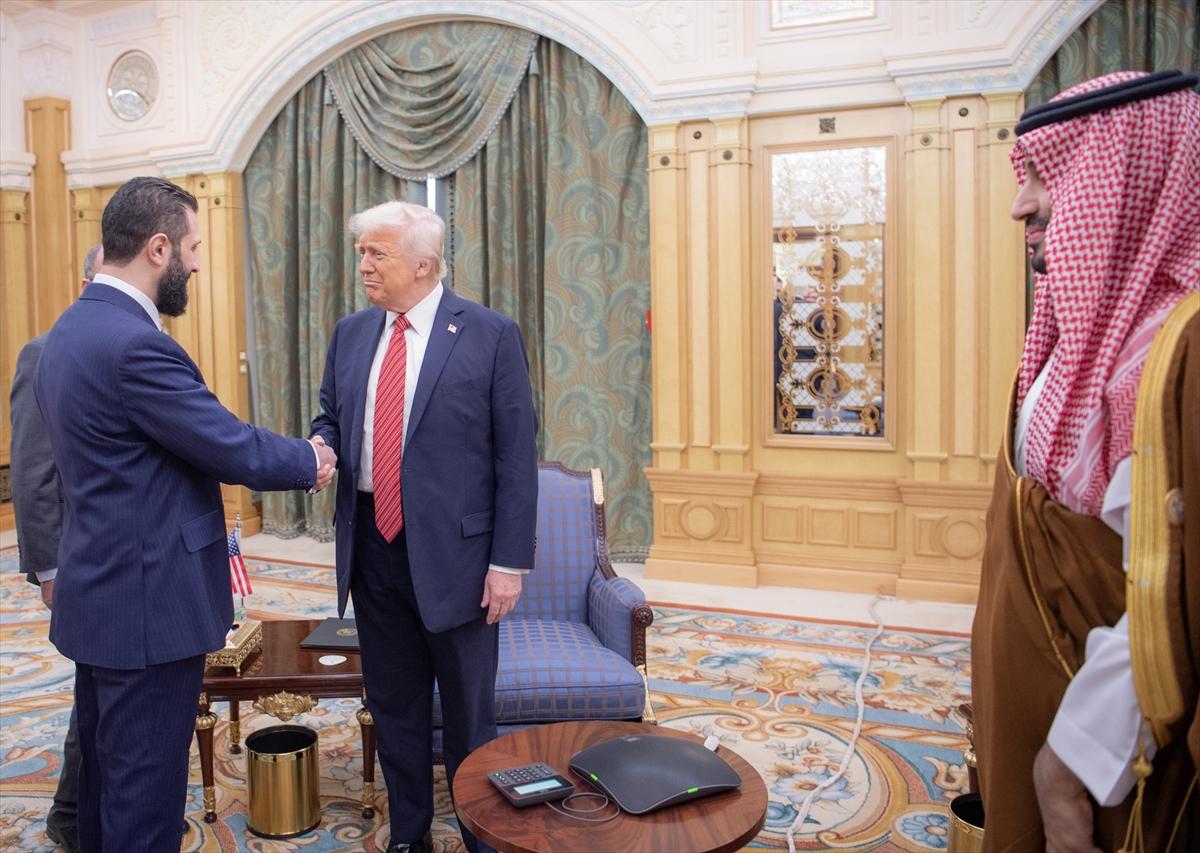
On 13 May 2025, U.S. President Donald Trump announced, following a meeting with Syrian President Ahmed al-Shara in Riyadh ahead of the Gulf Cooperation Council Summit, that all U.S. sanctions against Syria would be lifted. This announcement followed consultations with Saudi Crown Prince Mohammed bin Salman and President Recep Tayyip Erdoğan. Trump stated that this decision would provide Syria with an opportunity for a “new beginning”.
According to the U.S. President’s announcement, all economic sanctions imposed during the Bashar al-Assad regime are to be terminated. This decision marks the first high-level dialogue between the United States and Syria in 25 years.

Donald Trump's announcement was followed by celebration events in the capital Damascus on 13 May 2025. (Anadolu Agency)
On 23 May 2025, the Office of Foreign Assets Control (OFAC), under the U.S. Department of the Treasury, issued a regulation titled “General License 25” (GL 25). This license authorized activities previously prohibited under the Syria Sanctions Regulations, effectively lifting U.S. sanctions against Syria.
Under GL 25, new investments in Syria, the provision of financial and other services, transactions involving Syrian-origin petroleum and petroleum products, and the establishment of commercial relations with the new Syrian government are permitted. The license also grants specific exemptions allowing U.S. financial institutions to open correspondent accounts for the Syrian Commercial Bank. Additionally, certain transactions involving individuals and entities previously blocked are now permitted under specified conditions.
On 23 May 2025, U.S. Secretary of State Marco Rubio announced in a written statement that mandatory sanctions under the Caesar Syria Civilian Protection Act of 2019 would be suspended for 180 days. This exemption was granted to facilitate the provision of essential public services and the effective conduct of humanitarian operations.
The exemption enables the restoration of infrastructure services such as electricity, energy, water and sanitation, and removes obstacles hindering the activities of international humanitarian organizations. This measure, implemented alongside GL 25, covers financial transactions, investment activities and commercial initiatives linked to the energy sector within the scope of sanction exemptions.
The activities authorized under GL 25 apply exclusively to the interim government led by the new Syrian President Ahmed al-Shara. Sanctions against the former Bashar al-Assad regime and associated individuals and entities remain in force. Sanctions targeting terrorist organizations, human rights violators, drug traffickers and war criminals are also maintained.
No relaxation has been applied to sanctions regimes targeting states identified as “primary supporters” of the Assad regime, including Russia, Iran and North Korea. Financial or commercial transactions benefiting these countries fall outside the scope of GL 25.
The European Union (EU) announced on 20 May 2025, following a meeting of Foreign Ministers in Brussels, that all economic sanctions against Syria had been lifted. The announcement was made by EU High Representative for Foreign Affairs and Security Policy Kaja Kallas, who stated that the EU’s decision was guided by the objective of supporting the Syrian people in building a new, inclusive and peaceful country.
In an official statement by the Council of the European Union, it was stated that the lifting of economic restrictions on Syria after 14 years of sanctions constitutes a political decision and emphasized that this decision offers the Syrian people an opportunity to determine their own destiny. The Council explained that this approach has a “gradual and reversible” character.
The official statement issued by the Council of the European Union stressed that the lifting of sanctions is not permanent and may be reviewed in light of future developments. It was stated that “the Syrian government during the transition process must respect human rights and fundamental freedoms” and that the EU will continue to monitor developments on the ground.
The same document noted that the EU will continue to apply targeted individual sanctions against human rights violators pro-regime armed groups and individuals and entities fueling internal instability in Syria. Restrictions on the export of arms surveillance technology and instruments of internal repression remain in place.
As part of the decision to lift sanctions the European Union removed restrictions on frozen funds held by numerous banking institutions including the Central Bank of Syria. This measure aims to enable banks to reintegrate into the international financial system. According to EU diplomatic sources this step is intended to contribute to Syria’s financial stability and revitalize commercial flows in the region.
The process initiated in February 2025 with the suspension of sanctions covering sectors such as energy and transportation concluded with a final decision adopted on 20 May. Under this framework institutions including industrial banks credit institutions transportation and airline operators were removed from the sanctions list. EU member states are now permitted to engage in technical and financial cooperation with Syria’s Ministry of Defense and Ministry of Interior.
The Syrian Ministry of Foreign Affairs described the EU’s decision to lift economic sanctions in a written statement as a “historic step.” The statement affirmed that this decision marks the beginning of a new era in Syria-Europe relations. The Syrian government regarded the EU’s decision as an approach consistent with the principles of the rule of law and based on mutual respect.
Syria indicated that the decision will now make it possible for Syrians living in Europe to return to their country and contribute to its reconstruction through investment. It emphasized that this decision will strengthen economic and political cooperation between Syria and Europe. Syria declared its readiness to increase collaboration with European companies and investors.
In a statement by White House spokesperson Karoline Leavitt it was stated that U.S. President Trump has demanded that Syrian President Ahmed al-Sharaa meet certain conditions. These conditions include signing the Abraham Accords with Israel deporting foreign terrorists expelling certain Palestinian individuals from the country cooperating with the United States against ISIS and transferring responsibility for ISIS detention facilities under PKK/YPG control to the new Syrian government.

U.S. President DonaldTrump’s meeting with Syrian President al-Sharaa in Saudi Arabia 14 May 2025. (Anadolu Agency)
Trump also stated that fulfilling these conditions would lay the groundwork for a new relationship between the United States and Syria. In response Syria affirmed that it shares common interests with the United States regarding counterterrorism and the elimination of chemical weapons and pledged to act accordingly.
Immediately following the U.S. decision to lift sanctions Saudi Arabia and Qatar paid Syria’s total debt of $15.5 million to the World Bank. This information was made public in a statement issued by the World Bank.
This payment was carried out to open the way for Syria to access international financing for its reconstruction and development projects. In a parallel statement by the U.S. Department of the Treasury it was announced that all necessary authorizations will be implemented to encourage new investments and rebuild Syria’s economic infrastructure. This process is being coordinated by the U.S. Department of State and the National Security Council.
Al Jazeera. “EU Agrees to Lift All Economic Sanctions on Syria: Diplomats.” Al Jazeera. Accessed May 24, 2025. https://www.aljazeera.com/news/2025/5/20/eu-agrees-to-lift-all-economic-sanctions-on-syria-diplomats
Anadolu Ajansı. "ABD Hazine Bakanlığı, Suriye’ye Yönelik Yaptırımlarda Hafifletmeye Gitti." Accessed May 24, 2025. https://www.aa.com.tr/tr/dunya/abd-hazine-bakanligi-suriyeye-yonelik-yaptirimlarda-hafifletmeye-gitti/3578015
Anadolu Ajansı. "Batı, Suriye Yaptırımlarını Kaldırma Sürecine Giriyor." Accessed May 24, 2025. https://www.aa.com.tr/tr/dunya/bati-suriye-yaptirimlarini-kaldirma-surecine-giriyor/3574751#
Anadolu Ajansı. “AB, Suriye’ye Yönelik Ekonomik Yaptırımları Kaldırma Kararı Aldı.” Accessed May 24, 2025. https://www.aa.com.tr/tr/dunya/ab-suriyeye-yonelik-ekonomik-yaptirimlari-kaldirma-karari-aldi/3574302
Anadolu Ajansı. “Türkiye-ABD-Suudi Arabistan-Suriye Dörtlü Toplantısı Yapıldı.” Accessed May 24, 2025. https://www.aa.com.tr/tr/gundem/turkiye-abd-suudi-arabistan-suriye-dortlu-toplantisi-yapildi/3566960#
Council of the European Union. “Syria: Council Statement on the Lifting of EU Economic Sanctions.” Consilium.europa.eu. Accessed May 24, 2025. https://www.consilium.europa.eu/en/press/press-releases/2025/05/20/syria-council-statement-on-the-lifting-of-eu-economic-sanctions/
Reuters. “US Takes First Steps That Ease Sanctions on Syria.” Accessed May 24, 2025. https://www.reuters.com/world/middle-east/us-takes-first-steps-that-ease-sanctions-syria-2025-05-23/
U.S. Department of State. “Providing Sanctions Relief for the Syrian People.” Accessed May 24, 2025. https://www.state.gov/releases/office-of-the-spokesperson/2025/05/providing-sanctions-relief-for-the-syrian-people/
U.S. Department of the Treasury. “Press Release: Treasury Department Eases Sanctions on Syria.” Accessed May 24, 2025. https://home.treasury.gov/news/press-releases/sb0148
The Council of the European Union formally adopted on 28 May 2025 the decision taken at the level of foreign ministers on 20 May 2025 to lift economic sanctions against Syria. It was announced that the decision would be published shortly in the Official Journal of the European Union.
The statement indicated that 24 entities have been removed from the list of persons and entities subject to asset freezes. These include the Central Bank of Syria, various banks, companies operating in the oil production and refining sector, enterprises active in the cotton and telecommunications sectors, and media organizations.
The Council statement noted that sanctions targeting individuals and entities linked to the Bashar al-Assad regime have been extended until 1 June 2026. These measures are described as being maintained to “support accountability”.
Additionally, in reference to events in Latakia in March 2025, it was announced that new restrictive measures have been imposed under the EU Global Human Rights Sanctions Regime against two individuals and three entities. These measures were taken due to serious human rights violations. The statement also indicated that the European Union will continue to monitor developments on the ground and may impose additional sanctions if deemed necessary.
European Union officials stated that the process initiated following the suspension of sanctions adopted in February 2025 has been formally and legally completed as of 28 May 2025. It was clarified that the decisions taken are reversible and that developments within the country will continue to be monitored.
Anadolu Ajansı. "AB, Suriye’ye Yönelik Yaptırımlarını Resmen Kaldırdı." Accessed May 29, 2025. https://www.aa.com.tr/tr/dunya/ab-suriyeye-yonelik-yaptirimlarini-resmen-kaldirdi/3582097#
Anadolu Ajansı. "Trump, ABD’nin Suriye’ye Yaptırımlarını Sonlandıran Başkanlık Kararnamesini İmzaladı." Accessed July 1, 2025. https://www.aa.com.tr/tr/dunya/trump-abdnin-suriyeye-yaptirimlarini-sonlandiran-baskanlik-kararnamesini-imzaladi/3618041#
U.S. Department of State. "Termination of Syria Sanctions." Accessed July 1, 2025. https://www.state.gov/releases/office-of-the-spokesperson/2025/06/termination-of-syria-sanctions/#:~:text=The%20President%20ordered%20the%20cessation,the%20Revocation%20of%20Syria%20Sanctions.
The United Nations Security Council (UNSC) adopted a resolution on 6 November 2025 lifting sanctions imposed on Syrian President Ahmed al-Sharaa and Interior Minister Enes (Anas) Hattab. The resolution, drafted by the United States, was approved with 14 member states voting in favor and China abstaining.
The resolution provided for the removal of Ahmed al-Sharaa and Interior Minister Enes Hattab from the United Nations’ sanctions list associated with Al-Qaeda and Daesh (ISIS). This development marked the termination of measures that had been in effect since 2014, including travel bans, asset freezes, and arms embargoes.
At the time of the resolution’s adoption, United Nations sanctions monitoring reports indicated that no active link existed between Hayat Tahrir al-Sham (HTS) and Al-Qaeda during 2025. This finding served as the basis for removing al-Sharaa and Hattab from the sanctions list.
The adoption of the resolution occurred ahead of a meeting between Syrian President Ahmed al-Sharaa and U.S. President Donald Trump at the White House on 10 November 2025. This visit will be recorded as the first-ever visit by a Syrian president to the White House.
The resolution was drafted by the United States of America. U.S. Permanent Representative to the United Nations Mike Waltz stated that the adopted text sent a “strong political message recognizing that Syria has entered a new phase.” Waltz highlighted the efforts of the al-Sharaa administration in combating terrorism and narcotics, eliminating chemical weapons remnants, and promoting regional security and stability.
On the same day, U.S. President Donald Trump declared that “sanctions against Syria have been lifted because the country deserves a renewed opportunity.” Trump characterized his relationship with al-Sharaa as “a good dialogue” and affirmed that “progress has been made in Syria.”
Additionally, a bipartisan statement from the U.S. Senate Committee on Foreign Relations noted that “Congress must now act to support Syria’s economic reconstruction and stabilization following the UN’s decision.” Committee members Jim Risch and Jeanne Shaheen confirmed that they had been working toward the removal of sanctions under the Caesar Act.
China abstained from voting on the resolution. Chinese Permanent Representative Fu Cong explained the abstention by stating that “the text of the resolution does not fully reflect legitimate concerns regarding counter-terrorism and security.”
Fu Cong expressed particular concern about members of the East Turkestan Islamic Movement (ETIM) and foreign fighters operating in Syria. The Chinese representative stated that China expects the Syrian government to take “decisive steps against terrorist elements within its territory.”
Fu Cong also noted that during the drafting process, the United States “did not take into account the views of all Council members” and that the draft had been “urgently brought onto the Council’s agenda to serve certain political objectives.”
The Russian Federation supported the resolution. Permanent Representative Vasily Nebenzya stated that the adopted text “reflects the interests and expectations of the Syrian people.”
Nebenzya emphasized that the resolution affirms commitment to the principles of sovereignty, independence, unity, and territorial integrity of the Syrian Arab Republic. He recalled that Israel’s continued occupation of the Golan Heights violates international law and stressed that “all countries must adhere to these principles.”
Nebenzya also noted that Syria requires international support to achieve economic recovery and development and expressed the view that “the resolution will contribute to the country’s reconstruction.”
James Kariuki, representative of the United Kingdom’s mission to the United Nations, welcomed the progress made by the Syrian government in the political transition process and in combating terrorism. Kariuki stated that the resolution “will encourage deeper engagement between Syria and the international community.”
France’s Permanent Representative, Jérôme Bonnafont, stated that “the fight against Daesh is not yet complete and the risk of its resurgence must not be taken lightly.” Bonnafont noted that the decision constitutes “an important step toward the reconstruction of a sovereign, united and peaceful Syria.”
Syria’s Permanent Representative to the United Nations, Ibrahim Obeid, thanked the members of the Security Council following the adoption of the decision and stated that “the Council has united on the side of the Syrian people.” Obeid described the decision as “a sign of growing confidence in the new Syria its people and its leadership.”
In his address at the Security Council meeting, Obeid emphasized that the decision carries “a message of support for the efforts of Syrian men and women to rebuild their country.” He added that “Syria will serve as an example demonstrating that positive engagement and constructive cooperation are the most appropriate paths in international relations.”
Obeid underscored Syria’s commitment to its sovereignty and territorial integrity, asserting that “Syria is determined to build a modern state based on the rule of law.” The Permanent Representative stated that Syria “will continue to serve as a meeting point between the East and the West” and is ready to establish constructive relations with the international community.
In statements issued on behalf of the Syrian government, satisfaction with the decision was expressed, with it being described as “a turning point on the path toward national reconstruction, the establishment of stability and the advancement of international cooperation.” In a subsequent statement, the Syrian government declared that the country “will close the chapters of war and suffering and focus on the process of reconstruction.”
Al Jazeera. “UNSC Votes to Drop Sanctions on Syria’s Al-Sharaa ahead of Washington Visit.” Al Jazeera English. Accessed November 7, 2025. https://www.aljazeera.com/news/2025/11/6/unsc-votes-to-drop-sanctions-on-syrias-al-sharaa-ahead-of-washington-visit
Anadolu Ajansı. “UN Security Council Adopts Resolution to Remove Syrian President, Interior Minister from Sanctions List.” Anadolu Ajansı (English Edition). Accessed November 7, 2025. https://www.aa.com.tr/en/middle-east/un-security-council-adopts-resolution-to-remove-syrian-president-interior-minister-from-sanctions-list/3737165#
Reuters. “UN Security Council Removes Sanctions on Syria’s President, Interior Minister.” Accessed November 7, 2025. https://www.reuters.com/world/middle-east/un-security-council-removes-sanctions-syrias-president-interior-minister-2025-11-06/
United Nations News. “Security Council lifts terror-related sanctions on Syrian President.” UN News. Accessed November 7, 2025. https://news.un.org/en/story/2025/11/1166303
Following the United Nations Security Council resolution dated 6 November 2025, the United States of America (USA) took additional steps on 7 November 2025 to modify its sanctions regime against Syria. The U.S. Department of the Treasury announced on 7 November that it had removed Syrian President Ahmed al-Sharaa and Interior Minister Enes Hattab from its sanctions list. According to Al-Ikhbariya television, the decision has also been confirmed by Syria.
On the same date, the U.S. Department of State announced that al-Sharaa had been removed from the list of “Specially Designated Global Terrorists (SDGT).” Deputy Spokesperson Tommy Pigott stated that the decision, signed by Secretary Marco Rubio, fully rescinded al-Sharaa’s previous designation under the name “Muhammad al-Jawlanī.”
In his statement, Pigott described the move as “a strong political signal recognizing Syria’s transition to a new phase.” Simultaneously, the U.S. Department of the Treasury also removed Interior Minister Enes Hattab from the sanctions list.
The statement indicated that these steps were taken “to acknowledge the progress achieved by Syria’s leadership following the departure of Bashar al-Assad.” The U.S. emphasized that the government under Ahmed al-Sharaa has fulfilled its commitments regarding the search for missing Americans, the fight against terrorism and narcotics, the elimination of chemical weapons, the promotion of regional security and stability, and the continuation of an inclusive political process led by Syria.
The U.S. Department of State spokesperson further stated that the United States will continue to support the Syrian people’s efforts toward peace, stability, and reconstruction.
Anadolu Ajansı. "ABD, Suriye Cumhurbaşkanı Şarra’yı Küresel Terörist Yaptırım Listesinden Çıkardı." Accessed November 8, 2025. https://www.aa.com.tr/tr/dunya/abd-suriye-cumhurbaskani-sarayi-kuresel-terorist-yaptirim-listesinden-cikardi/3738164#

In 2025, the process of lifting economic and terrorism-related sanctions against Syria began. This step was taken following contacts established with the new administration led by Ahmed Shara after the end of the Bashar al-Assad regime. The United States and the European Union simultaneously ended economic restrictions in May 2025. Subsequently, on 6 November 2025, the United Nations Security Council adopted a resolution lifting terrorism-related sanctions targeting Ahmed Shara and Interior Minister Enes Hattab.
No Discussion Added Yet
Start discussion for "Process of Lifting Sanctions Against Syria (2025)" article
May 24, 2025
U.S. Decision and Implementation Steps to Lift Sanctions
May 24, 2025
European Union’s Decision to Lift Sanctions
May 24, 2025
U.S. Conditional Sanctions Relief and Demands Presented to Ahmed al-Sharaa
May 24, 2025
International Financial Contributions and Regional Support Measures
May 29, 2025
Final Approval and Implementation Details by the Council of the European Union
July 1, 2025
Official Termination of Sanctions Against Syria by U.S. Presidential Executive Order (30 June 2025)
November 7, 2025
United Nations Security Council Decision to Lift Sanctions Against Syrian President Ahmed al-Sharaa
November 7, 2025
Positions and Statements of Member States
November 7, 2025
Response from the Syrian Mission and Government
November 8, 2025
United States Lifts Sanctions Against Syrian President Ahmed al-Sharaa