

This article was automatically translated from the original Turkish version.
Hungary General Elections, held on Sunday, 12 April 2026, resulted in the end of Prime Minister Viktor Orbán’s 16-year rule. Led by Péter Magyar, general secretary of the Party of Respect and Freedom (Tisza), Tisza won 138 seats in Hungary’s 199-member National Assembly, securing 53.6 percent of the vote.

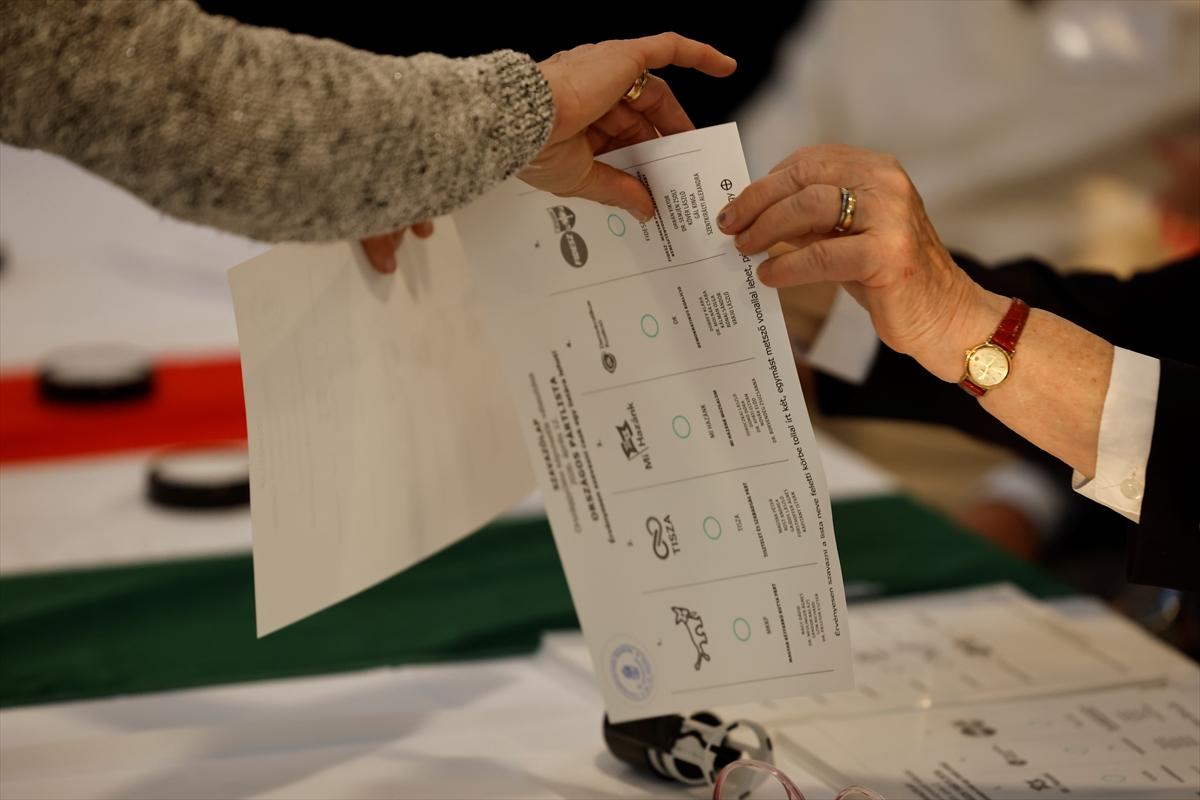
Voting at a polling station in Hungary, 12 April 2026 – (Anadolu Ajansı)
The election marked a transformation, as the Fidesz-KDNP alliance, which had held uninterrupted power since 2010, fell to just under 37 percent of the vote and secured 54–55 seats. Voter turnout reached 79.5 percent, the highest ever recorded in Hungary’s post-communist history.【1】
Viktor Orbán and the Fidesz-KDNP alliance won four consecutive general elections from 2010 to 2026, maintaining strong parliamentary majorities. During this period, the constitution was rewritten, judicial independence became a subject of controversy, and the majority of the media landscape came under the control of groups aligned with Fidesz. Orbán promoted the model of “illiberal democracy” as an alternative to European conservatism.
The Orbán administration experienced chronic friction with the European Union on multiple fronts. Brussels, arguing that democratic standards had declined, froze several planned EU funds for Hungary.【2】 Hungary also became one of the main countries to impose vetoes within the European Union on issues such as sanctions against Russia and the planned €9 billion financial support for Ukraine.
45-year-old lawyer and former diplomat Peter Magyar served in Hungarian diplomatic missions in Brussels during the Orbán era and held positions in various public institutions. Magyar rose to public prominence in early 2024 following the political withdrawal of his former wife and former Minister of Justice Judit Varga, and began openly criticizing the Fidesz administration.

Peter Magyar, leader of the Party of Respect and Freedom (Tisza), voting in the capital Budapest, 12 April 2026 – (Anadolu Ajansı)
Magyar assumed leadership of the Tisza Party in 2024 and won seven seats in the 2024 European Parliament elections by securing 29.6 percent of the vote. This result established him as one of the strongest opposition figures against Orbán. During the general election campaign, Magyar identified combating corruption, restoring the rule of law, repairing relations with the European Union, and strengthening public services as his core policy priorities.
Adopting a cautious stance on the Russia-Ukraine War, Magyar has argued that Hungary must align itself more closely with the European Union and NATO.
In all independent opinion polls conducted in the weeks leading up to the election, the Tisza Party was shown to be ahead of Fidesz. According to the IDEA Institute’s survey on 9 April 2026, when all voters were considered, Tisza’s vote share was measured at 39 percent compared to Fidesz’s 30 percent. When undecided voters were projected to distribute proportionally, these figures were estimated to rise to 50 percent and 37 percent respectively.

Peter Magyar, leader of the Party of Respect and Freedom (Tisza), voting in the capital Budapest, 12 April 2026 – (Anadolu Ajansı)
In IranTu’s survey covering 31 March to 4 April, Tisza was measured at 41 percent and Fidesz at 34 percent. Publicus’s survey from 27–30 March recorded Tisza at 36 percent and Fidesz at 30 percent. The 21 Research Center’s survey from 23–28 March showed Tisza at 40 percent and Fidesz at 28 percent.【3】
Hungary employs a mixed electoral system. Of the total 199 parliamentary seats, 106 are allocated to candidates who receive the most votes in single-member constituencies, with no requirement for an absolute majority. The remaining 93 seats are distributed proportionally based on national party lists.【4】
In the allocation of seats based on national lists, only direct votes are not considered. Votes cast for losing candidates in single-member constituencies, as well as surplus votes for winning candidates, are defined as “leftover votes” and added to the national vote pool. Votes from registered Hungarian voters abroad are also included in this pool.
The total vote count is then converted into 93 parliamentary seats through a stepwise calculation method. Domestic voters cast two votes: one for a candidate in their constituency and one for a national party list. Voters residing abroad may vote only for the national list. Due to this structure, the nationwide vote share does not always correspond directly to the distribution of parliamentary seats.

Hungarian Prime Minister Viktor Orbán voting at a school in Budapest, 12 April 2026 – (Anadolu Ajansı)
Voting began at 06:00 local time on 12 April and ended at 19:00. Citizens voted at 10,047 polling stations across the country. According to data from the National Election Office (NVI), voter turnout reached 77.80 percent by 18:30; the final figure was 79.5 percent, representing the highest turnout ever recorded in Hungary’s post-communist history.【5】The number of voters registered to vote abroad through foreign diplomatic missions exceeded 90,000, reaching the highest level in history. The number of remote voters was reported to have broken records at approximately 224,000.

Infographic showing election results – (Visual generated with AI assistance.)
With 97.35 percent of polling stations counted, the National Election Office reported the following distribution:
Tisza’s 138 seats exceed the two-thirds threshold of 133 required for constitutional amendments.【6】
At an early stage when only about 30 percent of votes had been counted, Péter Magyar posted on social media: “Prime Minister Viktor Orbán just called me to congratulate us on our victory.”
Shortly after Magyar’s announcement, Viktor Orbán accepted the election result in a press conference held at a congress center in Budapest. According to media reports, Orbán described the outcome as “clear and painful” and publicly congratulated the winning side. Tens of thousands of Tisza supporters gathered along the banks of the Danube River in Budapest and began celebrating immediately after the results were announced.
Péter Magyar addressed tens of thousands of supporters gathered along the Danube River in Budapest. Beginning his speech with the words “We did it,” Magyar characterized the election result as a decisive victory achieved on behalf of the entire Hungarian people.
Magyar noted that the elections concluded with high voter turnout and strong political legitimacy, signaling Hungary’s renewed commitment to reintegration with Europe. He appealed not only to his own voters but to the entire nation, calling for national unity.
In his speech, Magyar also addressed the approximately 800,000 Hungarian citizens who have emigrated abroad, urging them to return to the country. He also called on officials within state institutions who were closely aligned with the previous administration to resign.
Magyar also outlined the foreign policy priorities of the new government, announcing that his first official visit would be to Warsaw, followed by Vienna and Brussels. The central agenda item for the Brussels talks will be the release of approximately €1.7 billion in European Union funds frozen due to concerns over corruption and judicial independence.【7】
European Commission President Ursula von der Leyen, shortly after partial results were announced, stated: "Hungary has chosen Europe. Europe has always chosen Hungary. One country is returning to the European path. Unity is growing stronger... Europe’s heart is beating more strongly tonight in Hungary."
European Commission and Council circles have indicated they expect the lifting of Orbán’s veto block within the EU to enable the resumption of financial transfers to Ukraine and the restoration of rule-of-law mechanisms.
Ukrainian President Volodymyr Zelenskyy congratulated Magyar, saying: "Ukraine has always sought good neighborly relations with everyone in Europe and is ready to advance our cooperation with Hungary. We are ready for meetings and joint constructive work for the benefit of both nations and for peace, security, and stability in Europe."
UK Prime Minister Keir Starmer: "This is a historic moment not only for Hungary but for European democracy. I look forward to working with you for the security and prosperity of both our countries."
French President Emmanuel Macron: "I just spoke with Péter Magyar and congratulated him on his victory. France welcomes this result as a triumph of democratic participation and the Hungarian people’s commitment to EU values."
German Chancellor Friedrich Merz: "The Hungarian people have made their decision. My sincere congratulations on your success. Let us unite our strength for a strong, secure, and above all united Europe."
Polish Prime Minister Donald Tusk: "Hungary, Poland, Europe. We are together again! Magnificent victory, dear friends!" Tusk also sent a strong message using the Hungarian phrase "Ruszkik Haza" (Russians go home).
The prime ministers of Norway, Finland, Estonia, and Lithuania also congratulated Magyar, affirming their commitment to European unity and democratic values.
Before the election, U.S. President Donald Trump publicly supported Orbán five times within six months. U.S. Vice President JD Vance, during a visit to Budapest on 7–8 April 2026, delivered a speech at an Orbán campaign rally, telling Fidesz supporters: "We must elect Viktor Orbán as Hungary’s prime minister again, right?"
House Minority Leader Hakeem Jeffries made the following statement after the election: "The extremist authoritarian Viktor Orbán lost the election. Trump loyalists and MAGA extremists are now on the sidelines. Their time will come in November. Winter is coming."
Tesla and SpaceX CEO Elon Musk stated on his social media account: "The Soros company has taken control of Hungary." Musk’s post targeted a message from George Soros’s Open Society Foundations president and Soros’s son Alexander Soros, who had congratulated Tisza on its victory.
Al Jazeera. “Peter Magyar Wins Hungary Election, Unseating Viktor Orban After 16 Years.” Al Jazeera. Accessed April 13, 2026. https://www.aljazeera.com/news/2026/4/12/hungary-election-early-results-show-magyars-tisza-ahead-of-orbans-fidesz
Anadolu Ajansı. "Macaristan Genel Seçimi." Anadolu Ajansı Infographic. Accessed April 13, 2026. https://www.aa.com.tr/en/info/infographic/51402
Anadolu Ajansı. "Macaristan’da Genel Seçimi Magyar Büyük Farkla Önde Götürüyor." Accessed April 13, 2026. https://m.aa.com.tr/tr/dunya/macaristanda-genel-secimi-magyar-buyuk-farkla-onde-goturuyor/3903106
Anadolu Ajansı. “Macaristan, Genel Seçim İçin Yarın Sandık Başına Gidiyor.” Accessed April 13, 2026. https://www.aa.com.tr/tr/dunya/macaristan-genel-secim-icin-yarin-sandik-basina-gidiyor/3901719
Anadolu Ajansı. “Macaristan’da Genel Seçimi Kaybeden Orban: Kazanan Partiyi Tebrik Ettim.” Accessed April 13, 2026. https://www.aa.com.tr/tr/dunya/macaristanda-genel-secimi-kaybeden-orban-kazanan-partiyi-tebrik-ettim/3903141
Anadolu Ajansı. “Macaristan’da Seçimi Kazanan Magyar: Macaristan Tekrar Avrupa Ülkesi Olmak İstiyor.” Accessed April 13, 2026. https://www.aa.com.tr/tr/dunya/macaristanda-secimi-kazanan-magyar-macaristan-tekrar-avrupa-ulkesi-olmak-istiyor/3903234
BBC News. “Orbán Era Swept Away by Péter Magyar's Hungary Election Landslide.” Accessed April 13, 2026. https://www.bbc.com/news/articles/cd9vg782kx7o
Politico. "Vance, Putin … Zelenskyy: The Losers and Winners of Hungary’s Seismic Election." Accessed April 13, 2026. https://www.politico.eu/article/hungarian-election-2026-the-winners-and-losers/
Reuters. “Hungary's Conservative Icon Orban Defeated by Centre-Right Opposition.” Accessed April 13, 2026. https://www.reuters.com/world/europe/hungarians-vote-landmark-election-closely-watched-by-eu-russia-us-2026-04-11/
Reuters. “Hungary's Orbán Concedes After Magyar's Projected Supermajority Win - As It Happened.” Accessed April 13, 2026. https://www.reuters.com/world/hungary-election-2026-live-viktor-orbans-fidesz-faces-challenge-opposition-peter-2026-04-12/
Reuters. “Reactions to PM Orban's Defeat in Hungary's Election.” Accessed April 13, 2026. https://www.reuters.com/world/reactions-pm-orbans-likely-defeat-hungarys-election-2026-04-12/
[1]
BBC, "Orbán era swept away by Péter Magyar's Hungary election landslide", Access 12 April 2026. https://www.bbc.com/news/articles/cd9vg782kx7o
[2]
Al Jazeera, "Peter Magyar wins Hungary election, unseating Viktor Orban after 16 years", Access 12 April 2026. https://www.aljazeera.com/news/2026/4/12/hungary-election-early-results-show-magyars-tisza-ahead-of-orbans-fidesz
[3]
Anadolu Ajansı “Hungary heads to the polls tomorrow.” , Access 12 April 2026. https://www.aa.com.tr/tr/dunya/macaristan-genel-secim-icin-yarin-sandik-basina-gidiyor/3901719
[4]
Anadolu Ajansı “Hungary heads to the polls tomorrow.” , Access 12 April 2026. https://www.aa.com.tr/tr/dunya/macaristan-genel-secim-icin-yarin-sandik-basina-gidiyor/3901719
[5]
Reuters, “Hungary's conservative icon Orban defeated by centre-right opposition” , Access 13 April 2026. https://www.reuters.com/world/europe/hungarians-vote-landmark-election-closely-watched-by-eu-russia-us-2026-04-11/
[6]
Al Jazeera, "Peter Magyar wins Hungary election, unseating Viktor Orban after 16 years", Access 12 April 2026. https://www.aljazeera.com/news/2026/4/12/hungary-election-early-results-show-magyars-tisza-ahead-of-orbans-fidesz
[7]
BBC, "Orbán era swept away by Péter Magyar's Hungary election landslide", Access 12 April 2026. https://www.bbc.com/news/articles/cd9vg782kx7o

No Discussion Added Yet
Start discussion for "2026 Hungary General Elections" article
Political Background
Orbán’s Sixteen-Year Rule
Peter Magyar’s Political Rise
Pre-Election Poll Results
Electoral System
Election Day and Official Results
Voting Process and Turnout
Final Seat Distribution
Peter Magyar’s Victory Speech
International Reactions
European Union
Ukraine
Other Heads of State and Government Leaders
United States
Elon Musk’s Reaction