

 Recently Added:
This article was automatically translated from the original Turkish version.
Peru Political Crisis and Presidential Transition refers to the process in which interim President Jose Jerí was removed from office following a censure vote by the Peruvian Congress on 17 February 2026, and Jose Maria Balcazar was subsequently elected interim president on 18 February 2026.
On 17 February 2026, the Peruvian Congress approved a censure motion against Jose Jerí. The vote resulted in 75 legislators voting in favor of removal, 24 voting against, and 3 abstaining. This decision ended Jerí’s approximately four-month presidency.
One day after Jerí’s removal, Congress elected a new interim president. On 18 February 2026, Jose Maria Balcazar received 60 votes and was elected president.

Jose Jeri, 22 January 2026 - (Anadolu Ajansı)
Jose Jerí assumed the presidency on 10 October 2025, in accordance with constitutional succession rules following the removal of then-President Dina Boluarte. Boluarte’s removal was the result of a decision by Congress.
At the time he assumed the presidency, Jerí was serving as President of Congress. With no vice president available after Boluarte’s removal, Jerí was sworn in as successor under the constitutional line of succession.
Jerí’s rise to the presidency did not occur through election but through a constitutional transition mechanism. This resulted in his presidency having a provisional status.
Jerí was 39 years old when he assumed office. Upon his removal, he became the third consecutive president removed from office in Peru. Jerí’s term lasted approximately four months.
The central issue leading to Jose Jerí’s removal was a scandal known in the Peruvian press and international media as “Chifa-gate”. The crisis began when it was revealed that Jerí had held unofficial meetings with Chinese businesspeople.
The first controversial meeting took place on 26 December 2025 at a Chinese restaurant in Lima. Security camera footage showed Jerí entering the restaurant wearing a hooded jacket. One of the parties involved was Chinese businessman Zhihua Yang, who held state concessions for an energy project.
Jerí’s second meeting with Yang occurred on 6 January 2026 at a Chinese goods store. During this meeting, Jerí was seen wearing sunglasses. Neither meeting was recorded in the official presidential schedule.
Under Peruvian law, all official presidential activities must be documented. The failure to record these meetings triggered public and political backlash.
It was alleged that Chinese national Xiaodong Jiwu, who was under house arrest for illegal activities, was also present at the meetings. Jerí stated he did not speak with Jiwu and that he was merely served food.
Jerí acknowledged the meetings took place and issued a public statement. In it, he said: “I acknowledge my mistake and apologize to the public for entering the restaurant with a hooded jacket, which created doubt and uncertainty about my conduct and gave rise to entirely unfounded stories.” He further described the meetings as “situational” and insisted that the businessman had not requested any special favors.
Following the revelation of these meetings, Peru’s Attorney General’s Office launched an investigation against Jerí on charges of influence peddling.
During the process leading to Jose Jerí’s removal, allegations of various forms of corruption and influence peddling emerged alongside the unrecorded meetings with Chinese businessmen. The Peruvian Attorney General’s Office opened two separate investigations into Jerí, examining certain meetings and administrative decisions made during his term.
One of the most prominent allegations concerned Jerí’s late-night meetings in his presidential office. A local media report stated that five women, described as close to Jerí, held private meetings in the presidential office until midnight, after which they were awarded lucrative contracts with the state.【1】
Additionally, an allegation of sexual misconduct was raised against Jerí. This became one of the topics debated in public during his term.【2】
Jerí denied all allegations against him and characterized the investigations as a politically motivated campaign orchestrated by his rivals.
The censure motion against Jose Jerí was taken up by the Peruvian Congress on 17 February 2026. The session was held as an extraordinary meeting despite being scheduled during an official legislative holiday.
The vote resulted in 75 in favor, 24 against, and 3 abstentions. This outcome terminated Jerí’s term. Congress removed Jerí not through impeachment but through the censure procedure. Impeachment requires 87 votes in the 130-seat legislature, whereas censure requires only a simple majority.
This mechanism removed Jerí from his position as President of Congress, thereby vacating the presidency as well. Following the vote, interim Congress President Fernando Rospigliosi declared the office vacant, stating: “The Presidential Council hereby declares that the office of President of the Republic Congress is vacant and, consequently, the office of President of the Republic is also vacant.” Jerí stated he would respect the outcome of the vote. The removal occurred approximately two months before the general elections scheduled for April 2026.
After his removal, Jose Jerí posted a farewell message on the social media platform TikTok.
Jerí shared a video featuring footage from his four-month presidency and said: “Serving Peru has been an honor and will remain so. I leave with a full heart and in peace. It is not easy to resolve issues that have waited for decades in just a few months; but every step taken was done with conviction, responsibility, and sacrifice. We have firmly established our most critical mission: guaranteeing clean and transparent elections and continuing to strengthen security as the foundation of a stable and forward-looking country.”
He also said: “The love shown to me by the people on every street and in every region will stay with me.” He affirmed that he would continue his work as a member of Congress.
Following Jose Jerí’s removal by censure, the constitutional succession process was reactivated. The current President of Congress, Fernando Rospigliosi, although next in line constitutionally, declined to assume the presidency.
Therefore, Congress needed to elect a new president. The newly elected Congress President would automatically assume the role of interim president, as required by the constitution.
Rospigliosi announced that political parties had until 18:00 local time on 17 February 2026 to submit their candidates and that the vote would be held on Wednesday, 18 February 2026.

José María Balcazar, 19 February 2026 - (Anadolu Ajansı)
The voting process consisted of two rounds. In the first round, center-right lawyer María del Carmen Alva and left-leaning legislator Jose Maria Balcazar emerged as the leading candidates. Neither candidate secured the required majority in the first round.
In the second round of voting, a total of 113 valid votes were cast. Jose María Balcazar received 60 votes and won the election. Thus, Balcazar became the ninth president of Peru in the last 10 years.
After his election, it was announced that Balcazar’s term would last until the new president, to be inaugurated in July following the April 2026 elections, assumes office.
Jose Maria Balcazar is a left-leaning legislator from the Perú Libre (Free Peru) party. He is 83 years old and was born in the Cajamarca region of northern Peru.
He has been a member of Congress since 2021. During this period, he briefly left Perú Libre to join the Peru Bicentenario party.
Balcazar holds a law degree, has worked as an academic, and served as a judge. In 2004, while serving as an interim member of Peru’s Supreme Court, he attempted to overturn a final appellate ruling as required by law.
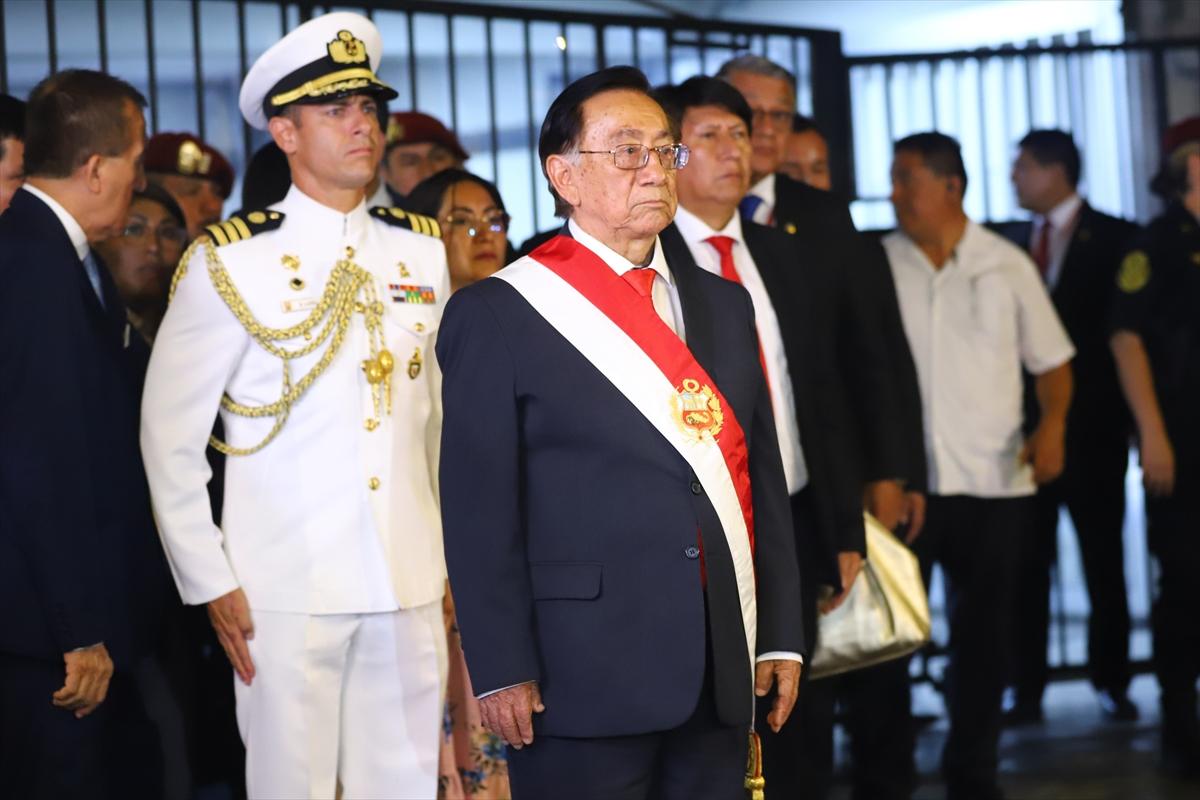
José María Balcazar, 19 February 2026 - (Anadolu Ajansı)
Following this action, he was subjected to a disciplinary process; the National Council of the Judiciary (CNM) declined to renew his term.
Various investigations have been conducted against Balcazar. A probe was opened over allegations that funds from the Lambayeque Bar Association were embezzled. According to Peruvian media, the Attorney General’s Office has requested a one-year suspended prison sentence and a fine of 348,344 Peruvian soles against Balcazar.
According to Lambayeque Bar Association sources, the trial is expected to begin in September. It has also been reported that Balcazar is under investigation in connection with a bribery scandal involving former Attorney General Patricia Benavides.
After Balcazar’s election, speculation arose regarding the potential pardon of former President Pedro Castillo.
Perú Libre spokesperson Flavio Cruz stated that the pardon was not on the agenda: “As spokesperson, I am stating now that I will never bring up the issue [of pardoning Castillo]; this matter belongs to a later period and is not part of this government’s term.”
In his first press conference, Balcazar said: “The former president is subject to a legal process; let it proceed according to due process. There is no need for concern.” He confirmed that a pardon was not under consideration.
In his inaugural address, Balcazar emphasized transparent elections, stating: “First, we guarantee a democratic, peaceful, and transparent transition; we will ensure no doubt remains about the elections. Second, we must pursue a process of reconciliation. [...] We must achieve national unity; the issue is to take action.”
He affirmed that the macroeconomic policy framework would be maintained, saying: “We must continue the macroeconomic course because we will not leap into a vacuum. We will pursue sound monetary policy to ensure economic actors can operate without disruption.” He also stated that he would meet with Central Bank President Julio Velarde. Balcazar indicated he would review cabinet ministers but declined to respond directly to questions regarding the police force.
General elections in Peru will be held on 12 April 2026. To win in the first round, a candidate must receive more than 50 percent of the vote. Otherwise, a second round is planned for June.
Traditionally, elected presidents in Peru take office at the end of July, on Independence Day. Accordingly, Balcazar, elected after Jerí’s removal, will serve in a provisional capacity until the new president assumes office.
Over the past decade, numerous Peruvian presidents have been removed or resigned. Jose Jerí became the third consecutive president removed from office. With Jerí’s removal, the number of individuals who have held the presidency in the last 10 years has reached nine.
Jose Jerí assumed office in October 2025 following the removal of Dina Boluarte, under the constitutional succession process. Jerí’s removal via censure on 17 February 2026 made him the third consecutive president removed from office.
His predecessor, Dina Boluarte, was removed in October 2025. Boluarte had assumed the presidency in December 2022 after Pedro Castillo’s removal.
Pedro Castillo was removed from office in December 2022 after attempting to dissolve Congress. He was arrested and later convicted of rebellion and conspiracy. In November 2025, he was sentenced to 11 years and 5 months in prison.
Of the last eight presidents, four were removed, and two resigned before completing their terms. The last president to serve a full term was Ollanta Humala. Humala’s term ended in July 2016.
Al Jazeera. “Peru appoints Jose Maria Balcazar as president, ninth leader in a decade.” Accessed February 19, 2026. https://www.aljazeera.com/news/2026/2/19/peru-appoints-new-president-after-jose-jeris-removal
Anadolu Ajansı. “Peru’da Geçici Devlet Başkanı Jose Maria Balcazar Oldu.” Accessed February 19, 2026. https://www.aa.com.tr/tr/dunya/peruda-gecici-devlet-baskani-jose-maria-balcazar-oldu/3834234
Anadolu Ajansı. “Peru’s Congress Removes President Jeri After 4 Months in Office.” Accessed February 19, 2026. https://www.aa.com.tr/en/americas/peru-s-congress-removes-president-jeri-after-4-months-in-office/3832996/
BBC News. “Peru's Congress ousts president after four months in office.” Accessed February 19, 2026. https://www.bbc.com/news/articles/cz7gvdx457vo
CNN. “Peru’s leader José Jerí ousted over ‘Chifa-gate’ scandal, as presidential ‘curse’ strikes again.” Accessed February 19, 2026. https://edition.cnn.com/2026/02/17/americas/peru-president-jose-jeri-ousted-intl-latam
El Comercio. "José Jeri Se Despidió en Redes Sociales de la Presidencia Tras Ser Destituido por el Congreso de la República: ‘Me Voy con el Corazón Lleno y en Paz’." Accessed February 19, 2026. https://elcomercio.pe/politica/gobierno/jose-jeri-se-despidio-en-redes-sociales-de-la-presidencia-tras-ser-destituido-por-el-congreso-de-la-republica-me-voy-con-el-corazon-lleno-y-en-paz-noticia/
El Comercio. "José María Balcázar Fue Elegido Presidente de la República: Cómo Se Gestó el Retorno de Perú Libre al Poder." Accessed February 19, 2026. https://elcomercio.pe/politica/jose-maria-balcazar-fue-elegido-presidente-de-la-republica-como-se-gesto-el-retorno-de-peru-libre-al-poder-tlc-nota-noticia/
Reuters. “Peru Congress ousts President Jeri because of China-linked secret meetings.” Accessed February 19, 2026. https://www.reuters.com/world/china/perus-congress-begins-debating-removal-president-jeri-2026-02-17/
[1]
Anadolu Ajansı. “Peru’s Congress Removes President Jeri After 4 Months in Office,” Anadolu Ajansı. Accessed 18 February 2026. https://www.aa.com.tr/en/americas/peru-s-congress-removes-president-jeri-after-4-months-in-office/3832996#
[2]
Al Jazeera. “Peru Appoints New President After Jose Jeri’s Removal.” Al Jazeera. Accessed 19 February 2026. https://www.aljazeera.com/news/2026/2/19/peru-appoints-new-president-after-jose-jeris-removal

On 17 February 2026, the Congress of Peru removed interim President Jose Jeri from office by a vote of 75 in favor, 24 against and 3 abstentions. Jeri assumed office on 10 October 2025 following the removal of Dina Boluarte, in accordance with the constitutional line of succession. He held unofficial meetings with Chinese businessman Zhihua Yang on 26 December 2025 and 6 January 2026, prompting investigations into allegations of influence peddling. On 18 February 2026, Congress voted to elect Jose Maria Balcazar as interim president by a vote of 60.
No Discussion Added Yet
Start discussion for "2026 Peru Political Crisis and Presidential Change" article
February 19, 2026
Jose Jerí’s Assumption of Office (October 2025)
February 19, 2026
The “Chifa-gate” Crisis
February 19, 2026
Corruption and Influence Peddling Investigations
February 19, 2026
Congressional Process and Censure Vote
February 19, 2026
Jose Jerí’s Farewell Statement
February 19, 2026
Process for Electing the New Interim President
February 19, 2026
Jose Maria Balcazar’s Political Identity
February 19, 2026
Balcazar’s Initial Statements
February 19, 2026
Election Calendar and Interim Period
February 19, 2026
Chronology of Presidential Successions in Peru