


This article was automatically translated from the original Turkish version.
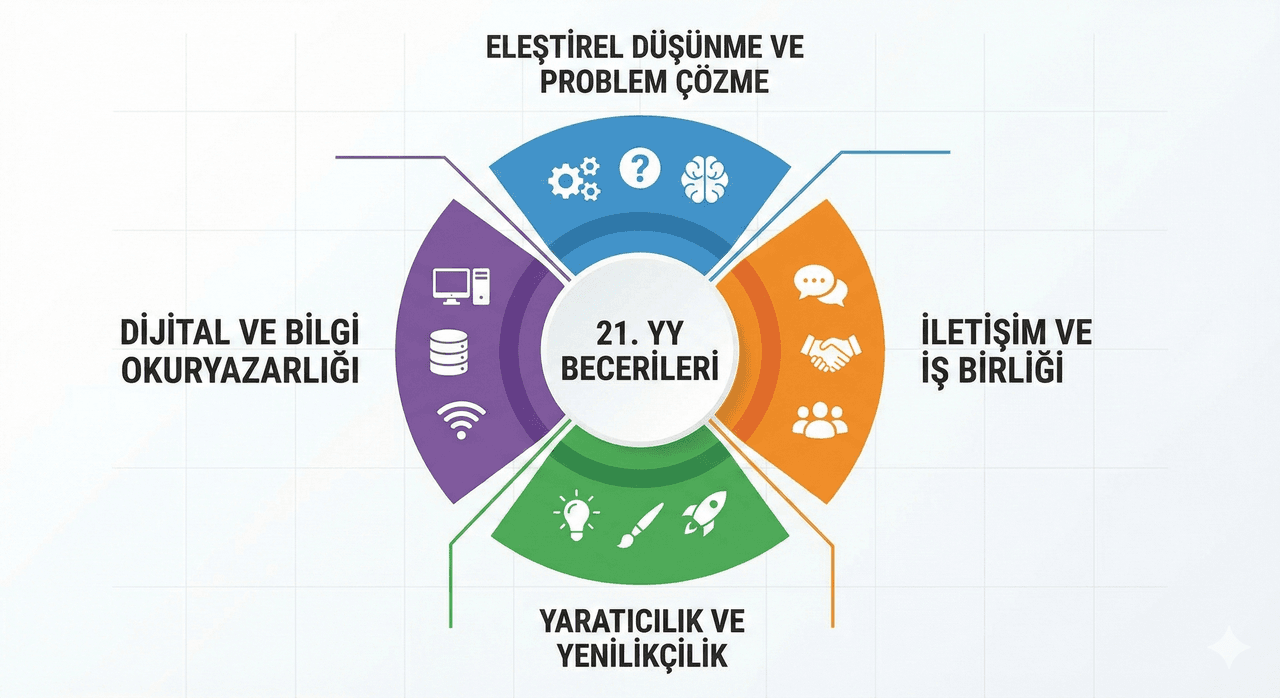
21st Century Skills
(Generated with Artificial Intelligence)
21st Century Skills
21St Century Competencies | Digital Literacy Information Literacy Innovation Collaboration Problem Solving Creativity Communication Critical Thinking | ||||||||
|---|---|---|---|---|---|---|---|---|---|
International Reference Frameworks | ATC21S P21 – 4C Model OECD – Learning Compass OECD – DeSeCo | ||||||||
Core Skill Areas | Digital Competencies Creative Production Skills Social-Communication Skills Higher-Order Cognitive Skills | ||||||||
21st Century Skills refer to the comprehensive set of cognitive, social, emotional, and digital competencies necessary for individuals to participate effectively in an information society. This concept emerged as a result of the need to restructure educational systems during the transition from an industrial society to an information and innovation society.【1】
Similarly, the Assessment and Teaching of 21st Century Skills Project (ATC21S – Assessment and Teaching of 21st Century Skills) has classified these skills into four main categories:
1. Ways of Thinking
2. Ways of Working
3. Tools for Working
4. Skills for Living in the World
The theoretical foundations of the 21st Century Skills concept were systematized particularly through international organizational studies conducted in the 2000s. The Organization for Economic Co-operation and Development (OECD) project titled Definition and Selection of Key Competencies (DeSeCo – Definition and Selection of Key Competencies) identified the core competency domains required for individuals to succeed in complex social conditions.【2】 In this study, competencies were addressed under the headings of interactive use of tools, interaction in heterogeneous groups, and autonomous action.
Similarly, the Assessment and Teaching of 21st Century Skills (ATC21S) project classified these skills into four main categories: ways of thinking, ways of working, tools for working, and skills for living in the world.【3】
Furthermore, Voogt and Roblin, in their comparative analysis of different international frameworks, demonstrated that 21st Century Skills frameworks largely share common themes, particularly emphasizing critical thinking, communication, collaboration, and creativity as central dimensions.【4】
Although the literature on 21st Century Skills has been shaped by diverse institutional and academic studies, three primary reference lines have emerged as dominant:
1. OECD Framework
2. P21 Model
3. ATC21S Project
The OECD-led Definition and Selection of Key Competencies (DeSeCo) project is among the earliest systematic efforts to establish the theoretical foundations of 21st Century Skills.
OECD has categorized competencies under three main headings:
This approach defines skills as holistic competencies that enable individual participation in social life. In subsequent years, OECD’s Learning Compass 2030 framework expanded this approach by incorporating values, attitudes, and transformative competencies.【5】
The OECD line positions 21st Century Skills within the context of education policy and international assessment systems such as PISA.

P21 Framework: 4C Model (Generated by AI)
The framework developed by the Partnership for 21st Century Learning (P21) presents 21st Century Skills in a simpler and more pedagogical structure.【6】
This model highlights four core skills known as the “4Cs”:
The P21 approach is widely adopted due to its practical framework for integrating skills into curricula and classroom practices.
Assessment and Teaching of 21st Century Skills (ATC21S) holds a distinct position in the literature not only for defining 21st Century Skills but also for developing models to measure them.
The ATC21S framework groups skills into four categories:
The most significant contribution of this approach is the development of performance-based and digital tools to assess complex skills such as collaborative problem solving.

Common Ground Among Frameworks (Generated by AI)
Although these three reference lines differ in focus, they largely overlap. While OECD provides a policy and competency-level framework, P21 offers pedagogical simplification, and ATC21S brings systematic contributions to the assessment dimension.
Voogt and Roblin’s comparative analysis reveals that international frameworks consistently identify critical thinking, communication, collaboration, and creativity as shared and central themes.

21st Century Skills (Generated by AI)
There is no complete consensus in the literature regarding the classification of 21st Century Skills. While international frameworks present different conceptualizations, critical thinking, communication, collaboration, creativity, and digital literacy consistently emerge as the most frequently emphasized core areas.
Frameworks such as OECD, P21, and ATC21S structure these skills under different categories, yet they show significant alignment at the content level. In this context, the most commonly emphasized core skills in the literature are summarized below.
Critical thinking is a higher-order cognitive skill encompassing the processes of analyzing, evaluating, and reconstructing information.
Problem solving is a multi-stage process involving the identification of a situation, development and implementation of solution strategies, and evaluation of outcomes. In the OECD and ATC21S frameworks, these skills are understood as the capacity to manage complex and uncertain situations.

Critical Thinking and Problem Solving (Generated by AI)
Measurable Indicators:
In STEM and out-of-school learning contexts, this skill becomes observable through project-based and design processes grounded in real-life problems.
Communication skill involves expressing ideas clearly, structurally, and contextually. Collaboration refers to the capacity to share responsibility and interact effectively within a group toward a common goal.

Communication and Collaboration (Generated by AI)
Measurable Indicators:
Within ATC21S, collaborative problem solving has been assessed through performance-based tasks in digital environments.
Team-based production processes in STEM workshops and out-of-school learning environments provide natural contexts for observing this skill.
Creativity is the capacity to generate original ideas and apply knowledge in new contexts. Innovation refers to the transformation of these ideas into practical solutions.

Creativity and Innovation (Generated by AI)
Measurable Indicators:
In the ATC21S framework, creativity is categorized under “ways of thinking.”
Design-based STEM applications and out-of-school learning environments enable performance-based assessment of creative production processes.
Digital literacy encompasses the conscious, safe, and ethical use of digital tools by individuals. Information literacy includes the abilities to access, evaluate, and apply information within context.

Digital and Information Literacy (Generated by AI)
Measurable Indicators:
In the OECD framework, these competencies are evaluated under the category of interactive use of tools.
Technology-supported applications in out-of-school learning environments enable contextual and practical observation of digital literacy.
The assessment of 21st Century Skills is a significant area of debate in the literature. Traditional multiple-choice tests often prove inadequate for measuring these skills. Therefore, performance tasks, rubric-based assessment, portfolios, and process-oriented measurement approaches are recommended.
Binkley and colleagues emphasize the necessity of contextual and applied assessment tools for evaluating these skills.【7】
In Türkiye, 21st Century Skills are addressed through initiatives led by the Ministry of National Education within national education policy. The Ministry’s publication, the Research Report on 21st Century Skills and Values, aims to define these skills in an integrated manner encompassing knowledge, skills, values, and ethics. This report highlights the importance of developing skills such as critical thinking, problem solving, communication, and learning to learn within educational programs.【8】
Additionally, since the 2024–2025 academic year, the implementation of the Türkiye Century Education Model has introduced competency-based, simplified, and deep learning approaches into curricula.【9】 This new model aims not only to move beyond mere information transmission in education but also to strengthen individuals’ socio-emotional development and skills integrated with values and ethics.
Academic evaluations within this framework indicate that the TYMM curricula take steps toward alignment with OECD’s international skill frameworks, yet highlight the need to further strengthen learning outcomes related to digital literacy and data skills, particularly at lower educational levels.【10】
There is ongoing debate in the literature regarding the definition and measurement of 21st Century Skills. Ananiadou and Claro emphasize that the concept is interpreted differently across countries and must be integrated with disciplinary content.【11】 Therefore, current approaches argue that these skills must be developed not independently of content but within discipline-based learning processes.
The concept of 21st Century Skills is increasingly viewed not only as a pedagogical but also as a political and societal transformation framework within contemporary education systems. Consequently, the concept is dynamically reinterpreted at both international and national levels.
Ananiadou, Katerina, and Magdalena Claro, *21st Century Skills and Competences for New Millennium Learners in OECD Countries*, OECD Education Working Papers No. 41 (Paris: OECD Publishing, 2009), Accessed February 17, 2026, https://www.oecd.org/en/publications/21st-century-skills-and-competences-for-new-millennium-learners-in-oecd-countries_218525261154.html
Binkley, Marilyn, Ola Erstad, Joan Herman, Senta Raizen, Martin Ripley, and Bernard Miller-Ricci, “Defining Twenty-First Century Skills,” in *Assessment and Teaching of 21st Century Skills*, ed. Patrick Griffin, Barry McGaw, and Esther Care (Dordrecht: Springer, 2012), 17–66, Accessed February 17, 2026, https://link.springer.com/book/10.1007/978-94-007-2324-5
Griffin, Patrick, Barry McGaw, and Esther Care, eds., *Assessment and Teaching of 21st Century Skills* (Dordrecht: Springer, 2012), Accessed February 17, 2026, https://link.springer.com/book/10.1007/978-94-007-2324-5
Ministry of National Education of the Republic of Türkiye, *Türkiye Yüzyılı Maarif Modeli: Öğretim Programları Genel Çerçevesi* (Ankara: MEB, 2024), Accessed February 17, 2026, https://tymm.meb.gov.tr
OECD, *Future of Education and Skills 2030: OECD Learning Compass 2030* (Paris: OECD Publishing, 2019), Accessed February 17, 2026, https://www.oecd.org/education/2030-project/
OECD, *The Definition and Selection of Key Competencies: Executive Summary* (Paris: OECD Publishing, 2005), Accessed February 17, 2026, https://www.oecd.org/pisa/35070367.pdf
Partnership for 21st Century Learning (P21), *Framework for 21st Century Learning* (Washington, DC: Battelle for Kids, 2019), Accessed February 17, 2026, https://www.battelleforkids.org/networks/p21/frameworks-resources
Turkish Ministry of National Education, *21st Century Skills and Values Research Report* (Ankara: MEB, 2011), Accessed February 17, 2026, https://ttkb.meb.gov.tr
Voogt, Joke M., and Natalie N. Pareja Roblin, “A Comparative Analysis of International Frameworks for 21st Century Competences: Implications for National Curriculum Policies,” *Journal of Curriculum Studies* 44, no. 3 (2012): 299–321, Accessed February 17, 2026, https://doi.org/10.1080/00220272.2012.668938
[1]
Bernie Trilling and Charles Fadel, 21st Century Skills: Learning for Life in Our Times (San Francisco: Jossey-Bass, 2009). access date: 17 February 2026, https://www.scirp.org/reference/ReferencesPapers?ReferenceID=1932817
[2]
OECD, The Definition and Selection of Key Competencies (DeSeCo) (Paris: OECD, 2005). access date 17 February 2026, https://one.oecd.org/document/EDU/EDPC/ECEC/RD(2010)26/en/pdf
[3]
Patrick Griffin, Barry McGaw, and Esther Care, eds., Assessment and Teaching of 21st Century Skills (Dordrecht: Springer, 2012). access date 17 February 2026, https://link.springer.com/book/10.1007/978-94-007-2324-5
[4]
Joke M. Voogt and Natalie N. Pareja Roblin, “A Comparative Analysis of International Frameworks for 21st Century Competences,” Journal of Curriculum Studies 44, no. 3 (2012): 299–321. access date 17 February 2026, https://scispace.com/pdf/a-comparative-analysis-of-international-frameworks-for-21st-7oaguzvc8w.pdf
[5]
OECD, Future of Education and Skills 2030: OECD Learning Compass 2030 (Paris: OECD, 2019). access date 17 February 2026, https://www.oecd.org/content/dam/oecd/en/about/projects/edu/education-2040/1-1-learning-compass/OECD_Learning_Compass_2030_Concept_Note_Series.pdf
[6]
Partnership for 21st Century Learning, Framework for 21st Century Learning (2019). access date 17 February 2026, https://static.battelleforkids.org/documents/p21/p21_framework_definitionsbfk.pdf
[7]
Michael Binkley et al., “Defining Twenty-First Century Skills,” in Assessment and Teaching of 21st Century Skills, ed. Griffin et al. (Springer, 2012). access date 17 February 2026, https://s2pnd-matematika.fkip.unpatti.ac.id/wp-content/uploads/2022/10/Assessment-and-Teaching-of-21st-Century-Skills_-Methods-and-Approach.pdf
[8]
Ministry of National Education, Research Report on 21st Century Skills and Values (2023), access date 17 February 2026, https://ttkb.meb.gov.tr/meb_iys_dosyalar/2023_05/11153521_21.yy_becerileri_ve_degerlere_yonelik_arastirma_raporu.pdf
[9]
Ministry of National Education, “Türkiye Century Education Model — Curriculum-Based Competency-Driven Simplified and Deep Learning Approach” (2024), access date 17 February 2026, https://www.meb.gov.tr/turkiye-yuzyili-maarif-modeli-mufredatla-beceri-temelli-sadelestirilmis-ve-derinlemesine-ogrenme-yaklasimi/haber/33493/tr
[10]
E.Seda Koç, “Analysis of the Türkiye Century Education Model’s Turkish Language Curriculum in Light of the OECD 2030 Learning Compass” (2025), access date 17 February 2026, https://www.researchgate.net/publication/388868911_Turkiye_Yuzyili_Maarif_Modeli_Ana_Dili_Egitimi_Mufredatinin_OECD_2030_Ogrenme_Pusulasi_Acisindan_Incelenmesi
[11]
Katerina Ananiadou and Magdalena Claro, 21st Century Skills and Competences for New Millennium Learners in OECD Countries, OECD Education Working Papers No. 41 (Paris: OECD, 2009), access date 17 February 2026, https://www.oecd.org/en/publications/21st-century-skills-and-competences-for-new-millennium-learners-in-oecd-countries_218525261154.html

21st Century Skills
(Generated with Artificial Intelligence)
21st Century Skills
21St Century Competencies | Digital Literacy Information Literacy Innovation Collaboration Problem Solving Creativity Communication Critical Thinking | ||||||||
|---|---|---|---|---|---|---|---|---|---|
International Reference Frameworks | ATC21S P21 – 4C Model OECD – Learning Compass OECD – DeSeCo | ||||||||
Core Skill Areas | Digital Competencies Creative Production Skills Social-Communication Skills Higher-Order Cognitive Skills | ||||||||
No Discussion Added Yet
Start discussion for "21st Century Skills" article
Conceptual Framework
International Frameworks and Reference Lines
OECD – Competency-Based Approach
P21 – 4C Model
ATC21S – Assessment and Evaluation Focused Framework
Relationships Among Frameworks
Core Skills
Critical Thinking and Problem Solving
Communication and Collaboration
Creativity and Innovation
Digital and Information Literacy
Assessment and Evaluation Dimension
21st Century Skills Research in Türkiye
Academic Debates