


This article was automatically translated from the original Turkish version.
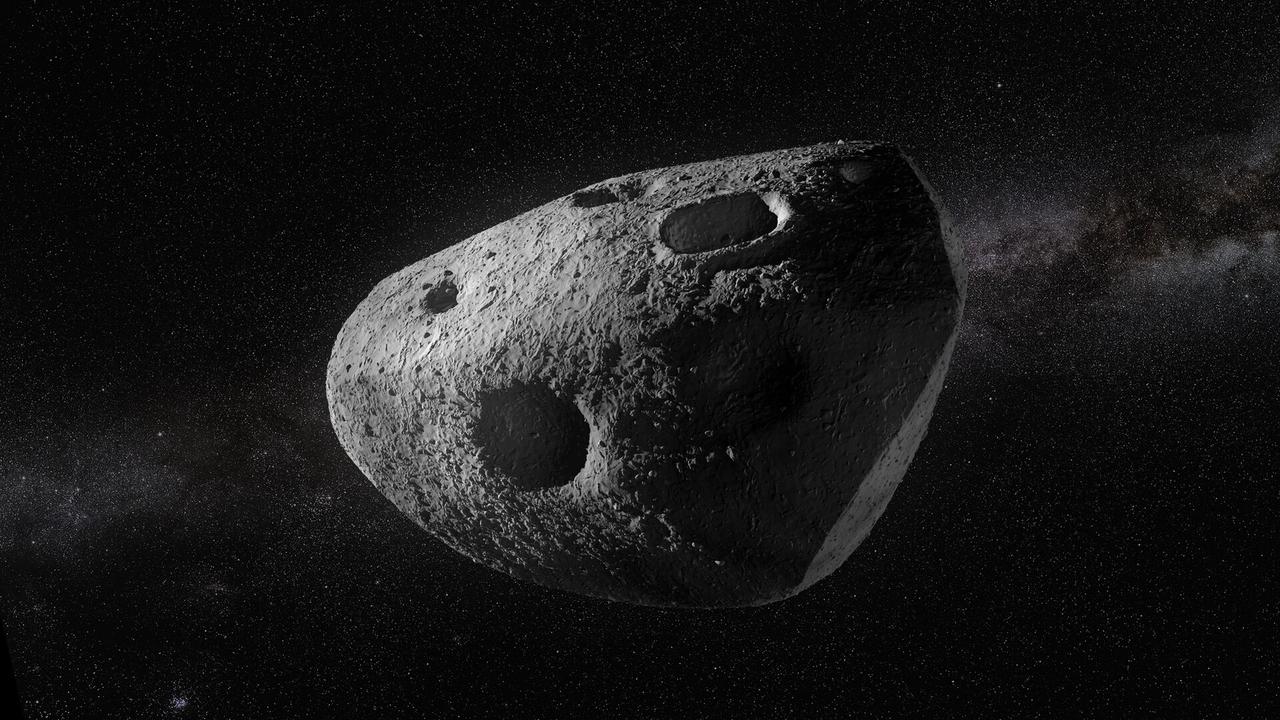
99942 Apofis
99942 Apophis, officially designated as (99942) Apophis, is a celestial body classified among Near-Earth Objects (NEOs) and considered a Potentially Hazardous Asteroid (PHA). First discovered on 19 June 2004 at the Kitt Peak Observatory, Apophis has been the subject of detailed astrometric and dynamical studies due to its orbital characteristics and close approaches to Earth.
99942 Apophis was discovered in 2004 by F. Bernardi, D. J. Tholen and R. A. Tucker. The asteroid is classified within the Aten group of asteroids due to its semi-major axis being less than 1 AU. It also meets the criteria for a Potentially Hazardous Asteroid (PHA) based on its absolute magnitude and proximity to Earth’s orbit.
The absolute magnitude (H) of Apophis has been estimated using various methods, with values reported in the literature ranging from 18.9 to 19.7. Based on these values and accepted albedo coefficients, the asteroid’s diameter is estimated to be approximately 0.3–0.46 km. Its rotation period has been determined to be approximately 30.4 hours.
The orbit of Apophis has been calculated using high-precision optical and radar observations. Its semi-major axis is approximately 0.92 AU, its eccentricity approximately 0.19, and its orbital inclination approximately 3.3°.【1】 In addition to gravitational perturbations, non-gravitational effects such as the Yarkovsky effect have been taken into account in orbital computations.

Orbit of the Apophis Asteroid (ESA)
It has been calculated that Apophis will make an extremely close approach to Earth on 13 April 2029. During this encounter, the asteroid is predicted to pass at a minimum distance of approximately 38,000 km from Earth’s center. This distance lies below the altitude of geostationary satellites and constitutes a dynamically significant close approach without any risk of impact.
Following the 2029 close approach, Apophis’s orbit may exhibit chaotic behavior, where small uncertainties in its trajectory could significantly influence future close approaches. As a result, very low-probability impact scenarios for 2036 and subsequent years have been evaluated in the literature.
Since its discovery, Apophis has been monitored by numerous ground-based observatories, with optical and radar observations submitted to the Minor Planet Center database. Orbital computations have employed the ORBFIT software, as well as the NEODyS and JPL systems, comparing different weighting schemes and error models. These studies have demonstrated the critical importance of new observations in reducing orbital uncertainties.
[1]
I Wlodarczyk,“The Potentially Dangerous Asteroid (99942) Apophis,” Monthly Notices of the Royal Astronomical Society 434, no. 4 (2013): syf 3056, https://academic.oup.com/mnras/article-pdf/434/4/3055/18498065/stt1227.pdf

99942 Apofis
Discovery and Classification
Physical Characteristics
Orbital Characteristics
Close Approaches to Earth
2029 Close Approach
Orbital Evolution After 2029
Observational and Dynamical Studies