

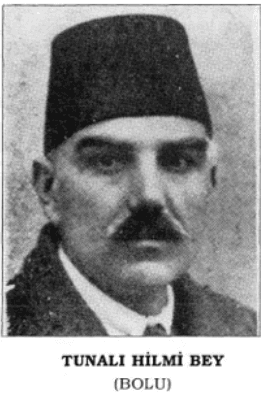
+2 More

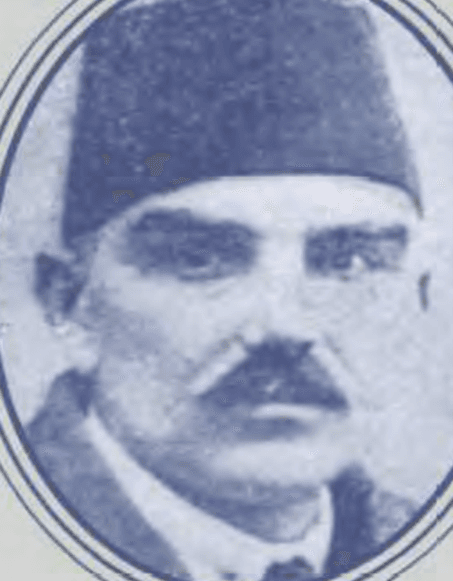
Abdullah Hilmi Tunalı (Tunalı Hilmi Bey)
Birth-Death | 28 August 1871, Eski Cuma (Targovişte) – 26 July 1928, Ankara | ||||||||
|---|---|---|---|---|---|---|---|---|---|
Education | Gülhane Military Medical School (incomplete) University of Geneva Law and Pedagogy | ||||||||
Political Positions | Deputyship of Bolu (1919, 1920) and Zonguldak (1921, 1923), Misak-ı Milli, Karadeniz Ereğlisi resistance (1920) | ||||||||
Administrative Duties | District governorships of Karadeniz Ereğlisi, Bayburt, Ordu, Mosul, Scutari; Directorate of Emigrants | ||||||||
Social Activities | Karadeniz Ereğlisi Marriage Association, Anti-Alcohol Association, Bayburt Muslims Do Not Marry Outside Their Faith Association | ||||||||
Suggestions | Simplification of Turkish, compulsory primary education, women's right to vote, workers' rights, cooperatives, village federations | ||||||||
Works | Macedonia (1898), Memiş Çavuş (1923), Hutbeler (1895), Education in Europe (1903) | ||||||||
Award(s) | Red-green striped Independence Medal (1924) | ||||||||
Abdullah Hilmi Tunalı, known as Tunalı Hilmi Bey, gained prominence during the transition from the late Ottoman Empire to the early years of the Republic through his political and social activities. Born on 28 August 1871 in the town of Eski Cuma (Targovişte) in Bulgaria, then part of the Ottoman territories, Tunalı Hilmi migrated with his family to Istanbul after the 1877–78 Russo-Turkish War, began his education in Üsküdar, and became involved in political activities by joining the Young Turk movement at the Gülhane Military Medical School. In 1895, before completing his medical studies, he traveled to Geneva to pursue education in law and pedagogy, published oppositional writings against the Ottoman regime, and joined the Committee of Union and Progress. After the Second Constitutional Era, he returned to the homeland and served as district governor and civil inspector in regions such as Karadeniz Ereğli, Bayburt, Ordu, and Mosul, establishing societies to address social issues. In 1919 he was elected as a deputy for Bolu and later for Bolu and Zonguldak in the First, Second, and Third Terms of the Grand National Assembly of Türkiye, where he proposed reforms on the simplification of Turkish, women’s rights, workers’ rights, educational reform, and peasant issues. In 1920 he organized resistance against the French occupation in Karadeniz Ereğli, received the Independence Medal in 1924, and died on 26 July 1928 from tuberculosis. His writings and parliamentary activities placed him at the heart of the transition from the Ottoman Empire to the Republic.
Tunalı Hilmi Bey was born on 28 August 1871 in the town of Eski Cuma (Targovişte) in Bulgaria, then under Ottoman rule. His father, İsmail Hakkı Efendi, was a tobacco factory owner and an expert in the state tobacco monopoly; his mother, Rukiye Hanım, came from the Hacı Abdullah family. He had three brothers named Fehmi, Şükrü, and Faik. During the 1877–78 Russo-Turkish War, he migrated with his family to Üsküdar in Istanbul. Due to his father’s bankruptcy and subsequent entry into civil service, he lived in various cities in Anatolia. He completed primary school at Üsküdar İptidai Mektebi, secondary school at Adana, Kastamonu, and Istanbul Fatih Askeri Rüştiyesi, and high school at Kuleli Askeri Tıbbiye İdadisi. In 1885 he entered the Military Medical School. In his final year, he was placed under surveillance after publishing a handwritten newspaper called Teşvik, which was submitted to the Imperial Council; however, no action was taken due to lack of evidence. At the Medical School, he founded the Gizli Mektepliler Cemiyeti and joined the Young Turk movement. In 1895, before completing his medical studies, he went to Geneva to express his ideas. He completed his higher education by studying law and pedagogy at the University of Geneva.
In Geneva he married Swiss citizen Juliette Hanım (who later changed her name to Hürriyet after the Second Constitutional Era); they had two children named Sevda and İnsan. During his exile, he continued his activities against the regime of Sultan Abdülhamid II. On 21 December 1896, together with Abdullah Cevdet and İshak Sükûti, he founded the Osmanlı İhtilal Komitesi and launched the newspaper Osmanlı. In its pages, he published Turkish nationalist, nationalist, and republican articles calling on the public to rise against despotism. On 22 October 1895, he published eleven brochures titled Hutbeler, outlining the goals of the Young Turks. Following the temporary agreement between the Young Turks and Sultan Abdülhamid II, he was appointed in 1900 as the Turkish Secretary at the Ottoman Embassy in Madrid, but his political activities led to his dismissal on 25 April 1901. He was sent by the Committee of Union and Progress as an inspector to Egypt, where he reorganized the Cairo branch and launched the newspaper Hak. In Cairo he taught Turkish to children of the Khedival family and Turkish families, wrote articles for the newspapers Kanun-ı Esasi and Hak, and earned his living by working in various courts.
With the proclamation of the Second Constitutional Era and the deposition of Sultan Abdülhamid II in 1909, he returned to Istanbul. On 1 September 1909 he became district governor of Karadeniz Ereğli. There he abolished the petition system to reduce bureaucracy and founded the Karadeniz Ereğlisi Evlendiriciler Cemiyeti to discourage early marriages and excessive wedding expenses. On 8 December 1909 he established the Karadeniz Ereğlisi Osmanlı İçki Düşmanları Cemiyeti; the society published its bylaws in the journal Sırat-ı Müstakîm in June 1910 to protect children from harmful habits. Between 1911 and 1913 he served as district governor in Silivri, Bayburt, and Ordu. In Bayburt he founded the Müslüman Dilendirmezler Cemiyeti to help the poor find employment instead of becoming professional scribes. In 1913 he was appointed civil inspector to Mosul, in 1914 to İşkodra, in 1915 to Gemlik as district governor, and in 1916 to the General Directorate of Emigrants’ External Deployment. In this role, he traveled throughout Anatolia to organize the conditions of those who had migrated to Türkiye due to the war.
In 1919 he was elected as a deputy for Bolu as a candidate of the Society for the Defense of the Rights of Anatolia and Rumelia. In the last Ottoman Chamber of Deputies, he became a member of the Layiha Encümeni, worked with the Müdafaa-i Hukuk Grubu, and contributed to the adoption of the Misak-ı Millî. Following the Allied occupation of Istanbul on 16 March 1920 and the closure of the Chamber, Mustafa Kemal Paşa’s circular of 19 March 1920 called for the convening of a new assembly in Ankara. Tunalı Hilmi arrived in Ankara on 27 April 1920 and joined the First Term of the Grand National Assembly of Türkiye. He traveled to Bolu to suppress internal uprisings. On 8 June 1920, in response to the French attempt to occupy Karadeniz Ereğli, he organized the Kuva-yı Milliye under Mustafa Kemal’s orders and repelled the French forces on 18 June 1920. For this, he received the red-and-green striped İstiklal Madalyası on 21 June 1924.
In the First Term of the Grand National Assembly of Türkiye, he served on the İrşad, Milli Eğitim, İktisat, Sağlık-Sosyal Yardım, and Tasarı Komisyonları. He proposed seventeen laws, including numbering laws, the adoption of the Milli Marş by parliamentary decision, and the removal of honorific titles and excessive expressions of respect in official addresses. He delivered 295 speeches on Turkish nationalism and nationalism, 39 of which were in closed sessions, and submitted 50 parliamentary questions. In the Second Term of the Grand National Assembly of Türkiye (1921), he was elected deputy for Zonguldak; he worked on the İrşad, Diyanet ve Evkaf, Mübadele, İmar ve İskân, Kanun-ı Esasi Encümenleri. He became a member of the Republican People’s Party and continued his parliamentary service for Zonguldak in the Third Term.
Tunalı Hilmi advocated for the simplification of the Turkish language. During the debates over relocating the Assembly to Kayseri amid the Kütahya-Eskişehir battles in 1921, he emphasized that for a nation to be independent, its language must also be independent. He proposed the Turkification of terminology and school textbooks, the denial of publication permits to newspapers and journals that did not conform to pure Turkish, and strict adherence to spelling rules in official correspondence. To expand education, he called for compulsory primary education, the establishment of printing presses, the distribution of teaching materials, and a significant allocation of the budget to education. He proposed opening art workshops, conservatories, and theaters to promote artistic education.
Tunalı Hilmi was the first deputy to bring women’s rights to the Grand National Assembly of Türkiye. During discussions on the Köy ve Bucak Yönetimi Kanun Tasarısı on 15 November 1921, he proposed granting women the right to vote in villages due to the shortage of male population, but the proposal was rejected. On 3 April 1923, during debates on the electoral law, he argued that women should be counted in population statistics, but this too was not accepted. On workers’ rights, he raised the plight of railway workers on the Ankara-Sivas line and called for the enactment of a Mesai Kanunu. Motivated by the case of a worker who lost both eyes in a factory accident, he demanded preventive measures against workplace accidents, solutions to the nutritional problems of female workers, and the cessation of the practice of dismissing and rehiring workers every two years to avoid wage increases. He proposed opening an art school at the shipyard to provide education to 500 orphaned children.
Tunalı Hilmi addressed peasant issues in his work Memiş Çavuş. He proposed the establishment of cooperatives, the merging of villages into federations, and improved access to roads, schools, and health services. He suggested the nationalization of coal mines, implementation of public health programs, campaigns against syphilis, improvement of prison conditions, aid to families of martyrs, inclusion of child care lessons in education, translation of Arabic tafsirs into Turkish, making New Year’s Day an official holiday, and preventive measures against automobile accidents. Most of his proposals were rejected due to the conditions of the period.
Tunalı Hilmi’s works reflect his ideas during his exile and parliamentary years: Makedonya: Mazisi, Hali, İstikbali (1898), Peşte’den Reşit Efendi ile (1899), Rezalet Portekiz’de (1900), Rezalet Yine İspanya’da (1900), Kongre-Cevapları, Cevabımız (1901), Kongre Nedir, Nasıl Olmalıdır? (1901), Avrupa’da Tahsil (1903), Osmanlı’da Ahali Hekimliği (1906), and Memiş Çavuş Büyük Millet Meclisinde (1923). He struggled with tuberculosis, traveled to Europe for treatment in 1927, but did not recover. He was hospitalized on Büyükada and died on 26 July 1928. He was initially buried in Istanbul’s Maçka Cemetery and later reinterred in Ankara’s Cebeci Asri Cemetery.
Kılıç, Fahri. “A. Tunalı Hilmi Bey (1871-1928).” *Atatürk Ansiklopedisi*. Accessed May 30, 2025. https://ataturkansiklopedisi.gov.tr/detay/1908/A.-Tunal%C4%B1-Hilmi-Bey-(1871-1928).
“Tunalı Hilmi.” Ordu Kültür ve Turizm Bakanlığı. Accessed May 30, 2025.

Abdullah Hilmi Tunalı (Tunalı Hilmi Bey)
Birth-Death | 28 August 1871, Eski Cuma (Targovişte) – 26 July 1928, Ankara | ||||||||
|---|---|---|---|---|---|---|---|---|---|
Education | Gülhane Military Medical School (incomplete) University of Geneva Law and Pedagogy | ||||||||
Political Positions | Deputyship of Bolu (1919, 1920) and Zonguldak (1921, 1923), Misak-ı Milli, Karadeniz Ereğlisi resistance (1920) | ||||||||
Administrative Duties | District governorships of Karadeniz Ereğlisi, Bayburt, Ordu, Mosul, Scutari; Directorate of Emigrants | ||||||||
Social Activities | Karadeniz Ereğlisi Marriage Association, Anti-Alcohol Association, Bayburt Muslims Do Not Marry Outside Their Faith Association | ||||||||
Suggestions | Simplification of Turkish, compulsory primary education, women's right to vote, workers' rights, cooperatives, village federations | ||||||||
Works | Macedonia (1898), Memiş Çavuş (1923), Hutbeler (1895), Education in Europe (1903) | ||||||||
Award(s) | Red-green striped Independence Medal (1924) | ||||||||
No Discussion Added Yet
Start discussion for "Abdullah Hilmi Tunalı (Tunalı Hilmi Bey)" article
Early Life and Education
Exile Years and Young Turk Activities
Second Constitutional Era and Administrative Roles
Political Career and National Struggle
Turkish Language and Educational Reforms
Women’s and Workers’ Rights
Peasant Issues and Social Reforms
Works and Final Years