This article was automatically translated from the original Turkish version.
+4 More
Basic Objectives | Energy Efficiency, Indoor Comfort, Sustainability | ||||||||
|---|---|---|---|---|---|---|---|---|---|
Working Principle | Adaptation through Mechanical Systems (Motor, Pneumatic) or Smart Materials (SMA, Thermochromic Glass) | ||||||||
Important Examples | Al Bahr Towers, Arab World Institute, Esplanade Theatre | ||||||||
Adaptive façade systems are advanced façade types that form the outer envelope of buildings and dynamically respond to changing external environmental conditions, user demands, or both. Unlike traditional static façades, these systems aim to optimize building energy performance, enhance interior comfort, and contribute to sustainability goals by altering their properties or behaviors in real time according to immediate requirements.
The increasing global energy demand, limited availability of fossil fuels, and climate change have necessitated the development of energy-efficient and environmentally sensitive solutions in the construction sector. Traditional façades are typically designed for the most extreme climatic conditions and therefore often fail to achieve optimal performance for much of the year. Adaptive façades have emerged as a solution to this issue, reducing energy consumption and improving user comfort by responding in real time to environmental data such as sunlight, temperature, and wind through sensors, smart materials, and mechanical systems.

Adaptive Façade (Generated by Artificial Intelligence)
The dynamic behavior of adaptive façades is primarily achieved through two main approaches: components moved by mechanical systems or smart materials that directly respond to environmental stimuli. These approaches can be categorized into systems incorporating different technologies. Academic studies classify these systems into five main categories based on their operating mechanisms: hydraulic, pneumatic, motor-based, material-based, and energy-generating systems.
Motor-Based Systems: These systems control movable components on the façade—such as sunshades, panels, and louvers—using electric motors. Operating on data from sensors, they precisely manage daylight and solar heat gain. The most common adaptive façade applications fall into this category. The sun-tracking, opening-and-closing "mashrabia"-like shading elements on the Al Bahr Towers in Abu Dhabi are well-known examples of motor-based systems.
Hydraulic and Pneumatic Systems: In these systems, movement is achieved through liquid or air pressure, respectively. They are particularly suitable for actuating large and heavy façade elements. The south façade of the Institut du Monde Arabe in Paris, designed by architect Jean Nouvel, is an example of this type. Thousands of mechanical diaphragms on the façade open and close via an electro-pneumatic system in response to the intensity of daylight, regulating the amount of light entering the interior.
Material-Based Systems (Smart Materials): These façades respond to environmental changes through the intrinsic properties of the materials themselves, without requiring external mechanical intervention. This approach offers lower maintenance requirements and more integrated solutions.
Shape Memory Alloys (SMA): Alloys such as nickel-titanium (Nitinol) have the ability to return to a pre-determined shape in response to temperature changes. These materials can create passive movement mechanisms in façades, enabling the automatic operation of sunshades or ventilation openings.
Thermochromic and Photchromic Materials: These materials change color or transparency in response to temperature and light intensity, respectively. Thermochromic glass becomes opaque when a specific temperature is reached, reducing solar heat gain, while photchromic glass darkens according to light intensity to control glare.
Energy-Generating Systems: These systems not only adapt to environmental conditions but also generate electricity to meet the building’s energy needs. Building-integrated photovoltaic (BIPV) panels, used as façade cladding materials, provide both an aesthetic appearance and electricity generation from solar energy. These systems enable buildings to become net-zero or energy-positive structures.

Adaptive Façade System (Generated by Artificial Intelligence)
The design of adaptive façade systems requires a performance-based approach beyond aesthetics. Their primary objectives and benefits include:
Adaptive façade technologies have been implemented in numerous buildings worldwide, demonstrating the potential and diversity of these systems.
Al Bahr Towers (Abu Dhabi, UAE): Designed by Aedas Architects, these twin towers feature a kinetic façade inspired by the traditional Arab architectural element known as "mashrabia." More than 2,000 shading modules, each resembling an umbrella, open and close under computer control to track the sun’s movement and protect the building from excessive heat and glare. This system significantly reduces the building’s cooling load.

Kinetic Façade Systems: Smart Shading Application – Al Bahr Towers (Flickr)
Institut du Monde Arabe (Paris, France): Jean Nouvel’s design is one of the exemplary applications of adaptive façades. The façade’s 30,000 light-sensitive metal diaphragms function like a camera lens, automatically regulating the amount of daylight entering the interior. This system provides both a functional solution and defines the building’s aesthetic identity.
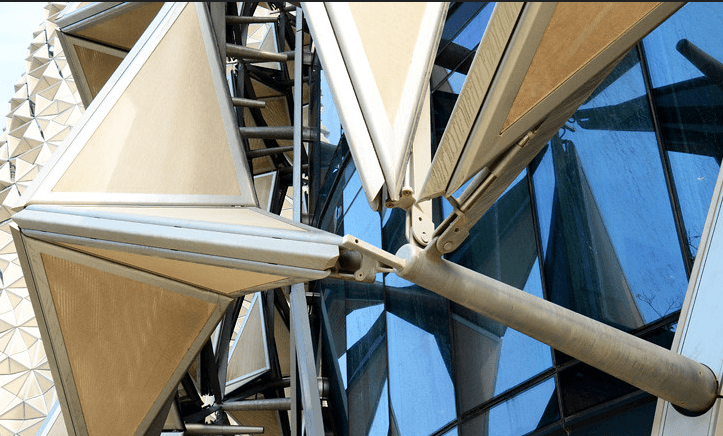
Esplanade Theatre (Singapore): The building’s exterior, resembling a durian fruit, is a complex adaptive system composed of over 7,000 triangular aluminum sunshades. These panels move throughout the day according to the sun’s angle to shield interior spaces from direct sunlight and glare while preserving views to the outside.
Eastgate Shopping Centre (Harare, Zimbabwe): Designed by architect Mick Pearce, this building does not feature a direct mechanical adaptive façade but applies an adaptive principle inspired by biomimicry. Drawing from the passive ventilation and cooling systems of termite mounds, the building’s design drastically reduces the need for mechanical cooling systems, allowing it to adapt passively to environmental conditions.
The field of adaptive façade systems is continuously evolving alongside technological advancements. Future trends in this area are focused on smarter, more integrated, and more efficient solutions. The integration of artificial intelligence and machine learning algorithms will enable façades to make predictive decisions based not only on real-time data but also on historical patterns and forecasts.
3D printing technology enhances design freedom by enabling faster and more cost-effective production of customized façade components with complex geometries. Innovations in materials science—particularly next-generation shape memory alloys, transparent concrete, and more efficient smart glass—will reduce reliance on mechanical systems and deliver more durable and elegant solutions.
Belek, Ayşe Nur, and Rümeysa Yamaçlı. “Adaptif Cephe Sistemlerinin Sürdürülebilir Tasarım Kriterlerine Yönelik Tasarım Çözümleri.” *ArtGRID - Journal of Architecture Engineering and Fine Arts* 5, no. 2 (2023): 216–239. Accessed July 26, 2025. https://doi.org/10.57165/artgrid.1357657
EkoYapı. "Cephelerde Yenilikçi Yaklaşımlar ve Sürdürülebilir Çözümler." EkoYapı Dergisi. Accessed July 26, 2025. https://www.ekoyapidergisi.org/cephelerde-yenilikci-yaklasimlar-ve-surdurulebilir-cozumler.
EkoYapı. "Sürdürülebilir Mimaride Cephe Sistemleri." EkoYapı Dergisi. Accessed July 26, 2025. https://www.ekoyapidergisi.org/surdurulebilir-mimaride-cephe-sistemleri.
Flickr. "Al Bahr Towers by AEDAS JPG." Accessed July 26, 2025. https://flic.kr/p/jMFq4U
Flickr. “Al Bahar Towers - Responsive Facade JPG.” Flickr. Accessed July 26, 2025. https://flic.kr/p/ezQiGU
Okumuş, Emine Merve. “Sürdürülebilir Mimarlık Kapsamında Akıllı Cephe Sistemlerinin İncelenmesi.” *8th International Symposium on Innovative Technologies in Engineering and Science (ISITES2020)*, October 23–25, 2020. Accessed July 26, 2025. https://doi.org/10.33793/ACPERPRO.03.01.54.
Taş, İrem Nur, and Filiz Şenkal Sezer. “Adaptif Cepheler ve Çalışma Mekanizmalarına Göre Adaptif Cephe Sistemlerinin Örnekler Üzerinden İncelenmesi.” *KAPU Trakya Journal of Architecture and Design* 4, no. 1 (2024): 63–82. Accessed July 26, 2025. Accessed adresi
Yapı Magazin. “Adaptif Cephe Sistemlerinin Geleceği ve Gelişen Teknolojileri Sürdürülebilirlik ve Enerji Verimliliğine Katkı Sunuyor.” *İNŞAAT, MİMARLIK, MALZEME, YAPI TEKNOLOJİLERİ DERGİSİ.* Accessed July 26, 2025. https://www.yapimagazin.com/adaptif-cephe-sistemlerinin-gelecegi-ve-gelisen-teknolojileri-surdurulebilirlik-ve-enerji-verimliligine-katki-sunuyor-5000983.

Basic Objectives | Energy Efficiency, Indoor Comfort, Sustainability | ||||||||
|---|---|---|---|---|---|---|---|---|---|
Working Principle | Adaptation through Mechanical Systems (Motor, Pneumatic) or Smart Materials (SMA, Thermochromic Glass) | ||||||||
Important Examples | Al Bahr Towers, Arab World Institute, Esplanade Theatre | ||||||||
No Discussion Added Yet
Start discussion for "Adaptive Facade Systems" article
Working Principles and Classification
Design Criteria and Advantages
Application Examples
Future Technologies and Trends