


This article was automatically translated from the original Turkish version.
+3 More
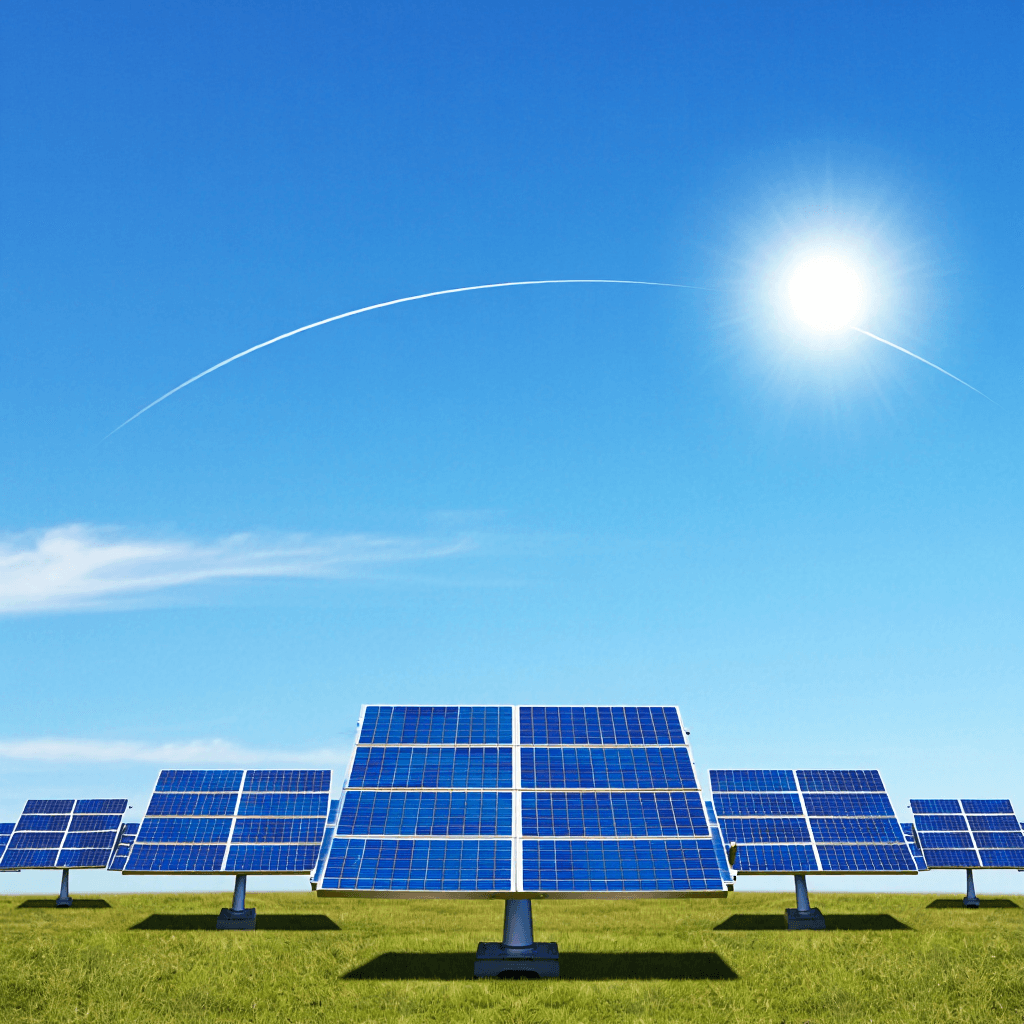
Solar Tracking System (Generated with Artificial Intelligence)
Primary Objective | Increase energy efficiency by keeping solar panels perpendicular to the sun | ||||||||
|---|---|---|---|---|---|---|---|---|---|
Main Type(s) | Single-axis and dual-axis | ||||||||
Control Methods | Passive (sensor-based) and active (astronomical algorithm-based) | ||||||||
Important Algorithm | Backtracking (preventing shading) | ||||||||
Application Area(s) | Solar Power Plants (SPP) Agricultural Irrigation | ||||||||
Solar tracking systems are setups composed of mechanical and electronic infrastructure that position photovoltaic (PV) panels to follow the sun’s movement across the sky throughout the day. The primary function of these systems is to ensure that sunlight strikes the panel surface at as close to a perpendicular angle as possible, thereby maximizing the electricity generation capacity of the photovoltaic cells.
Compared to fixed-tilt panel systems, solar tracking systems enable panels to maintain an optimal angle during different hours of the day and across various seasons of the year. As a result, energy production can increase by an average of 15% to 40%, depending on geographic latitude, local climatic conditions, and the type of tracking system used. Single-axis systems allow panels to follow the sun from east to west, while dual-axis systems can move in both horizontal and vertical planes, enabling more precise tracking of the sun’s daily and seasonal position changes.
This increase in energy production offers significant economic advantages, particularly in large-scale solar power plants (GES) installed over extensive areas. Higher production capacity shortens the payback period of the investment while also enhancing energy supply reliability. Moreover, these systems facilitate more efficient use of renewable energy sources, supporting global sustainability goals.
Although solar tracking technologies have higher installation costs compared to fixed systems, they are preferred due to the increased energy output they deliver over the long term. Consequently, they are now widely used, especially in ground-mounted solar plants and projects where high efficiency is prioritized.
The working principle of solar tracking systems is based on determining the sun’s position throughout the day and orienting photovoltaic panels accordingly. This ensures that panels receive the maximum possible solar radiation from sunrise to sunset. This method reduces efficiency losses observed in fixed-angle systems and maintains higher and more consistent energy production throughout the day. Solar tracking technology consists of three complementary main components that perform this function: mechanical support structures, moving mechanisms, and control systems.
This component serves as the structural framework that securely holds and moves the panels. It is typically manufactured from durable and corrosion-resistant materials such as hot-dip galvanized steel or aluminum. During the design phase, environmental factors such as wind speed, snow load, and seismic characteristics of the installation site are taken into account. This ensures the structure remains stable under prolonged outdoor conditions. In some advanced systems, spherical joints with three degrees of freedom are used to adapt to sloped or uneven terrain. Such designs facilitate optimal panel orientation under all conditions.
These consist of motors and actuators that physically move the panels in accordance with the sun’s position. Linear actuators operating at 24V DC are most commonly preferred. These actuators adjust the tilt angles of the panels based on commands received from the control unit. In single-axis systems, panels move in an east-west direction, while in dual-axis systems, movement is possible along both horizontal and vertical axes. The durability of the moving mechanism is a critical factor for system reliability. Therefore, bearing systems that reduce mechanical friction and weather-protected motor designs are widely employed.
The control system, one of the most fundamental components of a solar tracking system, processes data from sensors or computational algorithms and sends commands to the motors. This system can determine the sun’s position using two distinct methods: sensor-based tracking or astronomical algorithm-based calculation. In sensor-based methods, photodiodes or light-sensitive sensors placed on different parts of the panel detect which direction receives the highest irradiance and direct the mechanism accordingly. In algorithm-based systems, the sun’s angular position in the sky is calculated using geographic location, date, and time data. More advanced control systems can also consider cloud cover, wind speed, and temperature values to reposition panels for safety purposes. This ensures both energy production efficiency and the long-term durability of the system.
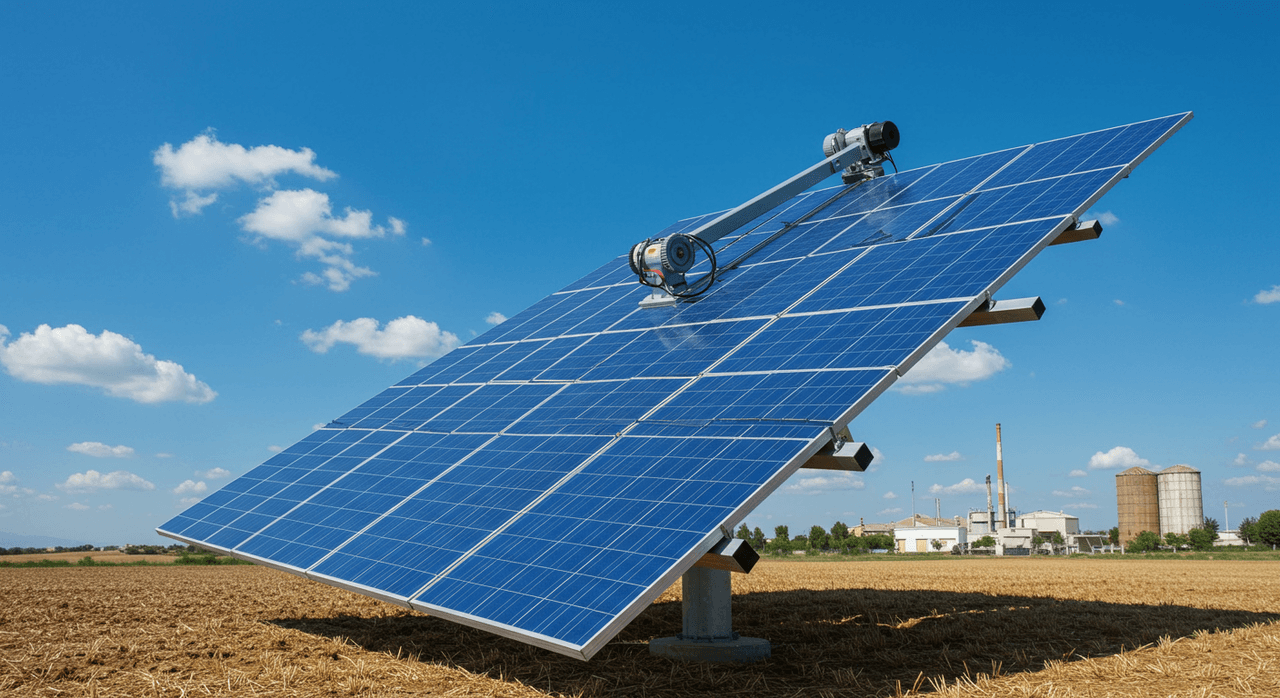
Solar Tracking Systems (Generated by Artificial Intelligence)
Solar tracking systems are mechanical and electronic arrangements designed to enable photovoltaic panels to capture sunlight with maximum efficiency. These systems are classified primarily based on their mobility capabilities and the control methods they employ. Classification criteria directly influence the systems’ efficiency levels, cost structures, and technical complexity. Therefore, the choice of system type depends on the geographic location, project scale, and economic feasibility.
These systems allow panels to rotate around a single axis. The most common configuration follows the sun’s daily east-to-west movement. An alternative application involves systems aligned along a north-south axis that compensate for seasonal variations in solar elevation. Single-axis systems can increase energy production by approximately 15% to 25% compared to fixed-angle systems. Due to their simpler mechanical structure, lower cost, and reduced maintenance requirements, they are widely preferred in large-scale projects. They are particularly prominent as a standard solution in ground-mounted solar power plants.
Dual-axis systems allow panels to move along both east-west and north-south axes. This dual-axis mobility enables panels to remain perfectly perpendicular to the sun at all times of the day and throughout the year. As a result, efficiency gains of 30% to 40% compared to fixed systems can be achieved. However, these systems require more complex mechanical structures, numerous moving components, and advanced control algorithms, resulting in higher installation and maintenance costs. Due to these characteristics, they are typically used in regions with high and valuable solar irradiance or in specialized projects where maximum efficiency is critical.
Passive systems directly detect the sun’s position using physical sensors. Typically, light-sensitive resistors (LDRs) or similar sensors are placed on different areas of the panel to measure differences in light intensity. The panels are then rotated toward the direction receiving the most light. This method operates on a closed-loop principle and provides simpler algorithmic solutions. However, measurement errors may occur under cloudy conditions, reflective lighting, or when sensor surfaces become dirty, potentially causing occasional instability in system behavior.
Active systems determine the sun’s position using astronomical calculation algorithms instead of sensors. These systems operate on an open-loop principle. Using geographic coordinates (latitude and longitude) entered during setup and real-time time data obtained via the internet or GPS, the sun’s angular position throughout the day is precisely calculated. Motors are then commanded to orient the panels to the correct angle. Because they are unaffected by external weather conditions such as cloud cover, rain, or fog, active systems are significantly more reliable and accurate than passive systems. They are widely preferred in large-scale solar power plants where efficiency and continuity are essential requirements.
Modern solar tracking systems are supported not only by mechanical mobility but also by embedded software solutions, control algorithms, and remote monitoring infrastructure. These advanced technologies ensure that systems maximize energy production efficiency while maintaining long-term reliability.
In large-scale solar power plants using closely spaced panel rows, morning and evening sunlight, which strikes the horizon at low angles, can cause front rows to cast shadows on rear rows. This results in significant production losses across the plant. The backtracking algorithm has been developed to mitigate this shading issue. The algorithm calculates the sun’s horizontal angle and elevation and, instead of positioning panels at the absolute optimal angle, slightly reorients them when shading risk is detected. This prevents inter-row shading and achieves a more balanced energy distribution. In particular, under uneven terrain conditions, this method can increase total energy yield by up to 4%.
The control mechanisms of solar tracking systems are typically managed by embedded software developed in programming languages such as C++. These software programs process data from on-site sensors and motors to coordinate panel movement. Additionally, systems can integrate with SCADA (Supervisory Control and Data Acquisition) infrastructure. Through this integration, facility managers can view real-time production values, monitor operational status, and receive SMS or email alerts for potential faults or anomalies via web-based dashboards or mobile applications. Remote access enables not only monitoring but also control functions; operators can modify system parameters, apply software updates, and optimize maintenance schedules. This infrastructure also facilitates the analysis of inverter data, generation of performance reports, and evaluation of long-term production trends.
Advanced solar tracking solutions do not rely solely on astronomical algorithms for position calculation. Instead, they use real-time production data—particularly from inverters—as feedback. This approach allows the control system to consider not only the theoretical position of the sun but also the actual power output generated by the panels at any given moment. Based on this data, small but critical adjustments are made to the tracking angle. As a result, the system continuously optimizes itself to achieve maximum production efficiency even under transient conditions such as cloud passages or reflection effects. This approach ensures continuous improvement in energy production and shortens the economic payback period, especially in high-capacity plants.
Solar tracking systems attract attention not only through increased energy production but also through enhanced system safety, ease of maintenance, and adaptability to environmental conditions. These features increase the long-term economic efficiency of the systems and contribute to sustainable energy production.
The most significant advantage of tracking systems is their ability to generate substantially more electricity than fixed-angle systems. By ensuring that sunlight strikes the panel surface at a near-perpendicular angle for most of the day, higher energy density is achieved on a given land area. This not only shortens the investment payback period but also reduces the number of panels required to produce the same amount of energy. Consequently, land use becomes more efficient and contributes to optimizing investment costs in large-scale projects.
Modern solar tracking systems are equipped with protective features against adverse weather conditions. Through wind sensors, the system continuously monitors wind speed. When wind speed exceeds a predefined safety threshold (e.g., 130 km/h), the panels automatically rotate to a horizontal (stow) position to minimize exposure to wind forces. This practice significantly reduces the risk of structural damage during extreme weather. Similarly, during storms or hail events, automatic repositioning of panels contributes to the long-term durability of the system.
In regions with heavy snowfall, accumulated snow on panels can lead to energy production losses. Solar tracking systems offer solutions to this problem. Through programming or sensor feedback, panels can be tilted to a vertical position, allowing snow to slide off naturally. This feature prevents production losses during winter months and enhances energy continuity. Additionally, some systems automatically switch to a cleaning mode during rainfall, facilitating the washing of panel surfaces by rainwater. This function helps keep panels cleaner and improves their ability to absorb sunlight efficiently.
New-generation solar tracking systems can be installed more rapidly thanks to modular and user-friendly designs developed by manufacturers. Reducing the number of components shortens on-site assembly time and simplifies logistics. Maintenance requirements are also minimized. For instance, self-lubricating joint materials eliminate the need for regular lubrication, while semiconductor-based control electronics enhance system durability and reliability. These features provide more sustainable usage with lower operational costs over the long term.
As technologies designed to enhance energy efficiency, solar tracking systems are primarily used in projects where high production capacity is critical. The most common application is in large-scale ground-mounted solar power plants (GES) installed over vast areas. In such plants, the efficiency gains provided by tracking systems help offset high initial investment costs and create long-term economic appeal. Tracking systems enable hundreds or thousands of panels spread over large areas to follow the sun at optimal angles throughout the day, significantly increasing total production capacity.
In addition to GES applications, these systems are also utilized in agricultural activities. Particularly in solar-powered irrigation systems, tracking systems are preferred to ensure continuous and high-efficiency operation of water pumps. This application enhances energy efficiency and supports sustainable farming practices by reducing dependence on fossil fuels.
Conversely, the use of solar tracking systems is limited in non-reinforced concrete rooftop applications. The additional load imposed by moving mechanisms, installation complexity, and maintenance difficulties make such applications economically unviable. Therefore, tracking systems are primarily preferred in projects installed on the ground or supported by structurally robust frameworks.
From a cost perspective, solar tracking systems increase the initial investment compared to fixed-angle systems. A single-axis tracking system can raise the total project cost by approximately 5% to 15%. In dual-axis systems, this increase is even greater due to the higher number of mechanical and electronic components and the complexity of the control infrastructure. Nevertheless, the additional energy production they deliver typically makes these systems economically advantageous. The extra energy generated over the system’s lifetime shortens the payback period and increases overall profitability. In regions with high electricity sale prices or in off-grid projects, the economic value of solar tracking systems becomes even more pronounced.
Harazin, Jacek, and Andrzej Wróbel. “Analysis and Study of the Potential Increase in Energy Output Generated by Prototype Solar Tracking, Roof Mounted Solar Panels.” *F1000Research* 9 (July 18, 2022): 1381. doi:10.12688/f1000research.27641.2. Accessed August 25, 2025. https://www.researchgate.net/publication/362098692_Analysis_and_study_of_the_potential_increase_in_energy_output_generated_by_prototype_solar_tracking_roof_mounted_solar_panels
Kofoworola, Adewumi, Adejumo Ezekiel, Abiodun Joshua, Oyetunji Oluwapelumi, Hakeem Oyeshola, and Oladimeji Azeez. “Solar Tracking Device for Photovoltaic Solar Energy System: A Review.” *OALib* 12 (January 1, 2025): 1–25. doi:10.4236/oalib.1113070. Accessed August 25, 2025. https://www.researchgate.net/publication/390227254_Solar_Tracking_Device_for_Photovoltaic_Solar_Energy_System_A_Review
Kuttybay, Nurzhigit, Saad Mekhilef, Nursultan Koshkarbay, Ahmet Saymbetov, Madiyar Nurgaliyev, Gulbakhar Dosymbetova, Sayat Orynbassar, Evan Yershov, Ainur Kapparova, Batyrbek Zholamanov, and Askhat Bolatbek. “Assessment of Solar Tracking Systems: A Comprehensive Review.” *Sustainable Energy Technologies and Assessments* 68 (2024): 103879. doi:10.1016/j.seta.2024.103879. Accessed August 25, 2025. https://www.sciencedirect.com/science/article/pii/S2213138824002753
Maiga, Aboubacarine. “Theoretical Comparative Energy Efficiency Analysis of Dual Axis Solar Tracking Systems.” *Energy and Power Engineering* 13 (January 1, 2021): 448–82. doi:10.4236/epe.2021.1312031. Accessed August 25, 2025. https://www.researchgate.net/publication/357421326_Theoretical_Comparative_Energy_Efficiency_Analysis_of_Dual_Axis_Solar_Tracking_Systems
Patel, M. Tahir, M. Sojib Ahmed, Hassan Imran, Nauman Z. Butt, M. Ryyan Khan, and Muhammad A. Alam. “Optimum Design of Tracking Bifacial Solar Farms – A Comprehensive Global Analysis of Next-Generation PV.” arXiv, 2020. doi:10.48550/arXiv.2011.01276. Accessed August 25, 2025. https://arxiv.org/abs/2011.01276
Talavera, D. L., Emilio Muñoz-Cerón, J. P. Ferrer-Rodríguez, and Pedro J. Pérez-Higueras. “Assessment of Cost-Competitiveness and Profitability of Fixed and Tracking Photovoltaic Systems: The Case of Five Specific Sites.” *Renewable Energy* 134 (2019): 902–13. doi:10.1016/j.renene.2018.11.091. Accessed August 25, 2025. https://www.sciencedirect.com/science/article/pii/S0960148118314101


Solar Tracking System (Generated with Artificial Intelligence)
Primary Objective | Increase energy efficiency by keeping solar panels perpendicular to the sun | ||||||||
|---|---|---|---|---|---|---|---|---|---|
Main Type(s) | Single-axis and dual-axis | ||||||||
Control Methods | Passive (sensor-based) and active (astronomical algorithm-based) | ||||||||
Important Algorithm | Backtracking (preventing shading) | ||||||||
Application Area(s) | Solar Power Plants (SPP) Agricultural Irrigation | ||||||||
No Discussion Added Yet
Start discussion for "Solar Tracking Systems" article
Working Principle and Components
Mechanical Support Structures
Moving Mechanisms
Control System
Types of Solar Tracking Systems
Classification by Number of Axes
Single-Axis Tracking Systems
Dual-Axis Tracking Systems
Classification by Control Method
Passive Controlled Systems
Active Controlled Systems
Technological Features and Algorithms
Backtracking Algorithm
Software and Remote Monitoring
Intelligent Feedback Systems
Advantages and Additional Functions
Energy Production Increase
Protection and Defense Modes
Snow Removal and Maintenance
Installation and Maintenance Ease
Applications