


This article was automatically translated from the original Turkish version.
+4 More
Smart materials are a specially designed class of materials that can dynamically and reversibly alter one or more of their properties in response to changes in external environmental conditions or specific stimuli. Also known as sensitive materials, these substances are capable of controlled changes in their physical or chemical properties, shape, or behavior when exposed to specific triggers such as temperature, light, pressure, humidity, electric fields, or magnetic fields. These changes can occur in mechanical, optical, electrical, magnetic, chemical, or thermal domains. This adaptive capability enables smart materials to respond to external conditions in a manner akin to biological systems. Developed through advances in materials science and engineering, these materials play a fundamental role in sustainable technologies and innovative solutions, offering significant advantages in performance, efficiency, and functionality across diverse sectors including aerospace, automotive, healthcare, construction, and consumer electronics.
Smart materials are categorized into various types based on the nature of the stimulus they respond to or the property they exhibit. This classification facilitates understanding of their potential applications and working principles. Major types include piezoelectric, shape-memory, chromic, and magnetostrictive materials.
Piezoelectric Materials: These are materials that generate an electrical voltage when subjected to mechanical stress or pressure, and conversely, change shape when exposed to an electric field. Due to these properties, they are widely used in sensors, actuators, and energy harvesting devices. They enable precise control and real-time monitoring in medical imaging and diagnostic equipment.
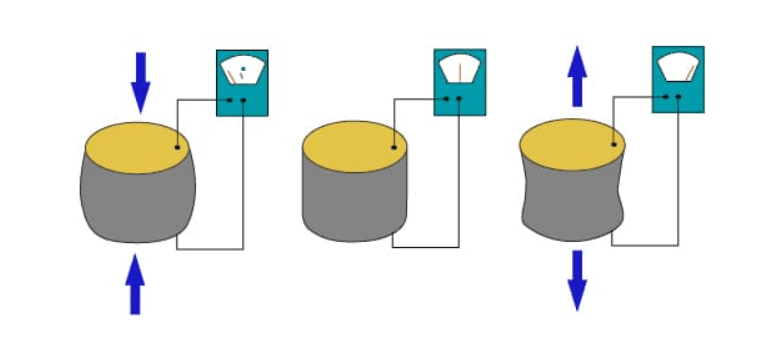
Piezoelectric Material Changing Shape Upon Exposure to Electric Current (Sektorumdergisi)
Shape-Memory Materials: These are materials capable of returning to a previously defined original shape when exposed to a specific temperature or electromagnetic field. The most well-known examples are shape-memory alloys. When deformed and subsequently heated, these materials recover their original form. This property makes them ideal for minimally invasive medical devices such as stents used to open blocked arteries, as well as aerospace applications.
Chromic Materials: These are materials that alter their optical properties—such as color or transparency—in response to an external stimulus. They are subdivided into categories depending on the type of stimulus:
Magnetostrictive Materials: These are materials that change shape when exposed to a magnetic field. This property is utilized in sensor and actuator systems requiring precise motion control.
Photocatalytic Materials: These materials accelerate chemical reactions when exposed to light. They typically contain titanium dioxide nanoparticles. These materials exhibit self-cleaning and air-purifying properties by breaking down dirt, microorganisms, and air pollutants on their surfaces.
Smart materials have the potential to revolutionize numerous industries due to their dynamic and adaptive properties, offering innovative solutions across a broad spectrum from architecture and healthcare to automotive and consumer electronics.
Smart materials are increasingly gaining importance in architecture and construction, particularly in alignment with goals of sustainability and energy efficiency.
Key applications in this field include:
Smart materials are driving significant innovations in healthcare by enhancing the functionality of medical devices and improving patient comfort.
Shape-memory alloys are used in stents that expand at body temperature to open blocked vessels, enabling less invasive procedures. Piezoelectric materials provide precise control in sensors used for medical imaging and diagnostic equipment. In June 2022, engineers at Stanford developed small robots capable of targeted drug delivery, demonstrating the potential of smart materials in precision medicine.
In the automotive industry, smart materials are used to reduce vehicle weight, thereby improving fuel efficiency and lowering emissions. Research indicates that a 10 percent reduction in vehicle mass can lead to fuel consumption savings of 3 to 7 percent. On average, every 100 kg reduction in weight corresponds to approximately 10 grams of CO₂ emissions saved per kilometer. In defense and aerospace sectors, these materials play a critical role in sensors, adaptive structures, and performance-enhancing systems.
Smart materials, when integrated with Industry 4.0 and Internet of Things (IoT) technologies, enable the creation of intelligent systems. Combined with additive manufacturing (3D printing) technologies, they make it possible to produce customized products with complex functionalities. In consumer electronics, they are used in sensors, flexible displays, and energy-harvesting devices.
The smart materials market is experiencing significant growth driven by increasing demand for materials capable of adapting to external stimuli across multiple industries. The global smart materials market size was recorded at $62.45 billion in 2023 and is projected to reach $160.03 billion by 2031, exhibiting a compound annual growth rate (CAGR) of 12.70 percent during this period. Key drivers behind this growth include rising demand for advanced medical devices, increasing awareness of sustainability and energy efficiency, and the widespread adoption of Internet of Things (IoT) technologies. However, high initial costs associated with research, development, and production remain a barrier to market expansion. To overcome this challenge, there is a growing trend toward strategic partnerships among companies, universities, and research institutions. In the future, advancements in nanotechnology are expected to further accelerate innovation in this field by enabling the development of next-generation smart materials precisely engineered for specific tasks.
Ekmekci, Dursun, and Emrah Kaplan. “Potansiyel Olarak Akıllı Malzemeler.” *International Journal of Advanced Natural Sciences and Engineering Researches*, 2023. https://as-proceeding.com/index.php/ijanser/article/view/2350/2277.
EkoYapı Dergisi. “Mimarlıkta Akıllı Malzemeler Nelerdir?” Accessed June 2, 2022. https://www.ekoyapidergisi.org/mimarlikta-akilli-malzemeler-nelerdir.
Perker, Z. Sevgen, and Kardelen Akkuş. “Optik Özelliği ve Rengi Değişebilen Akıllı Malzemelerin Mimarlıkta Kullanım Olanakları.” *Yapı Dergisi*. Accessed July 26, 2025. https://yapidergisi.com/optik-ozelligi-ve-rengi-degisebilen-akilli-malzemelerin-mimarlikta-kullanim-olanaklari/.
Süyük Makaklı, Elif. “Sürdürülebilir Mimarlık İçin Akıllı Malzemelerin Potansiyeli.” The Journal of Academic Social Science Studies, no. 55 (2017): 267–75. https://jasstudies.com/DergiTamDetay.aspx?ID=6910.
Yatağan, Mehmet Serkan. “Mimarlık Projelerinde Akıllı Malzeme ve Kullanım Detayları.” *Tasarım Mimarlık ve Mühendislik Dergisi* 4, no. 1 (2024): 57–77. https://dergipark.org.tr/tr/pub/dae/issue/86195/1438112.

Classification of Smart Materials
Application Areas
Architecture and Construction
Healthcare and Medicine
Automotive, Defense, and Aerospace
Industry and Consumer Electronics
Market and Future Outlook