


This article was automatically translated from the original Turkish version.
+2 More
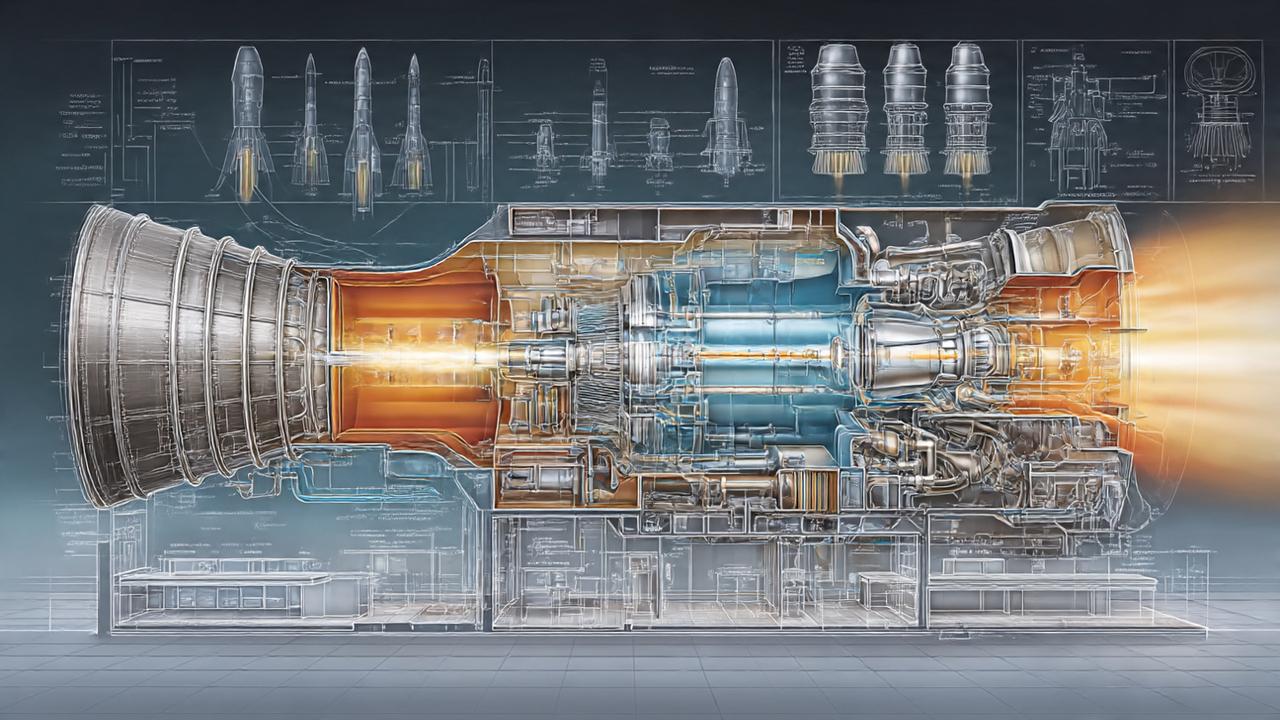
Advanced Rocket Motor Technologies (Generated with Artificial Intelligence.)
Application Area(s) | Reusable Launchers Advanced Orbital Maneuvering Technologies Microsatellite Launch Systems | ||||||||
|---|---|---|---|---|---|---|---|---|---|
Hybrid Systems | Paraffin-Based Fuels, Advanced Oxidizer Injection Techniques, Optimized Fuel Geometries, Approaches to Enhance Hybrid Motor Performance | ||||||||
Materials and Manufacturing | Ceramic Matrix Composites, High-Temperature Alloys, Additively Manufactured Regeneratively Cooled Nozzles | ||||||||
Propellants | Green Propellants, Nitromethane Derivatives, Hydrogen Peroxide, Nitrous Oxide-Based Mixtures | ||||||||
Advanced Cycles | Staged Combustion, Full Flow Cycle, Electric Pump Cycles | ||||||||
Basic Components | Combustion Chamber, Injector, Turbopump, Feed System, Cooling Channels, Nozzle | ||||||||
Advanced Rocket Motor Technologies: A multidisciplinary field of research and engineering that integrates chemical and electric propulsion concepts, advanced material solutions, novel propellants, and data-driven design tools. This field aims to optimize propulsion systems in terms of thrust, reusability, cost, and environmental impact. Current research focuses on enhancing classical liquid and solid motor architectures while developing new technologies such as hybrid motors, green propellants, rotating detonation engines, ceramic-based combustion chambers, and additively manufactured regeneratively cooled nozzles.

Advanced Rocket Motor Technologies (Generated by Artificial Intelligence)
The fundamental principle of rocket motor technology is the generation of thrust through the high-velocity expulsion of mass. In chemical rockets, this thrust is produced by accelerating gases generated from the combustion of fuel and oxidizer in the combustion chamber through a nozzle. In liquid propulsion systems, propellants are transported from tanks to the combustion chamber via pumps or pressure-fed systems, injectors mix the flows, and an ignition system initiates stable combustion. The system is an integrated whole in which components such as tanks, feed lines, turbopumps, gas generators, combustion chambers, and nozzles are tightly coupled, requiring simultaneous consideration of fluid and structural dynamics.
In motor design, system-level parameters such as mission profile, required thrust level, burn duration, relight capability, and the multistage architecture of the launch vehicle determine cycle selection and propellant combination. Advanced rocket motor technologies push the boundaries of performance and lifetime by adding higher combustion pressures, more aggressive propellant combinations, advanced cooling methods, and digital design tools to this fundamental framework.
Chemical rocket motors are generally classified into solid, liquid, and hybrid systems. Liquid rocket motors are further divided into monopropellant and bipropellant types. In monopropellant systems, a single propellant either decomposes or expands as a cold gas; these systems are primarily used for low-thrust orbital maneuvers. Bipropellant motors store fuel and oxidizer in separate tanks, mix them in an injector assembly, and achieve high specific impulse and broad mission flexibility.
In solid rocket motors, fuel and oxidizer are combined within a single solid grain propellant. This configuration offers simple mechanical design and high instantaneous thrust but limits precise thrust control and relight capability. Modern solid propellants involve intensive research into formulations of polymer binders, metallic additives, and high-energy oxidizers to improve mechanical strength, thermal stability, and combustion performance.
Hybrid rocket motors combine a solid fuel with a liquid oxidizer. This architecture provides greater controllability and shutdown capability than solid motors, and simpler storage and safety advantages compared to liquid systems. The design of hybrids depends on optimizing the regression rate of the solid fuel surface and the mixing characteristics of the propellants to achieve desired thrust performance and combustion stability.
A significant portion of advanced rocket motor technologies focuses on the development of liquid rocket motor cycles. In traditional gas-generator cycles, a portion of the propellant mixture is burned in a separate combustion chamber to drive the turbopumps, and the exhaust gas is typically vented without contributing to main thrust. This approach keeps the architecture relatively simple but results in thermodynamic losses.
In staged combustion cycles, the gas that drives the turbopumps is generated in a rich-fuel or rich-oxidizer preburner and then injected into the main combustion chamber to contribute to total thrust. This cycle requires materials capable of withstanding high pressures and temperatures, precise injector design, and advanced cooling techniques. In full-flow staged combustion cycles, both fuel and oxidizer undergo partial combustion in the preburners, and all mass flow passes through the turbomachinery. This enables more uniform thermal loading and higher overall efficiency, but significantly increases system complexity.
Electric pump-fed cycles replace mechanically driven turbopumps with high-power electric motors and energy storage units. This approach simplifies system topology by eliminating gas generators and associated piping, while enabling precise electronic control of thrust levels and operating points.
Combustion chambers and nozzles are among the most critical components of advanced rocket motors. Their ability to operate for extended durations under high pressure and temperature requires careful management of combustion stability and heat transfer control. Advanced injector configurations aim to reduce fuel-oxidizer mixing length, enhance combustion homogeneity, and suppress chamber oscillations. Swirl injectors, multi-orifice injectors, and porous injectors are among the methods under investigation to improve mixing and combustion stability.
Regenerative cooling remains one of the primary cooling methods. In this approach, fuel or oxidizer is circulated through channels in the combustion chamber liner and nozzle walls, lowering wall temperatures while simultaneously heating the propellant to improve overall efficiency. In addition, advanced cooling solutions such as transpiration-cooled porous walls and film cooling are employed to limit wall temperatures in high-heat-flux regions. Transpiration-cooled combustion chambers made from ceramic matrix composites have become a major research focus due to their high-temperature resistance and mass advantages.
Additive manufacturing techniques offer significant design freedom over traditional methods in producing regeneratively cooled nozzles and combustion chambers with complex internal channels. This enables single-piece fabrication, shorter lead times, and weight reduction. Combined with advanced design approaches, additive manufacturing allows optimization of nozzle geometries and the discovery of new trade-offs between flow dynamics, heat transfer, and mechanical strength.
A key trend in advanced rocket motor technologies is the shift toward green propellants that reduce toxicity and operational risks while maintaining high performance, replacing traditional propellants with high environmental impact. Components such as hydrazine and nitrogen oxide derivatives, despite their high performance, increase safety procedures and operational costs due to their toxicity and corrosiveness. In contrast, ammonium dinitramide-based monopropellants, hydrogen peroxide, nitrous oxide-based mixtures, and gel propellants are being investigated as more environmentally and operationally favorable alternatives.
Nitrous oxide and hydrocarbon-based premixed mixtures are attracting attention due to their potential for pressure-fed system architectures, ease of storage and handling, and high performance potential. In these systems, thermal stability of the mixture, material compatibility, flame holder design, and cooling solutions suitable for high combustion temperatures are critical research areas. Testing has demonstrated that these mixtures can operate stably and continuously when combined with regenerative cooling.
In nitromethane-based liquid propellants, research focuses on additives and inhibitors to reduce shock sensitivity and adiabatic compression susceptibility. Hydrogen peroxide-based hypergolic bipropellant systems and novel combinations operating with ionic liquids are also being systematically evaluated through testing and modeling for both safety and performance.
Research on hybrid rocket motors focuses on enhancing performance through fuel geometry, flow channel design, and oxidizer feeding strategies. On the fuel side, paraffin-based fuels and alternative sustainable fuel formulations have enabled increased regression rates and improved combustion efficiency. The internal geometry of the fuel grain directly affects performance by increasing surface area and improving mixing quality.
Swirl injectors, multi-point oxidizer injection, and innovative flow channel designs are being intensively studied to improve mixing and combustion processes in hybrid motors. Regression rate models are being updated using semi-empirical approaches and computational fluid dynamics solutions that account for turbulent boundary layer combustion and the interaction between mass and heat transfer. These advances are leading to new design principles for scaling hybrid motors and mitigating low-frequency combustion instabilities.
In practice, nitrous oxide–paraffin-based hybrid motors are being validated through ground tests and sounding rocket flights. Experimental data demonstrate that hybrid motors can be scaled across a wide range of applications, from student projects to commercial ventures, and can be integrated with alternative oxidizers.
In advanced rocket motor technologies, materials science plays a decisive role in performance and lifetime. Metallic alloys, ceramic matrix composites, and multilayer coatings are used for combustion chamber liners and nozzles operating under high temperatures and thermomechanical loads. Ceramic matrix composite combustion chambers, when combined with transpiration cooling, can reduce wall temperatures and limit erosion, thereby extending operational life.
Additive manufacturing enables the production of regeneratively cooled nozzles with complex internal channels, lightweight structural components, and integrated injector–nozzle modules. The single-piece fabrication approach reduces potential failure sources at welds and joints, while geometric optimization delivers positive effects on mass and cost. System engineering studies are underway to evaluate the system-level benefits of additive manufacturing in this domain.
In current rocket motor design, high-resolution computational fluid dynamics solutions, combustion models, and structural dynamics analyses have become standard. However, for complex configurations such as rotating detonation engines involving intricate flow and combustion processes, full-resolution simulations remain computationally prohibitive. Consequently, physics-based reduced-order models and data-driven approaches have become essential tools for design exploration and risk analysis.
Rotating detonation engines are next-generation propulsion concepts that operate using continuous detonation waves and offer theoretically higher thermodynamic efficiency. In these motor types, multi-scale temporal and spatial processes, wave–flow interactions, and combustion stability are studied through both experimental and numerical methods. Reduced-order models trained on distributed-memory algorithms aim to represent these complex dynamics with significantly lower computational cost using data from large-scale simulations.
Trends in advanced rocket motor technologies are shifting from isolated component improvements toward holistic system-level solutions. Reusable launch vehicles impose higher cycle life, wider operating envelopes, and modular maintenance requirements on propulsion systems. Methane-based motors have gained importance due to their balanced performance in storage, reusability, and environmental impact.
Machine learning is being applied to performance analysis of propulsion systems, prediction of combustion instabilities, and adaptive tuning of motor control strategies. Models trained on extensive datasets complement physical intuition regarding complex flow and combustion processes. Similarly, system engineering approaches integrate additive manufacturing, green propellants, hybrid architectures, and electric propulsion concepts within the constraints of mission profiles and economic limitations.
Advanced rocket motor technologies constitute a continuously evolving specialty field that integrates advances in cycle architecture, propellant chemistry, materials science, manufacturing technologies, and data-driven modeling. Innovations in chemical and hybrid motors, green propellants, rotating detonation engines, and advanced cooling–material solutions form the foundation of future spacecraft designs targeting higher performance, lower cost, and reduced environmental impact.
Abdullah, Md, Tamanna Rahman, Subrata Saha, and Md. Mosharrof Hossain. “Advancements in Propulsion Systems for Rocket Engines. A Review.” *Tuijin Jishu – Journal of Propulsion Technology* 45 (2024): 1001–4055. Accessed November 15, 2025. https://www.propulsiontechjournal.com/index.php/journal/article/view/8010.
Bennewitz, J. W., J. R. Burr, B. R. Bigler et al. “Experimental Validation of Rotating Detonation for Rocket Propulsion.” *Scientific Reports* 13 (2023): 14204. Accessed November 15, 2025. https://doi.org/10.1038/s41598-023-40156-y.
Farcaş, Ionuţ Gabriel, Rayomand P. Gundevia, Ramakanth Munipalli, and Karen E. Willcox. “Distributed Computing for Physics Based Data Driven Reduced Modeling at Scale: Application to a Rotating Detonation Rocket Engine.” *Computer Physics Communications* 313 (August 2025): 109619. Accessed November 15, 2025. https://doi.org/10.1016/j.cpc.2025.109619.
Haidn, Oskar. “Advanced Rocket Engines.” *Advances in Propulsion Technology for High-Speed Aircraft*. (2007): 6.1–6.40. Accessed November 15, 2025. https://www.researchgate.net/publication/225022069_Advanced_Rocket_Engines.
Wei, Shih Sin, Meng Che Li, Alfred Lai, Tzu Hao Chou, and Jong Shinn Wu. “A Review of Recent Developments in Hybrid Rocket Propulsion and Its Applications.” *Aerospace* 11, no. 9 (2024): 739. Accessed November 15, 2025. https://doi.org/10.3390/aerospace11090739.
Werling, Lukas, Dominic Freudenmann, Sophie C. Ricker et al. “Research and Test Activities on Advanced Rocket Propellants at DLR’s Institute of Space Propulsion in Lampoldshausen.” *9th EUCASS 2022 Conference Paper*. (2022). Accessed November 15, 2025. https://elib.dlr.de/190326/1/EUCASS2022-4540.pdf.
Xu, Qin, Qingchun Yang, Hongxin Wang, Xu Xu, and Oskar Haidn. “Research Progress in Rotating Detonation Propulsion Technology.” *Acta Astronautica* 236 (2025): 522–546. Accessed November 15, 2025. https://doi.org/10.1016/j.actaastro.2025.06.064.

Advanced Rocket Motor Technologies (Generated with Artificial Intelligence.)
Application Area(s) | Reusable Launchers Advanced Orbital Maneuvering Technologies Microsatellite Launch Systems | ||||||||
|---|---|---|---|---|---|---|---|---|---|
Hybrid Systems | Paraffin-Based Fuels, Advanced Oxidizer Injection Techniques, Optimized Fuel Geometries, Approaches to Enhance Hybrid Motor Performance | ||||||||
Materials and Manufacturing | Ceramic Matrix Composites, High-Temperature Alloys, Additively Manufactured Regeneratively Cooled Nozzles | ||||||||
Propellants | Green Propellants, Nitromethane Derivatives, Hydrogen Peroxide, Nitrous Oxide-Based Mixtures | ||||||||
Advanced Cycles | Staged Combustion, Full Flow Cycle, Electric Pump Cycles | ||||||||
Basic Components | Combustion Chamber, Injector, Turbopump, Feed System, Cooling Channels, Nozzle | ||||||||
No Discussion Added Yet
Start discussion for "Advanced Rocket Motor Technologies" article
Fundamental Principles of Rocket Motor Technologies
Traditional Chemical Rocket Motors
Advanced Liquid Rocket Motor Cycles
Advances in Combustion Chamber, Injector, and Cooling Technologies
Advanced and Green Propellants
Advanced Approaches in Hybrid Rocket Motors
Advanced Cooling, Materials, and Additive Manufacturing Applications
System-Level Trends and Future Directions