

This article was automatically translated from the original Turkish version.
+2 More
Director | Alejandro Amenábar | ||||||||
|---|---|---|---|---|---|---|---|---|---|
Genre | Historical Drama, Adventure, Biography, History | ||||||||
Screenwriter | Alejandro Amenábar, Mateo Gil | ||||||||
Production Location / Country | Spain | ||||||||
Production Year | 2009 | ||||||||
Duration | 2 hours 7 minutes (127 minutes) | ||||||||
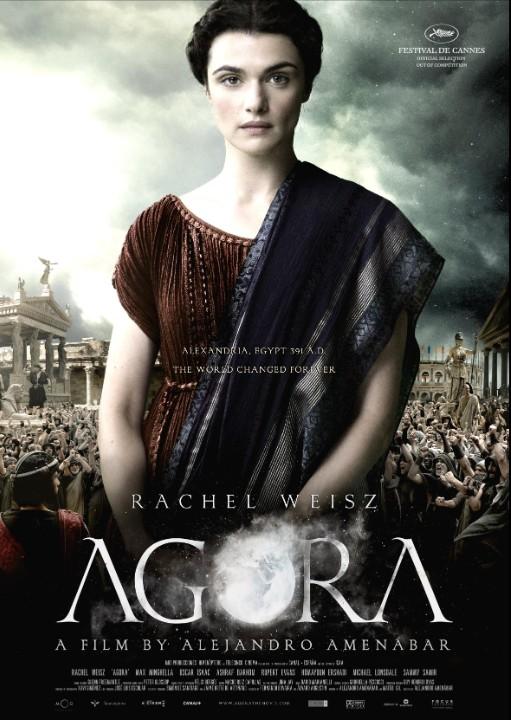
Agora is a 2009 historical drama, adventure, and biographical film directed by Alejandro Amenábar and written by Alejandro Amenábar and Mateo Gil. Produced in Spain, the story is set in late 4th century AD in the city of Alexandria in Egypt, and revolves around the life of the astronomer, mathematician, and philosopher Hypatia of Alexandria, as well as the social transformations driven by rising religious and political conflicts in the city.
Agora Official Trailer (AMBI Distribution)
The film begins in Alexandria in 391 AD. The philosopher Hypatia, who teaches astronomy, mathematics, and philosophy in the city, is focused on understanding the workings of the universe and the movements of celestial bodies. Her distinguished student Orestes and her personal slave Davus both harbor unrequited admiration and emotional attachment toward her.
At the time, Christian groups led by Ammonius are gaining increasing political and social power in the city. This shift in power leads to violent clashes between pagans and Christians. As tensions escalate, the pagans take refuge in the Serapeum temple, which also housed an extension of the Library of Alexandria. However, following an order from the Roman Emperor permitting Christians to enter the temple, the pagans are forced to abandon the site, and the library is looted. During this chaos, the slave Davus joins the rising Christianity movement in hopes of gaining his freedom.
The second part of the film shifts to around 20 years later, in 415 AD. Orestes, now the city’s prefect, maintains a fragile truce with Christian factions and their new radical religious leader, Cyril. Fanatical Christian groups seeking to establish absolute cultural hegemony in the city first target the Jewish community; after violent confrontations, the Jews are expelled from Alexandria.
The next target becomes those who do not adhere to any religious belief and follow science alone. Hypatia, distancing herself from these faith-based conflicts, works to develop an elliptical theorem explaining the motion of celestial bodies. Although she speaks peacefully and rationally at council meetings aimed at reconciliation, she is targeted by Cyril’s group as an unbeliever and a woman. The film concludes with Hypatia being declared a witch by a fanatical mob and brutally murdered.
The film has received a total of 11 wins and 15 nominations internationally. At Spain’s national film awards, the Goya Awards, it won in the categories of Best Original Screenplay, Best Cinematography, Best Production Design, Best Costume Design, Best Makeup and Hairstyling, Best Art Direction, and Best Special Effects.【1】
AMBI Distribution. "Agora - TRAILER (2009)." YouTube, 2:12. March 4, 2013. Accessed July 12, 2026.
Amenábar, Alejandro, dir. Agora. Spain: Telecinco Cinema / Mod Producciones, 2009.
Bäro, H. Sevim Işık. "Agora’da Bir Kadın; İskenderiyeli Hypatia." *kadinisci.org.* Accessed June 15, 2026.
Doğu, İsmail. "Bir Film Analizi: Agora." *Düşünen Şehir*, 2009. Accessed June 15, 2026.https://www.academia.edu/48967292/Bir_Film_Analizi_Agora_%C4%B0smail_Do%C4%9Fu
IMDb. "Agora (2009) Photo - Rachel Weisz as Hypatia." Accessed July 12, 2026.https://www.imdb.com/title/tt1186830/mediaviewer/rm3702819072/
IMDb. "Awards." Accessed June 15, 2026.https://www.imdb.com/title/tt1186830/awards/
Sinemalar. "Agora." *sinemalar.com.* Accessed June 15, 2026.https://www.sinemalar.com/film/25441/agora
[1]
IMDb, "Agora (2009) - Awards." IMDb, Erişim tarihi: 15 Haziran 2026, https://www.imdb.com/title/tt1186830/awards/

Director | Alejandro Amenábar | ||||||||
|---|---|---|---|---|---|---|---|---|---|
Genre | Historical Drama, Adventure, Biography, History | ||||||||
Screenwriter | Alejandro Amenábar, Mateo Gil | ||||||||
Production Location / Country | Spain | ||||||||
Production Year | 2009 | ||||||||
Duration | 2 hours 7 minutes (127 minutes) | ||||||||
Plot
Themes
Characters and Cast
Awards and Nominations