



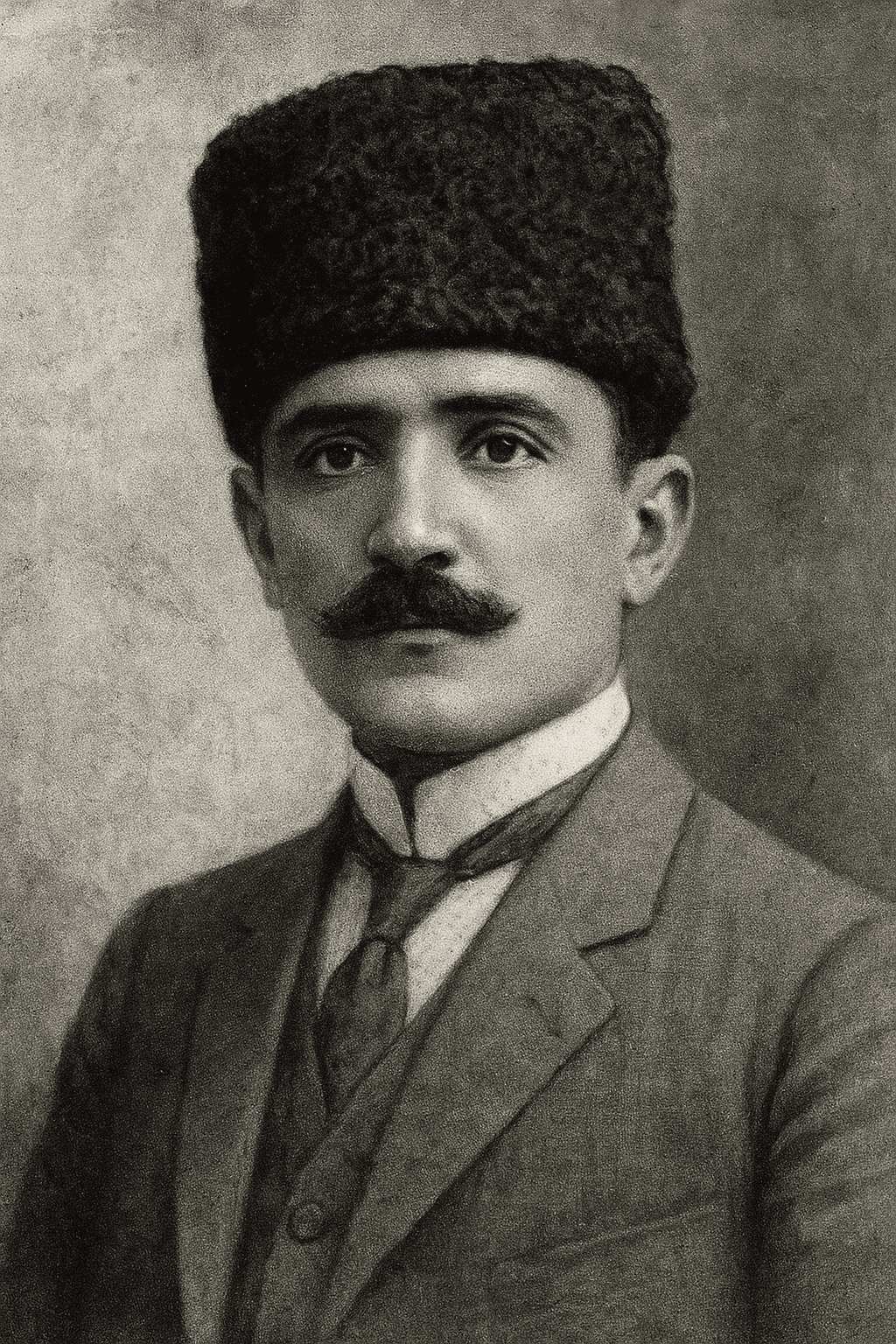
(Yapay Zeka ile Oluşturulmuştur.)
Ahmet Muhtar Fikri (Gücüm) played active roles during the Constitutional Monarchy and National Liberation periods. He served as a member of the Chamber of Deputies and the Grand National Assembly of Türkiye (TBMM), contributing to the National Liberation struggle on the Southern Front. He also engaged in journalism and made significant contributions to the development of regional press.
Ahmet Muhtar Fikri Bey was born in Muş in 1876. His father, Cizrelizade Mustafa Rıza Bey, was a state official who held various positions within the Ottoman bureaucracy, including district governor and provincial governor. His mother was İffet Hanım. Due to his father’s postings, he completed his primary and secondary education in Muş and Diyarbakır.
Although he was unable to continue his formal education, he was deeply influenced by the intellectual and political circles in Diyarbakır. In 1899, he was exiled first to Payas and then to Adana due to his opposition to the governance philosophy of Sultan Abdülhamid II.
During his time in Adana, he married Müzeyyen Hanım, daughter of Hazım Bey from the Ramazanoğlu family. They had five children: Mehmet, Fatma Nezihe, Mustafa Tekin, Ahmet Aydın, and Ülken.
During his years of exile, he worked as a teacher and deputy director at the Adana Hamidiye Industrial School. He particularly contributed to the development of the Accounting and Manufacturing departments and was honored in 1905 for these efforts. With the proclamation of the Second Constitutional Monarchy in 1908, his exile was lifted, but he chose to remain in Adana and continued his life through agriculture. Not ceasing his political and intellectual activities, Muhtar Fikri Bey, together with İhsan Fikri Bey, began publishing the newspaper İtidâl and assumed the role of editorial director. The newspaper published a total of 76 issues between 1908 and 1909 before closing due to economic difficulties. In 1913, he was elected as a member of the General Assembly from Mersin, formally entering political life.
Following the Armistice of Mudros and the occupation of Adana, increasing pressures and threats of punishment by the occupying administration prompted him to leave Adana together with İsmail Safa (Özler) Bey, Dr. Eşref (Akman) Bey, and journalist Mustafa (Mücavir) Bey. He traveled via Mersin and Silifke to Istanbul. However, when prosecution proceedings were initiated against him, he returned to Çukurova and joined the Defense of Rights and Kuva-yı Milliye organizations.
On 29 October 1919, he entered the Chamber of Deputies as a deputy from Harput. After the British dissolved the Chamber of Deputies, he continued his activities within the ranks of the National Liberation movement. On 23 April 1920, he was elected as a deputy from Mersin to the newly opened Grand National Assembly of Türkiye and joined its sessions on 9 May 1920.
During his tenure in the TBMM, he was dispatched by the Assembly to support the resistance on the Southern Front. He worked to increase public participation in areas under French occupation, boost the morale of national units, and provide logistical support. At meetings held at the Pozantı Defense of Rights Society headquarters, it was decided that he would visit the units alongside Damar (Arıoğlu) Bey. During these visits, in speeches addressed to those accompanying him, he emphasized the importance of his mission and affirmed his determination to fulfill his duty despite the dangers.
On 5 August 1920, he attended the Pozantı Congress, led by Mustafa Kemal Paşa and Fevzi Paşa. After the signing of the Ankara Agreement on 20 October 1921, which led to the withdrawal of French forces from the region, he returned to his duties in the Assembly.
During his four session years in the First Assembly, he served in various committees. In the first session year, he was a member of the Fourth Committee; in the second session year, he served in the Fifth Committee and the Foreign Affairs Council; and in the third and fourth session years, he was a member of the First Committee. On 20 July 1922, he was selected as one of three members of a committee appointed by the Council of Ministers to investigate the events in Trabzon. Additionally, on 14 December 1920, he submitted a proposal requesting assistance for migrants from Adana; this proposal was adopted by the Assembly. Within the Assembly, he was a member of the First Group of the Defense of Rights Faction.
After completing his duties in the TBMM, he settled in Adana and continued his life through farming. On 21 April 1925, by virtue of Decision No. 141, he was awarded the Red-Green Ribboned Independence Medal for his struggle on the Pozantı Front.
Ahmet Muhtar Fikri Bey passed away in Adana on 23 July 1930. His family adopted the surname "Gücüm" during the Republican period.
Bozkurt, Birgül. “Ahmet Muhtar Fikri (Gücüm).” Atatürk Araştırma Merkezi. Accessed July 31, 2025. https://ataturkansiklopedisi.gov.tr/detay/1693/Ahmet-Muhtar-Fikri-(Gücüm)-(1876-?).
Yuca, İrşad Sami. "Osmanlı’dan Cumhuriyet’e Adanalı Bir Siyasetçi: Ahmet Muhtar Fikri (Gücüm) Bey (1876-1930)." Akademik Tarih ve Düşünce Dergisi, Volume 7, no. 3, pp. 1561-1582. https://dergipark.org.tr/tr/download/article-file/1241436.

(Yapay Zeka ile Oluşturulmuştur.)
No Discussion Added Yet
Start discussion for "Ahmet Muhtar Fikri (Gücüm)" article
Educational Life
Teaching Career
Chamber of Deputies and National Liberation Period
Activities on the Southern Front
Activities in the Grand National Assembly
Later Years and Death