


This article was automatically translated from the original Turkish version.
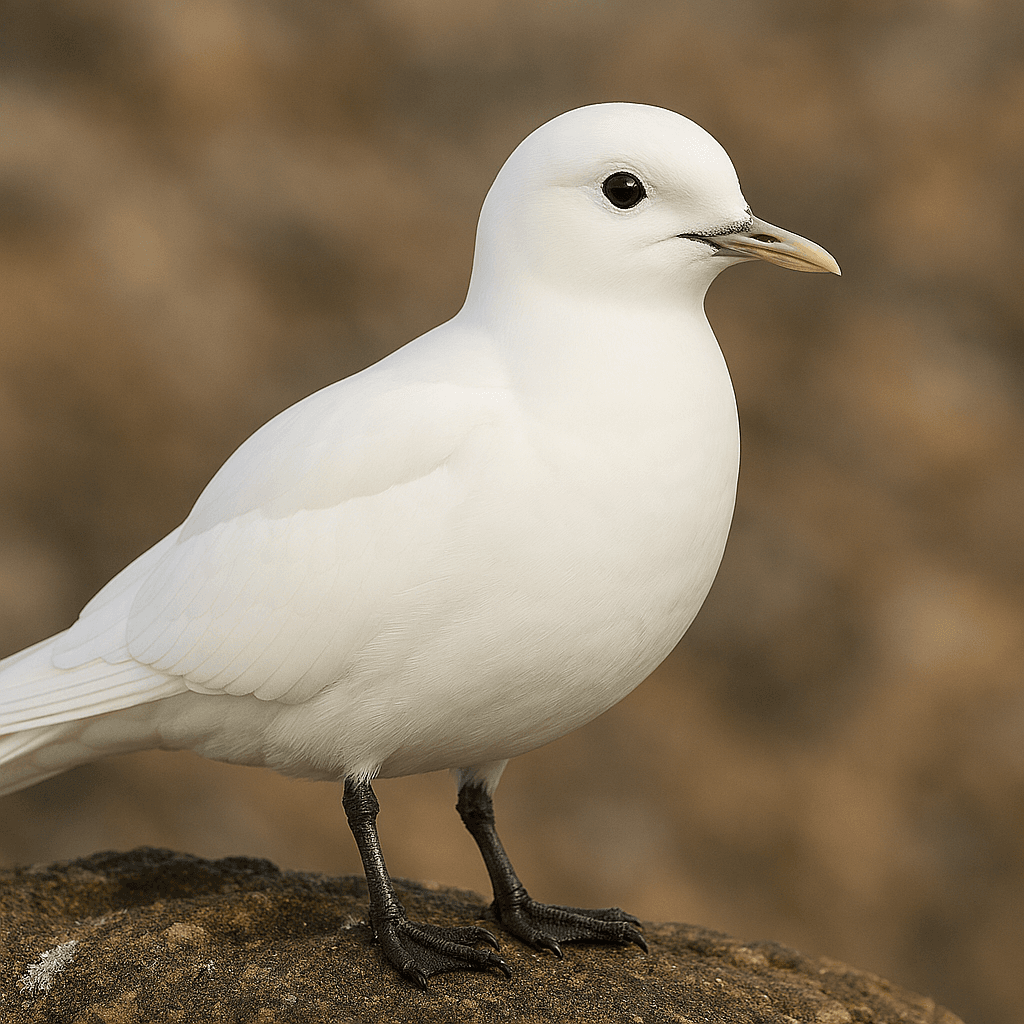
Ivory Gull (Pagophila eburnea) (generated by artificial intelligence.)
Team(s) | Charadriiformes | ||||||||
|---|---|---|---|---|---|---|---|---|---|
Family | Laridae | ||||||||
Specie(s) | Pagophila eburnea | ||||||||
Height(s) | 40–43 cm | ||||||||
Weight(s) | 500–700 g | ||||||||
Wingspan | 105–110 cm | ||||||||
Breeding Areas | and polar islands around the Kara Sea Severnaya Zemlya Franz-Josef Land (Russian Arctic) Svalbard Islands northern coasts of Greenland Canadian Arctic Archipelago | ||||||||
Conservation Status | Near Threatened (Near Threatened) category | ||||||||
The ivory gull (Pagophila eburnea) is a seabird endemic to the Arctic region and belongs to the family Laridae. This species exhibits distinctive morphological features including a completely white plumage black legs and a short thick bill. It is ecologically dependent on sea ice habitats in high latitudes. Its habitat selection feeding strategies and breeding behaviors are directly linked to glacial dynamics. The ivory gull is regarded as one of the indicator species representing the biological integrity of Arctic ecosystems.
The ivory gull is a medium-sized gull species. Its body length ranges from approximately 40 to 43 cm its wingspan from 105 to 110 cm and its weight from 500 to 700 grams. Its feathers are entirely white a trait that provides visual camouflage against the Arctic sea ice. The bill is yellowish at the base with a black tip while the legs are black. This morphological structure reflects the species adaptation to Arctic conditions both in terms of thermoregulation and camouflage.

Ivory Gull (Pagophila eburnea) (Generated by artificial intelligence.)
The ivory gull breeds exclusively in Arctic habitats. Key breeding areas include the northern islands of Canada Greenland the northern coasts of Siberia and Spitsbergen all located along the edges of sea ice. The breeding season begins in June; nests are typically built on isolated rocky outcrops atop glaciers. The female lays one to two eggs with an incubation period of approximately 24 days. Both parents actively participate in chick rearing. Breeding success is directly dependent on the presence of sea ice and access to food resources.
The ivory gull follows an omnivorous feeding strategy. Its diet includes fish crustaceans remains of marine mammals and eggs of other birds. In particular its reliance on remains of seals killed by polar bears underscores its position within the Arctic food web. This behavior reveals the species scavenging tendencies and its indirect ecological relationship with marine mammals. The ivory gull also feeds around landfills and near fishing vessels demonstrating its capacity to adapt to human-induced environmental changes.
Recent decade-long observations reveal a pronounced declining trend in ivory gull populations. Long-term monitoring studies conducted in the Canadian Arctic have shown that this decline is closely associated with sea ice loss and the resulting habitat degradation. Rising global temperatures cause earlier melting of sea ice disrupting the continuity of breeding sites. Furthermore the bioaccumulation of environmental pollutants particularly persistent organic compounds such as mercury and PCBs negatively affects chick development and survival rates.
The life cycle of the ivory gull is ecologically dependent on the presence of sea ice in high Arctic latitudes. Recent ecological observations and population analyses confirm that sea ice loss driven by climate change is a decisive factor in the species numerical decline. This loss disrupts the spatial continuity of breeding habitats and severely restricts trophic-level access to food. Additionally rising temperatures accelerate the bioaccumulation of persistent organic pollutants in biological tissues which adversely affects the physiological development and survival of chicks. The long-term viability of the species depends not only on local habitat management but also on the effectiveness of international climate policies and the holistic conservation of Arctic ecosystems.
According to BirdLife International the ivory gull is classified as Endangered at the global scale. The species conservation depends not only on local habitat management but also on the effectiveness of global strategies aimed at limiting climate change. The ivory gull is not merely a faunal component of the Arctic biogeography but also an indicator of regional ecological stability. Therefore monitoring this species is important not only for tracking bird populations but also as a biological indicator of the overall health of Arctic ecosystems.
Arktik Bilimi 10, no. 3 (March 22, 2024): 499–510, ScienceDirect. Accessed August 22, 2025. https://www.sciencedirect.com/org/science/article/pii/S2368746024000140.
Mallory, Mark L. and H. Grant Gilchrist. "History of monitoring the endangered ivory gull in the Canadian Arctic."
eBird. "Ak Martı/ Pagophila eburnea." Cornell Lab of Ornithology. Accessed August 22, 2025. https://ebird.org/species/ivogul?siteLanguage=tr.
Özkan, Korhan. “Ak Martı.” TÜBİTAK Kutup Ansiklopedisi. Accessed August 22, 2025. https://ansiklopedi.tubitak.gov.tr/kutup/ansiklopedi/ak-marti.
“Ivory Gull Pagophila eburnea.” DataZone by BirdLife. Accessed August 22, 2025. https://datazone.birdlife.org/species/factsheet/ivory-gull-pagophila-eburnea.

Ivory Gull (Pagophila eburnea) (generated by artificial intelligence.)
Team(s) | Charadriiformes | ||||||||
|---|---|---|---|---|---|---|---|---|---|
Family | Laridae | ||||||||
Specie(s) | Pagophila eburnea | ||||||||
Height(s) | 40–43 cm | ||||||||
Weight(s) | 500–700 g | ||||||||
Wingspan | 105–110 cm | ||||||||
Breeding Areas | and polar islands around the Kara Sea Severnaya Zemlya Franz-Josef Land (Russian Arctic) Svalbard Islands northern coasts of Greenland Canadian Arctic Archipelago | ||||||||
Conservation Status | Near Threatened (Near Threatened) category | ||||||||
No Discussion Added Yet
Start discussion for "Ak Martı (Pagophila eburnea)" article
Morphological Characteristics
Habitat and Breeding Behavior
Feeding Ecology
Population Trends and Threats
Climate Change and the Species Future
Conservation Status and Ecological Role