


This article was automatically translated from the original Turkish version.
+2 More
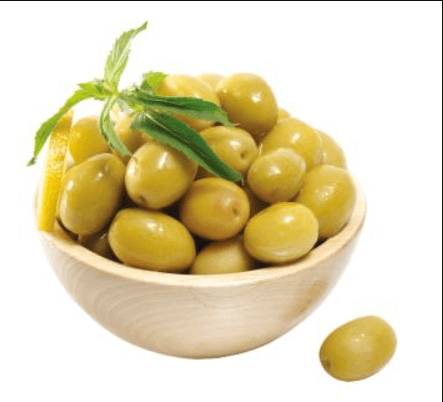
Akhisar Domat Olive
Product / Product Group(s) | Processed and unprocessed fruits and vegetables and mushrooms | ||||||||
|---|---|---|---|---|---|---|---|---|---|
Applicant/Registrant(s) | Akhisar Chamber of Commerce and Industry | ||||||||
Registration Date | 13.12.2012 | ||||||||
File Number | C2010/058 | ||||||||
Registration Number | 166 | ||||||||
Akhisar Domat Olive is a green table olive variety derived from the Olea europaea L. species. This olive is cultivated in the Akhisar district of Manisa Province in Türkiye and its surrounding districts. It has been officially registered under the Industrial Property Law No. 6769 as a “Place Name” and has been protected under geographical indication since 4 November 2010.
The Akhisar Domat Olive is distinguished by its large fruit structure and prominent cylindrical shape. Fruits harvested at the green maturity stage are processed for table use. The fruit is symmetrical with an average length of 26.70 mm, width of 19.48 mm, and a length-to-width ratio of 1.37. The flesh ratio is 83.76%, oil content is 20.57%, and moisture content is 55.89%. The mature fruit color is a glossy dark burgundy, while the flesh is whitish cream. The seed is cylindrical and constitutes 16.24% of the fruit.
The olive tree is characterized by a broad canopy and a strong trunk. Its leaves are very long and narrow with an elliptical shape; the upper surface is dark green while the lower surface is gray-green. The average leaf length is 68.53 mm and the width is 12.20 mm.

Akhisar Domat Olive (Encyclopedia of Turkish Tourism)
Before establishing an olive grove, deep soil preparation and, if necessary, leveling and drainage are carried out. Due to its large canopy structure, the Domat variety is planted at wide spacing such as 6x8 m or 7x7 m. Planting holes of 80x80 cm are dug and seedlings are fertilized according to soil analysis results.
Harvesting is done manually and olives are collected in crates. Depending on the processing method, the product is prepared as scratched, cracked, stuffed, sliced, or natural. Fermentation brine contains 0.5–7% salt and 0.065–1.2% acidity. Packaging brine is prepared with drinking water, table salt, lactic acid, vinegar, and olive oil as additives.
All processes are carried out in accordance with the Turkish Food Codex Table Olive Notice.
Akhisar district of Manisa Province and surrounding districts (Gölmarmara, Salihli, Turgutlu, Saruhanlı, Kırkağaç).
Monitoring is conducted by a commission composed of representatives from:
The commission conducts inspections at least once annually during the harvest season (October–November) and convenes urgently if needed or in case of complaints. Physical and chemical properties are verified, with laboratory analyses performed when necessary.
Ministry of Culture and Tourism. "Akhisar Domat Zeytini." Kültür Portalı. Accessed May 27, 2025. https://www.kulturportali.gov.tr/portal/akhisar-domat-zeytini
Turkish Patent and Trademark Office. "Akhisar Domat Zeytini." Geographical Indication Registration Certificate No: 166. Accessed May 27, 2025. https://ci.turkpatent.gov.tr/cografi-isaretler/detay/38037
Türkiye Turizm Ansiklopedisi. "Akhisar Domat Zeytini." Accessed May 27, 2025. https://turkiyeturizmansiklopedisi.com/akhisar-domat-zeytini.

Akhisar Domat Olive
Product / Product Group(s) | Processed and unprocessed fruits and vegetables and mushrooms | ||||||||
|---|---|---|---|---|---|---|---|---|---|
Applicant/Registrant(s) | Akhisar Chamber of Commerce and Industry | ||||||||
Registration Date | 13.12.2012 | ||||||||
File Number | C2010/058 | ||||||||
Registration Number | 166 | ||||||||
No Discussion Added Yet
Start discussion for "Akhisar Domat Olive" article
Product Description and Distinctive Characteristics
Production Method
Establishment and Planting:
Maintenance:
Harvesting and Processing:
Processing Stages:
Geographical Boundary and Monitoring
Geographical Boundary:
Monitoring: