

This article was automatically translated from the original Turkish version.
+2 More
Rakım | 1.7982100 | ||||||||
|---|---|---|---|---|---|---|---|---|---|
Surface Area | None | ||||||||
Depth | 10 | ||||||||
Water Property | Sodalı | ||||||||
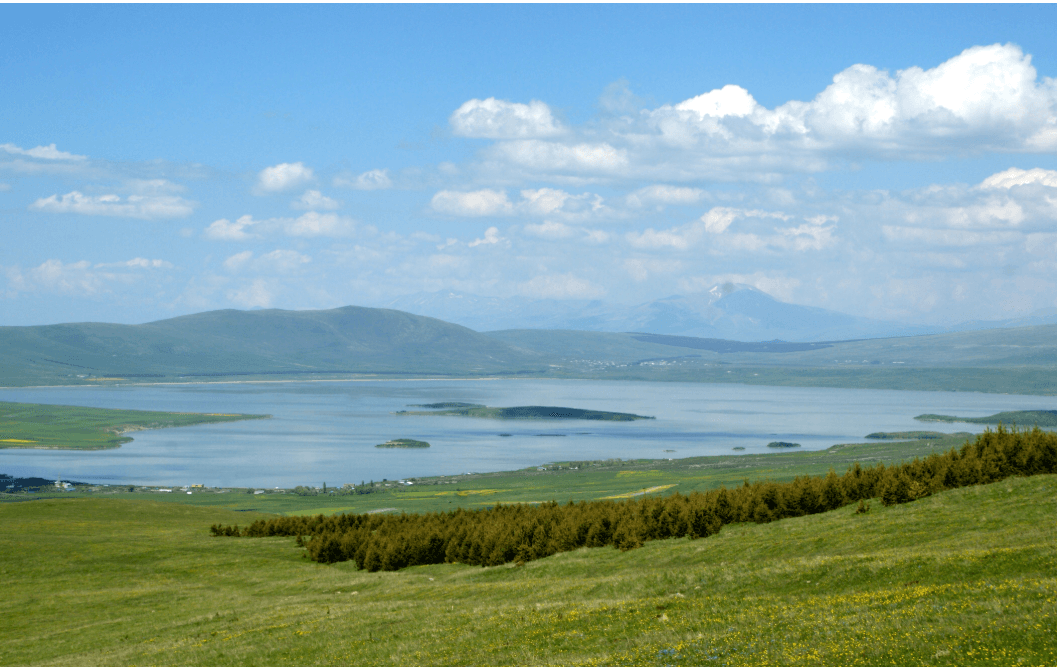
Aktaş Lake is a tectonic lake located on the border between Türkiye and Georgia. The lake lies within the boundaries of Çıldır district of Ardahan province in Türkiye and also extends into Georgia’s Samtskhe–Javakheti region. Situated on the high plateau between Türkiye and Georgia, the lake occupies elevations ranging from approximately 1,800 to 2,100 meters. Its total surface area is 2,700 hectares (27 km²), of which 1,400 hectares (14 km²) lie within Türkiye’s borders.
Aktaş Lake exhibits a shallow basin structure; its maximum depth is approximately 10 meters. The lake is primarily fed by snowmelt and small streams in its surrounding area. Water levels rise only during the spring months, when excess water is discharged via a spillway channel into the Kura River through the Arkbeli (Zigaristav) Stream in the northwest. The water has a saline (alkaline) character.
Aktaş Lake has been referred to by various names in historical sources, including local designations such as Hazapin, Kenarbel, Karsak, and Kazapin. In the 1921 Treaty of Moscow, the lake is recorded as “Kozapini.” On Georgian maps, it is spelled “Hozapini.” The name Kenarbel is used locally because access to the lake requires crossing a hill or ridge (“bel”).
The lake contains a total of twelve islets, none of which are inhabited. Although the boundary line passes through the lake’s deepest point, all islets—including the largest ones, Büyük Ada and Başak Ada—lie entirely within Türkiye’s territory. These islets have rocky formations and sparse vegetation. Surrounded by meadows and reed beds, they serve as vital breeding, feeding, and sheltering grounds for various wildlife, particularly bird species. Along the lake shore, small reed beds and dry cereal fields are present.
On the Turkish side of the lake lies Kenarbel Village; on the Georgian side lies Karçasi Village. The largest settlement on the Turkish side is Çıldır; on the Georgian side, it is Ahılkelek (Akhalkalaki). Kenarbel Village is the only settlement directly bordering the lake and houses approximately fifty households. The village has experienced significant emigration. Construction of the Aktaş Customs and Border Gate on the Turkish side was completed in the late 1990s but has not become operational due to deficiencies on the Georgian side.
Aktaş Lake is one of Türkiye’s most important wetlands in terms of avian biodiversity. It is the only wetland in Türkiye where both the great white pelican (Pelecanus onocrotalus) and the Dalmatian pelican (Pelecanus crispus) nest together. Approximately 50 pairs of great white pelicans and 20 pairs of Dalmatian pelicans have been recorded breeding here.
The lake also hosts Türkiye’s largest known population of the scoter (Melanitta fusca). Due to these characteristics, the lake is protected under the Regulation on the Conservation of Wetlands. Other bird species found in the lake include the rusty duck (Tadorna ferruginea), black-winged stilt (Himantopus himantopus), great cormorant (Phalacrocorax carbo), and the Armenian gull (Larus armenicus). Three shrub-covered islets within the lake serve as important breeding sites for raptors. Additionally, under the Important Natural Areas (INA) designation, the montagu’s harrier (Circus pygargus) is recorded to breed here with 10 to 15 pairs.
The area surrounding the lake is primarily used for agriculture and livestock farming. Natural meadows are harvested and used as animal fodder; large livestock are grazed there as well. Dry cereal crops are cultivated on titled lands. Commercial fishing is not practiced in the lake; only subsistence fishing by a single villager occurs. Grass on Büyük Ada is harvested and sold by local residents in June.
Local communities collect goose (Anser anser) eggs in spring and incubate them under domestic geese, raising the resulting birds for household needs.
Aktaş Lake does not have an official nature conservation status. However, due to its location within a first-degree border security zone, human activities are highly restricted. Access to the lake is permitted only with special authorization from the border command. While this border status benefits bird species, the planned Aktaş Customs Gate, which is scheduled to become operational in the future, is considered a significant threat. The potential impacts of increased road traffic and environmental changes on the lake’s ecosystem require further study.
Another environmental concern is the impact of widespread livestock farming on water quality. During summer months, when water levels drop, animal waste reaches the lake, leading to algal blooms. There have been reports of large livestock dying from cyanide poisoning as a result. A similar phenomenon has also been observed in Çıldır Lake, which shares comparable geographical and climatic characteristics.
Ardahan İl Directorate of Culture and Tourism. “Aktaş Gölü.” T.C. Kültür veTurizm Bakanlığı, Accessed June 1, 2025. https://ardahan.ktb.gov.tr/TR-55793/aktas-golu.html.
Doğa Derneği. "Aktaş Gölü." Accessed June 1, 2025. https://dogadernegi.org/aktas-golu/.

Rakım | 1.7982100 | ||||||||
|---|---|---|---|---|---|---|---|---|---|
Surface Area | None | ||||||||
Depth | 10 | ||||||||
Water Property | Sodalı | ||||||||
Geological and Hydrographic Characteristics
Nomenclature and History
Islets and Habitat Features
Settlements and Administrative Status
Ecological Value and Bird Species
Land Use and Local Activities
Protection Status and Threats