This article was automatically translated from the original Turkish version.
+1 More
Registration Number | 1578 | ||||||||
|---|---|---|---|---|---|---|---|---|---|
Registration Date | 19.04.2024 | ||||||||
Application Number | C2023/000092 | ||||||||
Application Date | 01.03.2023 | ||||||||
Name of the Geographical Indication | Alaca Camili Kilimi | ||||||||
Product / Product Group(s) | Kilim / Carpets and kilims | ||||||||
Type of Geographical Indication | Mahreç mark | ||||||||
Applicant/Registrant(s) | Alaca Municipality | ||||||||
Address of the Registrant | Denizhan Mah. Yozgat Cad. 21 Alaca ÇORUM | ||||||||
Geographical Boundary | Çorum Province Alaca District | ||||||||
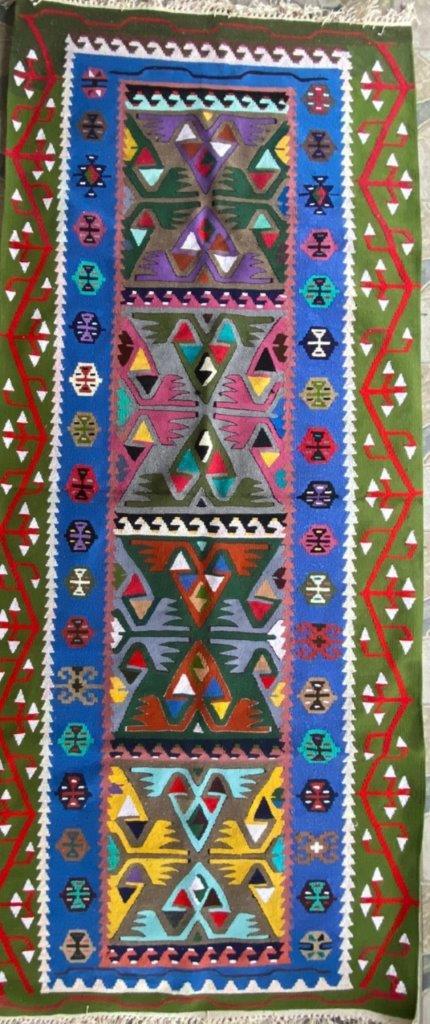
Alaca Camili Kilim is a handwoven carpet produced in the Alaca district of Çorum Province using traditional methods and registered with a geographical indication. It is made by dyeing wool threads with natural root dyes derived from sources such as soot, tetire herb, dried beetroot, and dye herb, then weaving them on ıstar looms or ip ağacı (warp frame). This carpet can be used both as a floor covering and as a wall hanging, featuring traditional motifs such as deveboynu, eliböğründe, ördekli, and sulupıtırak.
Alaca Camili Kilim is a traditional handwoven carpet unique to the Alaca district of Çorum Province. It is a product of the region’s long-standing weaving culture and is suitable for use both as a floor covering and as a wall hanging. Registered with a geographical indication, Alaca Camili Kilim is distinguished by its use of naturally dyed wool threads and its distinctive weaving technique. Key elements defining the product’s character include color compositions, the diversity of traditional motifs, arrangements of borders and central fields, weaving sequence, and technical details.
The threads used in weaving the carpet are made of wool. These threads are dyed using natural root dyes obtained through traditional methods from sources such as soot, tetire herb, dried beetroot, and dye herb. Over time, some productions have begun to incorporate commercially prepared threads. Initially, the color palette was limited to red, yellow, and black tones; over time, blue, green, brown, and their intermediate shades have also been incorporated into the designs.
The Alaca Camili Kilim is notable for its motif-based structure. The central motifs are arranged in boxed areas known as “top.” These tops are placed in square or rectangular forms at the center of the carpet and are woven in odd-numbered groups (1, 3, 5, 7, 9, 11), depending on the size of the carpet. Within each top, the same motif may be rendered in different colors, or each top may feature entirely different designs.
Among the motifs, traditional Turkish carpet patterns such as deveboynu, eliböğründe, mekikli, ördekli, sulupıtırak, and kıvrım stand out. Additional motifs include zincirli, karnıyarık, aynalı, çiftegül, koçboynuzu, and dal. Thin decorative bands, known as “arayol,” typically 2–3 cm wide, are used to separate the tops. These arayols are designed to harmonize with the border patterns.
The carpet features multiple border weavings. The outer border consists of repeating motifs that encircle all four sides of the carpet. Additionally, one or two inner borders may be present. On the long sides, three distinct motifs may be used; on the short sides, these motifs are continued or connected by zigzag transitions. The edge section, known as “etek,” marks the starting point of the weaving. The etek weaving integrates seamlessly with the border motifs, and tassels made from weft threads are attached to this area.
Alaca Camili Kilim is woven on traditional ıstar looms or ip ağacı frames. Before weaving begins, the warp threads are doubled and at least two rows of chain stitch are woven with the weft thread to prevent unraveling. Following this, the etek section is woven to a length of approximately 2 cm using white thread or the same threads used in the main weaving. Once the etek is completed, the motif weaving begins.
Motifs are applied within designated areas by weaving the thread back and forth using a thread color matching the background of that area. Specific motifs are selected for each border to form the border sections. The internal layout of the carpet is completed by weaving the boxed motifs separated by arayols. During weaving, threads are compacted using a tool called “kirkit,” and the weft threads are positioned with a comb. When weaving is finished, the etek section is rewoven, fringe is left intact, the warp threads are cut, and the ends are tied to complete the carpet.
The registered name of the Alaca Camili Kilim and its geographical indication appear on the product itself or its packaging. When direct application on the product is not feasible, these designations and symbols must be visibly displayed at the place of production.
Alaca Camili Kilim is produced exclusively within the boundaries of the Alaca district of Çorum Province. This weaving tradition, with a long history in the region, holds a significant place in the cultural and economic structure of Alaca. A historical and socio-economic reputation link exists between the kilim and the district. Therefore, all stages of production must be carried out within this geographical boundary.
The production processes and registration conditions of the Alaca Camili Kilim are monitored by a supervisory body established under the coordination of the Alaca Municipality. This body consists of six members, each representing the Alaca Subgovernorship, the Alaca District Directorate of Agriculture and Forestry, the Alaca Chamber of Commerce, the Alaca Craftsmen and Artisans Association, the Alaca Agricultural Chamber, and the Alaca Municipality. Monitoring inspections are conducted at least once annually; additional inspections may be carried out as needed or upon complaint. During inspections, the production materials, compliance with production methods, accuracy of product characteristics, and proper use of registration symbols are evaluated. Expert support from public or private sector professionals may be sought when necessary. The process of protecting legal rights is managed by the registering institution.
Turk Patent and Trademark Office. "Alaca Camili Kilimi - Tescil Belgesi ve Ürün Tanımı (PDF)." Accessed July 20, 2025. https://ci.turkpatent.gov.tr/Files/GeographicalSigns/72f1b615-cb8f-43de-8fc4-4f2e4f13e817.pdf.
Turk Patent and Trademark Office. "Alaca Camili Kilimi." *Geographical Indications Information System*. Accessed July 20, 2025. https://ci.turkpatent.gov.tr/cografi-isaretler/detay/8870.

Registration Number | 1578 | ||||||||
|---|---|---|---|---|---|---|---|---|---|
Registration Date | 19.04.2024 | ||||||||
Application Number | C2023/000092 | ||||||||
Application Date | 01.03.2023 | ||||||||
Name of the Geographical Indication | Alaca Camili Kilimi | ||||||||
Product / Product Group(s) | Kilim / Carpets and kilims | ||||||||
Type of Geographical Indication | Mahreç mark | ||||||||
Applicant/Registrant(s) | Alaca Municipality | ||||||||
Address of the Registrant | Denizhan Mah. Yozgat Cad. 21 Alaca ÇORUM | ||||||||
Geographical Boundary | Çorum Province Alaca District | ||||||||
General Characteristics
Materials and Dyeing
Motif and Design Features
Production Process and Technical Stages
Usage and Registration Procedure
Geographical Boundary and Reputation Link
Monitoring and Protection