

This article was automatically translated from the original Turkish version.
+2 More
The belief in Albastı (Al basması) has persisted across a wide region of Turkish cultural geography and in many other cultures, centering on the postpartum period and newborns, and involving faith in a malevolent and supernatural entity and the afflictions it causes. This belief is more than just a folk tale; it is the product of thousands of years of mythological and cultural accumulation.
This condition, commonly known as “Albasması” in folk tradition, has often been perceived as a mysterious illness leading to sudden illness, loss of consciousness, or death. In modern medicine, these symptoms are regarded as a cultural manifestation of Postpartum Syndrome, which encompasses psychological disorders such as intense anxiety, depression, or psychosis observed in women after childbirth.

Albastı Representational Image (Generated by Artificial Intelligence)
Albastı has been known by many names across different regions and dialects of the Turkish world. In Anatolia, the most common names are “Al,” “al karısı,” “al gelini,” “al anası,” or “albastı”; among the Turkmen it is called “Albası,” among the Kyrgyz “Albarsiı,” among the Karakalpaks and Nogay Turks “Albastı,” and among the Karachays and Balkars “Almaştı.” Among the Azerbaijani Turks, alternative names such as “Hal Helenesi” are also found.
Albastı is regarded as a malevolent evolution of the ancient Turkic spirit “Al,” who originally was a powerful and even protective deity in the early Turkic pantheon. The association of the word “Al” with fire cults suggests that Albastı may have originally been the deity of fire and hearth in the earliest periods. Over time, this protective spirit gave way to a malevolent and harmful entity.
The origins of this belief extend back to the Sumerian civilization and are linked to Lilith, a figure in Jewish tradition regarded as Adam’s first wife, who was believed to haunt newborns and postpartum women. This demonstrates the presence of malevolent female spiritual powers performing similar functions and targeting similar victims across diverse cultural geographies. Furthermore, the fact that in some beliefs the Red Albastı is regarded as the mother of humanity suggests she may be a mythological counterpart to Umay, the protective deity, both originating from the same fire cult but embodying opposing forces.
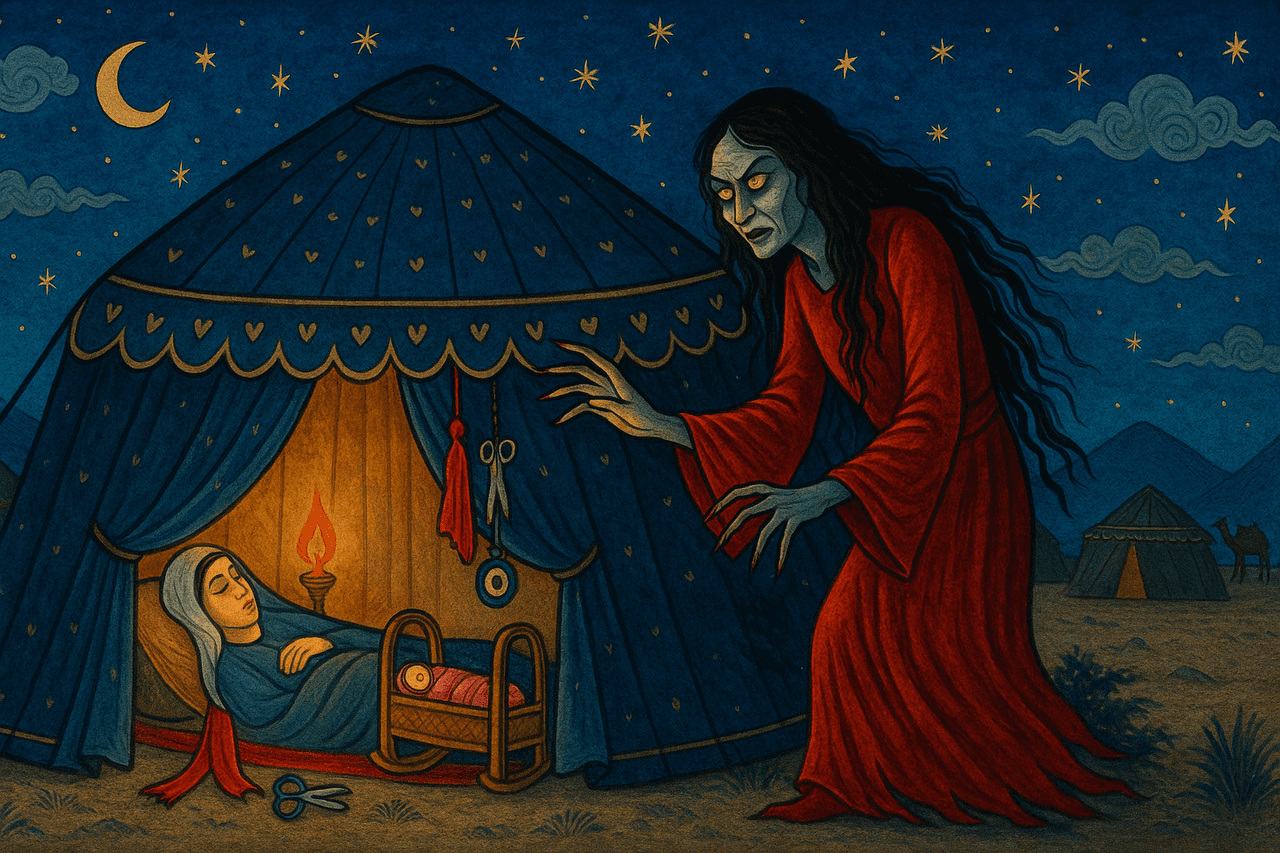
Albastı Representational Image (Generated by Artificial Intelligence)
Although Albastı is primarily associated with postpartum women and newborns, its influence extends to a broader range of individuals. The focus on these vulnerable groups has given rise to a cultural imperative to protect mothers and infants during this delicate period.
The most feared action attributed to Albastı is the belief that it tears out the lungs of the birthing woman or the newborn and either throws them into water or consumes them, causing sudden death. It is also believed to descend upon sleeping individuals and suffocate them; this condition is known as “Albastı illness.” According to the belief, this entity can also affect men, newly married brides, and deceased persons in houses of mourning. Moreover, Albastı does not limit its influence to humans—it also possesses animals.
It is believed to dwell in stables, where it exhausts horses by forcing them to run throughout the night and takes pleasure in braiding their manes. Horses found tired and sweaty in the morning are thought to have been ridden by Albastı. This belief also served a social function by necessitating constant supervision of horses.
The physical depiction of Albastı varies greatly depending on the region and the spirit it embodies, and it is often described as capable of shape-shifting (metamorphosis). Generally, it is portrayed as gigantic in size, with long fingers, long coppery nails, a grotesque face, and an enormous head.
Its hair is long, black, and disheveled; its feet may be reversed. It is commonly said to wear a red garment, though it is also sometimes seen in yellow or black clothing. In Turkish belief, there are three main types of Albastı: Black Albastı (Martu), which is serious and solemn, often causes death, and is the most dangerous variant; Red Albastı (“Red Woman”), who in some beliefs is regarded as the mother of humanity; and Yellow Albastı, appearing as a blonde woman with a mischievous and deceitful nature, but less dangerous than the Black Albastı.
In some regions, male forms of Albastı also appear. For example, research conducted in the Saratlı region of Aksaray identified not only the “Al Karısı” (ugly old woman) and “Al Gelini” (beautiful bride) types, but also a male variant composed of three men. In epic tales, Albastı appears as a male figure—a villainous alp (Alp Bastı)—who abducts virtuous women. It is generally believed to inhabit secluded, desolate areas near water sources such as springs or rivers.

Albastı Representational Image (Generated by Artificial Intelligence)
Methods of protection against Albastı have evolved from a fusion of ancient Turkish beliefs (Shamanism) and practices introduced after the advent of Islam. Protection is achieved through material objects, symbolic colors, and the presence of specific individuals.
Material and Symbolic Measures: Iron and sharp objects such as knives, scissors, sickles, locks, and iron coins are placed beside the postpartum woman. Iron was considered sacred by the ancient Turks and possesses protective qualities. The color red, symbolizing power and fire, is used by tying a red scarf or ribbon around the woman’s head. It is believed that loud noises, firing guns, or striking the lid of a cooking pot will scare Albastı away, as it fears the sound of iron. Additionally, the Qur’an, amulets (hamaylı), and the smoke of oregano are also used as protective measures.
Social Measures: Since it is believed that Albastı fears men, the primary protective practice is to ensure the postpartum woman is never left alone for forty days, the room is kept continuously lit, and a man—preferably a young boy—is stationed beside her.
Ocaklı Individuals: Those descended from individuals known as “ocaklı” or “alcı”—people who have captured Albastı or were born with this innate ability—are protected from its influence. Placing their personal belongings (sword, knife, jacket) beside the postpartum woman is considered a definitive safeguard.
Capture and Servitude: The most common method of capturing Albastı is to thrust a needle or pin into its chest while it is attempting to steal the lungs. Unable to remove the needle itself, Albastı becomes captive and serves the family for a period of time.
Avcı, Gülmira Moldosultanova, and Eliza Borubayeva. "Kırgızlarda 'Albarstı' İle İlgili İnançlar (Narın ve Isık-Köl Bölgeleri Örneğinde)." *Akademik Tarih ve Düşünce Dergisi* 6, no. 3: 1802-1815. https://dergipark.org.tr/en/download/article-file/829862.
Bekdemir, Ali. "Albastı İnancının Halk Tasavvuruna Yansıması: Saratlı Bölgesi Örneği." *Antropoloji ve Kültürel Bakış Dergisi* 7, no. 2: 63-76. http://antropolojidernegi.org/wp-content/uploads/2024/03/7-Antropoloji-Dergi-2.SAYI-ALI-BEKDEMIR.pdf.
Dursun, Havva Eylem. "Şan Kızı Destanı’ndaki Albastı İle Türk Halk İnançlarındaki Albastının Mukayesesi." *Kültürk* 5 (2022): 11-20. https://dergipark.org.tr/en/download/article-file/2241602.
Duvarcı, Ayşe. "Türklerde Tabiat Üstü Varlıklar ve Bunlarla İlgili Kabuller, İnanmalar, Uygulamalar." *Bilig* 32 (2005): 125-144. https://dergipark.org.tr/en/download/article-file/234413.
Kılıç, Yusuf, and Elvan Eser. "Lohusalık Sendromu (Al ana/Alkarısı/Albastı)’nun Eskiçağ Yakındoğu Toplumlarının Kültürlerindeki İzleri: Lilith Gerçeği." *Akademik Tarih ve Düşünce Dergisi* 5, no. 17 (Prof. Dr. Hüseyin Sever Armağan Sayısı) (2018): 29-60. https://dergipark.org.tr/en/download/article-file/615720.
Şimşek, Esma. "Türk Kültüründe “Alkarısı” İnancı ve Bu İnanca Bağlı Olarak Anlatılan Efsaneler." *Akra Kültür Sanat ve Edebiyat Dergisi* 5, no. 12 (2017): 99–115. https://dergipark.org.tr/en/download/article-file/324076.

Names and Mythological Origins
Targets and Actions
Physical Characteristics and Regional Variants
Protection and Healing Methods