


This article was automatically translated from the original Turkish version.
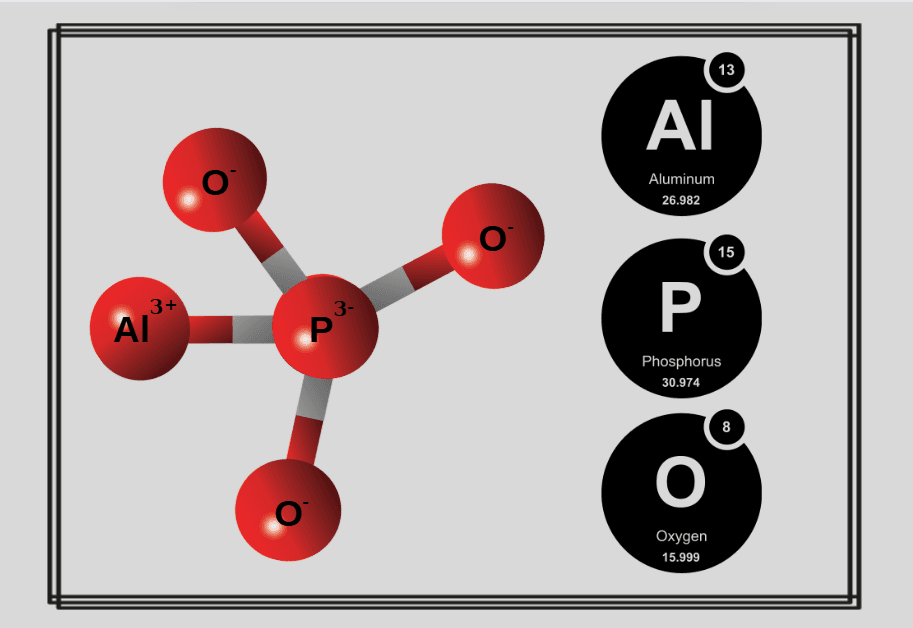
Image: Oksana Gülünay
Aluminum Phosphite (AlPO₃) Molecular Structure
Formula | Physical State: Powder/granule or coated form Density: ~2.56 g/cm³ Molecular Weight: 61.95 g/mol AlPO₃ | ||||||||
|---|---|---|---|---|---|---|---|---|---|
Properties | Does not emit flammable gases Thermal stability up to 300°C Very low water solubility (~0.1 g/100 mL) Low reactivity and toxicity | ||||||||
Applications | Semiconductor in electronic and optical applications Fungicide and pesticide in agriculture (limited use) Flame retardant and heat stabilizer (plastic/rubber/wood) | ||||||||
Production | Modern method: nano-crystal synthesis and microwave-assisted purification Industrial temperature: 80-100°C in aqueous medium Controlled reaction of aluminum compounds with phosphoric acid derivatives | ||||||||
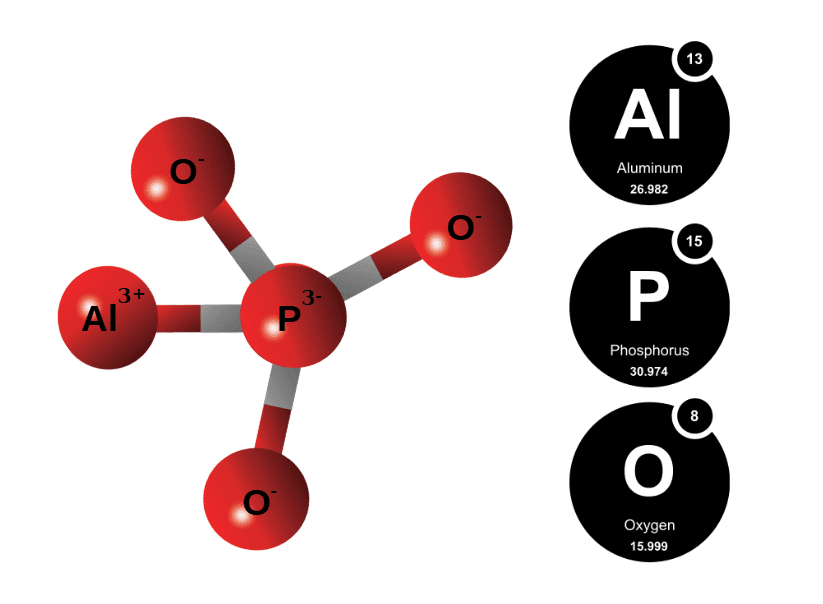
Aluminum Phosphite (AlPO3) Molecular Structure (Image: Oksana Gülünay)
Aluminum phosphite is a non-hygroscopic solid in the form of white to off-white crystalline powder. In its pure state it appears bright white but may exhibit slight yellowish tones due to industrial impurities. Its molecular formula is AlPO₃ with a molecular weight of 61.95 g/mol. At room temperature it exists as a solid and can be either amorphous or crystalline; in its crystalline form it adopts an orthorhombic structure with a density of approximately 2.56 g/cm³.
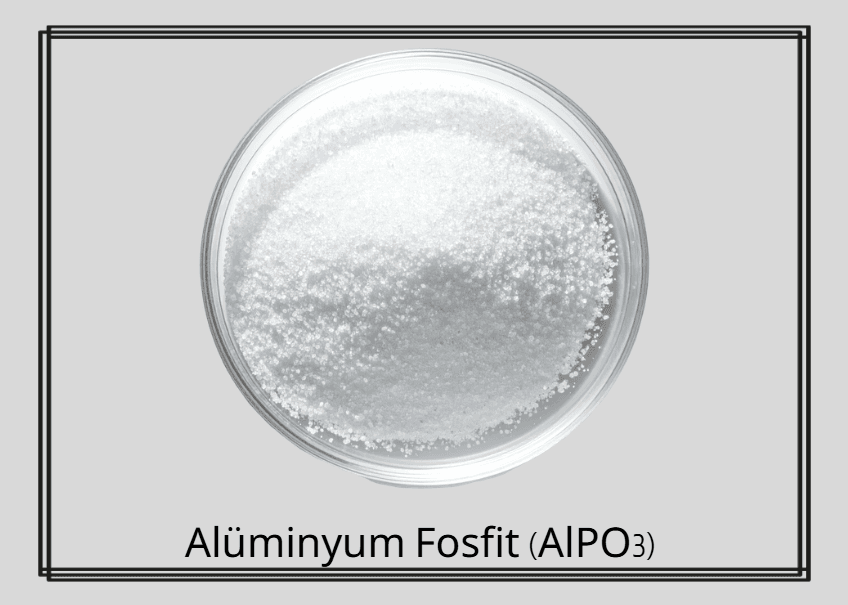
Aluminum Phosphite (AlPO3) Crystal Structure (Image: Oksana Gülünay)
Its solubility in water is low (approximately 0.1 g/100 mL), meaning it dissolves only partially and remains stable in aqueous environments. It reacts with strong acids or bases to produce phosphoric acid derivatives but demonstrates thermal stability up to 300°C in its dry form. The reaction is not exothermic and does not release flammable gases.
Reaction equation in acidic medium (e.g. with HCl):
This reaction supports the flame-retardant mechanism by promoting carbonization through the formation of phosphoric acid.
Aluminum phosphite has a chemically "oxidizing" character and enhances heat resistance in polymer matrices. It also exhibits semiconducting properties in electronic and optical applications, characterized by a wide bandgap (approximately 5–6 eV). Its physical structure is processed in industrial formulations as powder, granules, or coated forms.
Aluminum phosphite is synthesized through the controlled reaction of aluminum compounds with phosphorous acid derivatives. The traditional method involves the reaction between aluminum hydroxide (Al(OH)3) or aluminum oxide (Al2O3) and phosphorous acid (H3PO3):
On an industrial scale, the reaction is carried out in an aqueous medium at 80–100°C under stirring; the resulting precipitate is separated by centrifugation and dried for 16 hours at 200°C. Alternative syntheses include the reaction of aluminum chloride (AlCl3) with sodium phosphite (Na2HPO3) or the use of aluminum sulfate (Al2(SO4)3) with phosphorous acid.
The production process is conducted in closed reactors under an inert gas atmosphere (e.g. nitrogen); by-products (water, salts) are removed by filtration. Modern methods incorporate microwave-assisted synthesis and purification technologies for producing nano-crystalline forms. Global production is driven by demand from the plastics industry and is dominated by the Asia-Pacific region (China, India). Patents (e.g. "flame retardant compositions") optimize composite formulations containing 20–30% (AlPO3) with binders and fillers. 【1】
In Türkiye, aluminum phosphite is imported as an industrial chemical with limited domestic production. Chemical industry companies, particularly polymer processors, use it as a flame-retardant additive. It is registered under the KKDİK Regulation (Registration, Evaluation, Authorization and Restriction of Chemicals), which is analogous to REACH. It holds limited licensing for pesticide formulations; in the Ministry of Agriculture and Forestry’s BKÜ (Biological Control Product) database, it is listed as "Licensed" as a fungicide (products containing 10–20% AlPO3).
Sales are restricted to industrial suppliers and residential use is prohibited. Application is monitored by certified companies. 【2】
The production of pure forms of AlPO₃ is carried out in a limited number of specialized chemical facilities in Türkiye. Domestic production primarily serves domestic consumption in areas such as composite materials, plastic additives, flame-retardant modified products, and phosphate-based surface coating chemicals.
Production complies with quality and safety standards including TS EN 1289, ISO 9001, ISO 14001, and ISO 45001.
The chemical is predominantly imported from countries such as Germany, China, India, and the United States in technical-grade or flame-retardant-grade form with purity exceeding 98%. Imports are regulated under the Ministry of Trade’s “Regulation on the Import of Chemical Substances.” The customs classification falls under G.T.İ.P. 2835.39 – Phosphites and Phosphates.
AlPO₃ is among the substances required to be registered under Türkiye’s KKDİK (Registration, Evaluation, Authorization and Restriction of Chemicals) Regulation. The KKDİK Regulation is a chemical management system aligned with the European Union’s REACH legislation, governing the registration, evaluation, authorization, and restriction processes for the production, import, and market placement of chemical substances in Türkiye.
Under this regulation, all chemical substances produced or imported in Türkiye in quantities of 1 ton or more annually must be registered with the Ministry of Environment, Urbanization and Climate Change, accompanied by safety data sheets, chemical risk assessments, and necessary measures to protect human health and the environment. KKDİK aims to ensure safe chemical management by assigning responsibilities across all stages from market placement to use, to industry, importers, and distributors. 【3】
Commercial trade of AlPO₃ in Türkiye is conducted exclusively through licensed firms operating in the field of industrial chemical supply.
Under ADR/CLP, AlPO₃ is not classified as a hazardous substance and therefore does not fall under any special category mandated by ADR for transport. However, due to its fine particulate structure, it may pose risks of dust explosion and mechanical irritation, necessitating safety measures during storage and processing. In this context, storage practices in Türkiye should comply with TS 1449 Standard for Protection Against Dust Explosion Risks, including adequate ventilation, avoidance of ignition sources, and measures to prevent electrostatic charging. These approaches ensure compliance with CLP’s physical hazard categories and promote safe storage practices. 【4】
Aluminum phosphite is a low-toxicity substance; the oral lethal dose (LD50) in rats exceeds 2000 mg/kg, placing it in EPA Toxicity Category IV (low risk). The primary mechanism of effect is respiratory irritation due to dust inhalation; systemic poisoning is rare. Skin contact may cause mild irritation but does not release gases such as phosphine. 【5】
The potential for poisoning from AlPO₃ is associated with the following mechanisms:
Chronic exposure at low doses may increase the risk of pulmonary fibrosis, although mortality rate is <1%.【6】
No specific antidote is required; treatment is symptomatic. In cases of dust exposure, eye and face rinsing and respiratory support are applied. Activated charcoal may be administered if ingested.
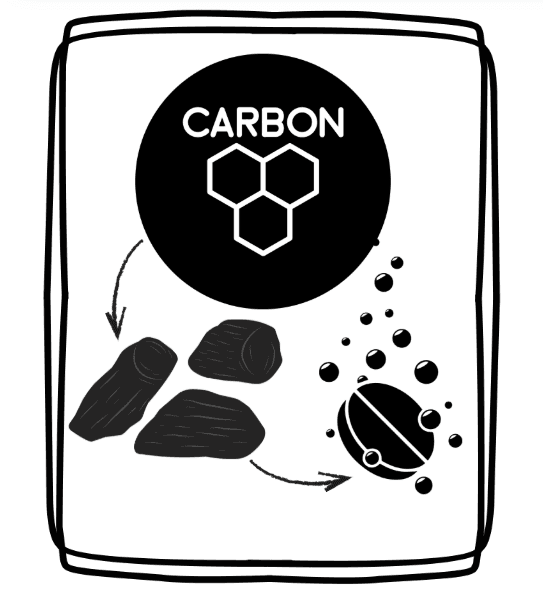
Activated Charcoal – Industrial Production Process (Image: Oksana Gülünay)
The general principles of treatment aim to first remove the exposed individual from the chemical source to prevent further contact. Subsequent basic decontamination steps include washing with clean water and providing fresh air to reduce irritation in the eyes and respiratory tract.
In case of skin contact, the affected area should be gently cleaned with copious amounts of water and any potential reactions controlled. If symptoms such as respiratory distress, pronounced eye irritation, dizziness, or general deterioration occur, the individual must be referred to medical facilities and evaluated by specialists. This approach forms the foundation of early and effective symptomatic management in low-toxicity AlPO₃ exposures. 【7】
Use of dust masks, gloves, and goggles is mandatory during work. Ventilation must be provided in enclosed areas and dust generation minimized. In emergencies, fresh air and medical assistance must be obtained. 【8】

Protective Equipment Guide (Image: Oksana Gülünay)
Aluminum phosphite is classified as a "corrosive solid" under the UN (United Nations Number) list (UN 3260) and is registered under REACH (EC) No 1907/2006. The EPA has approved it as a flame retardant, with professional use mandatory. FAO/WHO (Food and Agriculture Organization of the United Nations and World Health Organization) classify it as low risk in agricultural fungicide guidelines. 【9】
In the European Union, it is regulated under the EU Biocidal Products Regulation (EU) No 528/2012. In the United States, the EPA lists it as an industrial chemical under TSCA (Toxic Substances Control Act). Licensing is granted only to trained operators.
REACH is the European Union’s comprehensive chemical management legislation governing the production, import, and market placement of chemical substances. The regulation requires all chemicals present in quantities of 1 ton or more annually on the market to be registered with the European Chemicals Agency (ECHA), evaluated for safety data, subject to authorization if posing high risks to human health or the environment, and restricted if harmful. REACH ensures that producers and importers bear the responsibility of proving chemical safety, aiming to protect the environment and promote safe, sustainable production and trade within the European chemical sector.
Under GHS (Globally Harmonized System of Classification and Labelling of Chemicals), it is labeled as an "Irritant Solid" (Eye Irrit. 2, STOT SE 3). The CLP (Classification, Labelling and Packaging) Regulation defines packaging and labeling standards.
Aluminum phosphite is transported under ADR (Accord européen relatif au transport international des marchandises Dangereuses par Route) Class 8 (corrosive); moisture-resistant, airtight packaging is mandatory. IMDG (International Maritime Dangerous Goods Code) and IATA (International Air Transport Association) regulations impose similar requirements for sea and air transport. Storage must be in dry (<50% RH), cool (<25°C), and ventilated areas in accordance with FAO/OSHA (Food and Agriculture Organization of the United Nations and Occupational Safety and Health Administration) guidelines; CO2 is recommended for fire suppression. Damaged products are sent to disposal facilities.
Warning: The content provided herein is for general encyclopedic informational purposes only. These data must not be used for diagnosis, treatment, or medical guidance. Before making any health-related decisions, you must consult a physician or qualified healthcare professional. The author and KÜRE Encyclopedia assume no liability for any consequences arising from the use of this information for diagnostic or therapeutic purposes.
ADR Book. "UN 3260" ADR Book. Accessed November 23, 2025. https://adrbook.com/tr/2017/UN/3260
Ambic Organic. "Annexure-I: List of Products & Raw Materials (Aluminum Phosphide Production)." Date Published October 5, 2016. Accessed
Bennett, J., Nakano, A., Nakano, J., and Thomas, H. "Aluminum Phosphate Phase Changes Caused by the Exposure Environment" (2022). Accessed November 23, 2025. https://www.osti.gov/servlets/purl/1598988
Cai, Guoshuai, Jiaxuan Wu, Jiayi Guo, Yange Wan, Qingjun Zhou, Pengyu Zhang, Xiaolei Yu, and Mingchao Wang. "A Novel Inorganic Aluminum Phosphate-Based Flame Retardant and Thermal Insulation Coating and Performance Analysis." *Materials* 16, no. 13: 4498, 2023. Accessed November 23, 2025. https://www.mdpi.com/1996-1944/16/13/4498
ChemSpider. "Aluminum Phosphite | AlO₃P." ChemSpider. Accessed November 23, 2025. https://www.chemspider.com/Chemical-Structure.9746558.html
EPA (U.S. Environmental Protection Agency). Provisional Peer Reviewed Toxicity Values for Aluminum Compounds. Washington, DC: EPA, 2017. Accessed November 23, 2025. https://nepis.epa.gov/Exe/ZyNET.exe/P1012H2K.TXT?ZyActionD=ZyDocument&Client=EPA&Index=2006+Thru+2010&Docs=&Query=&Time=&EndTime=&SearchMethod=1&TocRestrict=n&Toc=&TocEntry=&QField=&QFieldYear=&QFieldMonth=&QFieldDay=&IntQFieldOp=0&ExtQFieldOp=0&XmlQuery=&File=D%3A%5Czyfiles%5CIndex%20Data%5C06thru10%5CTxt%5C00000046%5CP1012H2K.txt&User=ANONYMOUS&Password=anonymous&SortMethod=h%7C-&MaximumDocuments=1&FuzzyDegree=0&ImageQuality=r75g8/r75g8/x150y150g16/i425&Display=hpfr&DefSeekPage=x&SearchBack=ZyActionL&Back=ZyActionS&BackDesc=Results%20page&MaximumPages=1&ZyEntry=1&SeekPage=x&ZyPURL
Environmental Impact Assessment Permit and Inspection General Directorate. "KSTK Regulation Applications - Chemical Industry Sector." Ministry of Environment and Urbanization. Accessed November 23, 2025. https://ced.csb.gov.tr/kstk-yonetmeligi-uygulamalari---kimya-sanayisi-sektoru-haber-285355
Erkan, Dilek. "KKDİK Yönetmeliği Sunumu." Ministry of Environment and Urbanization. Date Published December 25, 2020. Accessed November 23, 2025. https://kimyasallar.csb.gov.tr/uploads/file/KKDİK%20sunum-KİPLAS2.pdf
Ministry of Agriculture and Forestry. "Active Ingredient Details, 57% Aluminium Phosphide." Ministry of Agriculture and Forestry, Plant Protection Products Directorate. Accessed November 23, 2025. https://bku.tarimorman.gov.tr/AktifMadde/Details/126
Ministry of Agriculture and Forestry. "Guide to the Regulation on Maximum Residue Limits of Pesticides in the Turkish Food Code." Accessed November 23, 2025. https://www.tarimorman.gov.tr/GKGM/Belgeler/DB_Gida_Kont/TGK_Pestisitlerin_Maksimum_Kalinti_Limitleri_Yonetmeligi_Rehberi.pdf
Ministry of Environment and Urbanization. "Regulation on Safety Data Sheets for Hazardous Substances and Mixtures." Official Gazette, no. 29204, December 13, 2014. Accessed November 23, 2025. https://kimyasallar.csb.gov.tr/uploads/file/Zararlı%20Maddeler%20ve%20Karışımlara%20İlişkin%20Güvenlik%20Bilgi%20Formları%20Hakkında%20Yönetmelik.pdf
National Institute for Occupational Safety and Health (NIOSH), “Aluminum” NIOSH Pocket Guide to Chemical Hazards. Accessed November 23, 2025.
United Nations. "Accord relatif au transport international des marchandises dangereuses par route (ADR)." United Nations iLibrary. Accessed November 23, 2025. https://www.un-ilibrary.org/content/periodicals/30070872
World Health Organization. "WHO Specifications for Pesticides." WHO Prequalification of Medical Products. Accessed November 23, 2025. https://extranet.who.int/prequal/vector-control-products/who-specifications-pesticides
[1]
Ambic Organic. "Annexure-I: List of Products & Raw Materials (Aluminum Phosphide Production)." 5 Ekim 2016. Erişim Tarihi 23 Kasım 2025. https://environmentclearance.nic.in/writereaddata/Online/TOR/05_Oct_2016_122007250F8M0QKVKAdditionalAttachment.pdf
[2]
Tarım ve Orman Bakanlığı. "Bitki Koruma Ürünleri Veri Tabanı." Tarım ve Orman Bakanlığı Bitki Koruma Ürünleri Daire Başkanlığı. Erişim tarihi 23 Kasım 2025. https://bku.tarimorman.gov.tr/AktifMadde/Details/126
[3]
Erkan, Dilek. "KKDİK Yönetmeliği Sunumu." Çevre ve Şehircilik Bakanlığı. Yayınlanma Tarihi 25 Aralık 2020. Erişim tarihi 23 Kasım 2025.
[4]
Çevre ve Şehircilik Bakanlığı. "Zararlı Maddeler ve Karışımlara İlişkin Güvenlik Bilgi Formları Hakkında Yönetmelik." Resmî Gazete, no. 29204 (13 Aralık 2014). PDF. Erişim tarihi 23 Kasım 2025. https://kimyasallar.csb.gov.tr/uploads/file/Zararlı%20Maddeler%20ve%20Karışımlara%20İlişkin%20Güvenlik%20Bilgi%20Formları%20Hakkında%20Yönetmelik.pdf
[5]
Bennett, J. “Aluminum Phosphate Phase Changes Caused by the …” OSTI Technical Report, 2019.
Erişim 23 Kasım 2025. https://www.osti.gov/servlets/purl/1598988
[6]
Cai, Guoshuai, Jiaxuan Wu, Jiayi Guo, Yange Wan, Qingjun Zhou, Pengyu Zhang, Xiaolei Yu, and Mingchao Wang. "A Novel Inorganic Aluminum Phosphate-Based Flame Retardant and Thermal Insulation Coating and Performance Analysis" Materials 16, no. 13: 4498, 2023. Erişim 23 Kasım 2025. https://www.mdpi.com/1996-1944/16/13/4498
[7]
EPA (U.S. Environmental Protection Agency).Provisional Peer Reviewed Toxicity Values for Aluminum Compounds. Washington, DC: EPA, 2017.
Erişim 23 Kasım 2025. https://www.epa.gov
[8]
Tarım ve Orman Bakanlığı. "Türk Gıda Kodeksi Pestisitlerin Maksimum Kalıntı Limitleri Yönetmeliği Rehberi." Erişim Tarihi 23 Kasım 2025. https://www.tarimorman.gov.tr/GKGM/Belgeler/DB_Gida_Kont/TGK_Pestisitlerin_Maksimum_Kalinti_Limitleri_Yonetmeligi_Rehberi.pdf
[9]
World Health Organization. "WHO Specifications for Pesticides." WHO Prequalification of Medical Products. Erişim Tarihi 23 Kasım 2025. https://extranet.who.int/prequal/vector-control-products/who-specifications-pesticides

Image: Oksana Gülünay
Aluminum Phosphite (AlPO₃) Molecular Structure
Formula | Physical State: Powder/granule or coated form Density: ~2.56 g/cm³ Molecular Weight: 61.95 g/mol AlPO₃ | ||||||||
|---|---|---|---|---|---|---|---|---|---|
Properties | Does not emit flammable gases Thermal stability up to 300°C Very low water solubility (~0.1 g/100 mL) Low reactivity and toxicity | ||||||||
Applications | Semiconductor in electronic and optical applications Fungicide and pesticide in agriculture (limited use) Flame retardant and heat stabilizer (plastic/rubber/wood) | ||||||||
Production | Modern method: nano-crystal synthesis and microwave-assisted purification Industrial temperature: 80-100°C in aqueous medium Controlled reaction of aluminum compounds with phosphoric acid derivatives | ||||||||
No Discussion Added Yet
Start discussion for "Aluminum phosphite (AlPO₃)" article
Chemical Properties
AlPO₃ + 3HCl → AlCl₃ + H₃PO₃
Production
2Al(OH)₃ + 2H₃PO₃ → 2AlPO₃ + 6H₂O
AlCl₃ + Na₂HPO₃ → AlPO₃ + 2NaCl + HCl
Production and Licensing Status in Türkiye
Domestic Production
Imports
KKDİK Scope
Residential and Retail Use
Sales and Supply Chain
Regulation and Inspection
Industrial Use Restrictions
Toxicity and Health Effects
Acute Effects
Poisoning Treatment
Precautions and Emergency Measures
International Regulations
Pesticide Licensing and Inspection
Hazardous Substances Classification
Transport and Storage Regulations