


This article was automatically translated from the original Turkish version.
+2 More
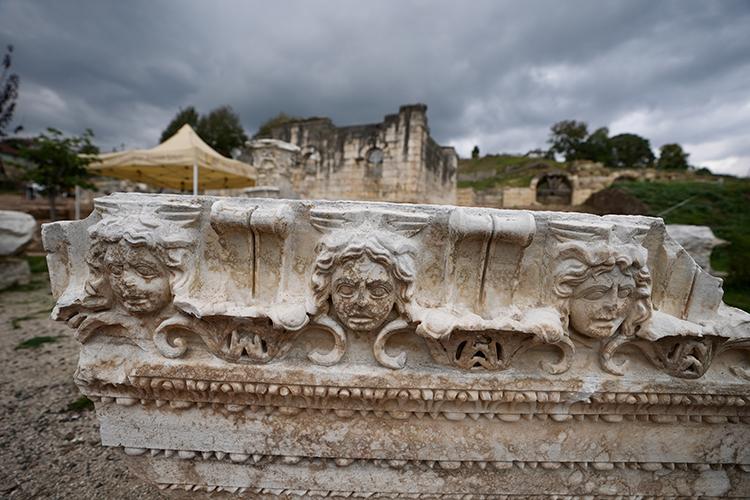
Prusias ad Hypium is an ancient Greek colony located in the eastern part of ancient Bithynia, within the modern boundaries of the Konuralp neighborhood in Düzce Province, Türkiye. During the Roman Imperial period, it experienced prolonged development as one of the leading cities of the region in political, economic, and cultural terms. The city’s remains have been partially uncovered through archaeological excavations and present a historical panorama through its theater, aqueducts, agora, baths, bridge, walls, and epigraphic documents.

Amphitheater (AA)
Prusias ad Hypium is situated along the banks of the Hypios River, frequently mentioned in ancient sources and known today as the Melen River. The expression “Prusias pros Hypio” or its Latin form “Prusias ad Hypium” means “Prusias opposite Hypios.” The city’s acropolis is located on a hill above the modern settlement of Konuralp. This topography provided natural defense for the city and conferred strategic importance due to its proximity to east-west trade routes.
The city was surrounded by Herakleia Pontika to the north, Claudiopolis (Bolu) to the east, Nikomedia (Izmit) to the west, and Nikaia (İznik) to the south. During the Roman period, Prusias ad Hypium’s western boundary extended along the Hypios River, while its eastern boundary passed through regions rich in mineral resources, bordering Bithynion/Claudiopolis.
Prusias ad Hypium Ancient City (HT History of Science Philosophy)
The city’s earliest name was Kieros, believed to have been given by colonists originating from Boeotia-Megara during the Greek colonization period. Established as part of the hinterland of Herakleia Pontika, the settlement initially developed as a dependency of Herakleia. During the reign of Prusias I (228–182 BCE), the city came under the control of the Kingdom of Bithynia and was renamed Prusias pros Hypio in honor of the king. In the Roman period, the Latin form Prusias ad Hypium was used.
Prusias ad Hypium came under Roman rule in 74 BCE following the bequest of Bithynia to Rome. Its status was defined by the Lex Pompeia, making it one of the principal cities of a senatorial province. The city had twelve phyles (tribes), whose names reflect both the legacy of Greek colonists and Roman emperors (e.g., Megaris, Thebais, Dionysias, Prusias; later Hadriane, Faustiniane, Antoniane).
Epigraphic sources record numerous public offices such as dekaprotos, agoranomos, prytanis, grammateus, and sebastophantes, indicating that Prusias ad Hypium exhibited the typical characteristics of a Roman municipium.
The city possessed a rich network of public buildings. The main structures surviving to the present day include:
According to epigraphic and archaeological evidence, a wide variety of gods and goddesses were worshipped in the city. Cults of Zeus Soter, Demeter, Artemis, Dionysos, Asklepios-Hygeia, Aphrodite Epekoos, Serapis-Apis, Kybele, and Helios were strongly represented. The imperial cult was also highly developed; emperors were deified and rituals were conducted through priestly classes such as sebastophantes and hierophantes. It is also known that Christian influences began to appear in the city during Late Antiquity.
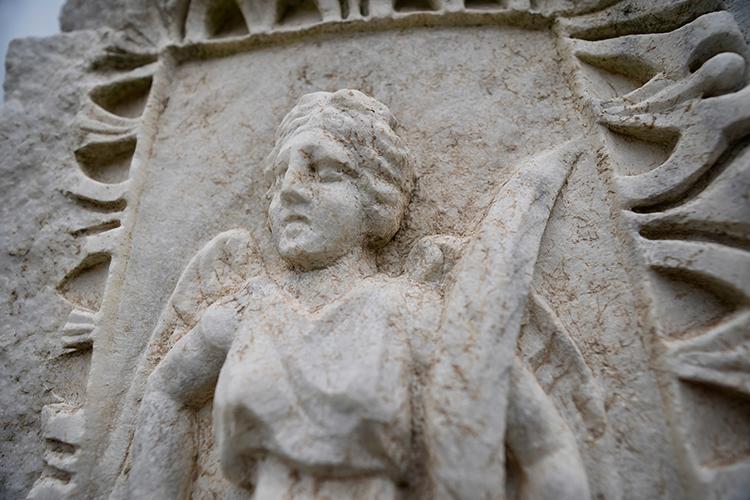
Example of Figurative Sculpture from the Ancient City (AA)
During the Roman Imperial period, Prusias ad Hypium became a significant trading hub between the Black Sea and the interior of Anatolia. Through its port emporia named Dia, Lilaion, and Elaios, the city maintained commercial relations with Olbia (Ukraine), Tomis (Romania), and the Kingdom of the Bosporus. Agriculture, animal husbandry, and especially cheese production were central to its economy. The city’s advantageous location at the intersection of land routes and its access to river transport via the Hypios River granted it significant logistical advantages.
A large number of inscriptions and coins have been recovered that illuminate the city’s history. Walter Ameling’s work Die Inschriften von Prusias ad Hypium compiles over 200 inscriptions. These texts mention both local officials and Prusian senators and soldiers serving in the Roman bureaucracy (e.g., Flavius Domitianus Nestor, Domitius Paulianus Falco, Lucius Domitius Proclus). During the Roman period, the city held the right to mint autonomous coinage; coins feature both mythological figures and imperial portraits.
In the third century, Gothic incursions prompted the construction of defensive walls and a shift toward militarized policies; this led to a decline in trade and economic stagnation. Although the city’s prosperity diminished after the Gothic attacks, its religious and administrative structures persisted for some time. During the reign of Theodosius, the city was included within the province of Honorias and became a bishopric center.

Mosaic from the Ancient City (AA)
Prusias ad Hypium was a politically and economically significant center in northwestern Anatolia during the Roman Imperial period. It is a city of considerable historical importance due to its public architecture, rich epigraphic corpus, and long-standing settlement history. The structures and inscriptions uncovered through excavations today provide a vital example for understanding urban life in Roman Anatolia.
Anadolu Ajansı. “Prusias ad Hypium Antik Kentinde Kazı Çalışmalarında Sona Gelindi.” Anadolu Ajansı. Accessed May 15, 2025.
Düzce Belediyesi. “Konuralp Prusias Ad Hypium Antik Kenti.” *Kent Portal*. https://kentportal.duzce.bel.tr/konuralp-prusias-ad-hypium-antik-kenti/. Accessed May 15, 2025.
HT Bilim Tarih Felsefe. "Prusias ad Hypium Antik Kenti | Geçmişin İzinde." YouTube, Date Published: October 11, 2020. Accessed May 20, 2025. https://www.youtube.com/watch?v=FvmQ_ysqsag
Höyük Bilgi Sistemi. "Prusias ad Hypium." *Hoyuk.gov.tr*. https://hoyuk.gov.tr/tam-metin/62/tur. Accessed May 15, 2025.
Karakuş, Onur Sadık. *Roma İmparatorluk Döneminde Prusias ad Hypium*. Master's thesis, Anadolu Üniversitesi, 2017. ProQuest Dissertations & Theses Global. https://www.proquest.com/docview/2570366369?pq-origsite=gscholar.
Ministry of Culture and Tourism. "Antik Şehir Prusias ad Hypium - Konuralp." *Kültür Portalı*. https://www.kulturportali.gov.tr/turkiye/duzce/gezilecekyer/antk-sehr-prusias-ad-hypium-konuralp. Accessed May 15, 2025.

No Discussion Added Yet
Start discussion for "Ancient City of Prusias ad Hypium" article
Geographical Location and Historical Geography
Foundation and Nomenclature in Antiquity
Urbanization and Administrative Structure in the Roman Period
Architecture and Urban Fabric
Religious Life and Cults
Economic Structure and Trade
Epigraphic and Numismatic Evidence
Late Antiquity and Decline