+1 More

Location | Konuralp Town Düzce / Turkey Düzce-Akçakoca Highway | ||||||||
|---|---|---|---|---|---|---|---|---|---|
Opening Date(s) | 2003 | ||||||||
Affiliated Institution | Ministry of Culture and Tourism | ||||||||
Total Number of Artifacts | 6.237 (1.848 archaeological, 491 ethnographic, 3.898 coins) | ||||||||
Museum Sections | Archaeology Hall, Ethnography Hall, Stone Artifacts Hall, Coin Sections, Conference Hall, Laboratory and Storage, Outdoor Exhibits | ||||||||
Highlight Artifacts | Tyche Statue (Moulage), Orpheus Mosaic, God Janus Statue, 1st-century Roman Sarcophagus, Achilles and Thetis Mosaic | ||||||||
Düzce Konuralp Museum, located in the town of Konuralp in the central district of Düzce province along the Düzce-Akçakoca highway, was opened to visitors in 2003. The museum was established to preserve and exhibit the rich cultural heritage of the Prusias ad Hypium Ancient City. Construction of the museum building began in 1977 and was completed in 1992. Initially operating as a unit affiliated with Bolu Museum, the museum attained directorate status in December 2009. The building consists of three exhibition halls (archaeology, ethnography, and stone artifacts), two coin sections, a laboratory, two storage rooms, a conference hall, and administrative offices.
The museum's collection includes a total of 6,237 artifacts, consisting of 5,746 archaeological artifacts (of which 3,898 are coins) and 491 ethnographic items. The artifacts are presented to visitors in chronological and thematic arrangements.
In the archaeology hall, artifacts from the Bronze Age (3000–2000 BCE) to the Eastern Roman period (395–1453 CE) are displayed. These include terracotta and marble figurines, metal objects, jewelry, glass containers, and grave offerings. Among the exhibited objects are flasks, lamps, unguentaria, alabastrons, weights, pots, amphorae, bronze ornaments and jewelry, glass cups, and goblets. The coin section of the archaeology hall displays gold, silver, and bronze coins from the Bithynia (Prusias), Roman, and Ottoman periods.
One of the most notable pieces in the archaeology hall is the Tyche Statue. This statue was found during excavations at the Konuralp Ancient City, and its original is exhibited at the Istanbul Archaeology Museum. The museum displays a moulage (cast replica) of the statue. The artifact is a copy made during the Roman period in the 2nd century CE of a statue originally dating back to the 4th century BCE. In Greek mythology, Tyche is the goddess of fate, luck, and success, and she is also considered the protector of cities. The statue features a crown representing city walls decorated with olive leaves. In her left arm, there is a cornucopia filled with fruits alongside a child figure named Plutos, symbolizing wealth. Tyche is one of the daughters of Oceanus, and it is believed that each city had its own Tyche figure.

Statue of Tykhe (Türkiye Kültür Portalı)
The museum’s stone artifacts hall is dedicated to stone materials obtained from Konuralp and surrounding areas. A prominent piece in this hall is the Orpheus Mosaic. This mosaic, used as flooring in a Roman-era property, measures approximately 45 square meters. It has been fully conserved and is displayed in the museum today. In Greek mythology, Orpheus is known as a musician who could move trees and rocks and calm monsters. The mosaic’s center depicts Orpheus playing the lyre, surrounded by representations of the seasons and female heads, along with animal figures such as lions, tigers, and peacocks.
Another important piece in the Stone Artifacts Hall is the God Janus Statue. In Roman mythology, Janus is the god of gates, doors, beginnings, and endings. Depicted with two faces, one looks at people entering the city, and the other at those leaving, symbolizing the regulation of city safety and passage. The figure of Janus is also frequently seen on Roman coins.

Orpheus Mosaic (Türkiye Kültür Portalı)
In the ethnography hall, traditional Ottoman objects from the 19th century to the present day are displayed. The collection includes handcrafts, regional costumes, decorative items, kitchen utensils, lighting tools, weighing devices, personal belongings, swords, and rifles. Additionally, a traditional home setup and a bridal room recreated with mannequins are presented to visitors.
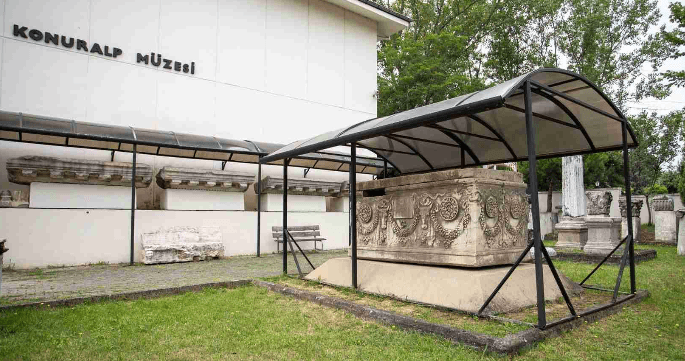
In the museum garden, numerous stone artifacts excavated from Prusias ad Hypium Ancient City are displayed. These include architectural elements, columns, bomos (dedication inscriptions), ostothek (small stone sarcophagi for ashes), city law inscriptions, pythos (large storage jars), tomb steles, fountain fragments, and Islamic gravestones.
A prominent outdoor piece is a sarcophagus tomb found in 1937 in the necropolis area west of Konuralp. Dating to the 1st century CE, this marble sarcophagus belongs to the Roman period. The long face of the sarcophagus is adorned with wreaths carried by ox heads in relief, with a tabula ansata (inscription panel) in the center, while the lower part features various animal figures.

Works Exhibited in the Museum's Garden (T.C. Kültür ve Turizm Bakanlığı)
Mosaics from the floor of a Roman villa along the Düzce-Akçakoca highway include depictions of the Greek mythological poet Orpheus with the four seasons, and another mosaic portrays Achilles and his mother, the sea goddess Thetis. Restoration work on these mosaics began on July 2, 2012.
The museum has been included in the EU-supported “Inter-Museum Thematic Cooperation Network” project coordinated by the East Marmara Development Agency (MARKA). As part of this project, Düzce Konuralp Museum prepared a presentation showcasing important artifacts from the Bithynia Region, which was displayed in April on the Greek island of Lesbos and featured in an exhibition there.
Kültür Varlıkları ve Müzeler Genel Müdürlüğü. “Düzce Müze Müdürlüğü.” Kültür Varlıkları ve Müzeler Genel Müdürlüğü. Accessed 22 April 2025. https://kvmgm.ktb.gov.tr/TR-44148/duzce-muze-mudurlugu.html.
T.C. Kültür ve Turizm Bakanlığı. “Düzce Konuralp Müzesi - Düzce.” Türkiye Kültür Portalı. Accessed 22 April 2025. https://www.kulturportali.gov.tr/turkiye/duzce/gezilecekyer/konuralp-muzesi?ysclid=m9s87mj5jl566731645.
T.C. Kültür ve Turizm Bakanlığı. “Tyche Heykeli ve Orpheus Mozaiği.” Türkiye Kültür Portalı. Accessed 22 April 2025. https://www.kulturportali.gov.tr/turkiye/duzce/gezilecekyer/tyche-heykel-ve-orpheus-mozag.
Turkish Museums. “Düzce Konuralp Müzesi.” turkishmuseums.kprod.kultur.gov.tr. Accessed 22 April 2025. https://turkishmuseums.kprod.kultur.gov.tr/museum/detail/2036-duzce-konuralp-muzesi/2036/1.

Location | Konuralp Town Düzce / Turkey Düzce-Akçakoca Highway | ||||||||
|---|---|---|---|---|---|---|---|---|---|
Opening Date(s) | 2003 | ||||||||
Affiliated Institution | Ministry of Culture and Tourism | ||||||||
Total Number of Artifacts | 6.237 (1.848 archaeological, 491 ethnographic, 3.898 coins) | ||||||||
Museum Sections | Archaeology Hall, Ethnography Hall, Stone Artifacts Hall, Coin Sections, Conference Hall, Laboratory and Storage, Outdoor Exhibits | ||||||||
Highlight Artifacts | Tyche Statue (Moulage), Orpheus Mosaic, God Janus Statue, 1st-century Roman Sarcophagus, Achilles and Thetis Mosaic | ||||||||
Archaeology Hall
Stone Artifacts Hall
Ethnography Hall
Outdoor Exhibits
Mosaics and Additional Activities
This article was created with the support of artificial intelligence.