This article was automatically translated from the original Turkish version.
Origin(s) | Lateral epicondyle of the humerus | ||||||||
|---|---|---|---|---|---|---|---|---|---|
Adhesion | Lateral surface of the olecranon, posterior surface of the ulna | ||||||||
Nerve | Radial nerve (C7–C8) | ||||||||
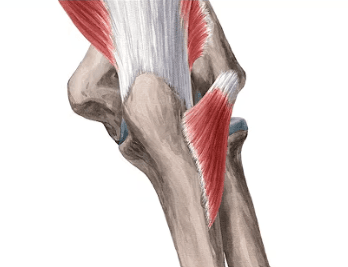
Anconeus muscle is a small skeletal muscle located on the posterior aspect of the elbow joint. It has a close structural and functional relationship with the triceps brachii muscle. Due to its anatomical position, it is associated with both the posterior compartment of the arm and the posterior compartment of the forearm. Although its clinical significance is limited, it may become relevant in certain traumatic injuries and neurological impairments. Its Latin name, musculus anconeus, is derived from the ancient Greek word ankōn, meaning “elbow”.
The anconeus muscle originates from the posterior surface of the lateral epicondyle of the humerus and inserts distally onto the superior posterior surface of the ulna and the lateral aspect of the olecranon. It has a small, triangular shape. Due to its superficial location in the elbow region, it can be palpated immediately lateral to the olecranon process. The muscle fibers run obliquely and contact the capsule of the elbow joint.
Embryologically, the anconeus muscle is homologous to the posterior (extensor) compartment muscles of the upper limb because it is innervated by nerves arising from the posterior cord of the brachial plexus. Some sources classify this muscle within the posterior compartment of the arm, while others place it in the posterior compartment of the forearm. This structure may also be regarded as a distal extension of the triceps brachii and is included in the group of accessory extensor muscles.
The anconeus muscle is innervated by the anconeus nerve, a branch of the radial nerve arising from the posterior cord of the brachial plexus. These nerve fibers originate from cervical segments C7–C8. Innervation occurs via a branch that diverges from the main radial nerve trunk as it passes through the radial groove of the humerus. The muscle’s blood supply is provided by the middle collateral artery, a branch of the profunda brachii artery. This vascular network ensures adequate perfusion to both the deep and superficial regions of the muscle.
The anconeus muscle assists in elbow extension and prevents the joint capsule from being pinched in the olecranon fossa during this movement. While the triceps brachii acts as the primary extensor, the anconeus serves a stabilizing role. Additionally, it produces a slight abduction of the ulna, contributing to the rotational axis of the forearm and facilitating alignment of the fingers with this axis. Clinically, the anconeus muscle is rarely directly affected by trauma. However, injury to the radial nerve resulting from shoulder dislocation, fractures of the proximal humerus, or trauma around the olecranon can lead to paralysis of this muscle. Furthermore, functional impairment may occur in certain systemic or local pathologies such as muscular dystrophies or heterotopic ossification.
Esen, Hakan, and Betül Aydın. "Anconeus Kasının Morfometrik Özellikleri: Kadavra Çalışması." Kütahya Sağlık Bilimleri Üniversitesi Tıp Fakültesi Dergisi 9, no. 1 (2023): 91–95. https://dergipark.org.tr/en/pub/kutfd/issue/86679/1484130.
Kenhub. "Anconeus Kası."Kenhub Anatomi Library. Accessed July 18, 2025. https://www.kenhub.com/en/library/anatomy/anconeus-muscle.
PhysioPedia. "Anconeus." Physio-Pedia. Accessed July 18, 2025. https://www.physio-pedia.com/Anconeus.
Solak, S., and A. Akgün. "Radiokapitellar Artrit Tedavisinde Anconeus İnterpozisyon Artroplastisi: Uzun Dönem Sonuçlar." Acta Orthopaedica et Traumatologica Turcica 42, no. 1 (2008): 10–15. https://dergipark.org.tr/en/pub/aott/issue/18211/192061.
TeachMeAnatomy. "Anconeus." TeachMeAnatomy.info. Accessed July 18, 2025.

Origin(s) | Lateral epicondyle of the humerus | ||||||||
|---|---|---|---|---|---|---|---|---|---|
Adhesion | Lateral surface of the olecranon, posterior surface of the ulna | ||||||||
Nerve | Radial nerve (C7–C8) | ||||||||
Anatomical Structure
Embryological Origin and Classification
Innervation and Vascular Supply
Function and Clinical Relevance