This article was automatically translated from the original Turkish version.
Starts | Long head (infraglenoid tubercle), lateral head (humerus shaft), medial head (distal humerus) | ||||||||
|---|---|---|---|---|---|---|---|---|---|
Attachment Site | Olecranon process of the ulna | ||||||||
Nerve Source | Radial nerve (C6-C8), axillary nerve (variation in long head) | ||||||||
Artery | Deep brachial artery | ||||||||
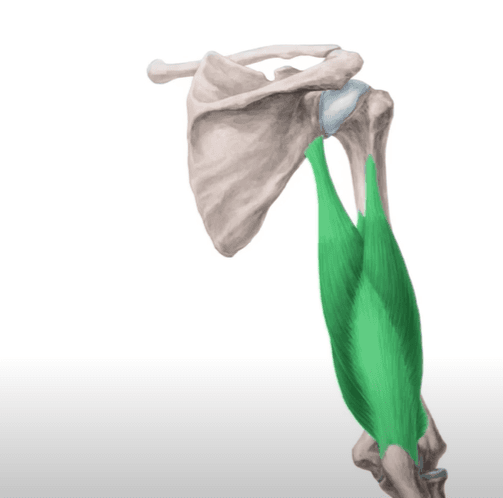
Triceps Brachii is a large muscle located in the posterior region of the upper arm, characterized by its three-headed structure (lateral, medial, and long). It is the primary muscle responsible for elbow extension (straightening of the arm). The long head also passes over the shoulder joint, contributing to shoulder movements.
The Triceps Brachii is a large, three-headed muscle situated in the posterior compartment of the upper arm. Its three heads are named the long head (caput longum), lateral head (caput laterale), and medial head (caput mediale). The long head originates from the infraglenoid tubercle of the scapula and travels between the teres major and teres minor muscles toward the posterior surface of the humerus. The lateral head arises from the upper part of the radial groove on the posterior surface of the humerus. The medial head originates from the distal posterior surface of the humerus and the intermuscular septa. All three heads converge and insert onto the olecranon process of the ulna. The triceps tendon sends fibers into the elbow joint capsule and extends partially into the forearm fascia. Superiorly, the deltoid muscle is adjacent to this muscle, while inferiorly, the anconeus muscle lies nearby. The primary nerve supplying the muscle is the radial nerve; however, in rare cases, the long head may also receive innervation from the axillary nerve.
The Triceps Brachii develops embryologically from the dorsal mass of the upper limb muscle groups and belongs to the posterior (extensor) muscle group. Developmentally, this muscle group is classified together with other muscles innervated by the radial nerve. The three-headed structure of the triceps is a classic example of distinct muscle segments uniting to form a functional unit. This anatomical arrangement supports both powerful and fine motor movements of the upper limb, enhancing functional adaptation.
The Triceps Brachii is primarily innervated by the radial nerve (C6–C8), which provides branches to all three heads. However, in approximately 14% of cases, the long head is reported to be innervated by the axillary nerve. In about 3% of cases, dual innervation by both the radial and axillary nerves has been observed. The vascular supply of the muscle comes from the deep brachial artery, which runs alongside the radial nerve along the posterior surface of the humerus and gives off branches to all three heads. This ensures robust neural and vascular support for its functions.
The primary function of the Triceps Brachii is elbow extension, which straightens the arm. In this role, it acts as the antagonist to the biceps brachii and brachialis muscles. It plays an active role in rapid and forceful arm movements such as pushing or throwing. The long head, which crosses the shoulder joint, also contributes to shoulder adduction (pulling the arm toward the body) and retroversion (moving the arm backward). Additionally, it assists in stabilizing the elbow during fine motor tasks such as writing. Functionally, there are differences among the heads: the lateral head is most active during high-intensity, explosive movements; the medial head dominates in low-force, precise movements; and the long head is engaged during prolonged activities requiring coordination between the shoulder and elbow. Clinically, this muscle is susceptible to various injuries. Overuse can lead to tendinitis, causing inflammation of the olecranon tendon. During humerus fractures, the radial nerve may become compressed, resulting in neurological symptoms such as wrist drop. Triceps tendon ruptures are rare and typically associated with direct trauma or anabolic steroid use. Diagnosis is made clinically using elbow extension tests and resisted pushing maneuvers. Magnetic resonance imaging (MRI) is particularly effective in evaluating tendon tears. Treatment depends on the severity of the lesion: mild cases are managed with rest, nonsteroidal anti-inflammatory drugs (NSAIDs), and physical therapy, while complete ruptures may require surgical tendon repair.
Accessed November 26, 2025.
Güvenç, Emre, and Bahar Koç. "Morphological Study of the Levator Scapulae Muscle." International Journal of Morphology 30, no. 3 (2012): 1027–1032. Accessed July 22, 2025.
Hatton, A. L., and M. K. Turner. Anatomy, Shoulder and Upper Limb, Levator Scapulae Muscle. StatPearls [Internet]. Treasure Island (FL): StatPearls Publishing, 2023. Accessed July 3, 2025.
Park, John. “Anatomy Head and Neck: Levator Scapulae Muscles.” ResearchGate, 2019. Accessed July 22, 2025. https://www.researchgate.net/publication/340599297_Anatomy_Head_and_Neck_Levator_Scapulae_Muscles.
Reaves, Whitfield. “Levator Scapulae: Anatomy and Function.” Whitfield Reaves, 2016. Accessed July 22, 2025. https://www.whitfieldreaves.com/resources/files/levator-scapulae.pdf.
Redwood Physiotherapy. "Upper Trapezius and Levator Scapulae Stretches." Redwood Physiotherapy, 2014. Accessed July 22, 2025. https://www.redwoodphysio.nz/wp-content/uploads/2014/08/Upper-trapezius-and-levator-scapulae-stretches.pdf.

Starts | Long head (infraglenoid tubercle), lateral head (humerus shaft), medial head (distal humerus) | ||||||||
|---|---|---|---|---|---|---|---|---|---|
Attachment Site | Olecranon process of the ulna | ||||||||
Nerve Source | Radial nerve (C6-C8), axillary nerve (variation in long head) | ||||||||
Artery | Deep brachial artery | ||||||||
No Discussion Added Yet
Start discussion for "Triceps Brachii Muscle" article
Anatomical Structure
Morphology and Attachment Points
Embryological Origin and Classification
Innervation and Vascular Supply
Function and Clinical Relevance