


This article was automatically translated from the original Turkish version.
+1 More
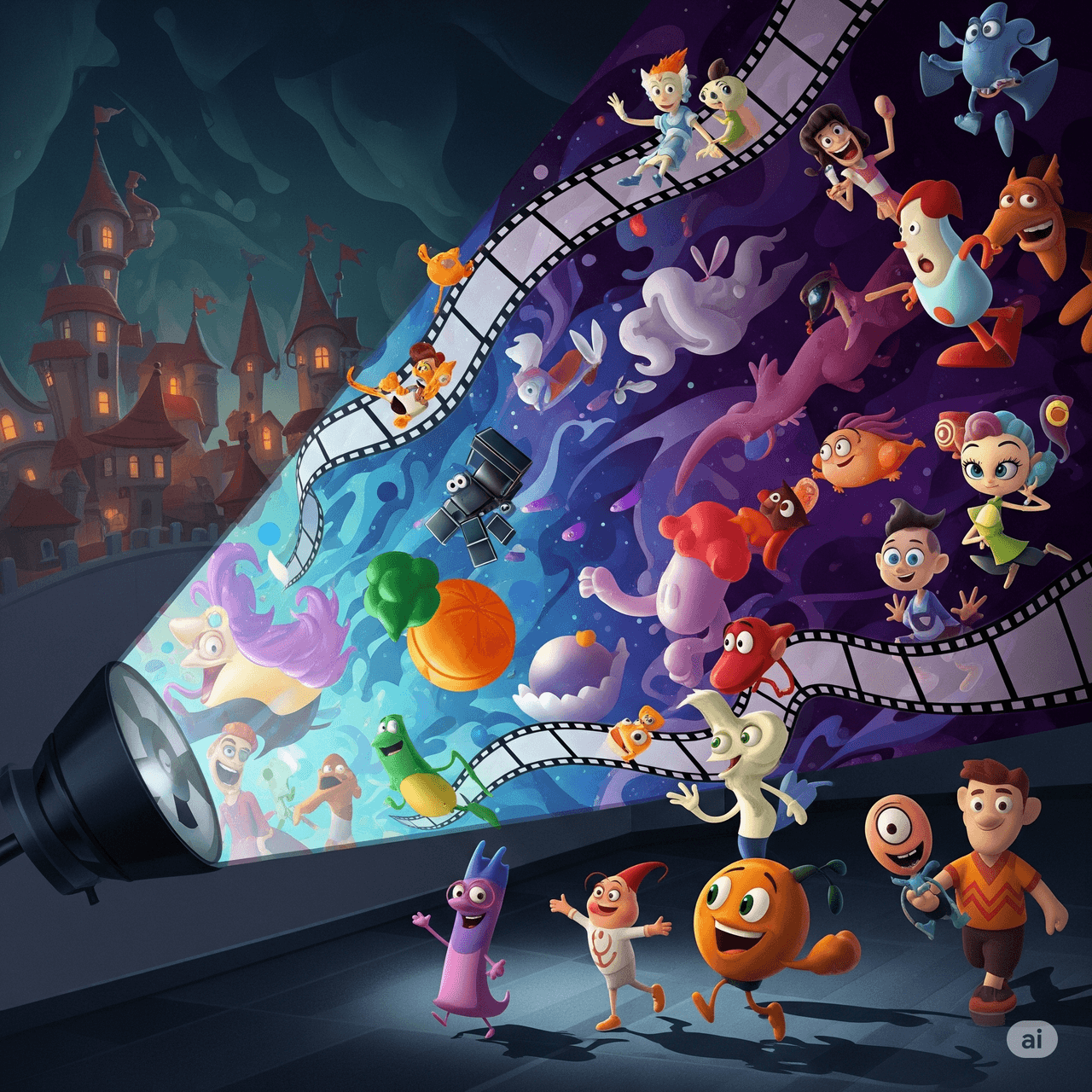
Animation Cinema (Generated with Artificial Intelligence)
Definition(s) | Flip book animation - films created by arranging drawings or computer-generated images to create the illusion of motion | ||||||||
|---|---|---|---|---|---|---|---|---|---|
First Oscar Winner (Best Animation) | Shrek (2002) | ||||||||
Important Studios | Walt Disney, Pixar, DreamWorks, Studio Ghibli, Aardman Animations | ||||||||
Important Techniques | Traditional (2D), Computer-Assisted (CGI), Stop-Motion | ||||||||
Animation cinema is a film production technique that creates the illusion of motion by displaying a sequence of individually created frames (drawings, models, computer graphics, etc.). Although often perceived as a film genre, animation is in fact a narrative form capable of producing works across a wide range of genres—including drama, comedy, adventure, and science fiction—just like live-action films. With its colorful characters, worlds that enable limitless imagination, and potential to explore universal themes, animation appeals to a broad audience encompassing both children and adults.
The origins of animation extend back to the earliest attempts to create moving images. However, the foundations of modern animated cinema were laid in the early 20th century. Walt Disney’s “Snow White and the Seven Dwarfs,” released in 1938 and awarded a special Academy Honorary Award for its innovations in film production, is regarded as a landmark in cinema history as one of the first full-length animated features. This success was followed by classics such as “Pinocchio” (1940), which won Oscars for Best Original Music and Best Original Song, and “Dumbo” (1941). These early films helped elevate animation from being seen merely as children’s entertainment to a serious art form and narrative medium.
The 1990s marked a renaissance for animated cinema. Disney led the industry with critically and commercially successful films such as “The Little Mermaid” (1989), “Beauty and the Beast” (1991), and “The Lion King” (1994). Notably, “Beauty and the Beast” became the first animated film ever nominated for the Academy Award for Best Picture. During the same period, Pixar Animation Studios, founded by former Disney animators, entered the scene in 1995 with “Toy Story.” This entirely computer-generated (CGI) film revolutionized animation technology and permanently transformed the industry. The creation of the Academy Award category for Best Animated Feature in 2002 and its first winner, DreamWorks’ “Shrek,” solidified animation’s place within the art of cinema.

Animation Cinema (Generated by Artificial Intelligence)
Animated cinema employs various techniques that offer distinct visual aesthetics and narrative possibilities. These techniques can be broadly categorized into three main types:
This is the oldest and most classical method, in which each frame is hand-drawn. Disney’s early films such as “Snow White and the Seven Dwarfs” and “Pinocchio” are among the best-known examples of this technique. It directly reflects the artist’s drawing skill and creativity.
This technique is created by photographing physical objects—such as puppets, clay, or LEGO bricks—with small incremental movements between each frame, then combining the images into a sequence. The British Aardman Studios’ “Wallace & Gromit” series and the film “Shaun the Sheep” are popular examples of this method. Stop-motion stands out for its distinctive texture and handmade aesthetic.
This is the most widely used technique today. Characters, objects, and environments are created and animated digitally in either three-dimensional (3D) or two-dimensional (2D) formats. Productions such as Pixar’s “Toy Story,” DreamWorks’ “How to Train Your Dragon,” and Disney’s “Frozen” showcase the capabilities of CGI. It provides great flexibility in creating realistic textures, complex camera movements, and large-scale scenes.
The world of animation has been shaped by studios distinguished by their unique styles and storytelling approaches.
Initially competitors, these two studios later merged and together form the greatest force in Western animation. Disney is renowned for its fairy-tale narratives and musicals, while Pixar is known for its technological innovation and profound exploration of universal themes such as friendship, family, loss, and growth. Films like “Finding Nemo,” “Up,” “WALL-E,” and “Inside Out” demonstrate Pixar’s ability to craft layered stories that resonate with both children and adults.
DreamWorks is known for its humorous and ironic tone, often incorporating references to popular culture. It has produced successful franchises such as “Shrek,” “Madagascar,” “Kung Fu Panda,” and “How to Train Your Dragon.” DreamWorks films are recognized for their subversive takes on classic fairy-tale narratives.
Studio Ghibli, led by directors such as Hayao Miyazaki and Isao Takahata, has brought Japanese animation (anime) to global recognition. Ghibli films stand out through their hand-drawn aesthetics, reverence for nature, pacifism, and complex female characters. “Spirited Away” is the first and only hand-drawn foreign-language film to win the Academy Award for Best Animated Feature. Works such as “Princess Mononoke” and “Grave of the Fireflies” demonstrate the depth and seriousness with which anime can address complex themes.
Although often overshadowed by American and Japanese schools, European animation draws attention through its artistic and original productions. The Irish studio Cartoon Saloon creates visually rich, hand-drawn animations inspired by Celtic mythology, as seen in films like “Song of the Sea” and “WolfWalkers.” French production “The Summit of the Gods” and Spanish production “Robot Dreams” also stand out for their dialogue-free storytelling and themes aimed at adult audiences.
Animation cinema in Türkiye has experienced significant growth since the 2010s. Local productions have achieved notable box office success and cultivated their own audience base. The adaptation of TV series aired on TRT Çocuk into theatrical films has played a major role in this success. The “Rafadan Tayfa” series is one of the most successful examples in this field. Its films—“Rafadan Tayfa Göbeklitepe,” “Rafadan Tayfa Galaktik Tayfa,” and “Rafadan Tayfa 4: Hayrimatör”—appear on Türkiye’s list of all-time most-watched animated films. Similarly, the “Kral Şakir” and “Aslan Hürkuş” series have reached millions of viewers, proving the strength of the local animation industry. These productions combine local cultural elements and values with modern storytelling, earning widespread popularity.
Animated films are not merely entertainment tools; they serve as powerful platforms for conveying significant social and cultural messages. “Zootopia” addresses issues of prejudice and social diversity, while “WALL-E” offers a critique of environmental pollution and consumerism. “Inside Out” concretizes the emotional worlds of children and adults, delivering a lesson on emotional intelligence. Universal themes such as family bonds, friendship, courage, self-discovery, and coping with loss form the foundation of animation. These films entertain and educate by presenting complex subjects in language accessible to viewers of all ages. The involvement of famous voice actors and the popularization of film soundtracks further enhance the cultural impact of animation.
"All Popular Animated Movies." *Beyazperde.com*. Accessed July 26, 2025. https://www.beyazperde.com/filmler-tum/tur-13026/.
"Animasyon Filmleri İzle Altyazılı & Türkçe Dublaj." TV+. Accessed July 26, 2025. https://tvplus.com.tr/film-izle/tur/animasyon--1104.
"Animation –Film Listesi." *Çocukla Sinema*. Accessed July 26, 2025. https://www.cocuklasinema.com/filmler?kategori=animasyon.
"Best Animation Movies / En İyi Animasyon Filmleri." IMDb. Accessed July 26, 2025. https://www.imdb.com/list/ls074323905/.
"En Yeni Animasyon Filmleri." *Sinemalar.com*. Accessed July 26, 2025. https://www.sinemalar.com/filmler/en-yeni-animasyon-filmleri.
"En İyi Animasyon Filmleri." *IMDb*. Accessed July 26, 2025. https://www.imdb.com/list/ls032832850/.
"En İyi Animasyon Filmleri." *OGGUSTO*, June 26, 2025. Accessed July 26, 2025. https://www.oggusto.com/lifestyle/film-ve-dizi-onerileri/en-iyi-animasyon-filmleri.
"En İyi Animasyon Filmleri." *Sinemalar.com*. Accessed July 26, 2025. https://www.sinemalar.com/filmler/en-iyi-animasyon-filmleri.
"Oscar-Winning Animated Films." *Anima Okul Blog*. Accessed July 26, 2025. https://www.animaokul.com/blog/oscar-kazanan-animasyon-filmleri.
"Seyirci Rekortmeni Animasyon Filmleri – Tüm Zamanlar." Box Office Türkiye. Accessed July 26, 2025. https://boxofficeturkiye.com/tum-zamanlar/turler/animasyon-filmleri.
Bendazzi, Giannalberto. Animation: A World History. CRC Press, 2015.
Furniss, Maureen. Art in Motion: Animation Aesthetics. Indiana University Press, 1998.
Haswell, Fiona. "Translating Intertextuality in Animated Films – An Analysis of DreamWorks, Disney and Pixar Animations." *Polonica* 42 (2022): 5–28. https://www.alphavillejournal.com/Issue8/HTML/ArticleHaswell.html.
Kurian, Nomisha. "Designing Child-Friendly AI Interfaces: Six Developmentally-Appropriate Design Insights from Analysing Disney Animation." *arXiv* preprint arXiv:2504.08670 (2024). Accessed July 26, 2025. https://doi.org/10.48550/arXiv.2504.08670.
Lesley University – The 12 Principles of Animation. *Lesley.edu*. Accessed July 26, 2025. https://lesley.edu/article/the-12-principles-of-animation.
Magger, Sine. "Avrupa Animasyonları: İlham Verici Çizgiler." *theMagger*, February 5, 2025. Accessed July 26, 2025. https://www.themagger.com/dunya-sinemasi-en-iyi-animasyon-filmler/.
Pixar Research Team. "Pixar.com." Accessed July 26, 2025. https://www.pixar.com/research-team.
Wald, I., et al. "Digesting the Elephant – Experiences with Interactive Production Quality Path Tracing of the Moana Island Scene." *arXiv preprint* arXiv:2001.02620 (2020). Accessed July 26, 2025. https://arxiv.org/abs/2001.02620.
Wells, Paul. Understanding Animation. Routledge, 1998.
Wojciechowska-Pieszko, Anna. "Translating Intertextuality in Animated Films – An Analysis of DreamWorks, Disney and Pixar Animations." *Polonica* 42 (2022): 5–28. https://doi.org/10.17651/POLON.42.1.

Animation Cinema (Generated with Artificial Intelligence)
Definition(s) | Flip book animation - films created by arranging drawings or computer-generated images to create the illusion of motion | ||||||||
|---|---|---|---|---|---|---|---|---|---|
First Oscar Winner (Best Animation) | Shrek (2002) | ||||||||
Important Studios | Walt Disney, Pixar, DreamWorks, Studio Ghibli, Aardman Animations | ||||||||
Important Techniques | Traditional (2D), Computer-Assisted (CGI), Stop-Motion | ||||||||
History and Development
Main Animation Techniques
Traditional Animation (2D)
Stop-Motion Animation
Computer-Generated Imagery (CGI)
Studios and Schools
Walt Disney and Pixar
DreamWorks Animation
Studio Ghibli and Japanese Anime
European Animation
Animation Cinema in Türkiye
Themes and Cultural Impact