

This article was automatically translated from the original Turkish version.
+2 More
The Antakya Turkish Catholic Church is a historically and architecturally significant structure located in the Zenginler Neighborhood of the Antakya district in Hatay Province, still functioning as a church today. It reflects the city’s multicultural identity through its original spatial design, which has evolved over centuries and integrated with traditional Antakya residential architecture. This important religious and cultural heritage is also known as the Antakya Catholic Church, the Church of Saint Peter and Saint Paul, and the Latin Catholic Church. In accordance with the directives of Pope Pius IX, it was reestablished in Antakya in 1846 after nearly 600 years of absence, alongside the Capuchin friars.【1】
The first spiritual representative to arrive in Antakya with the Capuchin friars was Father Basilio Galli, selected from the religious region of Parma. After Galli’s death, administration passed to French friars. With an official permit granted by Sultan Abdülmecid in 1852, a monastery was constructed and the Catholic Church was formally institutionalized.【2】
Antakya Katolik Kilisesi (EXPO 2021 HATAY)
The Capuchin friars, with the participation of Lebanese priests, carried out their activities in this initial settlement area for 90 years. In 1939, they were compelled to relocate to a new neighborhood. In 1977, the land was expropriated, and the priests were forced to move into a 150-year-old house in the historic and former Jewish quarter of old Antakya.【3】
After being relocated to a new district of the city in 1939, church activities were conducted in an old sugar factory. In 1965, construction began on a new church at the site of the Antakya Tax Office, but the project was never completed. The current church and monastery complex was formed by purchasing and restoring the building, which was also the birthplace of architect Vilyam Azaroğlu, along with its adjacent neighbor house. Restoration works were completed between 1989 and 1991, and in 1995, a guesthouse with nine rooms and 18 beds was added to the complex.

Antakya Katolik Kilisesi (Antakya Rum Katolik Kilisesi Vakfı)
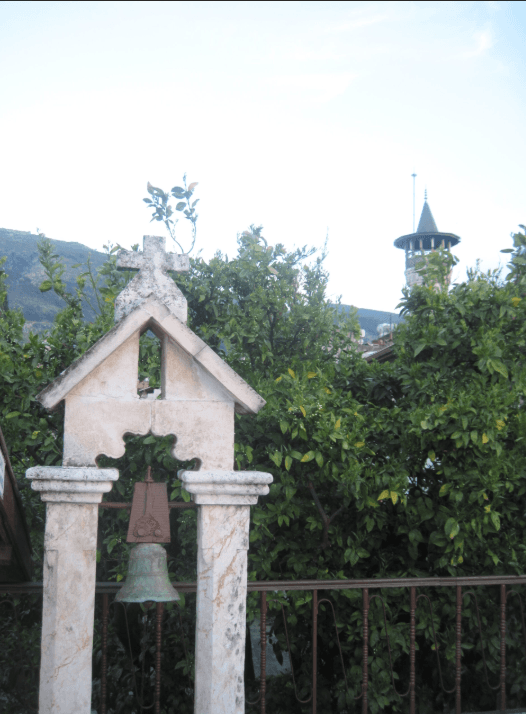
The building features an “L”-shaped plan centered around a courtyard with a pool and fine stone cladding, reflecting traditional Antakya house characteristics. The arcade surrounding the courtyard consists of two Arab arches, with its floor paved in geometrically patterned marble. Interior spaces have ornate shelving, ceilings repaired with plywood, and a marble votive stele with an inscription on the wall opposite each room’s entrance. The complex includes meeting halls and three gardens; a bell tower is located on the terrace accessible via stairs from the garden area.【4】
Antakya Church occupies a symbolic position known as the “Ecumenical Triad,” due to its spatial proximity to the nearby Sarımiye Mosque and the Antakya Synagogue. This coexistence demonstrates the area’s multicultural character. In local literature, it is described as a symbol of tolerance where the calls to prayer, church bells, and synagogue chants resonate together.【5】

Antakya Katolik Kilisesi (Anadolu Ajansı)
The Antakya Turkish Catholic Church suffered damage during the Kahramanmaraş earthquakes on February 6, 2023. Damage assessment studies conducted by the Ministry of Culture and Tourism confirmed that this registered cultural heritage site will be included in restoration projects. It has been decided that restoration efforts will proceed under the supervision of a scientific committee.【6】 The Ministry of Culture and Tourism announced that restoration and reconstruction work on registered cultural assets, including this church, began in the same week.【7】
[1]
Kültür Envanteri. “Antakya Türk Katolik Kilisesi.” Erişim Tarihi 17 Mart 2026. https://kulturenvanteri.com/yer/antakya-turk-katolik-kilisesi/
[2]
Kültür Envanteri. “Antakya Türk Katolik Kilisesi.” Erişim Tarihi 17 Mart 2026. https://kulturenvanteri.com/yer/antakya-turk-katolik-kilisesi/
[3]
Cemaat Vakıfları. “Antakya Rum Katolik Kilisesi Vakfı.” Erişim Tarihi 17 Mart 2026. https://www.cemaatvakiflaritemsilcisi.com/index.php/vakiflar/rum-vakiflari/15-antakya-rum-katolik-kilisesi-vakfi
[4]
Bellek Antakya. “Katolik Kilisesi.” Erişim Tarihi 17 Mart 2026. https://www.bellekantakya.com/katolik-kilisesi/
[5]
Cemaat Vakıfları. “Antakya Rum Katolik Kilisesi Vakfı.” Erişim Tarihi 17 Mart 2026. https://www.cemaatvakiflaritemsilcisi.com/index.php/vakiflar/rum-vakiflari/15-antakya-rum-katolik-kilisesi-vakfi
[6]
Anadolu Ajansı. "Hoşgörü Kenti"nde ezan ve çan sesinin birbirine karıştığı yapılar depremden zarar gördü.” Erişim Tarihi 17 Mart 2026. https://www.aa.com.tr/tr/pg/foto-galeri/hosgoru-kentinde-ezan-ve-can-sesinin-birbirine-karistigi-yapilar-depremden-zarar-gordu/13
[7]
Anadolu Ajansı. “Bakan Ersoy: Tescilli kültür varlıklarımızın restorasyon ve rekonstrüksiyon çalışmalarına bu hafta başlıyoruz.” Erişim Tarihi 17 Mart 2026. https://www.aa.com.tr/tr/asrin-felaketi/bakan-ersoy-tescilli-kultur-varliklarimizin-restorasyon-ve-rekonstruksiyon-calismalarina-bu-hafta-basliyoruz/2830338

No Discussion Added Yet
Start discussion for "Antakya Catholic Church" article
Founding Phase and First Representatives
Spatial Transformations and Settlement Process
Structure
Ecumenical Triad Location