This article was automatically translated from the original Turkish version.
+2 More
Population | The only continent with no native (permanent) human population | ||||||||
|---|---|---|---|---|---|---|---|---|---|
Size(s) | Approximately 13 000 km² 661 | ||||||||
Title(s) | The coldest and driest continent on Earth windiest | ||||||||
International Agreements | the Antarctic Treaty System (ATS) the Protocol on Environmental Protection (Madrid Protocol - 1991) The Antarctic Treaty (1959) | ||||||||
Location | entirely surrounded by the Southern Ocean The southernmost continent | ||||||||
Freshwater Reserve | It alone contains approximately 70% to 90% of the world's freshwater reserves | ||||||||
Highest Elevation | The highest continent on Earth, with an average elevation of 2,500 meters | ||||||||
Ice Cover | 98% of the continental landmass is covered by ice up to 4.7 kilometers thick | ||||||||
Antarctica, with an area of approximately 14 million square kilometers, is the fifth largest continent on Earth and is located at the southernmost point of the Southern Hemisphere.【1】 A large portion of the continent is covered by an ice sheet and holds the titles of the coldest, windiest, and driest geography on Earth. Antarctica also alone contains more than 70 percent of the world’s freshwater reserves.【2】
Antarctica remained untouched and inaccessible to humans until the 19th century. Since its first contacts in the 19th century and the “Heroic Age” of the early 20th century, it has been a harsh frontier of exploration that has tested the limits of human endurance.【3】 The continent’s highest point is Mount Vinson, with an elevation of approximately 5,000 meters. The lowest recorded temperature is -94.7°C and the highest is 20.8°C. Some regions have not seen rainfall for two million years. Despite its snowy and icy climate, various animal species and organisms live on and around the continent. These include various penguin species, leopard seals, elephant seals, snow petrels, wandering albatrosses, and killer whales.
Today, Antarctica is the only continent without sovereignty over any country, entirely dedicated to “peace and science” thanks to the Antarctic Treaty, which entered into force in 1961. This white continent, with its thousands-of-years-old ice cores that illuminate past climates, functions as a “time machine” and is also a fundamental regulator of global climate balance, sea levels, and ocean circulation. In this vast laboratory where the effects of climate change are most clearly observed, Türkiye, through its National Antarctic Science Expeditions in recent years, actively participates; aiming to establish a permanent base and attain the decision-making status of “Consultative Country” while contributing scientific knowledge to humanity’s shared future.
The discovery history of Antarctica is based on indigenous oral traditions and written records of European expeditions. Māori oral traditions dated to the 7th century suggest that Polynesian seafarers may have reached the icy waters south of the Pacific; this tradition indicates that the continent’s discovery may have occurred even before European expeditions.【4】
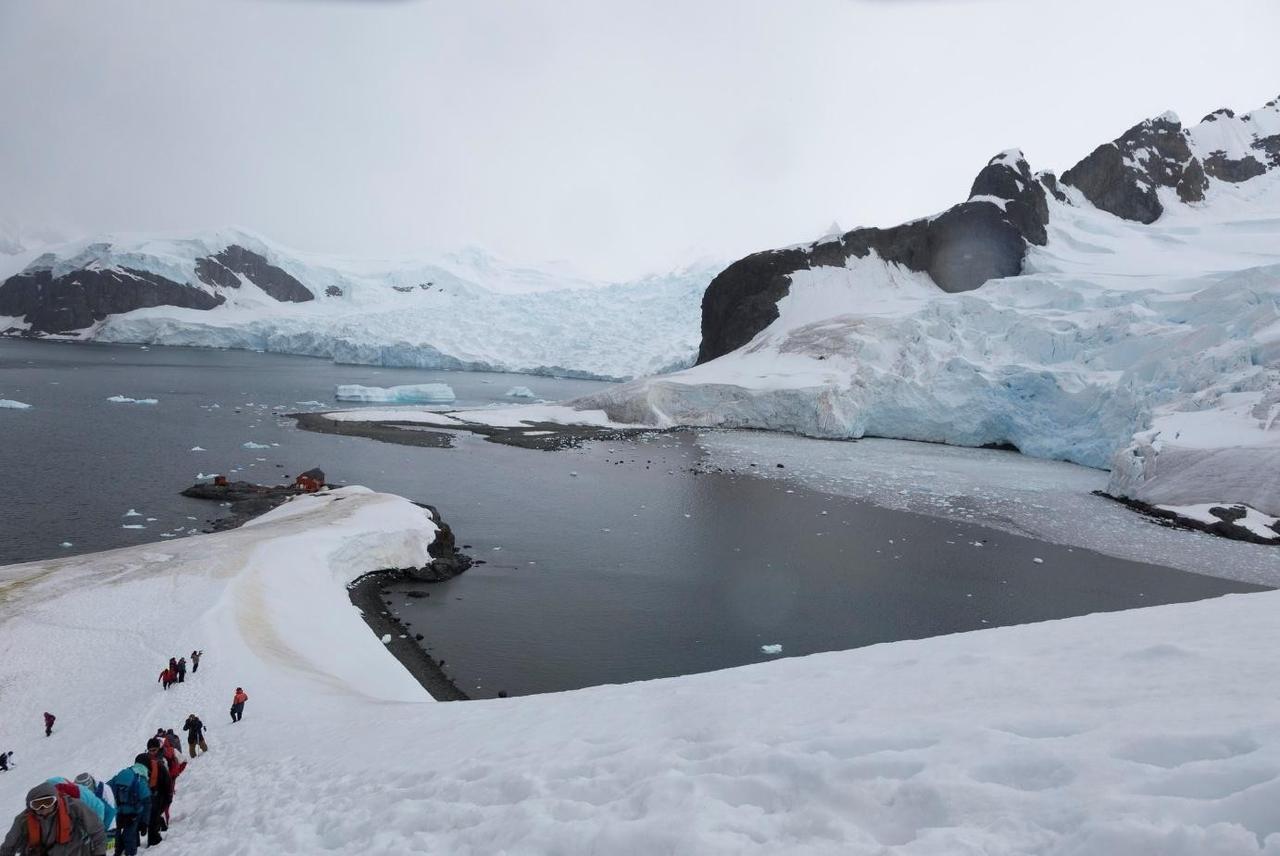
A View from the Antarctic Continent (Flickr)
In European sources, the first significant contact began in 1773 with James Cook’s crossing of the Antarctic Circle. Although Cook never set foot on the continent, he noted the possibility of a landmass beyond the vast ice sheets.【5】
The first observation of the continent by European explorers occurred in January 1820. At this time, Thaddeus von Bellingshausen (and Mikhail Lazarev) representing Russia, Edward Bransfield representing the United Kingdom, and Nathaniel Palmer representing the United States are recorded as the first to sight the continent.【6】
On 20 February 1823, Captain James Weddell reached the furthest south point ever recorded, setting a new record; the Weddell Sea and the Weddell seal, the southernmost land-dwelling mammal, are named after this explorer.
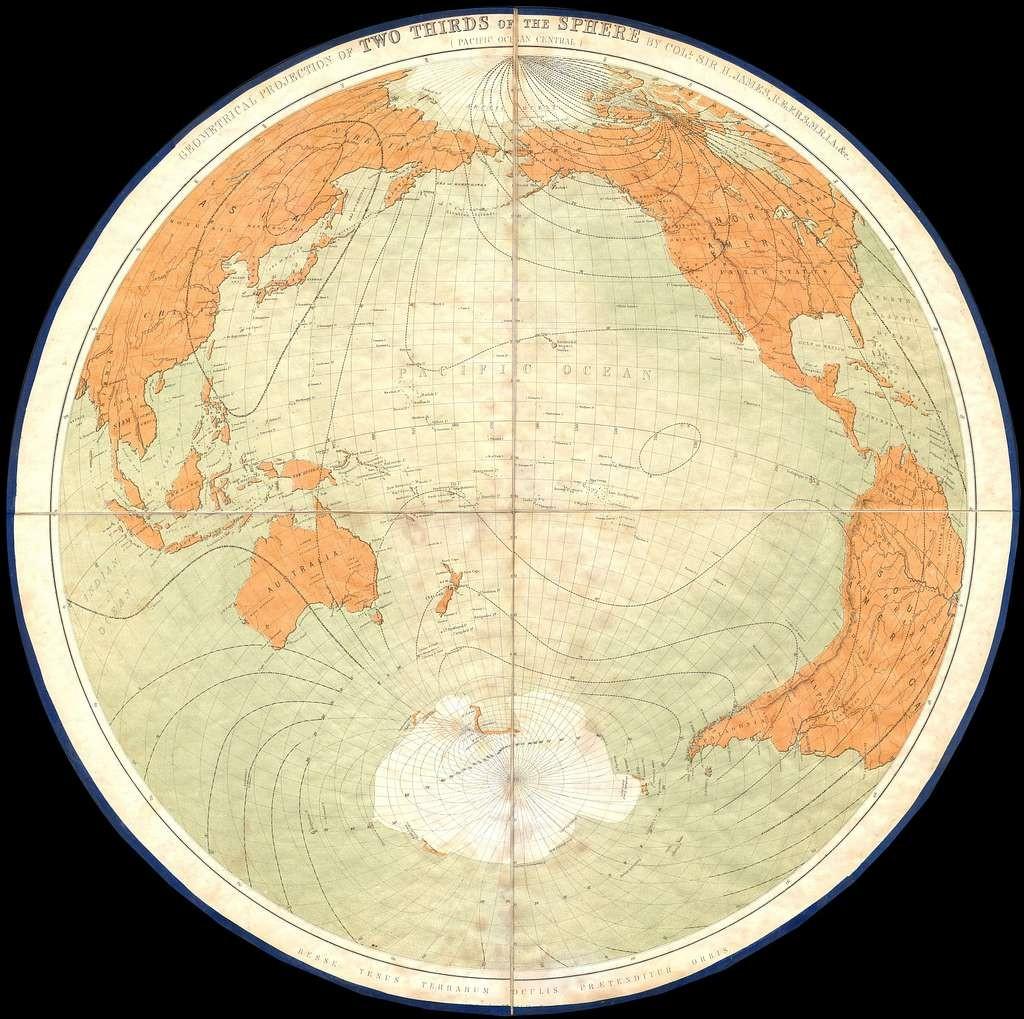
Antarctic Map Prepared by Henry James in 1860 (Picrly)
Between 1831 and 1832, Captain John Biscoe became the third person to circumnavigate the continent after Cook and Bellingshausen and observed Enderby and Graham Lands.【7】
James Clark Ross’s expedition between 1839 and 1841 became one of the foundational milestones of modern Antarctic exploration. The identification of the Ross Sea, Ross Island, and the massive Ross Ice Shelf determined the routes for all subsequent inland expeditions.
By the end of the century, explorers inspired by Arctic experience began arduous land journeys aimed at reaching the South Pole.
The period between 1897 and 1922 is known as the “Heroic Age of Antarctic Exploration.”【8】 During this time, 16 major expeditions were organized by eight countries.【9】 In the early 20th century, explorers began advancing into the continent’s interior, competing primarily for the goal of being the first human to reach the South Pole rather than for scientific research.【10】
From 1898 to 1899, Adrien de Gerlache’s Belgica expedition became the first Antarctic wintering in history. In 1899, Carsten Borchgrevink led the first team to overwinter on the continent’s mainland and gathered valuable observations on human endurance. Between 1901 and 1904, Robert Falcon Scott, Ernest Shackleton, and Edward Wilson were forced to turn back 410 miles from the Pole, but their experiences laid the foundation for future expeditions. Shackleton’s 1907–1909 Nimrod expedition reached within 97 miles of the Pole and concluded with a celebrated return, setting a benchmark in leadership.
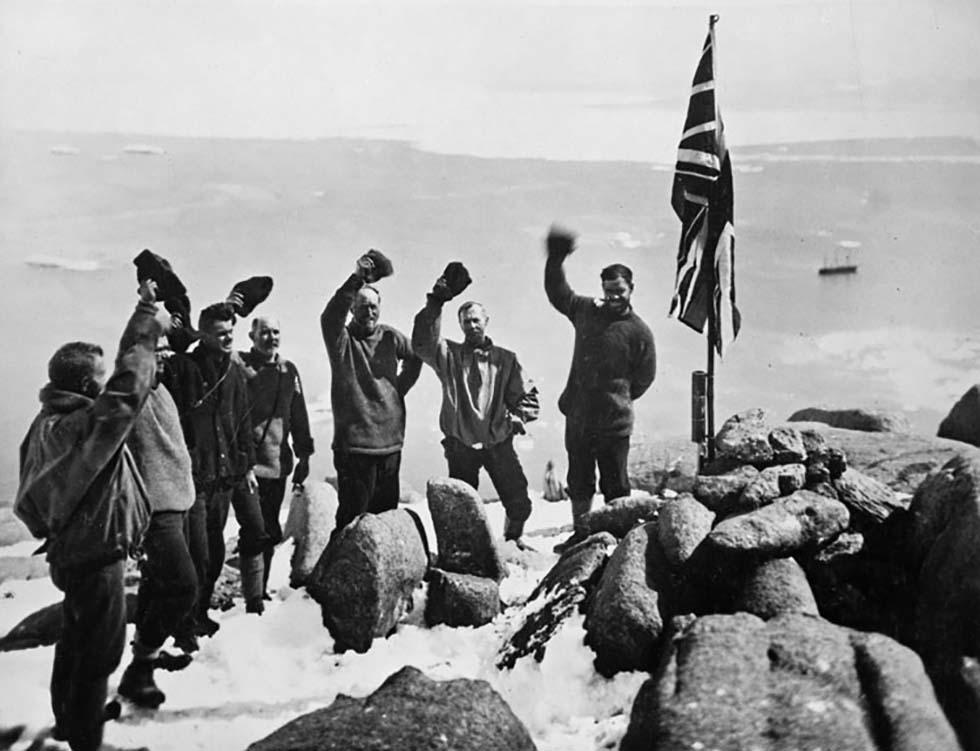
A Visual from an Antarctic Exploration Expedition (National Archives of Australia)
In 1911, a competition unfolded between Norwegian Roald Amundsen and British explorer Robert Falcon Scott. Amundsen’s team departed from the Bay of Whales on the Ross Sea on 19 October, using dog sleds and skis, covering approximately 64 kilometers per day to become the first group to reach the South Pole.【11】 Scott’s team arrived at the Pole on 18 January 1912 but tragically lost all members on the return journey.【12】
Shackleton’s Endurance expedition from 1914 to 1917 gained fame not for exploration but for survival. Despite the sinking of their ship after becoming trapped in ice, Shackleton and his crew miraculously survived.
The mid-20th century marked the beginning of a new era in polar research. In 1958, the Commonwealth Trans-Antarctic Expedition led by Vivian Fuchs became the first expedition to cross the continent from one end to the other. This period also saw the advancement of technologies such as radar, aerial photography, and subglacial measurements, shifting knowledge from military exploration to scientific research.【13】
This modernization process gained institutional structure with the Antarctic Treaty, which entered into force in 1961. The Antarctic Treaty guarantees the continent’s use solely for science and peace.
The Antarctic Treaty does not recognize any country’s sovereignty claims over the continent, but seven territorial claims made before the Treaty’s entry into force remain in a “frozen” status. These claims were made by Argentina, Chile, the United Kingdom, Australia, New Zealand, Norway, and France. Some claims overlap: Argentina, Chile, and the United Kingdom’s claims nearly coincide; Australia claims the largest portion of the continent. Under the Treaty, these claims are suspended; countries may only demonstrate symbolic influence through scientific research and logistical presence.
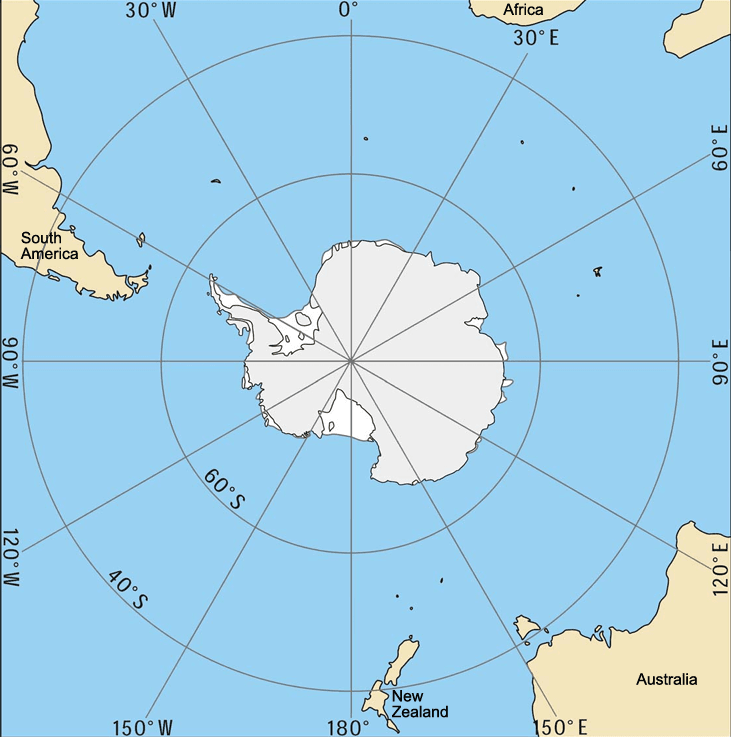
Antarctica and Its Surroundings (Australian Antarctic Program)
Geographically closest countries to Antarctica—primarily Argentina, Chile, Australia, and New Zealand—maintain their relationship with the continent on both diplomatic and strategic levels. These countries cannot maintain military presence but establish “dual-use” (non-military but capable of enhancing national capacity when needed) infrastructure through scientific stations, air-rescue capabilities, logistical fleets, and emergency support systems.
Argentina and Chile incorporate Antarctica into their national identity and sovereignty narratives due to its proximity to the geopolitics of the South Atlantic; their bases in the region are used to enhance diplomatic visibility. Australia and New Zealand adopt a more environmentally focused approach; climate research, marine conservation, and strengthening the Antarctic Treaty System are their primary diplomatic priorities.【14】
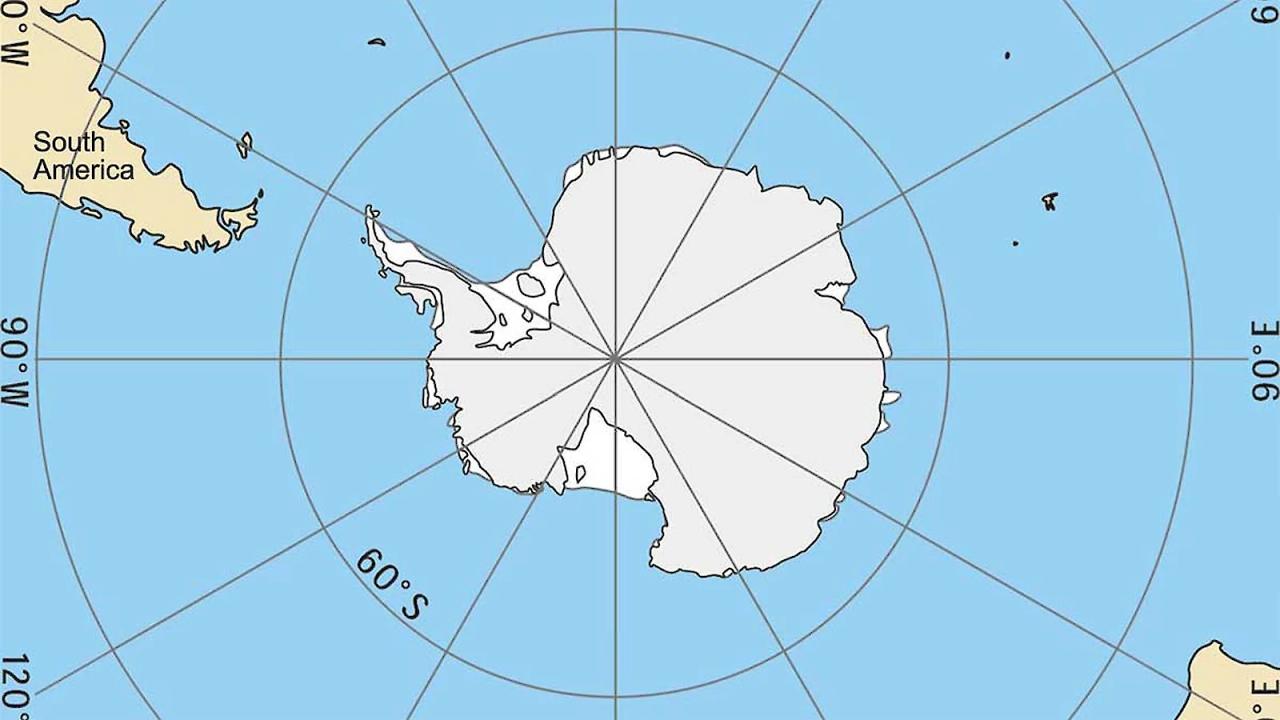
Antarctica is the fifth largest continent, located at the southernmost point of the Earth and surrounded by the Southern Ocean.【15】 The Antarctic Region refers to all areas south of 60 degrees South Latitude, including all associated ice shelves.【16】 Including all islands and ice shelves, the continent’s total area is approximately 13,661,000 square kilometers.【17】 The continent’s nearest neighbor is the southern tip of South America, more than two days by boat and approximately 1,000 kilometers away.【18】 Antarctica is the only continent with no native human population.
The Antarctic ecosystem consists of resilient species adapted to extreme conditions such as low humidity, low temperatures, and high winds. Although terrestrial life on the continent is very limited, the surrounding Southern Ocean is an exceptionally productive biological system. Phytoplankton growing at the ocean surface serves as the region’s primary energy source and provides nourishment for many species, especially krill. This foundational level supports complex food webs that sustain large populations of whales, seals, seabirds, and penguins. The continent’s ecosystem is tightly linked to the delicate balance between the atmosphere and the ocean; therefore, changes in sea ice directly affect all biological communities.
No trees or shrubs grow in Antarctica.【19】 The region’s plants and microorganisms consist of species capable of withstanding repeated freeze-thaw cycles, lack of freshwater, and high solar UVB radiation.【20】 Terrestrial vegetation generally includes about 200 lichen species, over 50 mosses (bryophytes) and liverworts, more than 700 terrestrial algae species, and fungi.【21】 Plant life varies regionally. The maritime Antarctic region, encompassing the western part of the Antarctic Peninsula and nearby islands, is more favorable for terrestrial plant and microscopic animal life due to higher precipitation and relatively milder temperatures.【22】 In contrast, plant life is nearly absent in the continent’s interior.【23】
Despite limited terrestrial vegetation, the ocean surrounding Antarctica is described as one of the most biodiverse waters on the planet.【24】 The process of nutrient upwelling from deep waters to the surface promotes the growth of phytoplankton and algae. Species such as krill, which feed on plankton, form the foundation of the marine food web.【25】
Healthy populations of blue whales, fin whales, humpback whales, right whales, minke whales, sei whales, and sperm whales inhabit the Southern Ocean.【26】 Orcas (killer whales) also live in the region and prey on seals.【27】 The leopard seal, one of the top predators in the food chain, is an aggressive marine animal reaching up to 3 meters in length and 400 kilograms in weight, using long, sharp teeth to tear apart prey such as penguins and fish.【28】
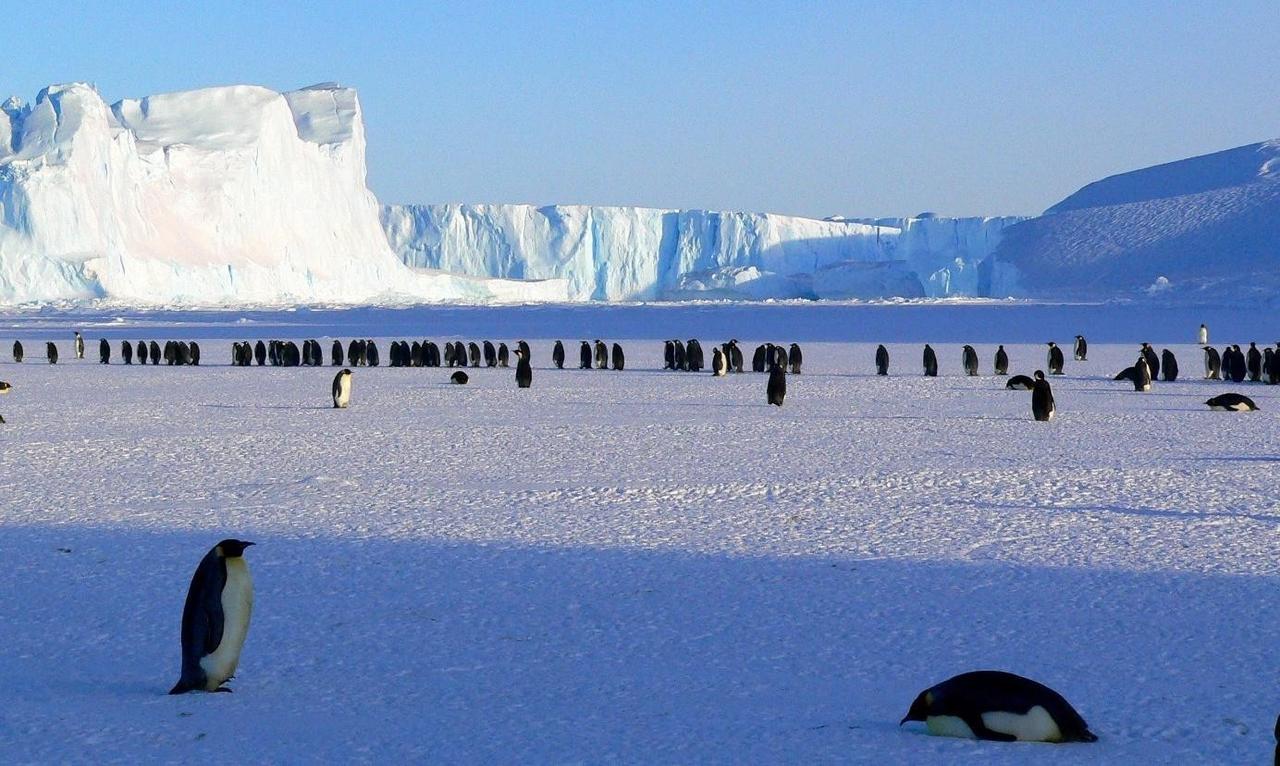
An Image of Penguins Symbolizing the Antarctic Continent (Pxhere)
Penguins, among the most well-known species of Antarctica, are physically adapted to cold coastal waters. They use their wings as flippers for swimming underwater to hunt squid and fish. A layer of trapped air between their feathers provides insulation against freezing waters.【29】
Emperor penguins, abundant on the continent, have a two-layered feather coat, a thick fat reserve, and small beaks and flippers to minimize heat loss in extreme cold. Behaviorally, they huddle together in groups to conserve warmth. Individuals on the outer edges of the group, exposed to the harshest cold and wind, rotate positions periodically to warm up.【30】
Antarctica is home to the world’s largest ice sheet, covering approximately 14 million square kilometers. Much of the continent’s surface lies more than 3,000 meters above sea level, and ice thickness exceeds 4,000 meters in some areas. This massive ice mass covers entire mountain ranges and harbors numerous volcanoes beneath its icy surface.【31】
The ice mass on the Antarctic continent consists primarily of three major components: the Antarctic Peninsula Ice Sheet, the West Antarctic Ice Sheet, and the East Antarctic Ice Sheet. Approximately 98 percent of the continent is covered by ice; nunataks—mountain peaks protruding through the ice—form ice-free areas such as James Ross Island and Alexander Island on the Antarctic Peninsula and the McMurdo Dry Valleys in East Antarctica, which resemble the barren landscapes of the Moon and Mars.【32】
Beneath Antarctica’s thick ice cover, liquid water flows and subglacial lakes exist. Despite the continent’s extreme aridity and freezing temperatures, life exists on, within, and beneath the ice.
The Antarctic ice sheet is drained by fast-moving ice streams. Antarctic glaciers terminate either on land or in the sea as floating ice shelves or grounded/flowing outlet glaciers. These ice streams are highly sensitive to climate change and respond rapidly; depending on environmental conditions, they can be studied, accelerate, retreat, or even cease flowing entirely.
The Antarctic Ice Sheet contains a total volume of 25.4 million cubic kilometers of ice. One of the greatest future risks is the melting of this massive ice mass; if all of it melted, global sea levels would rise by 58 meters.【33】
Another factor increasing the system’s vulnerability to climate change is its topography. Parts of the West Antarctic Ice Sheet rest on bedrock more than 1,500 meters below sea level. This situation makes the impact of warming ocean waters on continental glaciers and future melt risks critically significant on a global scale.
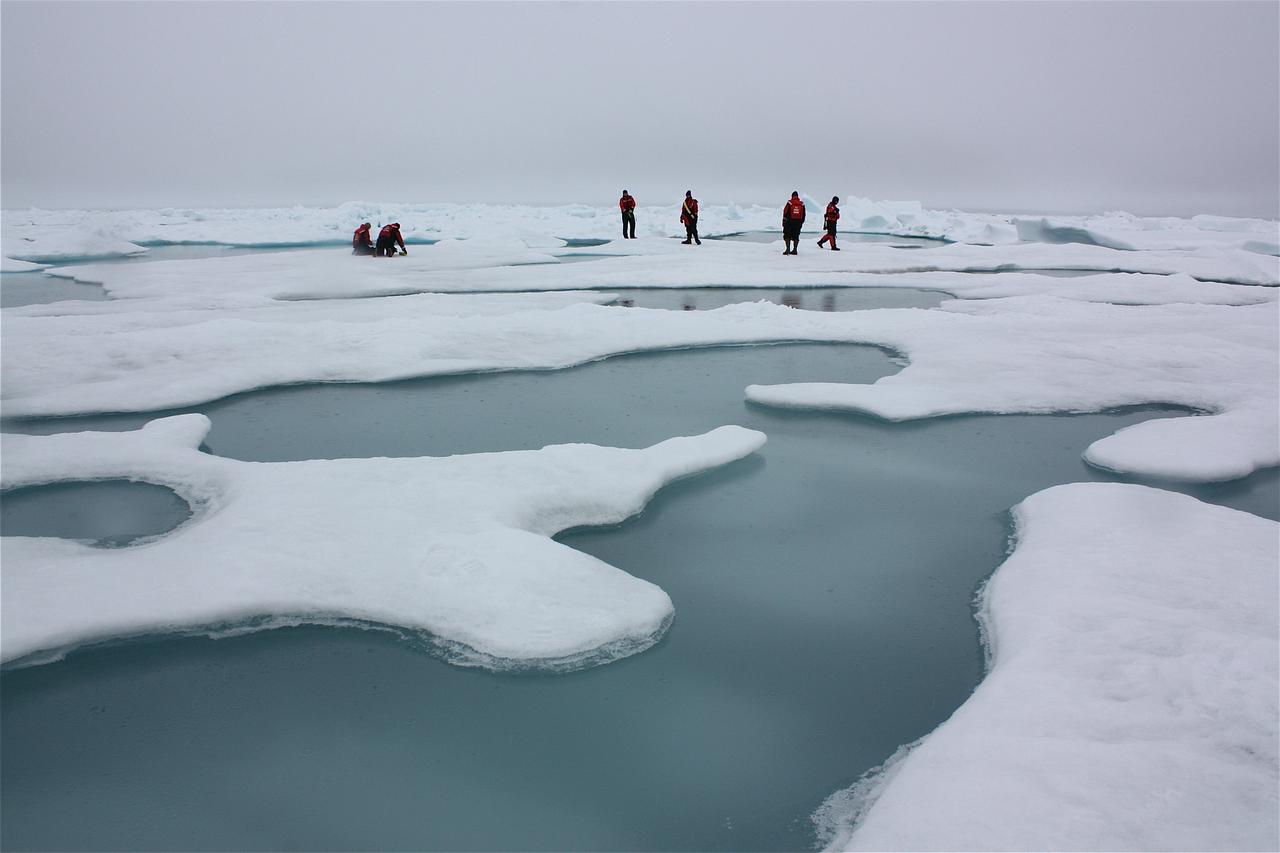
Arctic Sea Ice Is Melting Day by Day (Flickr)
Ninety-eight percent of the continental landmass is covered by the Antarctic Ice Sheet, with thicknesses ranging from 4 to 4.7 kilometers.【34】 This vast ice mass contains approximately 30 million cubic kilometers of freshwater, representing about 90 percent of the world’s freshwater reserves.【35】
Sea ice extent varies seasonally; in late summer, sea ice covers approximately 3 million square kilometers, expanding to up to 19 million square kilometers during winter.【36】
Antarctica is the coldest, windiest, and driest continent on Earth.【37】 Due to Earth’s axial tilt, the continent experiences only two seasons: summer and winter. During summer, there is continuous daylight for six months; during winter, there is continuous darkness for six months.【38】
The continent’s average annual temperature is around -10°C along the coast and approximately -60°C in the high interior regions.【39】 The lowest temperature ever recorded was -89.2°C (some sources report -89.4°C) on 21 July 1983 at the Vostok Station.【40】 The highest temperature recorded is 15°C.【41】
Due to its low precipitation, Antarctica is scientifically classified as a “desert.”【42】 The average annual snowfall, measured as water equivalent, is 150 millimeters; this drops below 50 millimeters on high interior plateaus and exceeds 200 millimeters in some coastal areas. Almost all precipitation on the continent occurs as snow or ice crystals.【43】
High-pressure centers in the continent’s interior and radiative cooling cause dense, cold air to flow rapidly downhill under gravity, generating katabatic winds.【44】 These winds can reach speeds of up to 327 kilometers per hour, lifting snow to create blizzards and causing whiteout conditions that reduce visibility to zero.【45】
Based on climatic and geographic conditions, the continent is divided into two main subregions:【46】
Antarctica is not only a vast ice mass but also one of the fundamental gears of Earth’s climate machine. Its expansive white surfaces reflect a large portion of incoming sunlight back into space, creating a powerful albedo effect that limits planetary warming. Cold, dense waters formed here sink into the deep ocean, regulating global heat, CO₂, and nutrient circulation. Therefore, changes in Antarctica can affect systems far beyond polar latitudes—from tropical rainfall patterns to storm tracks in Europe. Scientific data show that the Southern Ocean currently absorbs a significant portion of excess atmospheric carbon dioxide, slowing global warming.
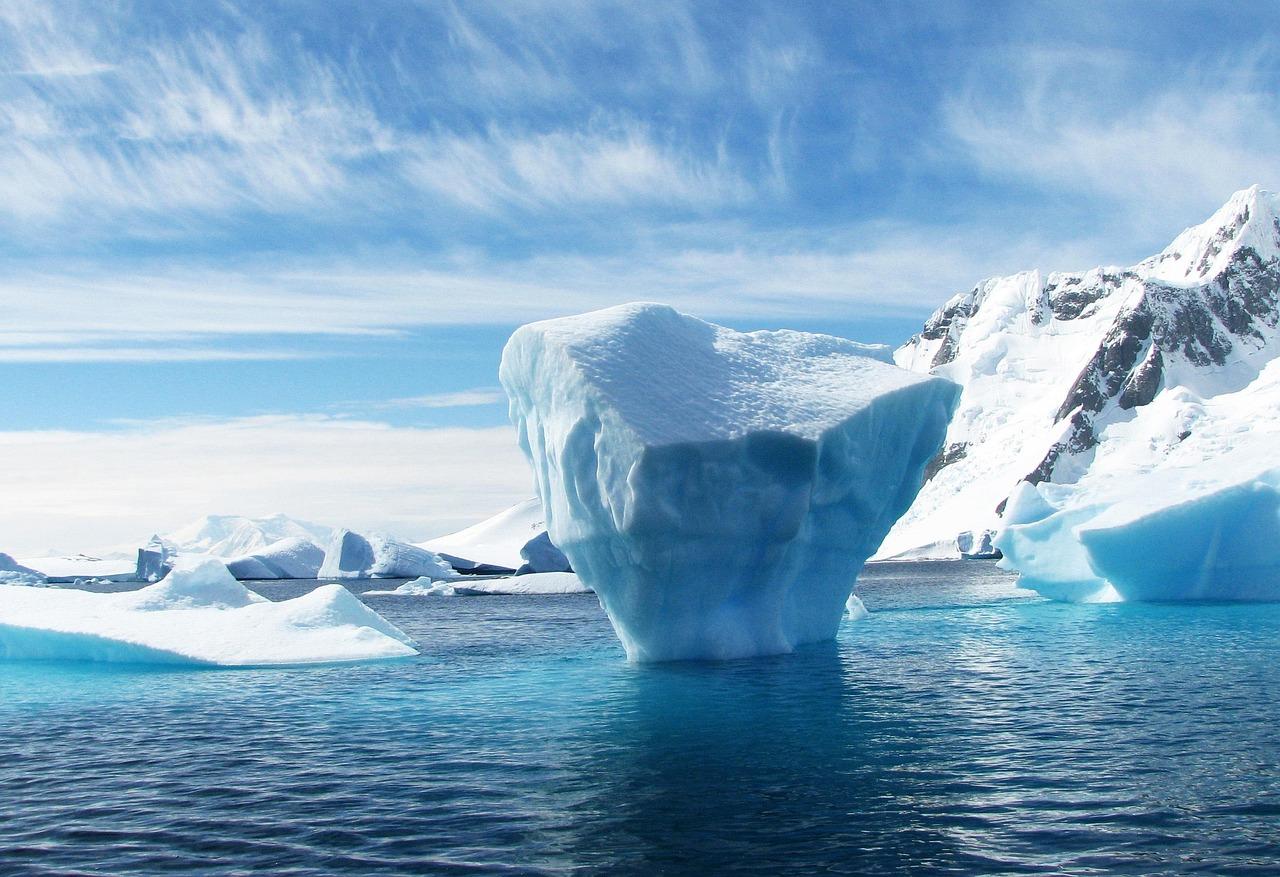
A massive freshwater iceberg, calved from a glacier and floating in ocean waters iceberg (Pixabay)
The “ozone hole” that emerged at the end of the 20th century caused severe thinning in the upper atmosphere over Antarctica, strengthening westerly winds around the pole and altering climatic circulation patterns. With the reduction of harmful chemicals under the Montreal Protocol, an improvement trend in the ozone layer has been observed since the 2000s.【47】
Between 2012 and 2017, ice loss on the continent rose from an average of 76 billion tons per year before 2012 to 219 billion tons. In 2023, sea ice extent reached its lowest recorded level at 1.79 million square kilometers. While reduced sea ice facilitates ship access to the continent, it poses ecological threats.【48】
Turkish scientists’ observations have revealed that previously ice-covered Gullet and Barlas channels have become open and that the sea ice boundary has shifted five degrees further south. This change affects not only biological balances in polar regions but also global atmospheric and precipitation patterns.
The Antarctic region is shaped by snow and ice masses, and its surroundings are highly sensitive to climate change.【49】 The continent’s climate and geography directly influence numerous processes that shape the global climate system. These include carbon dioxide absorption by the Southern Ocean, deep ocean overturning circulation, the ice sheet’s water storage balance, and energy transfer from the atmosphere into space.【50】 The extreme cold stored in the Antarctic ice sheet affects the entire global climate system through surface energy, humidity, cloud formation, precipitation rates, and ocean circulation changes.【51】
Climate change is expected to cause significant alterations in ocean circulation.【52】 If coastal waters around Antarctica warm, the formation of Antarctic Bottom Water—which transports oxygen from the ocean surface to its deepest depths—will be disrupted, altering deep-sea biological communities.【53】
Increasing atmospheric carbon dioxide levels are absorbed by ocean waters, raising their acidity.【54】 Increased acidity threatens the habitats of marine organisms such as Coccolithophorid and Pteropod, and can alter the composition of microbial communities. These organism-level changes are likely to trigger cascading consequences throughout the entire Antarctic food web.【55】
As one of the cleanest regions on Earth, Antarctica serves as an ideal laboratory for measuring global pollutants and the effects of rising atmospheric carbon dioxide.【56】 However, traces of industrial chemicals produced elsewhere and released into the atmosphere have been detected in Antarctic snowpacks. Over time, these foreign chemicals accumulate in the bodies of animals such as seals, penguins, and whales, creating potential long-term harm.【57】
Human activities in the region span over a century.【58】 Environmental impacts during this period have included overhunting of certain species to the brink of extinction, soil contamination, discharge of sewage into the sea, and abandonment of waste. Since the late 1980s, commercial tourism has grown rapidly.【59】 Today, visits are strictly regulated to prevent disturbance of wildlife, damage to vegetation, introduction of non-native species, and pollution.【60】
Although Antarctic tourism has increased rapidly in recent years, it is strictly regulated by international rules. Tourist visits occur mostly during summer months when sea ice recedes. Most tourists reach the continent by ship; only a limited number are permitted to land. Tourism activities must comply with environmental protection principles: strict rules require cleaning of clothing and equipment to prevent invasive species, maintaining a safe distance from wildlife, and restricting access to sensitive areas. Tourism serves not only as an economic sector but also as a tool to raise international awareness for Antarctica’s conservation. However, increasing visitor numbers have brought growing potential pressures on the ecosystem, necessitating continuous monitoring and regulation.【61】
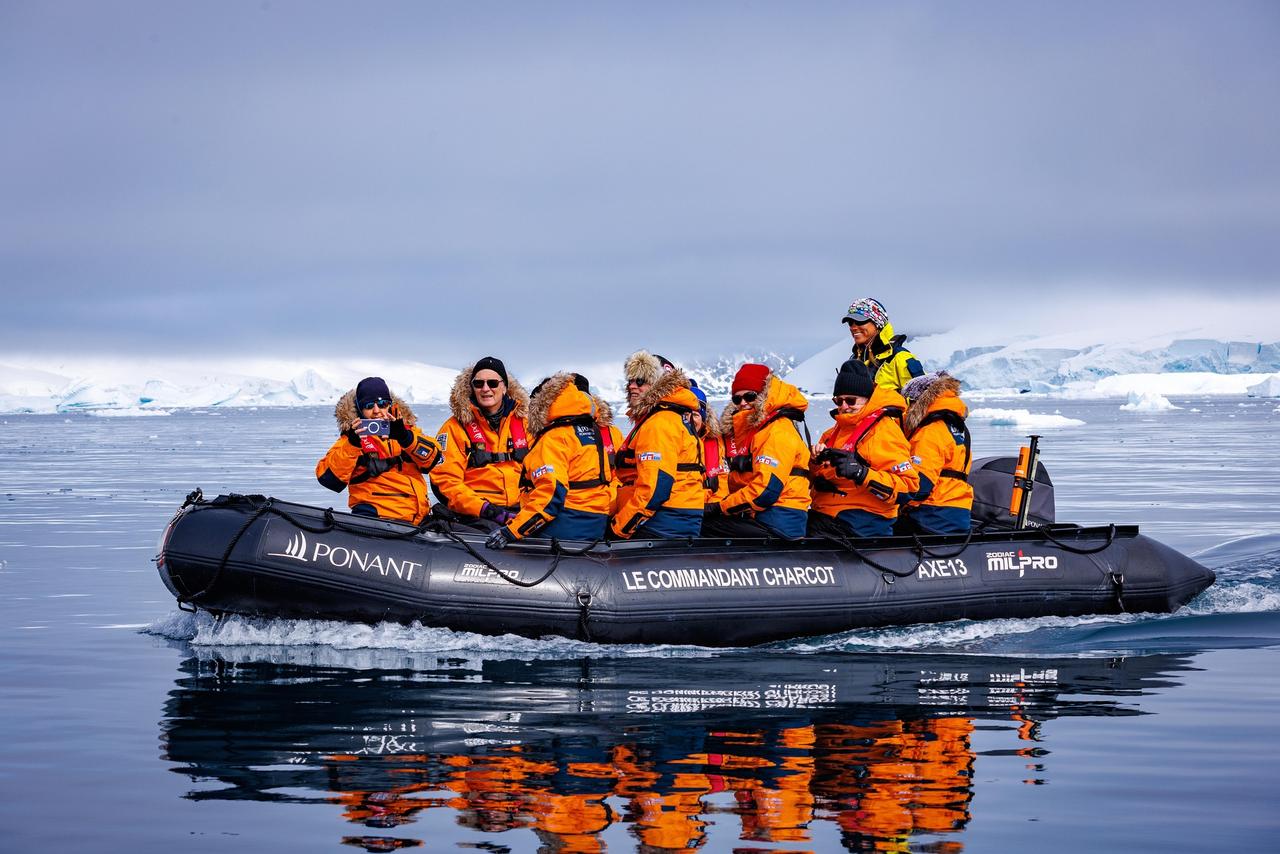
During exploration trips, passengers can board small Zodiac boats to participate in activities such as glacier cruises, canoeing, or snowshoeing (pixabay)
Tourism activities remain a key agenda item; approximately 40,000 visitors arrived in the region in 2010. At the 2009 ATCM meeting in New Zealand, regulations were developed in collaboration with the International Association of Antarctica Tour Operators (IAATO) to reduce carbon footprints and environmental impacts. These regulations include limits on the number of people landing ashore, wildlife observation guidelines, and medical evacuation plans.【62】 Member states continue efforts to combat illegal, unreported, and unregulated (IUU) fishing and manage marine protected areas in sensitive regions such as the Ross Sea.【63】
In the late 1940s, competition among nations making territorial claims in the Antarctic Peninsula region intensified. Concerns arose that Antarctica could become a pawn in the Cold War due to the interests of the United States and the Soviet Union.【64】 Amid these political tensions, diplomatic and scientific efforts culminated in the International Geophysical Year (IGY), held from July 1957 to December 1958. The success of this initiative laid the groundwork for the International Council for Science (ICSU) to establish the Scientific Committee on Antarctic Research (SCAR) in 1958 to coordinate international scientific activities.【65】
1959 Antarctic Treaty (United Nations YouTube Page)
Building on the positive outcomes of scientific cooperation, 12 countries (Argentina, Australia, Belgium, Chile, France, Japan, New Zealand, Norway, South Africa, the Soviet Union, the United Kingdom, and the United States) signed the Antarctic Treaty in 1959. The Treaty entered into force on 23 June 1961, declaring the continent a “natural reserve devoted to peace and science.”【66】
The Treaty system has expanded over time: Measures for the Conservation of Antarctic Flora and Fauna (1964), the Convention for the Conservation of Antarctic Seals (1972), and the Convention on the Conservation of Antarctic Marine Living Resources (1980) have entered into force.【67】 In 1991, prompted by Australia, France, Italy, and Belgium, the Madrid Protocol (Antarctic Treaty Environmental Protection Protocol) was signed and entered into force in 1998. This protocol permanently banned mining and mineral resource activities in Antarctica and codified standards for waste management, prevention of marine pollution, and environmental impact assessments. Protection of marine life in the Southern Ocean is ensured by the CCAMLR Convention.【68】
Today, the Antarctic Treaty Consultative Meetings (ATCM), the Committee for Environmental Protection (CEP), and SCAR regularly assess challenges in the region.
Antarctica has no sovereign nation. The Antarctic Treaty, which entered into force in 1961
Anadolu Ajansı. “Buzlar Kıtası Antarktika Bu Yıl Rekor Seviyede Erimeye Devam Ediyor.” May 12, 2023. Accessed March 13, 2026. https://www.aa.com.tr/tr/dunya/buzlar-kitasi-antarktika-bu-yil-rekor-seviyede-erimeye-devam-ediyor/2895613
Antarctic Glaciers. "The Antarctic Continent." Accessed March 13, 2026. https://www.antarcticglaciers.org/
Antarctic and Southern Ocean Coalition (ASOC). “Antarctic Ice and Rising Sea Levels.” 2025. Accessed March 13, 2026. https://www.asoc.org/learn/antarctic-ice-and-rising-sea-levels/
Antarctic and Southern Ocean Coalition (ASOC). “Introducing CCAMLR.” Accessed March 13, 2026. https://www.asoc.org/learn/introducing-ccamlr/
Antarctica Treaty Secretariat. "The Antarctic Treaty." Accessed March 13, 2026. https://www.ats.aq/e/antarctictreaty.html
Australian Antarctic Program. "Climate Change." Accessed March 13, 2026. https://www.antarctica.gov.au/about-antarctica/weather-and-climate/climate-change/
Australian Antarctic Program. "Environmental Management." Accessed March 13, 2026. https://www.antarctica.gov.au/about-antarctica/environment/pollution-and-waste/
Australian Antarctic Program. "Ice and Atmosphere." Accessed March 13, 2026. https://www.antarctica.gov.au/about-antarctica/ice-and-atmosphere/ice-sheet/.
Australian Antarctic Program. “Geography and Geology.” October 27, 2020. Accessed March 13, 2026. https://www.antarctica.gov.au/about-antarctica/geography-and-geology/
Australian Antarctic Program. “History of the Antarctic Treaty.” Accessed March 13, 2026. https://www.antarctica.gov.au/about-antarctica/law-and-treaty/history/
Australian Antarctic Program. “People in Antarctica.” Accessed March 13, 2026. https://www.antarctica.gov.au/about-antarctica/people-in-antarctica/.
Australian Antarctic Program. “Plants and Microbes.” October 27, 2020. Accessed March 13, 2026. https://www.antarctica.gov.au/about-antarctica/plants/
Australian Antarctic Program. “Tourism.” Accessed March 13, 2026. https://www.antarctica.gov.au/about-antarctica/tourism/.
BBC. "Where is Antarctica? / Physical Geography / Wildlife / Human Geography." Accessed March 13, 2026. https://www.bbc.co.uk/bitesize/articles/z4whsk7#zmnckty
Başlar, Kemal. “Antarktika’da Türk Bilimsel Araştırma Üssü Kurulması.” *Bilge Strateji* 7, no. 13 (2015): 11–16. Accessed March 13, 2026. https://dergipark.org.tr/tr/pub/bs/article/50923?issue_id=3797
Flickr. February 26, 2015. Photograph. Accessed March 13, 2026. https://www.flickr.com/photos/61412013@N08/16447550657/in/photostream/
Flickr. “ICESCAPE Mission.” July 8, 2010. Photograph. Accessed March 13, 2026. https://www.flickr.com/photos/nasahqphoto/4774967640
Geographicus Rare Antique Maps. “James Polar Projection of the Globe, Antarctica (Pacific Center).” 1860. Picryl. Accessed March 13, 2026. https://picryl.com/media/1860-james-polar-projection-of-the-globe-antarctica-pacific-center-geographicus-19318b
Guido, Sophia. “The Continent.” History of the Antarctic Treaty System. Library of Congress. Accessed March 13, 2026. https://www.loc.gov/ghe/cascade/index.html?appid=eb78cec7f5e34c40a2ee13732c4bf805&bookmark=Discovery
Mandal, Gagan, Jia-Yuh Yu, and Shih-Yu Lee. "The Influence of Antarctic Sea Ice Distribution on the Southern Ocean Overturning Circulation for the Past 20,000 Years." *Proceedings* 87, no. 1 (2023): 9. Accessed March 13, 2026. https://doi.org/10.3390/IECG2022-14145
Massachusetts Institute of Technology (MIT). "The Ozone Hole is Healing, Thanks to Global Reduction of CFCs." ScienceDaily. March 5, 2025. Accessed March 13, 2026. www.sciencedaily.com/releases/2025/03/250305134800.htm
Ministry of Industry and Technology of the Republic of Türkiye. "10th National Antarctic Science Expedition Completed." March 5, 2026. Accessed March 13, 2026. https://www.sanayi.gov.tr/medya/haber/10-ulusal-antarktika-bilim-seferi-tamamlandi
NASA Science. "What Is Antarctica? | NASA Space Place." Accessed March 13, 2026. https://spaceplace.nasa.gov/antarctica/en/
National Academies. “Celebrating Antarctica Day and the Promise of Antarctic Research Program News.” Accessed March 13, 2026. https://www.nationalacademies.org/news/celebrating-antarctica-day-and-the-promise-of-antarctic-research
National Geographic. “Antarctica.” February 13, 2024. Accessed March 13, 2026. https://education.nationalgeographic.org/resource/antarctica/
New Zealand Ministry of Foreign Affairs and Trade (MFAT). “Antarctica and the Southern Ocean.” 2022. Accessed March 13, 2026. https://www.mfat.govt.nz/en/environment/antarctica-and-the-southern-ocean
PxHere. Photograph. Accessed March 13, 2026. https://pxhere.com/tr/photo/1083462
Royal Museum Greenwich. “History of Antarctic Explorers.” 2021. Accessed March 13, 2026. https://www.rmg.co.uk/stories/maritime-history/history-antarctic-explorers
TRT World. "Antarctica Diaries: A Trip to the End of the World." YouTube, November 14, 2020. Accessed March 13, 2026. https://www.youtube.com/watch?v=hjJYsttJn78
U.S. Geological Survey (USGS). "Antarctic Region." Accessed March 13, 2026. https://www.usgs.gov/international-programs/antarctic-region
[1]
Guido, Sophia . “The Continent.” History of the Antarctic Treaty System. Library of Congress. Erişim. 11 Mart 2026 https://www.loc.gov/ghe/cascade/index.html?appid=eb78cec7f5e34c40a2ee13732c4bf805&bookmark=Discovery.
[2]
Guido, "The Continent."
[3]
Guido, "The Continent."
[4]
Royal Museum Greenwich. “History of Antarctic Explorers.” 2021.Erşimi. 11 Mart 2026 https://www.rmg.co.uk/stories/maritime-history/history-antarctic-explorers
[5]
Royal Museum Greenwich, "History of Antarctic Explorers."
[6]
Guido, "Exploring the Continent."
[7]
Royal Museum Greenwich, "History of Antarctic Explorers."
[8]
Royal Museum Greenwich, "History of Antarctic Explorers."
[9]
Aurora Expedititions. “The Fascinating History of Antarctic Explorers.” 2019. Erişim. 11 Mart 2026. https://www.aurora-expeditions.com/blog/history-of-antarctic-explorers.
[10]
National Geographic. “Antarctica.” National Geographic. 13 February 2024. Erişim. 11 Mart 2026 https://education.nationalgeographic.org/resource/antarctica/.
[11]
National Geographic. “Antarctica.”
[12]
National Geographic. “Antarctica.”
[13]
Royal Museum Greenwich, "History of Antarctic Explorers."
[14]
Australian Antarctic Division. “Australian Antarctic Strategy & Action Plan.” 13 January 2025. Erişim Tarihi 29 November 2025.
[15]
U.S. Geological Survey (USGS). "Antarctic Region." Erişim 7 March 2026. https://www.usgs.gov/international-programs/antarctic-region.
[16]
U.S. Geological Survey (USGS), "Antarctic Region".
[17]
Australian Government, Department of Climate Change, Energy, the Environment and Water. "Ice and atmosphere." Erişim 7 March 2026. https://www.antarctica.gov.au/about-antarctica/ice-and-atmosphere/ice-sheet/
[18]
BBC. "Where is Antarctica? / Physical geography / Wildlife / Human geography." Erişim 7 March 2026. https://www.bbc.co.uk/bitesize/articles/z4whsk7#zmnckty.
[19]
NASA Science. “What Is Antarctica? | NASA Space Place – NASA Science for Kids.” Spaceplace.nasa.gov. https://spaceplace.nasa.gov/antarctica/en/.
[20]
Australian Antarctic Program. “Plants and Microbes.” 27 October 2020. Erişim. 12 March 2026 https://www.antarctica.gov.au/about-antarctica/animals/.
[21]
Australian Antarctic Program, " Plants and Microbes".
[22]
Australian Antarctic Program, "Plants and Microbes".
[23]
National Geographic Education, "Antarctica".
[24]
National Geographic Education, "Antarctica".
[25]
National Geographic Education, "Antarctica".
[26]
National Geographic Education, "Antarctica".
[27]
BBC, "Where is Antarctica?".
[28]
National Geographic Education, "Antarctica".
[29]
National Geographic Education, "Antarctica".
[30]
BBC, "Where is Antarctica?".
[31]
Antarctic Glaciers. “The Antarctic Continent.” Erişim. 12 March 2026. https://www.antarcticglaciers.org/.
[32]
Antarctic Glaciers. “The Antarctic Continent
[33]
Antarctic and South Ocean Coalitions (ASOC). “Antarctic Ice and Rising Sea Levels” 2025. https://www.asoc.org/learn/antarctic-ice-and-rising-sea-levels/.
[34]
Australian Government, Department of Climate Change, Energy, the Environment and Water. "Animals, Plants and Microbes." Erişim 7 March 2026. https://www.antarctica.gov.au/about-antarctica/plants/.
[35]
Australian Government, "Antarctic geography and geology".
[36]
National Geographic Education, "Antarctica".
[37]
Australian Antarctic Program, "Antarctic weather." Erişim 7 March 2026. https://www.antarctica.gov.au/about-antarctica/weather-and-climate/weather/.
[38]
NASA Space Place. "What Is Antarctica?" Erişim 7 March 2026. https://spaceplace.nasa.gov/antarctica/en/.
[39]
Australian Government, "Antarctic weather".
[40]
Australian Government, "Antarctic weather"; NASA Space Place, "What Is Antarctica?".
[41]
NASA Space Place, "What Is Antarctica?".
[42]
NASA Space Place, "What Is Antarctica?".
[43]
Australian Government, "Antarctic weather".
[44]
Australian Government, "Antarctic weather".
[45]
Australian Government, "Antarctic weather".
[46]
Australian Antarctic Program, "Plants and Microbes".
[47]
Massachusetts Institute of Technology. "The ozone hole is healing, thanks to global reduction of CFCs." ScienceDaily. www.sciencedaily.com/releases/2025/03/250305134800.htm.
[48]
Mandal, Gagan, Jia-Yuh Yu, and Shih-Yu Lee. 2023. "The Influence of Antarctic Sea Ice Distribution on the Southern Ocean Overturning Circulation for the Past 20,000 Years" Proceedings 87, no. 1: 9. Erişim Tarihi 29 November 2025. https://doi.org/10.3390/IECG2022-14145.
[49]
Australian Antarctic Program, "Climate Change." Erişim 7 March 2026. https://www.antarctica.gov.au/about-antarctica/weather-and-climate/climate-change/.
[50]
Australian Antarctic Program, "Climate Change".
[51]
Australian Antarctic Program, "Ice and atmosphere." Erişim 7 March 2026.https://www.antarctica.gov.au/about-antarctica/ice-and-atmosphere/ice-sheet/
[52]
Australian Antarctic Program, " Plants and Microbes".
[53]
Australian Antarctic Program, " Plants and Microbes".
[54]
Australian Antarctic Program, "Plants and Microbes".
[55]
Australian Antarctic Program, "Plants and Microbes".
[56]
Australian Antarctic Program, "Environmental Management." Erişim 7 March 2026. https://www.antarctica.gov.au/about-antarctica/environment/pollution-and-waste/
[57]
Australian Government, "Environmental Management".
[58]
Australian Government, "Environmental Management".
[59]
Australian Arctic Program, "People in Antarctica." Erişim 7 March 2026. https://www.antarctica.gov.au/about-antarctica/people-in-antarctica/
[60]
Australian Government, "People in Antarctica".
[61]
Australian Antarctic Program, “Tourism” Erişim. 12 March 2026. https://www.antarctica.gov.au/about-antarctica/tourism/
[62]
National Geographic. “Antarctica.”
[63]
New Zealand Ministry of Foreign Affairs and Trade. “Antarctica and the Southern Ocean.” New Zealand Ministry of Foreign Affairs and Trade. MFAT. 2022.Erişim. 11 March 2026. https://www.mfat.govt.nz/en/environment/antarctica-and-the-southern-ocean.
[64]
Australian Antarctic Program. “History of the Antarctic Treaty.” https://www.antarctica.gov.au/about-antarctica/law-and-treaty/history/.
[65]
Australian Government. “History of the Antarctic Treaty.”
[66]
Sophia , Guido. “History of the Antarctic Treaty System.” Library of Congress. Erişim. 11 March 2026 https://www.loc.gov/ghe/cascade/index.html?appid=eb78cec7f5e34c40a2ee13732c4bf805.
[67]
Sophia Guido. “The Antarctic Treaty.” History of the Antarctic Treaty System. Library of Congress. Erişim. 11 March 2026. https://www.loc.gov/ghe/cascade/index.html?appid=eb78cec7f5e34c40a2ee13732c4bf805&bookmark=The%20Antarctic%20Treaty
[68]
Antarctic and Southern Ocean Coalition. “Introducing CCAMLR.” Erişim Tarihi 29 November 2025. https://www.asoc.org/learn/introducing-ccamlr/.


Population | The only continent with no native (permanent) human population | ||||||||
|---|---|---|---|---|---|---|---|---|---|
Size(s) | Approximately 13 000 km² 661 | ||||||||
Title(s) | The coldest and driest continent on Earth windiest | ||||||||
International Agreements | the Antarctic Treaty System (ATS) the Protocol on Environmental Protection (Madrid Protocol - 1991) The Antarctic Treaty (1959) | ||||||||
Location | entirely surrounded by the Southern Ocean The southernmost continent | ||||||||
Freshwater Reserve | It alone contains approximately 70% to 90% of the world's freshwater reserves | ||||||||
Highest Elevation | The highest continent on Earth, with an average elevation of 2,500 meters | ||||||||
Ice Cover | 98% of the continental landmass is covered by ice up to 4.7 kilometers thick | ||||||||
History
Heroic Age (1897–1922) and the Race to the South Pole
Sovereignty Claims and Regional Policies
Geography
Living Ecosystem
Terrestrial Vegetation and Flora
Marine Fauna and Food Web
Penguins and Physical Characteristics
Ice Sheet Structure
Subglacial Lakes and Ice Streams
Future Risks and Sea Level Rise
Ice Cover and Water Resources
Climate and Atmospheric Conditions
Temperature and Precipitation
Winds and Climate Zones
Role in the Global Climate System
Climate Change Findings
Global Climate Processes and Ocean Circulation
Ocean Acidification
Pollution, Human Impacts, and Management
Tourism
Antarctic Treaty System and Environmental Protection Mechanisms
Scientific Research