

This article was automatically translated from the original Turkish version.
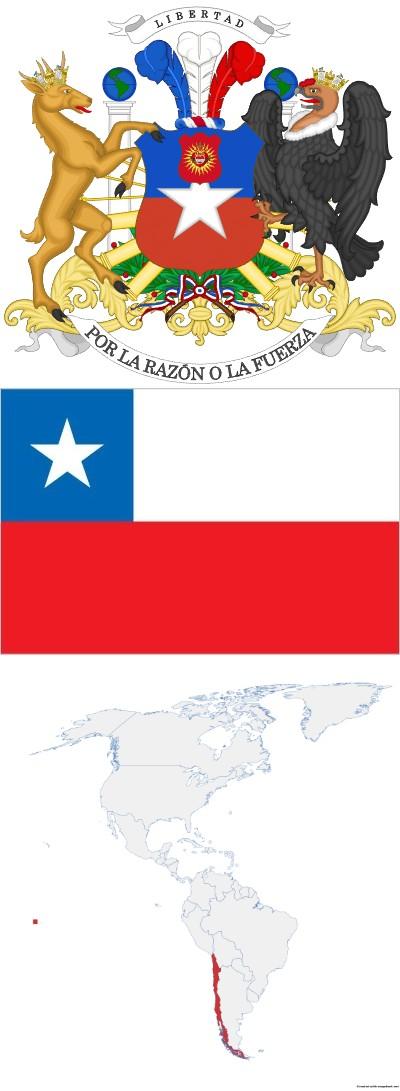
Republic of Chile
Official Name(s) | Republic of Chile | ||||||||
|---|---|---|---|---|---|---|---|---|---|
Form of Government(s) | Unitary Presidential Republic | ||||||||
Date of Independence | 12 February 1818 (from Spain) | ||||||||
Capital(s) | Santiago | ||||||||
Head of State | Gabriel Boric Font (2022 – Present) | ||||||||
Official Languages | Spanish | ||||||||
Common Languages | etc.) Aymara Indigenous languages (Mapudungun English (%10.2) Spanish (%99.5) | ||||||||
National Day | 18 September (Fiestas Patrias / Declaration of the First Government Junta) | ||||||||
Area(s) | 756 102 km² | ||||||||
Total Population | Around 20 million | ||||||||
Climate(s) | Desert (Atacama) in the north and cool and humid/glacial climate dominates in the south Mediterranean climate in the central region | ||||||||
GDP (Nominal) | 347.17 billion US dollars | ||||||||
GDP Per Capita (Nominal) | 17,180 USD | ||||||||
Ethnic Groups | Mapuche and Other Indigenous Peoples: ~%11.1 White and Non-Indigenous: ~%88.9 | ||||||||
Religious Composition | Other Religions: ~%4 No Religious Affiliation (Non-religious): ~%26 Protestant: %16) Christian: ~%70 (Catholic: %54 | ||||||||
Telephone Code | +56 | ||||||||
Internet Domain Code | .cl | ||||||||
Chile (Republic of Chile) is a republic governed by a presidential system with a population of approximately 19.6 million. It is located in the southwestern part of South America, bordered by Peru to the north, Bolivia to the northeast, Argentina to the east, and the Pacific Ocean to the west. The country stretches in a narrow strip averaging 175 kilometers in width but extending about 4,300 kilometers in length between the Andes Mountains and the ocean. In addition to its continental territory, Chile exhibits a tri-continental structure encompassing Easter Island (Rapa Nui) in Polynesia and its claimed Antarctic Territory (Territorio Chileno Antártico). The capital, Santiago, situated in a fertile valley in the central region, is recognized as one of the continent’s largest metropolitan areas. The official language is Spanish, and the national flag, known as “La Estrella Solitaria” (The Lone Star), features colors symbolizing the sky, independence, and the blood shed in the struggle for freedom, with a white star at its center.
National Anthem of Chile (Ian Berwick YouTube Channel)
Chile’s national anthem, Himno Nacional de Chile, was composed by Ramón Carnicer in 1847. The current lyrics were written by Eusebio Lillo. It is the official anthem performed at state ceremonies and national holidays. The modern version is a symbol of the national identity forged after the independence struggle.
The Chilean flag was officially adopted on October 18, 1817. It consists of two horizontal bands: white on top and red on the bottom. In the upper left corner, a blue square contains a single white star. The white represents the snow of the Andes, the red symbolizes the blood shed in the war of independence, and the blue stands for the sky. The star signifies national unity and the centralized state structure. The flag is among the oldest modern national flags in the Americas in terms of design. 【1】

The Mapuche peoples who lived in the region before the Spanish (Look and Learn)
The oldest known archaeological evidence of human presence in present-day Chile is the Monte Verde settlement, dated to approximately 18,500 years ago and recognized as one of the earliest human settlements in the Americas. In the north, the Chinchorro culture—particularly noted for its early mummification techniques—dominated, while in the center, the Picunche and Mapocho Valley communities thrived. In the south, the Mapuche culture was defining. Near the Altiplano, the Aymara and Atacameño communities developed agriculture, salt lake economies, and highland pastoral traditions.【2】 . The Inca expanded into northern Chile during the 15th century but were halted by Mapuche resistance around the Maule River and could not advance further south.
The Spanish arrived in the region in 1540 under the command of Pedro de Valdivia and founded Santiago in 1541. Despite the valuable mineral resources in the north, colonial administration was strained by constant military expenditures due to intense Mapuche resistance in the south. The Araucanía region remained largely unconquered for three centuries. Mapuche uprisings in the 16th and 17th centuries—particularly those of 1553, 1598, and 1655—pushed colonial boundaries back and established a prolonged frontier economy. During the colonial era, Chile was administered as a captaincy under the Viceroyalty of Peru, with agriculture and livestock forming the backbone of the colonial economy.【3】

Daily Clothing of Spanish Colonists (Look and Learn)
The Napoleonic occupation of Spain in 1808 triggered an autonomy movement in Santiago, culminating in the establishment of the first national junta in 1810. The independence movement led by José Miguel Carrera and Bernardo O’Higgins faced setbacks against reorganized Spanish forces. In 1817, the Army of the Andes under José de San Martín crossed the Andes into Chile, altering the course of the independence war. The declaration of independence was issued on February 12, 1818. The new state was structured as a centralized republic with a strong executive branch.【4】
Following independence, Chile experienced rapid economic growth fueled by silver and nitrate mining in the north. The 1833 Constitution established a powerful presidential system. The annexation of Araucanía in the 1880s—the most significant territorial expansion after colonial rule—was completed. In the War of the Pacific (1879–1883), Chile defeated Peru and Bolivia, acquiring vast northern territories and strategic resources, thereby eliminating Bolivia’s access to the sea. This period marked Chile’s rise as a regional power. The 1891 civil war resolved the power struggle between the president and congress in favor of congress, establishing a new political balance with a parliamentary tendency.【5】

Poster for the Centennial Celebration of the Republic of Chile (Flickr)
In the early 1900s, skilled migration, mining revenues, and port-based trade accelerated Chile’s modernization. However, the collapse of nitrate prices after World War I and the state’s need for industrialization increased political instability in the 1920s.【6】 . State-led policies strengthened after 1932. Eduardo Frei Montalva’s reforms in the 1960s and Salvador Allende’s socialist government in 1970 polarized the country amid allegations of foreign interference. On September 11, 1973, a military coup led by Augusto Pinochet occurred.【7】 . The Pinochet regime witnessed severe human rights violations and radically restructured the economy through free-market policies. A 1988 plebiscite ended the dictatorship, and democratic rule was restored in 1990.【8】
Since the transition to democracy, center-left coalitions governed the country for an extended period. Social policy reforms, copper revenues, and macroeconomic stability transformed Chile into one of Latin America’s most stable economies.【9】 . The 2010 earthquake, the 2019–2022 protest wave, and the new constitutional process reshaped the country’s political agenda. The rejection of constitutional drafts in referendums in 2022 and 2023 prolonged a period of political impasse. Since 2022, the government of Gabriel Boric has sought to reduce social inequalities and strengthen state capacity. Starting in March 2026, governance will pass to the government of José Antonio Kast.
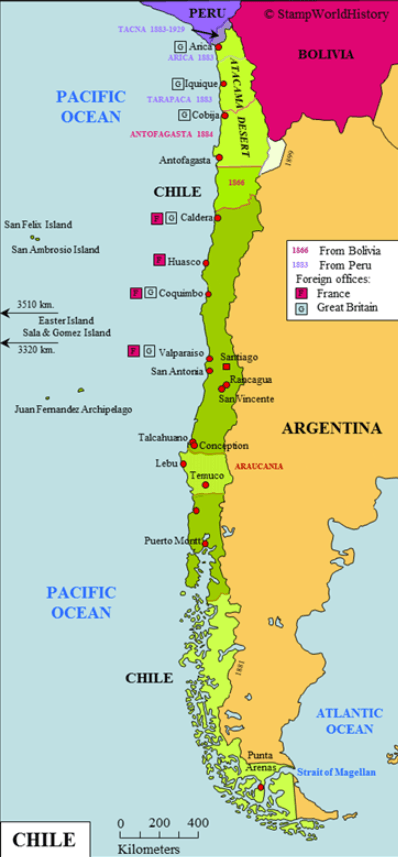
Chile’s Geographic Location (Stamp World History)
Chile occupies a narrow, elongated geographic strip along the western coast of South America. It shares land borders with Peru to the north, Bolivia to the northeast, and Argentina to the east. Its western boundary is the Pacific Ocean. This positioning makes Chile a “mountainous coastal state” squeezed between the Andes Mountains and the ocean.【10】
Chile’s long, narrow land strip is defined by the Andes Mountains (Cordillera de los Andes), which rise along its western border. Elevations increase significantly along this range; for example, Ojos del Salado, one of the country’s highest peaks, reaches 6,893 meters.
Mountainous terrain varies from north to south: arid in the north and volcanic with rain-fed mountain systems in the south.
Between the mountain range and the ocean lies a narrow coastal strip, while inland, especially in the central zone, relatively lower and more suitable terrain exists. These valleys and plains are vital for agricultural and socioeconomic settlement. The central region, in particular, contains fertile valleys and arable land.【11】
Numerous rivers flow through Chile. One is the La Ligua River, which runs through the central-north region, sustaining agricultural irrigation and settlements. Originating in the Andes, it empties into the Pacific. River systems flowing from the Andes into the Pacific are vital for water resources. The La Ligua River, for instance, is a critical source for irrigation in the central-north region but has faced severe water stress in the last decade due to the “Megadrought.”【12】
In the south, numerous lakes, fjords, and watersheds are found. Rich aquatic geography, marked by forests, river systems, and lakes, is prominent.
Chile’s climate varies dramatically according to geographic position and latitude.

Atacama Desert (Pexels)
Vegetation reflects this climatic diversity: desert flora and arid-adapted formations in the north, garden cultivation, orchards, maquis, and Mediterranean-type plants in the center, and forests, coniferous trees, and humid forest ecosystems in the south.【13】
Chile is rich in mineral resources. Its most important natural resource is copper: Chile is among the world’s leading copper producers.【14】 . Other minerals include molybdenum, iron ore, nitrates, iodine, and lithium.

Chuquicamata Copper Mine (Flickr)
In agriculture, the central valleys are highly productive, yielding fruits (grapes, apples), cereals, and vegetables. Fruit and wine production are vital for both domestic consumption and export.【15】 . Coastal areas are prominent for seafood and fishing; forest resources in the southern regions are exploited for timber and other forest products.【16】
Chile’s geographic diversity offers potential for energy production, particularly hydropower, closely linked to its topography. Mining infrastructure, from extraction to refining, transport, and export ports, is critical to the sector.【17】
A long coastline provides maritime transport via ports and shipping. Inland, mountainous terrain shapes road and rail infrastructure according to geographic constraints.
Chile’s economy is regarded as one of the most stable and successful in South America.【18】 . Historically based on agricultural and mining exports, the economy was shaped in the 19th century by key commodities such as nitrates and copper. After the Great Depression of the 20th century, the economy shifted toward socialist programs with increased state control and import substitution policies. During the administration of Salvador Allende Gossens (1970–73), copper mines and banks were nationalized.【19】
Following the 1973 military coup, Augusto Pinochet’s regime initiated sweeping economic reforms embracing free-market principles, privatization, and export-led growth. Although these reforms faced periods of high inflation and volatility, they accelerated Chile’s economic growth from the 1990s onward and reduced poverty by more than half.【20】 . Copper remains the country’s most important export, but since the early 21st century, Chile has developed a broader export economy including non-traditional products such as seafood, fruit, and wine.
Chile is a high-income economy and a member of the OECD. Its currency is the Chilean Peso (CLP).
Central Bank (Banco Central de Chile), since 1989 an autonomous institution, implements monetary and exchange rate policies and regulates domestic banking. Governments have pursued policies since 2014 to gradually reduce the fiscal deficit.【22】

Vineyards Form a Significant Part of Chilean Agriculture (Flickr)
Chile’s economy is characterized by a strong mining sector, growing services, and diversified export products.
Although favorable climatic conditions and abundant water resources support agriculture, the sector contributes less than one-tenth of GDP and employs approximately one-sixth of the labor force. Under Chile’s outward-oriented economic policies, exports of fresh fruit (grapes, apples), canned vegetables, and wine have grown significantly. Chile is typically among the world’s top ten wine producers.【23】 . Major products include cereals (wheat), potatoes, corn, and industrial crops (sugar beet).
With its long coastline and rich Pacific Ocean resources, Chile is among the world’s leading producers of fisheries and aquaculture products.【24】 . Key harvested species include sardines, anchovies, mackerel, and herring, most of which are processed into fishmeal and fish oil.【25】
Aquaculture, especially salmon and trout farming, is one of Chile’s most dynamic and largest export sectors.【26】 . Chile is the world’s second-largest salmon producer and exporter after Norway. This trade is concentrated in the Patagonian regions of Los Lagos and Aysén and makes a significant contribution to the country’s foreign trade revenues.【27】

The Sanhattan District in Santiago (Flickr)
In Chile, 22% of the economically active population is employed in manufacturing. The broader industrial sector, including mining and construction, accounts for 29.7% of the economy.【28】 . Production facilities are concentrated primarily in the Santiago metropolitan area (46.4% share), Valparaíso, and Concepción. The sector is divided between light industries—such as food, beverages, and chemicals—and large industrial complexes. However, Chile’s largest steel mill, Huachipato, ceased operations in September 2024.【30】 . Petrochemical refineries continue to meet 60% of the country’s fuel needs, while pulp and paper mills preserve Chile’s strategic position in global markets.【31】 【32】
A large portion of Chile’s economy comes from the services sector. Banking and the financial system, thanks to consistent policies since the 1980s, are among the most advanced and reliable in the region.【33】 . In addition to the Central Bank, private commercial banks, the State Bank, and international banks from Europe, the United States, and Asia operate freely. The “Sanhattan” district in Santiago has emerged as the financial center.
Chile has an export-oriented economic structure. Estimated exports in 2024 reached USD 111.123 billion.【34】
Chile has signed numerous bilateral and regional free trade agreements (FTAs) to enhance foreign trade, including with the European Union, China, Japan, and the United States.
Chile offers an open and transparent business environment for foreign investors. Its approach to foreign direct investment is codified in the Foreign Investment Law, with simple and transparent registration procedures.【37】
Chile’s population is estimated at approximately 20.21 million in 2025. The population growth rate is low, and the country is becoming one of Latin America’s fastest-aging societies. The majority of the population is concentrated in the central region. The Santiago metropolitan area alone houses more than one-third of the national population. Urbanization follows a coastal model. Rural population is low, and the urbanization rate exceeds 88%.【40】 .

Chile Population Pyramid (World Factbook)
Santiago, the Valparaíso-Viña del Mar corridor, the Concepción metropolitan area, and Antofagasta in the north are the main population centers. Population density decreases in the south. Patagonia, despite its vast area, has a low population.
The majority of Chile’s population consists of mixed groups of European and indigenous descent, though statistical data on ethnic composition varies. According to the 2012 CIA estimate, approximately 88.9% of the population belongs to the European and Non-Indigenous group (of Spanish descent and European immigrants).【41】 The Mapuche are the largest indigenous group (9.1%). Aymara, Rapa Nui, Atacameño, and other Andean communities are represented in smaller proportions.
Approximately 70% of the population is Christian. Catholicism has historically been dominant, but secularization has accelerated in recent decades. The proportion of Catholics has declined to nearly half, while Protestant-Evangelical communities and those identifying with no religion have gained significant shares.【42】
Since the 2010s, Chile has become a major destination for regional migration. Immigrant populations from Venezuela, Colombia, Peru, and Haiti have concentrated in urban areas. Internal migration is largely driven by economic factors toward the central region. Mining centers in the north and Santiago are the main attractors. As of 2023, the number of foreign nationals in Chile reached 1.9 million, representing approximately 9.6% of the total population. The highest immigrant populations are from Venezuela (38.0%), Peru (13.6%), and Colombia (10.9%).【43】

University of Chile Campus During the 2011 Protests (Pxhere)
Education policies have long been the focus of debates on public funding, inequality, and access. After the 2011 student movements, public support for higher education increased, and improving school quality in disadvantaged regions has become a key priority.
Chile’s education system is based on compulsory basic education and extended secondary education. The literacy rate exceeds 96%.【44】 Public and private education models coexist, with a high proportion of private and semi-autonomous schools.
The university system is diverse: traditional public universities, private foundation universities, and technical higher education institutions form a broad spectrum. A centralized entrance examination system is used for university admission. In terms of research capacity, Chile is considered one of the region’s most advanced countries, with scientific output concentrated largely in institutions in Santiago.
Chilean culture developed along a line blending indigenous heritage with Spanish colonial traditions. Rituals, languages, and crafts of the Mapuche, Aymara, Rapa Nui, and other indigenous communities retain an important place in modern national identity. Spanish influence is evident in language, literature, urban fabric, and religious practices.
With urbanization, Chilean culture has integrated into contemporary Latin American cultural currents, developing a significant production capacity in music, cinema, and visual arts at a regional level.

Cazuela, a Popular Dish in Chile (Flickr)
Chilean cuisine offers regional diversity: seafood and Andean influences in the north, agricultural-olive oil zones in the center, and Patagonian traditions of meat and wood-fired cooking in the south. Besides the widely found Latin American dish Asado (barbecue), notable dishes include Cazuela (meat and vegetable stew), Empanada (baked or fried pastry with meat or cheese), Pastel de Choclo (meat casserole topped with corn purée), and Curanto (a Patagonian dish of seafood and meat cooked on hot stones).
Wine production is one of the country’s cultural and economic symbols. The national drink is the Pisco Sour, especially popular in summer months.
Chile has sites on the UNESCO list for both natural and cultural heritage. The stone statues (moai) of Rapa Nui, the historic port area of Valparaíso, the Sewell mining settlement, and the wooden churches of the Chiloé Archipelago are prominent examples.

Moai Statues on Easter Island (Pexels)
Throughout the country, colonial-era buildings, missionary settlements, pre-Inca sites, and indigenous rock dwellings offer wide diversity. In the north, pre-Inca settlements; in the south, Mapuche defensive structures; and on Rapa Nui, archaeological sites are key centers.
In Santiago, the National History Museum, the Museum of Memory and Human Rights, the Museum of Fine Arts, and the National Library of Chile are key institutions showcasing the country’s historical and cultural heritage. Regional museums play an active role in documenting local cultures.

Old Town Center of Valparaíso (Pexels)
Chile, due to its geographic diversity, is well-suited for ecotourism, nature tourism, cultural tourism, and adventure tourism. A significant portion of tourists come from the United States, Brazil, Argentina, and European countries. Although its economic share varies over time, tourism remains a stable component of the services sector.
Tourism policies prioritize conservation of natural areas, management of national parks, sustainable use of cultural heritage, and controlled visitor pressure in sensitive ecosystems such as Patagonia.
Santiago, Valparaíso, Viña del Mar, Concepción, and La Serena are the country’s most accessible and best-developed service centers. Valparaíso’s narrow streets and colorful port architecture, combined with Santiago’s historic core and modern architecture, hold significant tourist appeal.

Torres del Paine in Southern Chile (Pexels)
The Atacama Desert, one of the world’s driest regions, attracts scientific and tourist interest.【45】 . Torres del Paine National Park is a popular destination combining glaciers, mountains, and fjords. The Lake District stands out with its volcanoes and forest ecosystems. Rapa Nui is both an archaeological and cultural world heritage island.
Ecotourism, high-altitude observation points, wine route tourism, coastal resorts, trekking, and glacier hiking are areas of strong international interest. Chile’s north-south climatic diversity enables year-round tourism activities.

Pinochet After the Coup, 1973 (Flickr)
Chile’s foreign policy tradition has been shaped by geographic isolation, regional territorial disputes, and efforts to preserve economic independence. Foreign policy has consistently followed a pragmatic, stable, and respectful of international law course.【46】
After independence, Chile experienced tense relations with neighbors due to border disputes. The most significant was the War of the Pacific (Guerra del Pacífico) against Peru and Bolivia (1879–1884). Chile emerged victorious, acquiring rich nitrate territories in what is now northern Chile (Antofagasta, Tarapacá) and permanently blocking Bolivia’s access to the sea.【47】
During the Cold War, Chile was ideologically divided. The socialist government of Salvador Allende Gossens (1970–73) deepened ties with Cuba and the Soviet Union, provoking tensions with the United States. The subsequent Augusto Pinochet military regime (1973–90) shifted foreign policy ideologically toward the Western alliance (anti-communism), but international isolation followed due to human rights violations.【48】
After the transition to democracy (1990), Chile’s foreign policy embraced multilateralism, cooperation with international institutions, and free trade. During this period, Chile gained recognition as a stable and reliable partner in the region, reinforcing its global role by joining the OECD in 2010.

Chilean President Gabriel Boric with Former U.S. President Joe Biden (Gobierno de Chile)
Chile emphasizes diplomatic diversity in its foreign policy, cultivating strong economic ties with both traditional Western partners and rising powers in Asia.
U.S.-Chile relations, excluding tensions during the Pinochet era, have been strong and cooperative in the modern period.【49】 . The United States is one of Chile’s largest trading partners, and the Free Trade Agreement (FTA), effective since 2004, forms the foundation of this relationship.【50】 . Relations focus on democracy, human rights, economic cooperation, security, and regional stability.
Since the early 2010s, China has become Chile’s number one trading partner, primarily based on exports of copper and other commodities. Chile is among the first Latin American countries to join China’s Belt and Road Initiative (BRI), reflecting its economic pragmatism.

Chilean President Gabriel Boric and European Commission President Ursula von der Leyen (Gobierno del Chile)
Relations with Russia are limited and traditionally focused on energy and defense equipment cooperation rather than politics. Chile has generally adopted a critical stance toward Russia’s invasion of Ukraine on international platforms.
European states played a significant role in supporting Chile’s transition to democracy. The European Union (EU) is a major investment and trade partner. Chile signed a comprehensive partnership agreement with the EU in 2002. Spain and Germany are especially prominent partners due to historical ties and strong immigrant communities.
Chile is among the first Latin American countries to establish diplomatic relations with Turkey. Bilateral relations have generally followed a friendly and stable course, free from political disputes. The Free Trade Agreement (FTA) signed in 2011 significantly increased trade volume between the two countries. Turkey is seen by Chile as a bridge to East Asia and Europe, while Chile is a strategic partner for Turkey in Latin America.
Chile is a member of numerous international and regional organizations, reflecting its commitment to international law and multilateralism.
The Chilean Armed Forces (Fuerzas Armadas de Chile) are regarded as one of the most professional, modern, and well-equipped military forces in South America. Historically influenced by Prussian/German military traditions, their mission is to safeguard the country’s territorial integrity, sovereignty, and national security.

The Chilean Army Still Maintains Prussian Traditions (Flickr)
The Armed Forces consist of three main branches, all composed of professional volunteers (compulsory military service has been abolished).
Chile maintains a limited but strategic defense industry capacity to meet its own needs and serve as a regional supplier.
Chile’s logistics infrastructure must adapt to the country’s extreme length and narrow geography. The military’s ability to rapidly deploy from the arid north to the icy Patagonian south is fundamental to its logistical planning.
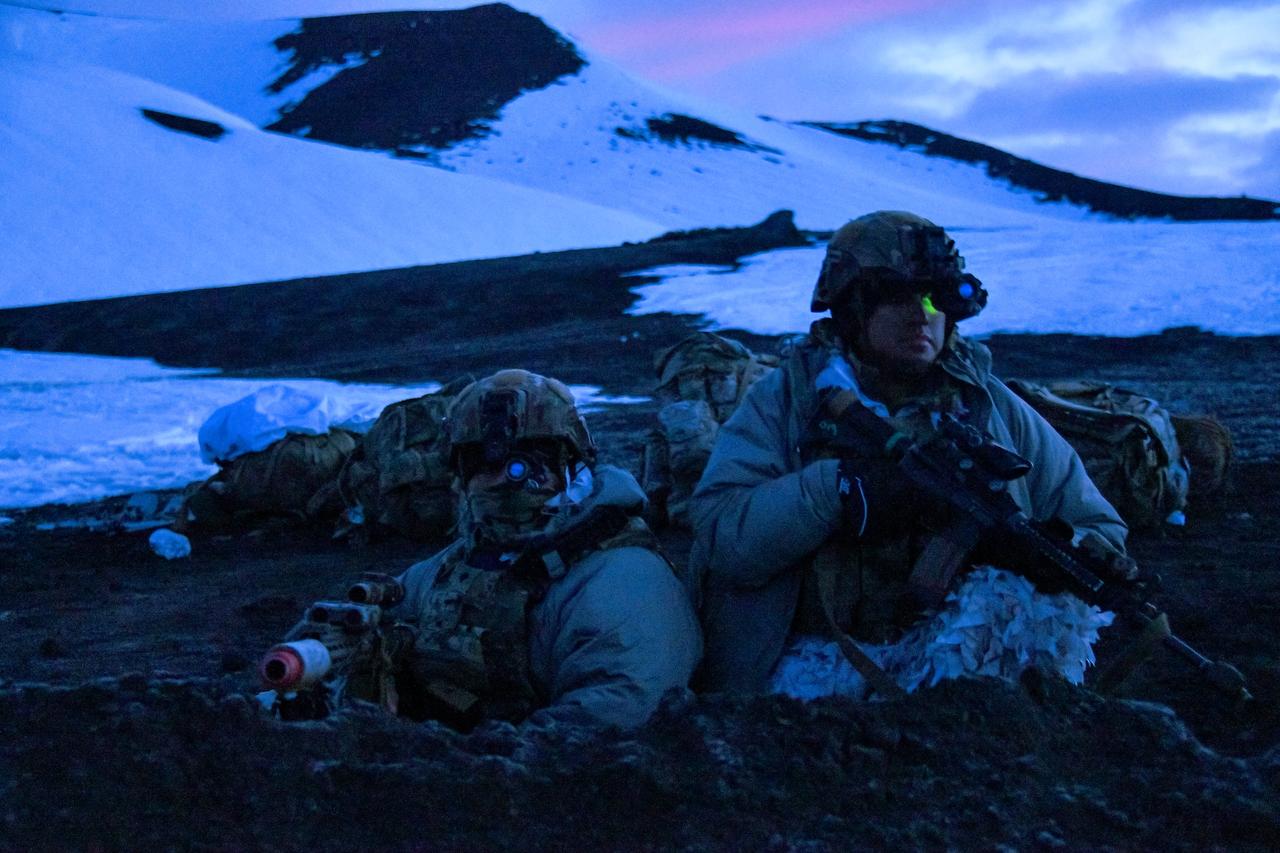
Special Forces During Southern Vanguard 25 Exercises (Flickr)
The Chilean military’s operational history is defined by national defense and regional stability efforts.
Adkins, Roy and Lesley Adkins. "Navigating Nitrate: The Hazards and Historical Significance of Chilean Cargoes." Lloyd's Register Foundation Heritage & Education Centre. April 28, 2025. Accessed December 22, 2025. https://hec.lrfoundation.org.uk/whats-on/stories/navigating-nitrate-the-hazards-and-historical-significance-of-chilean-cargoes.
Adriano Ramos de Mello. "Chile." Photograph. Flickr, December 2, 2017. Accessed December 2, 2025. https://www.flickr.com/photos/adrianormello/36983879415.
Argandoña-Castro, Fabián, and Fernando Peña-Cortés. 2025. "A Systematic Review of Developments in Farmland Cover in Chile: Dynamics and Implications for a Sustainable Future in Land Use." *Sustainability* 17, no. 9: 3905. https://doi.org/10.3390/su17093905.
Batarce, Ricardo, and Lucia Soriano. "The Transformation Process of the Chilean Army: Building integrity and legitimacy through the democratization process of Chile." University of Oxford. April 2019. Accessed December 22, 2025. https://integrity.bsg.ox.ac.uk/article/transformation-process-chilean-army-building-integrity-and-legitimacy-through.
Biblioteca Nacional de Chile. "El impacto de la guerra del Pacífico (1879-1929)." Memoria Chileana. Accessed December 22, 2025. https://www.memoriachilena.gob.cl/602/w3-article-100610.html.
Biblioteca del Congreso Nacional de Chile (BCN). "Clima y vegetación." Accessed December 22, 2025. https://www.bcn.cl/siit/nuestropais/clima.htm.
Budds, Jessica. "Securing the market: Water security and the internal contradictions of Chile’s Water Code." *Geoforum* 113 (2020): 165-175. Accessed December 22, 2025. https://ueaeprints.uea.ac.uk/id/eprint/68746/1/Geoforum_water_security_Chile_revised_second_190918.pdf.
Bureau of Western Hemisphere Affairs. "U.S. Relations With Chile." U.S. Department of State. September 17, 2024. Accessed December 22, 2025. https://2021-2025.state.gov/u-s-relations-with-chile/.
Caputo, Rodrigo, and Diego Saravia. "The History of Chile." A Monetary and Fiscal History of Latin America 2017 (1960).
Carlos Varela. "Cazuela." Photograph. Flickr, July 6, 2010. Accessed December 2, 2025. https://flic.kr/p/8gozrH.
Central Intelligence Agency. “Chile Flag.” The World Factbook. Accessed December 22, 2025. https://www.cia.gov/the-world-factbook/countries/chile/flag/.
Central Intelligence Agency. “Chile Population Graph 2024.” The World Factbook. Accessed December 2, 2025. https://www.cia.gov/the-world-factbook/static/748b355382e7eec32483db6a1d248101/ci_popgraph2024.jpeg.
Central Intelligence Agency. “Chile – Economy.” *The World Factbook*. Accessed December 22, 2025. https://www.cia.gov/the-world-factbook/countries/chile/#economy.
Central Intelligence Agency. “Chile – People & Society.” The World Factbook. Accessed December 22, 2025. https://www.cia.gov/the-world-factbook/countries/chile/#economy.
Central Intelligence Agency. “Chile — Country Overview.” The World Factbook, Accessed December 2, 2025. https://www.cia.gov/the-world-factbook/countries/chile/.
Central Intelligence Agency. “Flag of Chile.” The World Factbook. Accessed December 2, 2025. https://www.cia.gov/the-world-factbook/countries/chile/flag/.
Chilean Salmon Council. "Farmed Chilean Salmon & A Rapidly Changing World." Salmon de Chile. Accessed December 22, 2025. https://chileansalmon.org/the-case-for-chilean-salmon/.
Collier, Simon, and William F. Sater. A History of Chile, 1808-1994. Vol. 82. Cambridge University Press, 1996.
Costa, Rosanna. "Monetary Policy in Chile: A Look Behind and Beyond." September 10, 2024. Accessed December 22, 2025. https://www.bis.org/review/r240910d.pdf.
Crow, Joanna. The Mapuche in Modern Chile: A Cultural History. 1st ed. Gainesville: University Press of Florida, 2013.
ESTIMACIÓN DE PERSONAS EXTRANJERAS. December 2024. Accessed December 22, 2025. https://www.ine.gob.cl/docs/default-source/demografia-y-migracion/publicaciones-y-anuarios/migraci%C3%B3n-internacional/estimaci%C3%B3n-poblaci%C3%B3n-extranjera-en-chile-2018/informe-resultados-epe2023.pdf?sfvrsn=91b95f6f_10.
EY. "Chile’s mining and metals investment guide 2025." February 28, 2025. Accessed December 22, 2025. https://www.ey.com/content/dam/ey-unified-site/ey-com/es-cl/about-us/documents/informe-minero-2025.pdf.
Ejército de Chile. "MMC_2350." Photograph. Flickr, September 1, 2025. Accessed December 2, 2025. https://www.flickr.com/photos/ejercitodechile/.
Empresa Nacional del Petróleo (ENAP). "Enap of the Future." January 10, 2025. Accessed December 22, 2025. https://www.enap.cl/enap-of-the-future.
Espina, Alberto. Javier Iturriaga and Ricardo Martinez Menanteau. “Chile’s Armed Forces.” *Americas Quarterly*. Accessed December 2, 2025. https://www.americasquarterly.org/fullwidthpage/chiles-armed-forces/.
Espina, Alberto. Javier Iturriaga and Ricardo Martinez Menanteau. “Chile’s Armed Forces.” *Americas Quarterly*. Accessed December 2, 2025. https://www.americasquarterly.org/fullwidthpage/chiles-armed-forces/.
European Space Agency. "The Atacama Desert, Chile." November 19, 2004. Accessed December 22, 2025. https://www.esa.int/Applications/Observing_the_Earth/The_Atacama_Desert_Chile.
Fruits from Chile. "Growing Regions." Accessed December 22, 2025. https://fruitsfromchile.com/about/growing-regions/.
Gilmour, Matthew. "The Pinochet regime and Chilean politics." E-International Relations 3 (2013).
Gobierno de Chile. "Our Country." Accessed December 3, 2025. https://www.gob.cl/en/our-country/.
Gonzalez Ramirez, F., F. Aldunate, and Mounu Prem. "The limits of hegemony: US banks and Chilean firms in the Cold War." Journal of Development Economics (2023).
González, Matías, Violeta Morin, Nicolás Labra, and Ariel Castro. "The cellulose industry and its impact on the population: From the social to the biochemical." *RIAT: Revista Interamericana de Medioambiente y Turismo* 17, no. 2 (2021): 179-188. https://www.scielo.cl/pdf/riat/v17n2/0718-235X-riat-17-02-179.pdf.
Ian Berwick. "National Anthem: Chile - Himno Nacional de Chile." YouTube video, YouTube, 02:15. February 1, 2016. Accessed December 2, 2025. https://www.youtube.com/watch?v=GdevCZxTqSg&list=RDGdevCZxTqSg&start_radio=1.
Instituto Nacional de Estadísticas. "INFORME DE RESULTADOS DE LA
International Monetary Fund (IMF). “Chile.” *IMF DataMapper*. Accessed December 1, 2025. https://www.imf.org/external/datamapper/profile/CHL.
International Trade Administration. “Chile – Mining.” Country Commercial Guides, United States Department of Commerce. November 24, 2025. Accessed December 22, 2025. https://www.trade.gov/country-commercial-guides/chile-mining.
InvestChile. "NEW FOREIGN INVESTMENT REGIME, LAW 20.848." March 2017. Accessed December 22, 2025. https://investchile.gob.cl/wp-content/uploads/2017/03/NEW-FOREIGN-INVESTMENT-REGIME.pdf.
Joaquin Pereyra. "Sanhattan, Santiago de Chile." Photograph. Flickr. May 10, 2021. Accessed December 22, 2025. https://www.flickr.com/photos/192989323@N06/51170484001/in/photolist-29gixsm-2kXL79a.
Klein, Marcus. "The Human Rights Violations of the Pinochet Regime and Their Legacy." (2003): 107-114.
Lachcim Kejarko. "Moai Statues." Photograph. Pexels, November 7, 2020. Accessed December 2, 2025. https://www.pexels.com/photo/moai-statues-5819212/.
Lais Queiroz. "Buildings in Valparaiso in Chile". Photograph. Pexels. November 1, 2023. Accessed December 2, 2025. https://www.pexels.com/photo/buildings-in-valparaiso-in-chile-17808457/.
Look and Learn. "Activities of Native Americans of Chile." Look and Learn. Accessed December 2, 2025. https://www.lookandlearn.com/history-images/YJC0017157/Activities-of-Native-Americans-of-Chile?t=1&q=mapuche&n=10.
Look and Learn. "The war between Chile and Peru and Bolivia: The Chilean division arriving in front of Calama on March 23, 1879." Photograph. Accessed December 3, 2025. https://www.lookandlearn.com/history-images/YWM2022269/The-war-between-chile-and-peru-and-bolivia-the-chilean-division-arriving-in-front-of-calama-on-march-23-1879?t=1&q=chile+peru+war&n=1.
Magri, Carla. "A Journey Through Chile’s Lithium Landscape." Columbia Global Center. November 30, 2023. Accessed December 22, 2025. https://globalcenters.columbia.edu/news/journey-through-chiles-lithium-landscape.
MapChart. "The Americas." Accessed December 2, 2025. https://www.mapchart.net/americas.html.
Marcelo Gonzalez. "Parada Militar 19 Sept. Chile." Photograph. Flickr, September 22, 2014. Accessed December 2, 2025. https://www.flickr.com/photos/magofu2000/.
Marek Piwnicki. "Majestic Mountain Landscape of Atacama Desert." Photograph. Pexels. March 25, 2024. Accessed December 2, 2025. https://www.pexels.com/photo/majestic-mountain-landscape-of-atacama-desert-29176041/.
Marek Piwnicki. "Majestic Peaks of Torres del Paine, Chile." Photograph. Pexels. November 18, 2025. https://www.pexels.com/photo/majestic-peaks-of-torres-del-paine-chile-34792552/.
Maximo Berrios. "Augusto Pinochet (1915 - 2006)". Photograph. Flickr, August 14, 2014. Accessed December 2, 2025. https://www.flickr.com/photos/126914543@N06/14919763872.
Maximo Berrios. "Salvador Allende." Photograph. Flickr, August 14, 2014. Accessed December 2, 2025. https://www.flickr.com/photos/126914543@N06/.
Ministerio de Energía. "Plan de Mitigación y Adaptación al Cambio Climático de Energía." 25. Gobierno de Chile. December 25, 2024. Accessed December 22, 2025. https://energia.gob.cl/sites/default/files/documentos/proyecto_definitivo_plan_sectorial_energia_13_dic.pdf.
Ministerio de Relaciones Exteriores de Chile. "Emblemas Nacionales." Accessed December 2, 2025. https://www.minrel.gob.cl/ceremonial-y-protocolo/emblemas-nacionales.
Ministerio de las Culturas, las Artes y el Patrimonio. *El Presidente de la República, Gabriel Boric Font, asiste alTedeum Ecume de Fiestas Patrias 12.* Photograph. Flickr. September 23, 2022. Accessed December 2, 2025. https://www.flickr.com/photos/consejocultura/52377478252.
Ministerio de las Culturas, las Artes y el Patrimonio. *El Presidente de la República, Gabriel Boric Font, asiste alTedeum Ecume de Fiestas Patrias 12.* Photograph. Flickr. September 23, 2022. Accessed December 2, 2025. https://www.flickr.com/photos/consejocultura/52377478252.
Ministry of Trade of the Republic of Turkey. *Chile Country Profile 2025*. Ministry of Trade of the Republic of Turkey, 2025. Accessed December 2, 2025. https://ticaret.gov.tr/data/5ef31b9513b876a1ec56ad7b/%C5%9Eili%20%C3%9Clke%20Profili_2025.pdf.
Monse Olmos. "Santiago Museum of Contemporary Art." Photograph. Pexels, November 23, 2022. Accessed December 2, 2025. https://www.pexels.com/photo/santiago-museum-of-contemporary-art-14530671/.
Museo de la Buena Memoria. "Gobierno Militar blanco y negro 19x6". Photograph. Flickr. April 15, 2020. Accessed December 2, 2025. https://www.flickr.com/photos/157849795@N08/.
Nugent, Ciara. "Chile’s largest steel mill shuts amid surge in Chinese imports." Financial Times. August 7, 2024. Accessed December 22, 2025. https://www.ft.com/content/5896ecaa-71af-4fc6-8391-cd40c0d9d8f8.
OEC. "Fish Oil in Chile." September 2025. Accessed December 22, 2025. https://oec.world/en/profile/bilateral-product/fish-oil/reporter/chl.
OECD (2023). "FDI Qualities Review of Chile: Boosting Sustainable Development and Diversification." OECD Publishing. Paris. Accessed December 22, 2025. https://doi.org/10.1787/98bf1829-en.
Pedro Encina. "Primera Junta Nacional De Gobierno Chile hace 200 años." Photograph. Flickr, September 5, 2010. Accessed December 2, 2025. https://www.flickr.com/photos/stgonostalgico/4958422939.
Pedro Encina. "celebracion Primer Centenario 1910". Photograph. Flickr, February 20, 2010. Accessed December 2, 2025. https://www.flickr.com/photos/stgonostalgico/42958582540.
Plummer, Katalin. "Home TURF: Successful Co-Management of Chilean Fisheries." University of Washington School of Marine and Environmental Affairs. February 15, 2024. Accessed December 22, 2025. https://smea.uw.edu/currents/home-turf-successful-co-management-of-chilean-fisheries-by-chilean-fishers/.
Plummer, Katalin. "Home TURF: Successful Co-Management of Chilean Fisheries." University of Washington School of Marine and Environmental Affairs. February 15, 2024. Accessed December 22, 2025. https://smea.uw.edu/currents/home-turf-successful-co-management-of-chilean-fisheries-by-chilean-fishers/.
Presidencia de la República de Chile. "Presidente Gabriel Boric sostiene reunión bilateral con la Presidenta de la Comisión Europea, Ursula von der Leyen." Photograph. Presidencia de la República de Chile. September 23, 2024. Accessed December 2, 2025. https://prensa.presidencia.cl/fotonoticia.aspx?id=290460.
Presidencia de la República de Chile. "Presidente de la República Gabriel Boric Font se reúne con presidente de Estados Unidos Joseph Biden." Photograph. Presidencia de la República de Chile. June 9, 2022. Accessed December 2, 2025. https://prensa.presidencia.cl/fotografia.aspx?id=195887.
PxHere. "Strike, Santiago: 'The struggle belongs to the whole society. All for free education. July 26, 2011.'" Photograph. PxHere, January 15, 2017. Accessed December 2, 2025. https://pxhere.com/es/photo/393559.
Redden, Andrew. "‘Guided By God’ beyond the Chilean frontier: the travelling early modern European conscience." *Renaissance Studies* 23, no. 4 (2009): 486-500. Accessed December 22, 2025. https://onlinelibrary.wiley.com/doi/10.1111/j.1477-4658.2009.00606.x.
Santander Trade. "Chile: Economic and Political Outline." 2025. Accessed December 22, 2025. https://santandertrade.com/en/portal/analyse-markets/chile/economic-political-outline.
Shevchenko, Natalia, Anastasia Kosenko-Sologub, and Ivan Fechko. "Chile: Main Trends in Domestic and Foreign Policy." Foreign Policy Council "Ukrainian Prism". November 1, 2023. Accessed December 22, 2025. https://prismua.org/wp-content/uploads/2023/11/Chile_eng.pdf.
Statista. "Adult literacy rate as a share of the population in Chile from 1982 to 2022." April 2025. Accessed December 22, 2025. https://www.statista.com/statistics/1390699/adult-literacy-rate-chile/?srsltid=AfmBOoqgLDXYIxKgiLSn4MlW2ObSxjw6-qqoASLb0ky0ugBwTTI2X1qn.
Statista. "Ratio of military expenditure to GDP in Chile from 1960 to 2023." April 2025. Accessed December 22, 2025. https://www.statista.com/statistics/810369/ratio-of-military-expenditure-to-gross-domestic-product-gdp-chile/?srsltid=AfmBOoqBnNKOQRizkSU_Mauatlql6r3HGgEytSqr9qu0a-svF0OgjnTp.
Sánchez, Wilder Alejandro. Science, Cooperation, and Winter Uniforms: The Role of South American Militaries in Antarctica. Center for Strategic and International Studies. March 20, 2025. Accessed December 22, 2025. https://www.csis.org/analysis/science-cooperation-and-winter-uniforms-role-south-american-militaries-antarctica.
Torres, Nicolás, and Gerhard Reinecke. "The wine supply chain in Chile: Lessons to analyse and improve regulatory compliance." International Labour Organization. November 6, 2024. Accessed December 22, 2025. https://www.ilo.org/publications/wine-supply-chain-chile-lessons-analyse-and-improve-regulatory-compliance.
Tridge. "Chilean Salmon and Trout Industry Booms Due to High Global Demand." January 13, 2022. Accessed December 22, 2025. https://www.tridge.com/stories/chilean-salmon-and-trout-industry-boom-due-to-high-global-demand#:~:text=Chile's%20fishery%20exports%20improved%20significantly,up%2018%25%20compared%20with%202020..
UNESCO. “Chile.” UNESCO World Heritage Convention. Accessed December 2, 2025. https://whc.unesco.org/en/statesparties/cl/.
United States Department of State. "The Allende Years and the Pinochet Coup, 1969–1973." Office of the Historian. Accessed December 22, 2025. https://history.state.gov/milestones/1969-1976/allende.
United States Department of State. "The Allende Years and the Pinochet Coup, 1969–1973." Office of the Historian. Accessed December 22, 2025. https://history.state.gov/milestones/1969-1976/allende.
United States Trade Representative. "Chile Free Trade Agreement." Accessed December 22, 2025. https://ustr.gov/trade-agreements/free-trade-agreements/chile-fta.
World Bank. “Chile.” *Data360*. Accessed December 2, 2025. https://data360.worldbank.org/en/economy/CHL.
XMAP AI. "Industrial, Manufacturing and Resources Locations in Chile." Accessed December 22, 2025. https://www.xmap.ai/location-intelligence-reports/industrial--manufacturing--resources-locations-in-chile.
Zamani, Mohsen. 2025. “The Strategic Position of Chile in Latin America”. *Political Science and Security Studies Journal* 6 (1): 10–19. Accessed December 22, 2025. https://doi.org/10.33445/psssj.2025.6.1.3
[1]
Central Intelligence Agency. “Chile Flag.” The World Factbook. Access Date December 22, 2025. https://www.cia.gov/the-world-factbook/countries/chile/flag/.
[2]
Crow, Joanna. The Mapuche in Modern Chile : A Cultural History. 19. 1st ed. Gainesville: University Press of Florida, 2013.
[3]
Redden, Andrew. "‘Guided By God’ beyond the Chilean frontier: the travelling early modern European conscience." Renaissance Studies 23, no. 4 (2009): 486-500. https://onlinelibrary.wiley.com/doi/10.1111/j.1477-4658.2009.00606.x.
[4]
Collier, Simon, and William F. Sater. A history of Chile, 1808-1994. Vol. 82. 33-35. Cambridge University Press, 1996.
[5]
Collier, Simon, and William F. Sater. A history of Chile, 1808-1994. Vol. 82. 154-157. Cambridge University Press, 1996.
[6]
Adkins, Roy ve Lesley Adkins. "Navigating Nitrate: The Hazards and Historical Significance of Chilean Cargoes." Lloyd's Register Foundation Heritage & Education Centre. April 28, 2025. Access Date December 22, 2025. https://hec.lrfoundation.org.uk/whats-on/stories/navigating-nitrate-the-hazards-and-historical-significance-of-chilean-cargoes.
[7]
United States Department of State. "The Allende Years and the Pinochet Coup, 1969–1973." Office of the Historian. Access Date December 22, 2025..
[8]
Klein, Marcus. "The Human Rights Violations of the Pinochet Regime and Their Legacy." (2003): 107-114.
[9]
Caputo, Rodrigo, and Diego Saravia. "The History of Chile." 224. A Monetary and Fiscal History of Latin America 2017 (1960). Access Date December 22, 2025. https://manifold.bfi.uchicago.edu/system/resource/7/f/b/7fba982a-a763-4875-bb61-d56854b0b7f5/attachment/24a2912ad62ab7e40fbe95cbaa9acb84.pdf.
[10]
Gobierno de Chile. “Our Country.” Access Date December 3, 2025. https://www.gob.cl/en/our-country/.
[11]
Argandoña-Castro, Fabián, ve Fernando Peña-Cortés. 2025. "A Systematic Review of Developments in Farmland Cover in Chile: Dynamics and Implications for a Sustainable Future in Land Use" Sustainability 17, no. 9: 3905. https://doi.org/10.3390/su17093905.
[12]
Budds, Jessica. "Securing the market: Water security and the internal contradictions of Chile’s Water Code." Geoforum 113 (2020): 165-175. Access Date December 22, 2025. https://ueaeprints.uea.ac.uk/id/eprint/68746/1/Geoforum_water_security_Chile_revised_second_190918.pdf.
[13]
Biblioteca del Congreso Nacional de Chile (BCN). "Clima y vegetación." Access Date December 22, 2025. https://www.bcn.cl/siit/nuestropais/clima.htm.
[14]
International Trade Administration. “Chile – Mining.” Country Commercial Guides, United States Department of Commerce. November 24, 2025. Access Date December 22, 2025. https://www.trade.gov/country-commercial-guides/chile-mining.
[15]
Fruits from Chile. "Growing Regions." Access Date December 22, 2025. https://fruitsfromchile.com/about/growing-regions/.
[16]
Plummer, Katalin. "Home TURF: Successful Co-Management of Chilean Fisheries." University of Washington School of Marine and Environmental Affairs. February 15, 2024. Access Date December 22, 2025. https://smea.uw.edu/currents/home-turf-successful-co-management-of-chilean-fisheries-by-chilean-fishers/.
[17]
EY. "Chile’s mining and metals investment guide 2025." February 28, 2025. Access Date December 22, 2025. https://www.ey.com/content/dam/ey-unified-site/ey-com/es-cl/about-us/documents/informe-minero-2025.pdf.
[18]
EY. "Chile’s mining and metals investment guide 2025." February 28, 2025. Access Date December 22, 2025. https://www.ey.com/content/dam/ey-unified-site/ey-com/es-cl/about-us/documents/informe-minero-2025.pdf.
[19]
Gonzalez Ramirez, F., F. Aldunate, and Mounu Prem. "The limits of hegemony: US banks and Chilean firms in the Cold War." Journal of Development Economics (2023).
[20]
Gilmour, Matthew. "The Pinochet regime and Chilean politics." E-International Relations 3 (2013).
[21]
International Monetary Fund (IMF). “Chile.” IMF DataMapper. Access Date December 1, 2025. https://www.imf.org/external/datamapper/profile/CHL.
[22]
Costa, Rosanna. "Monetary Policy in Chile: A Look Behind and Beyond." September 10, 2024. Access Date December 22, 2025. https://www.bis.org/review/r240910d.pdf.
[23]
Torres, Nicolás, ve Gerhard Reinecke. "The wine supply chain in Chile: Lessons to analyse and improve regulatory compliance." International Labour Organization. November 6, 2024. Access Date December 22, 2025. https://www.ilo.org/publications/wine-supply-chain-chile-lessons-analyse-and-improve-regulatory-compliance.
[24]
Plummer, Katalin. "Home TURF: Successful Co-Management of Chilean Fisheries." University of Washington School of Marine and Environmental Affairs. February 15, 2024. Access Date December 22, 2025. https://smea.uw.edu/currents/home-turf-successful-co-management-of-chilean-fisheries-by-chilean-fishers/.
[25]
OEC. "Fish Oil in Chile." September 2025. Access Date December 22, 2025. https://oec.world/en/profile/bilateral-product/fish-oil/reporter/chl.
[26]
Tridge. "Chilean Salmon and Trout Industry Booms Due to High Global Demand." January 13, 2022. Access Date December 22, 2025. https://www.tridge.com/stories/chilean-salmon-and-trout-industry-boom-due-to-high-global-demand#:~:text=Chile's%20fishery%20exports%20improved%20significantly,up%2018%25%20compared%20with%202020..
[27]
Chilean Salmon Council. "Farmed Chilean Salmon & A Rapidly Changing World." Salmon de Chile. Access Date December 22, 2025. https://chileansalmon.org/the-case-for-chilean-salmon/.
[28]
Santander Trade. "Chile: Economic and Political Outline." 2025. Access Date December 22, 2025. https://santandertrade.com/en/portal/analyse-markets/chile/economic-political-outline.
[30]
Nugent, Ciara. "Chile’s largest steel mill shuts amid surge in Chinese imports." Financial Times. August 7, 2024. Access Date December 22, 2025. https://www.ft.com/content/5896ecaa-71af-4fc6-8391-cd40c0d9d8f8.
[31]
Ministerio de Energía. "Plan de Mitigación y Adaptación al Cambio Climático de Energía." 25. Gobierno de Chile. December 2024. Access Date December 22, 2025. https://energia.gob.cl/sites/default/files/documentos/proyecto_definitivo_plan_sectorial_energia_13_dic.pdf.
[32]
González, Matías, Violeta Morin, Nicolás Labra, and Ariel Castro. "The cellulose industry and its impact on the population: From the social to the biochemical." RIAT: Revista Interamericana de Medioambiente y Turismo 17, no. 2 (2021): 179-188. https://www.scielo.cl/pdf/riat/v17n2/0718-235X-riat-17-02-179.pdf.
[33]
Zamani, Mohsen. 2025. “The Strategic Position of Chile in Latin America”. Political Science and Security Studies Journal 6 (1):10-19. Access Date December 22, 2025. https://doi.org/10.33445/psssj.2025.6.1.3.
[34]
Central Intelligence Agency. “Chile – Economy.” The World Factbook. Access Date December 22, 2025. https://www.cia.gov/the-world-factbook/countries/chile/#economy.
[35]
Central Intelligence Agency. “Chile – Economy.” The World Factbook. Access Date December 22, 2025. https://www.cia.gov/the-world-factbook/countries/chile/#economy.
[36]
Central Intelligence Agency. “Chile – Economy.” The World Factbook. Access Date December 22, 2025. https://www.cia.gov/the-world-factbook/countries/chile/#economy.
[37]
InvestChile. "NEW FOREIGN INVESTMENT REGIME, LAW 20.848." March 2017. Access Date December 22, 2025. https://investchile.gob.cl/wp-content/uploads/2017/03/NEW-FOREIGN-INVESTMENT-REGIME.pdf.
[38]
OECD (2023). "FDI Qualities Review of Chile: Boosting Sustainable Development and Diversification." OECD Publishing. Paris. Access Date December 22, 2025. https://doi.org/10.1787/98bf1829-en.
[39]
Magri, Carla. "A Journey Through Chile’s Lithium Landscape." Columbia Global Center. November 30, 2023. Access Date December 22, 2025. https://globalcenters.columbia.edu/news/journey-through-chiles-lithium-landscape.
[40]
World Bank. “Chile.” Data360. Access Date: December 2, 2025. https://data360.worldbank.org/en/economy/CHL.
[41]
Central Intelligence Agency. “Chile – People & Society.” The World Factbook. Access Date December 22, 2025. https://www.cia.gov/the-world-factbook/countries/chile/#economy.
[42]
Central Intelligence Agency. “Chile – People & Society.” The World Factbook. Access Date December 22, 2025. https://www.cia.gov/the-world-factbook/countries/chile/#economy.
[43]
Instituto Nacional de Estadísticas. "INFORME DE RESULTADOS DE LA
ESTIMACIÓN DE PERSONAS EXTRANJERAS." December 2024. Access Date December 22, 2025. https://www.ine.gob.cl/docs/default-source/demografia-y-migracion/publicaciones-y-anuarios/migraci%C3%B3n-internacional/estimaci%C3%B3n-poblaci%C3%B3n-extranjera-en-chile-2018/informe-resultados-epe2023.pdf?sfvrsn=91b95f6f_10.
[44]
Statista. "Adult literacy rate as a share of the population in Chile from 1982 to 2022." April 2025. Access Date December 22, 2025. https://www.statista.com/statistics/1390699/adult-literacy-rate-chile/?srsltid=AfmBOoqgLDXYIxKgiLSn4MlW2ObSxjw6-qqoASLb0ky0ugBwTTI2X1qn.
[45]
European Space Agency. "The Atacama Desert, Chile." November 19, 2004. Access Date December 22, 2025. https://www.esa.int/Applications/Observing_the_Earth/The_Atacama_Desert_Chile.
[46]
Shevchenko, Natalia, Anastasia Kosenko-Sologub ve Ivan Fechko. "Chile: Main Trends in Domestic and Foreign Policy. " Foreign Policy Council "Ukrainian Prism". November 1, 2023. Access Date December 22, 2025..
[47]
Biblioteca Nacional de Chile. "El impacto de la guerra del Pacífico (1879-1929)." Memoria Chileana. Access Date December 22, 2025. https://www.memoriachilena.gob.cl/602/w3-article-100610.html.
[48]
United States Department of State. "The Allende Years and the Pinochet Coup, 1969–1973." Office of the Historian. Access Date December 22, 2025. https://history.state.gov/milestones/1969-1976/allende.
[49]
Bureau of Western Hemisphere Affairs. "U.S. Relations With Chile." U.S Department of State. September 17, 2024. Access Date December 22, 2025. https://2021-2025.state.gov/u-s-relations-with-chile/.
[50]
United States Trade Representative. "Chile Free Trade Agreement." Access Date December 22, 2025. https://ustr.gov/trade-agreements/free-trade-agreements/chile-fta.
[51]
Batarce, Ricardo, ve Lucia Soriano. "
The Transformation Process of the Chilean Army: Building integrity and legitimacy through the democratization process of Chile." University of Oxford. April 2019. Access Date December 22, 2025. https://integrity.bsg.ox.ac.uk/article/transformation-process-chilean-army-building-integrity-and-legitimacy-through.
[52]
Sánchez, Wilder Alejandro. Science, Cooperation, and Winter Uniforms: The Role of South American Militaries in Antarctica. Center for Strategic and International Studies. March 20, 2025. Access Date December 22, 2025. https://www.csis.org/analysis/science-cooperation-and-winter-uniforms-role-south-american-militaries-antarctica.
[53]
Statista. "Ratio of military expenditure to GDP in Chile from 1960 to 2023." April 2025. Access Date December 22, 2025. https://www.statista.com/statistics/810369/ratio-of-military-expenditure-to-gross-domestic-product-gdp-chile/?srsltid=AfmBOoqBnNKOQRizkSU_Mauatlql6r3HGgEytSqr9qu0a-svF0OgjnTp.
[54]
Espina, Alberto. Javier Iturriaga ve Ricardo Martinez Menanteau. “Chile’s Armed Forces.” Americas Quarterly. Access Date December 2, 2025. https://www.americasquarterly.org/fullwidthpage/chiles-armed-forces/.

Republic of Chile
Official Name(s) | Republic of Chile | ||||||||
|---|---|---|---|---|---|---|---|---|---|
Form of Government(s) | Unitary Presidential Republic | ||||||||
Date of Independence | 12 February 1818 (from Spain) | ||||||||
Capital(s) | Santiago | ||||||||
Head of State | Gabriel Boric Font (2022 – Present) | ||||||||
Official Languages | Spanish | ||||||||
Common Languages | etc.) Aymara Indigenous languages (Mapudungun English (%10.2) Spanish (%99.5) | ||||||||
National Day | 18 September (Fiestas Patrias / Declaration of the First Government Junta) | ||||||||
Area(s) | 756 102 km² | ||||||||
Total Population | Around 20 million | ||||||||
Climate(s) | Desert (Atacama) in the north and cool and humid/glacial climate dominates in the south Mediterranean climate in the central region | ||||||||
GDP (Nominal) | 347.17 billion US dollars | ||||||||
GDP Per Capita (Nominal) | 17,180 USD | ||||||||
Ethnic Groups | Mapuche and Other Indigenous Peoples: ~%11.1 White and Non-Indigenous: ~%88.9 | ||||||||
Religious Composition | Other Religions: ~%4 No Religious Affiliation (Non-religious): ~%26 Protestant: %16) Christian: ~%70 (Catholic: %54 | ||||||||
Telephone Code | +56 | ||||||||
Internet Domain Code | .cl | ||||||||
State Symbols
National Anthem
Flag
History
Ancient and Pre-Columbian Period
Spanish Period (1540–1810)
Independence Process (1810–1818)
19th Century: State Consolidation and Wars
20th Century: Modernization, Social Transformation, and Authoritarian Rule
Post-1990: Democratic Era and the New Century
Geography
Location
Landforms
Mountains
Plains and Valleys
Rivers and Lakes
Climate and Vegetation
Natural Resources
Energy and Transportation Infrastructure
Economy
Key Economic Indicators (2024)【21】
Sectoral Distribution
Agriculture and Livestock
Fisheries and Aquaculture
Industry
Services Sector and Financial System
Foreign Trade
Foreign Investment and Business Environment
Demography and Education
Key Demographic Indicators
Population Distribution and Urbanization
Ethnic Composition
Religious Distribution
Migration and Population Mobility
Education
Culture and Tourism
Cultural Structure
UNESCO World Heritage Sites
Historic Structures and Archaeological Sites
Museums and Cultural Institutions
Tourism Sector
Touristic Regions and Diversity
Main Tourist Cities
Natural Wonders and National Parks
Touristic Regions and Types
Foreign Policy and Security
From Foundation to Present
19th Century: Territorial Disputes
20th Century: Cold War and Ideological Shifts
Post-1990 Multilateralism and Free Trade
Bilateral Relations
Relations with the United States
Relations with China
Relations with Russia
Relations with European States
Relations with Turkey
International Organizations
Military and Defense Capacity
Land, Air, and Naval Components
Land Forces (Ejército de Chile)
Air Force (Fuerza Aérea de Chile - FACh)
Navy (Armada de Chile)
Defense Industry and Logistics Capacity
Defense Budget
Personnel Strength
Logistics Infrastructure
Operational History
