

This article was automatically translated from the original Turkish version.
+1 More
Length(s) | 40.73 m | ||||||||
|---|---|---|---|---|---|---|---|---|---|
Engine(s) | 4 × Progress D-27 Propfan | ||||||||
Height(s) | 16.38 m | ||||||||
First Flight(s) | 16 December 1994 | ||||||||
Primary Users | Antonov Airlines Ukrainian Air Force | ||||||||
Range (With Maximum Fuel) | 8.000 km | ||||||||
Cruising Speed | 700 - 750 km/h | ||||||||
Maximum Speed | 780 km/h | ||||||||
Empty Weight | 73.000 kg | ||||||||
Maximum Useful Load | 47.000 kg | ||||||||
Wingspan | 44.06 m | ||||||||
Capacity | 300 fully equipped soldiers or 206 stretchers | ||||||||
Crew | 3 - 5 (2 pilots and 1 navigator) | ||||||||
Country of Origin | Ukraine / Russia (Joint Project) | ||||||||
Antonov An-70, developed initially during the final years of the Soviet Union and completed after Ukraine gained independence by the Antonov Design Bureau, is a four-engine, medium-to-long-range strategic transport aircraft. The An-70, which made its first flight on 16 December 1994, is the world’s first wide-body aircraft to use propfan technology, combining the speed of jet engines with the fuel efficiency of turboprops. Unlike conventional jet transport aircraft, its ability to take off with heavy loads from short and unprepared runways (STOL) has made it one of the most critical platforms in its class.
The An-70’s most distinctive feature is its Ivchenko-Progress D-27 propfan engines, each driving two counter-rotating propeller groups. This engine configuration not only delivers substantial thrust but also provides 20 to 30 percent fuel savings compared to conventional jet engines. Equipped with modern fly-by-wire flight control systems and a six-screen full digital cockpit (glass cockpit), the aircraft was developed as a direct competitor to the Airbus A400M, with a maximum useful payload capacity of 47 tons. However, two major accidents during the design phase and subsequent political disagreements severely restricted the aircraft’s transition to series production.【1】
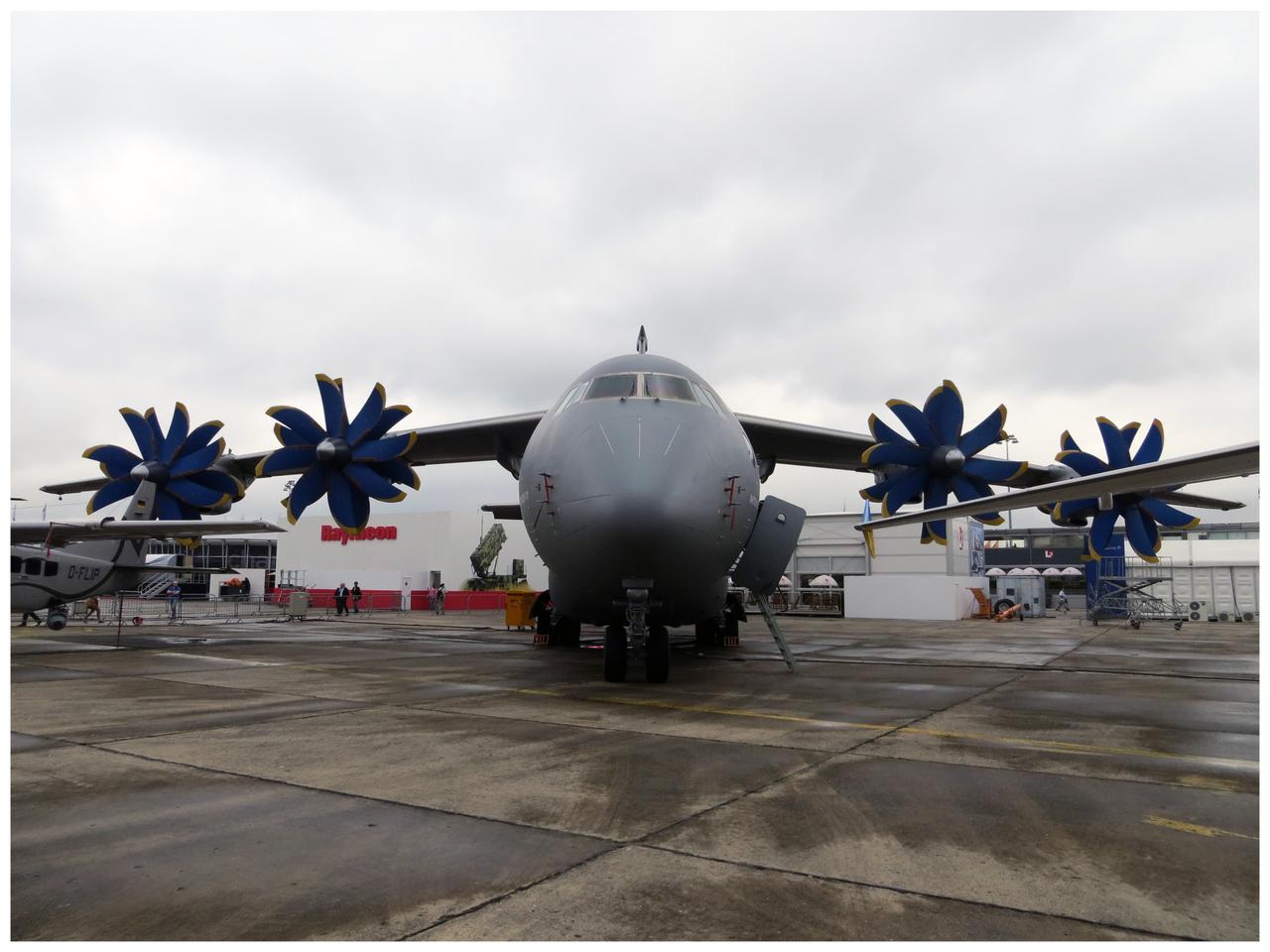
Antonov An-70 (Aerofossile2012)
The design process of the Antonov An-70 began in the late 1970s when the Soviet Air Force sought an aircraft to replace the An-12, one that could combine both strategic and tactical capabilities. The project’s primary goal was to create a platform offering the speed and altitude performance of a jet aircraft while retaining the fuel efficiency and short takeoff and landing (STOL) performance of a propeller-driven aircraft. This demanding requirement led Antonov engineers to adopt the rare propfan (counter-rotating propeller jet) engine technology. The project gained momentum in the 1980s but faced a major financial crisis following the dissolution of the Soviet Union, continuing only through joint participation by Ukraine and Russia.【2】
The development process became one of the most notable test phases in aviation history. Just two months after the successful first flight on 16 December 1994, the first prototype crashed during a test flight after colliding with an escort aircraft, killing all seven crew members. Despite this tragedy, the program was not halted, and the second prototype took to the skies in 1997. This second prototype suffered severe damage in 2001 due to an engine failure during a hard landing near Omsk. These accidents, combined with the aircraft’s high technological complexity, significantly delayed the development schedule. However, lessons learned from these incidents led to improvements in the airframe’s structural integrity and system redundancy.【3】
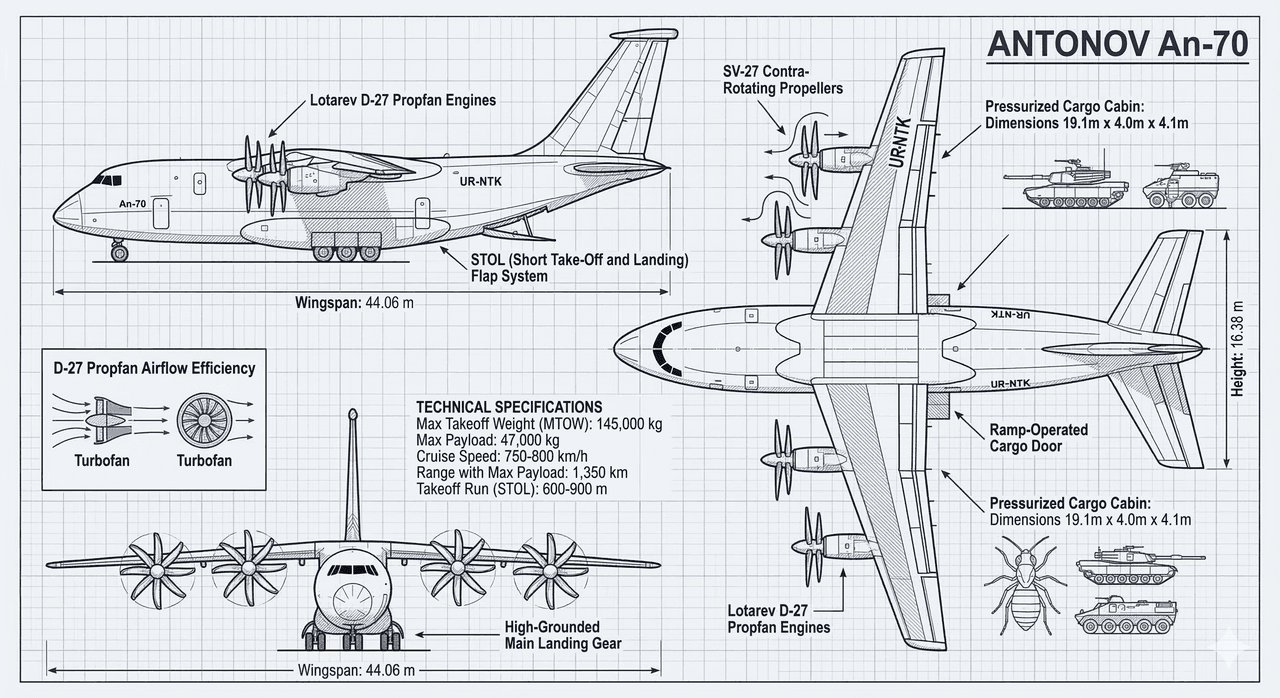
Antonov An-70 Technical Drawing (Generated by Artificial Intelligence)
The aircraft’s design was among the most advanced of its time, not only due to its engine technology but also because of its fully digital control systems. The An-70 was one of the first transport aircraft in the Soviet/Ukrainian tradition to employ fly-by-wire (wireless flight control) systems on this scale, and it also achieved weight savings through the use of composite materials. In the early 2000s, several European countries, led by Germany, evaluated the An-70 as a potential candidate for joint production or procurement before the Airbus A400M project. However, political preferences and concerns over NATO compatibility prevented any collaboration. After extensive testing, the aircraft was officially accepted into service by the Ukrainian Armed Forces in 2015.
The most distinctive feature of the Antonov An-70 is its propfan (open fan) technology, which integrates the advantages of conventional turboprops and modern turbofan engines into a single system. The aircraft is powered by four Ivchenko-Progress D-27 engines, each driving a pair of Aerosila SV-27 counter-rotating propellers. This engine configuration maintains turboprop-level fuel efficiency while enabling the aircraft to achieve cruise speeds of up to 800 km/h, approaching jet speeds. Propfan technology enhances lift by optimizing airflow over the wings, providing critical control authority at low speeds.【4】
The engine operates on a dual-propeller system: eight forward blades and six rear blades, both featuring high-curvature scimitar-shaped blades. The counter-rotation cancels out the swirling airflow generated by the front propellers, increasing the efficiency of thrust conversion to over 90 percent. This high efficiency allows the An-70 to consume 20 to 30 percent less fuel than comparable jet transport aircraft. To overcome the major challenge of excessive noise and vibration inherent in propfan technology, Antonov engineers employed specialized damping composite materials in the wing structure and fuselage insulation.
These engines also deliver exceptional STOL (Short Takeoff and Landing) performance. The intense airflow from the engines passes over the wing flaps, creating a significant pressure differential even at low speeds. As a result, the An-70 can take off from relatively short runways even with a 47-ton payload and significantly reduce its landing distance using reverse thrust generated by the engines. The D-27 engines have positioned the An-70 as the world’s only strategic transport aircraft in its class to be developed for series production with this technology.
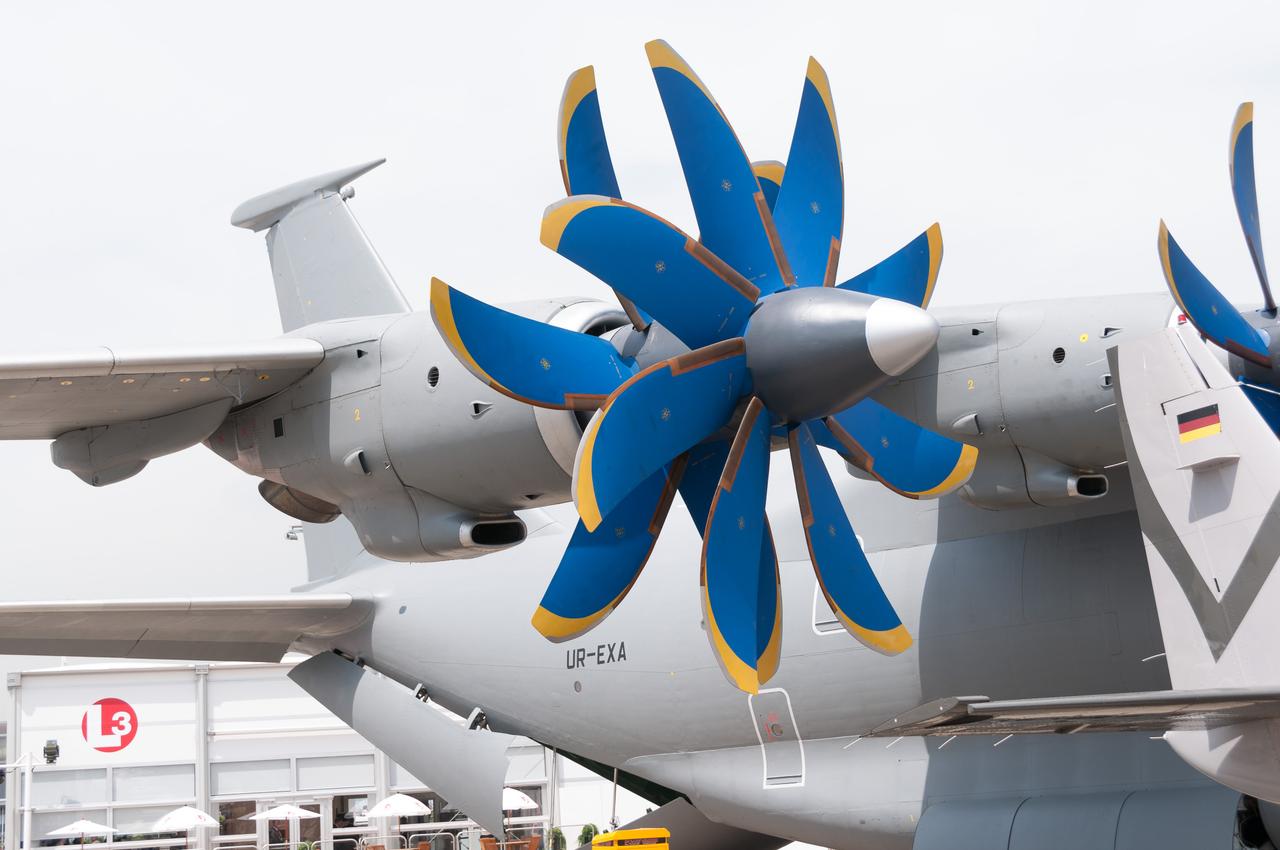
Antonov An-70 Propeller (Node worx)
The Antonov An-70 features a design that unifies the payload capacity of a strategic transport aircraft with the agility of a tactical aircraft in a single airframe. With a length of approximately 40.7 meters and a wingspan of 44.06 meters, its wide fuselage enables it to carry heavy military equipment, tracked vehicles, and helicopters—such as two Mi-8 helicopters or one T-72 tank—without any special preparation. The cargo compartment measures 19.1 meters in length (22.4 meters including the ramp), 4 meters in width, and 4.1 meters in height, providing a total volume of 425 m³.【5】
In terms of performance, the An-70 achieves a maximum takeoff weight (MTOW) of 145,000 kg (145 tons) using four Ivchenko-Progress D-27 propfan engines, each producing 13,880 horsepower (10,350 kW). One of the aircraft’s key features is its flexible runway requirements depending on payload. While operating from standard runways with a full 47-ton load, it can operate from unprepared or dirt runways as short as 600 to 900 meters with a 20-ton payload. This “dual-character” capability allows the aircraft to be used both in intercontinental strategic transport and tactical operations on the front line.【6】
The aircraft’s range and fuel efficiency are competitive with its contemporaries. With a maximum payload of 47 tons, it can fly 1,350 kilometers; with a 35-ton payload, this extends to 5,100 kilometers; and with a 20-ton payload, it reaches 6,600 kilometers. Capable of cruising at 750–800 km/h at service altitudes between 8,000 and 12,000 meters, the An-70 is operated by a crew of only three: two pilots and one flight engineer/system operator, thanks to its digital glass cockpit and fly-by-wire control systems.
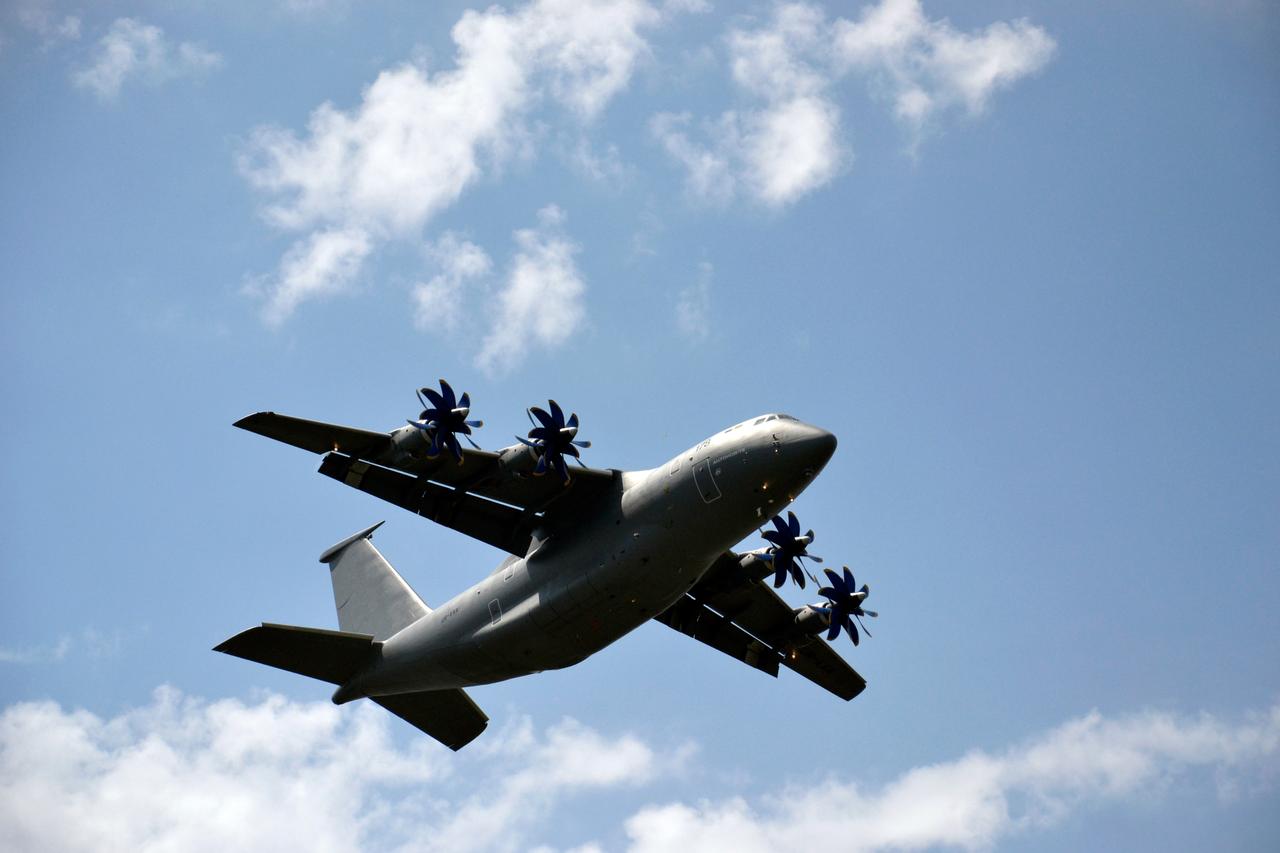
Antonov An-70 Flight (KHMedia)
Although the Antonov An-70 made its first flight in 1994, its transition to series production was repeatedly delayed due to financial crises following the dissolution of the Soviet Union and shifting political dynamics between Russia and Ukraine. The aircraft’s testing phase was overshadowed by two major accidents in 1995 and 2001. The second crash near Omsk raised questions about engine reliability, but the airframe’s structural integrity allowed the aircraft to be repaired and returned to testing, demonstrating the robustness of its design.【7】
In the early 2000s, the An-70 was considered a serious competitor to the Airbus A400M in meeting Europe’s need for a next-generation transport aircraft. Germany, in particular, considered joining the project due to its technological superiority and cost advantages, but political pressures and concerns over NATO compatibility prevented any collaboration. After this turbulent testing period, the aircraft was officially accepted into service by the Ukrainian Armed Forces in 2015. Today, only one prototype remains active and is used by Antonov Airlines for specialized operations requiring heavy loads to be delivered to short, unprepared runways.
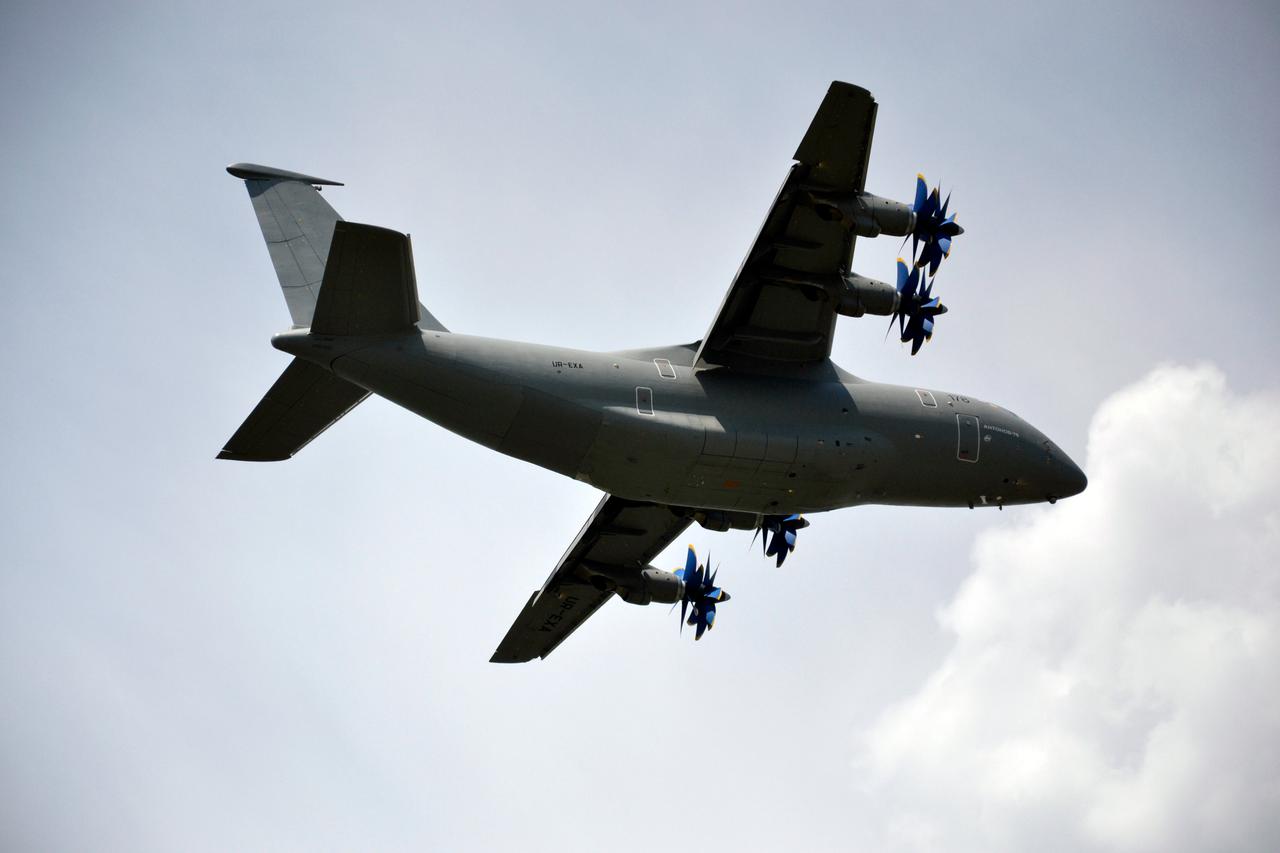
Antonov An-70 (Darkellysio)
Although the An-70 platform was proposed in numerous variants on paper to meet diverse market needs, most of these projects remained at the prototype or design stage:
The An-70’s industry legacy lies in demonstrating the feasibility of propfan technology, which successfully combines the fuel efficiency of propeller-driven aircraft with the speed of jet aircraft in a single platform. In this context, the An-70 pioneered the design philosophy of the Airbus A400M—the concept of a high-speed strategic-tactical turboprop—and globally validated the aerodynamic advantages of counter-rotating propeller configurations in heavy transport aircraft.
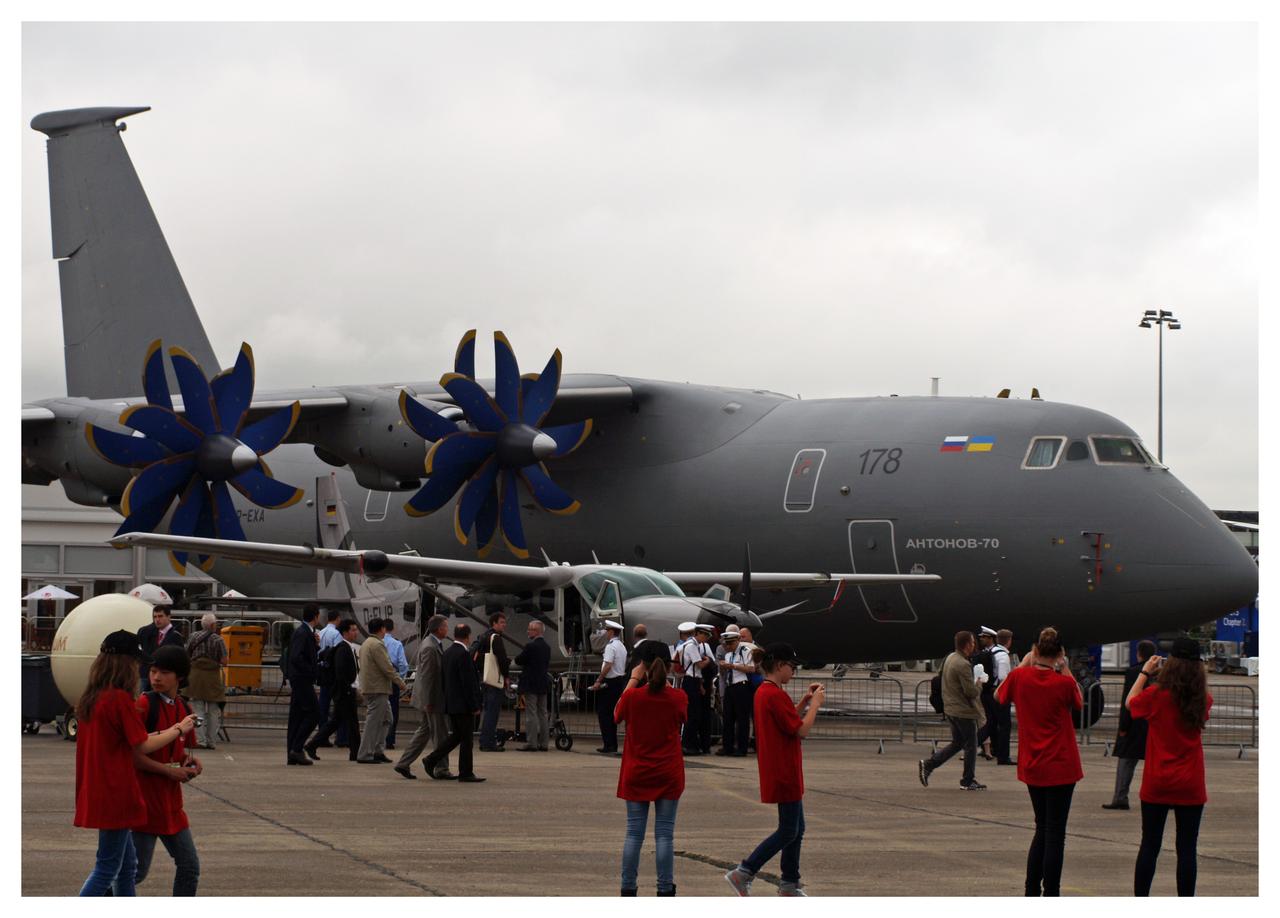
Antonov An-70 (Aerofossile2012)
Technically, the An-70 is among the first Eastern Bloc designs to integrate fly-by-wire systems into the heavy transport category. This technological transition established a digital foundation for Antonov’s subsequent projects; the high proportion of composite materials and carbon fiber structures used in the airframe contributed to redefining the weight-to-strength balance in transport aircraft.
The most concrete legacy of the An-70 in industry terms is the current Antonov An-188 project. This new concept, developed by adding Western engines and avionics to the An-70’s aerodynamic airframe, demonstrates that the An-70’s engineering provides a platform-based, sustainable foundation for future developments.
Aerofossile2012. "Antonov An-70." Flickr, June 21, 2013. Photograph. Accessed March 14, 2026. https://www.flickr.com/photos/aerofossile2012/18490343081/
Airforce Technology. "Antonov An-70 Transport / Cargo Aircraft." Accessed March 14, 2026. https://www.airforce-technology.com/projects/antonovan70freighter/
Antonov Company. "An-70." Accessed March 14, 2026. https://www.antonov.com/en/history/an-70.
Aviastar. "Antonov An-70 - Transport." Virtual Aircraft Museum. Accessed March 14, 2026. https://www.aviastar.org/air/russia/an-72.php
Darkellysio. "2013-06-17_13-57-53_01." Flickr, June 1, 2013. Photograph. Accessed March 14, 2026. https://www.flickr.com/photos/97765277@N08/9082037397/
Darkellysio. "2013-06-17_13-58-00_02." Flickr, June 1, 2013. Photograph. Accessed March 14, 2026. https://www.flickr.com/photos/97765277@N08/9082037601/
GlobalSecurity. "Antonov An-70." Accessed March 14, 2026. https://www.globalsecurity.org/military/world/ukraine/an-70-specs.htm
Janes Migavia. "Antonov An-70." Accessed March 14, 2026. https://janes.migavia.com/ukr/antonov/an-70.html
KHMedia. "Антонов Ан-70 МАКS 2013 UR-EXA." YouTube. Accessed March 14, 2026. https://www.youtube.com/watch?v=hgh1EJ-PQ9k.
Nodeworx. "LeBourget2013_007." Flickr, June 18, 2013. Photograph. Accessed March 14, 2026. https://www.flickr.com/photos/nodeworx/9076622075/
[1]
Airforce Technology."Antonov An-70 Transport / Cargo Aircraft". Airforce Technology. erişim 14 Mart 2026. https://www.airforce-technology.com/projects/an70/.
[2]
Antonov Company Official Site. "An-70". Antonov Company Official Site. Erişim 14 Mart 2026. https://www.antonov.com/en/history/an-70.
[3]
Antonov Company Official Site. "An-70". Antonov Company Official Site. Erişim 14 Mart 2026. https://www.antonov.com/en/history/an-70.
[4]
Janes Migavia. "Antonov An-70." Janes migavia.Erişim 14 Mart 2026. https://janes.migavia.com/ukr/antonov/an-70.html.
[5]
GlobalSecurity. "Antonov An-70". GlobalSecurity.org. Erişim 14 Mart 2026. https://www.globalsecurity.org/military/world/ukraine/an-70-specs.htm.
[6]
GlobalSecurity. "Antonov An-70". GlobalSecurity.org. Erişim 14 Mart 2026. https://www.globalsecurity.org/military/world/ukraine/an-70-specs.htm.
[7]
Airforce Technology."Antonov An-70 Transport / Cargo Aircraft". Airforce Technology. erişim 14 Mart 2026. https://www.airforce-technology.com/projects/an70/.

Length(s) | 40.73 m | ||||||||
|---|---|---|---|---|---|---|---|---|---|
Engine(s) | 4 × Progress D-27 Propfan | ||||||||
Height(s) | 16.38 m | ||||||||
First Flight(s) | 16 December 1994 | ||||||||
Primary Users | Antonov Airlines Ukrainian Air Force | ||||||||
Range (With Maximum Fuel) | 8.000 km | ||||||||
Cruising Speed | 700 - 750 km/h | ||||||||
Maximum Speed | 780 km/h | ||||||||
Empty Weight | 73.000 kg | ||||||||
Maximum Useful Load | 47.000 kg | ||||||||
Wingspan | 44.06 m | ||||||||
Capacity | 300 fully equipped soldiers or 206 stretchers | ||||||||
Crew | 3 - 5 (2 pilots and 1 navigator) | ||||||||
Country of Origin | Ukraine / Russia (Joint Project) | ||||||||
Design and Development Process
Propfan Technology and Engine Configuration
Technical Specifications
Operational History
Variants
Industry Legacy