This article was automatically translated from the original Turkish version.
+1 More
Location | Antalya Türkiye | ||||||||
|---|---|---|---|---|---|---|---|---|---|
Ancient Name | Aperlae | ||||||||
Origin(s) | Luwi language – Aprillai ("River Canyon") | ||||||||
Foundation | 5th century BCE (approximate) | ||||||||
Prominent Period | Hellenistic, Byzantine | ||||||||
Aperlai is a small-scale Lycian port town located on the northwestern slope of the Sıcak Peninsula, within the boundaries of Antalya Province in modern-day Türkiye, between Kaş and Kekova, at the head of a long, narrow bay. Access to this area, known today as Kuyubelen, is provided by sea routes from Kaş or Üçağız to Sıcak Pier.

Aperlia Ancient City (Antalya Provincial Directorate of Culture and Tourism)
The town’s name appears in ancient sources as “Aperlae.” This name derives from the Luwian word “Aprillai,” meaning “river gorge.” The name is recorded by ancient authors including Pliny, Ptolemy, Stadiasmus Maris Magni, and Hierokles, and appears in Byzantine episcopal lists in the form “Aprillae.” Additionally, in the 16th century, Piri Reis noted in his work Kitab-ı Bahriye that the town had a sheltered harbor and was inhabited at the time by only a few fishing families.
Aperlai’s history can be traced through coins dating to the 5th and 4th centuries BCE, bearing the Lycian abbreviations “APR” and “PRL.” These coins indicate that Aperlai was an independent city prior to its incorporation into the Lycian League. Later, as a member of the League, it minted coins bearing the League’s distinctive designs. Aperlai formed a sympoliteia (shared citizenship and political union) with the cities of Simena, Apollonia, and İsinda, with the four cities collectively represented by a single vote within the League.
Aperlai suffered severe damage from a major earthquake in 141 CE. A significant portion of the town’s coastal structures was partially or entirely submerged as a result. The prominent benefactor of the era, Opramoas of Rhodiapolis, contributed 30,000 denarii toward its reconstruction. However, after the Arab raids of the 7th century CE, Aperlai was completely abandoned.
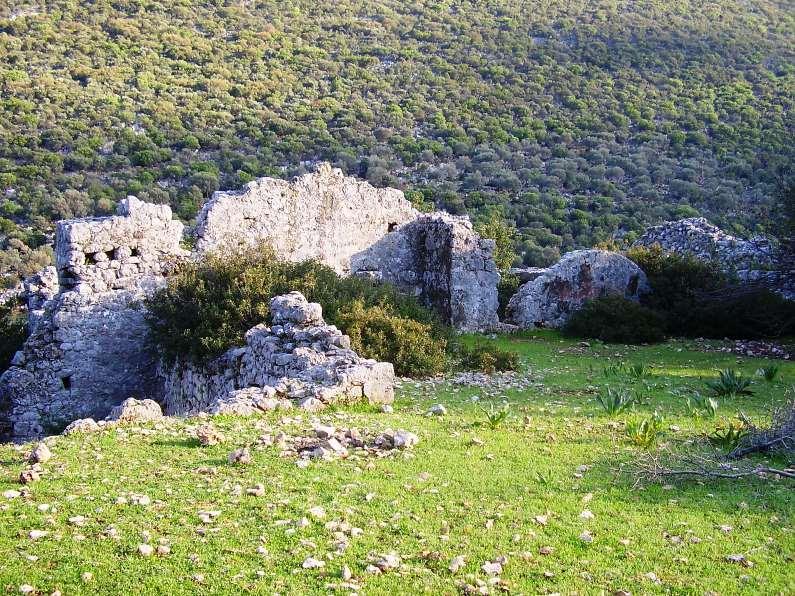
Most of the visible archaeological remains in the city date to the Roman period, with some originating from the Hellenistic period. Aperlai’s wall system is constructed of rectangular and polygonal stonework and reinforced with defensive towers. The western wall, with its three gates, is the best-preserved section surviving to the present day. The southern wall extends perpendicularly down the slope in polygonal masonry.
The settlement contains three arches, the remains of a church, and numerous Lycian-type sarcophagi. The necropolis lies to the east of the citadel walls and contains approximately 70 sarcophagi. Some sarcophagi and a burial structure near the shoreline, along with the quay and coastal buildings, are now entirely submerged.
The two Roman baths and at least two Early Byzantine churches are architecturally significant. These churches were built on a basilical plan, featuring a central aisle and an apse. Additionally, more than forty cisterns, an agora, and several unidentified structures form part of Aperlai’s urban architecture.
The coastal zone and harbor structures to the south of the city have been submerged over time due to rising sea levels and earthquakes, covering an area of approximately 15,000 square meters. Underwater surveys in this zone have uncovered numerous artifacts, including fragments of amphorae, roof tiles, terracotta oil lamps, glass bases, and ship ballast stones from the Roman and Byzantine periods.
One of the most remarkable discoveries is a cluster of Murex trunculus (sea snail) shells spread over an area of 1,500 square meters within the submerged western structures. These remains provide clear evidence that purple dye, highly valued in the ancient world, was produced in Aperlai. It is believed that, despite limited water and agricultural resources, the city derived its economic prosperity from the purple dye trade. Research indicates that purple dye production in the Lycian region was concentrated primarily in Aperlai and Andriake.
Access to the Aperlai Ancient City by sea or land offers visitors a tranquil experience where history and nature intertwine. The city, largely unexcavated, continues to be revealed through surface surveys and underwater archaeology.
T.C. Antalya Provincial Directorate of Culture and Tourism. "Aperlai." T.C. Ministry of Culture and Tourism. Accessed July 16, 2025. https://antalya.ktb.gov.tr/TR-312265/aperlai.html.
T.C. Kültür ve Turizm Bakanlığı. "Aperlai." Kültür Portalı. Accessed July 16, 2025. https://www.kulturportali.gov.tr/turkiye/antalya/gezilecekyer/aperlai.
Türkiye Turizm Ansiklopedisi. "Aperlai." Türkiye Turizm Ansiklopedisi. Accessed July 16, 2025. https://turkiyeturizmansiklopedisi.com/aperlai
Location | Antalya Türkiye | ||||||||
|---|---|---|---|---|---|---|---|---|---|
Ancient Name | Aperlae | ||||||||
Origin(s) | Luwi language – Aprillai ("River Canyon") | ||||||||
Foundation | 5th century BCE (approximate) | ||||||||
Prominent Period | Hellenistic, Byzantine | ||||||||
No Discussion Added Yet
Start discussion for "Aperlia Ancient City" article
History
Earthquakes, Reconstruction, and Abandonment
Archaeological Remains and Architecture
Submerged Structures and Purple Dye Production
Current Status and Visit