


This article was automatically translated from the original Turkish version.
+2 More

Geographical Boundary | Ardahan Province | ||||||||
|---|---|---|---|---|---|---|---|---|---|
Product / Product Group(s) | Processed and unprocessed meat products | ||||||||
Registration Status | Geographical Indication | ||||||||
Applicant/Registrant(s) | Ardahan Chamber of Commerce and Industry | ||||||||
Registration Date | 24.01.2022 | ||||||||
Registration Number | 1008 | ||||||||
Ardahan goose meat is a regional meat product obtained from native geese raised in the Ardahan province of northeastern Türkiye, processed and preserved using traditional methods. The production process is carried out under the specific climatic conditions unique to Ardahan and its surroundings, and the product has long been regarded as an integral part of the local culinary tradition.
The production of Ardahan goose meat begins in spring with a natural rearing process. During summer, the geese are freely grazed on the high-altitude natural pastures of Ardahan. This free-range movement naturally promotes muscle development. Starting in autumn, the feeding phase begins, during which the geese are fed local cereals such as barley, wheat, and corn. This feeding regimen enables the animals to naturally accumulate fat, significantly influencing the flavor of the product.
Slaughtering typically takes place between November and January. After slaughter, the feathers are removed, internal organs are extracted, and the meat is salted and hung in cold air conditions. The drying process lasts 10 to 15 days, in accordance with Ardahan’s natural climatic conditions, without the use of any additives. The meat can be stored either whole or in portions. Dried goose meat can be preserved without spoilage for up to six months in a cold storage facility and up to one year in a deep freezer.

Frozen Ardahan Goose Meat (Turkish Patent and Trademark Office)
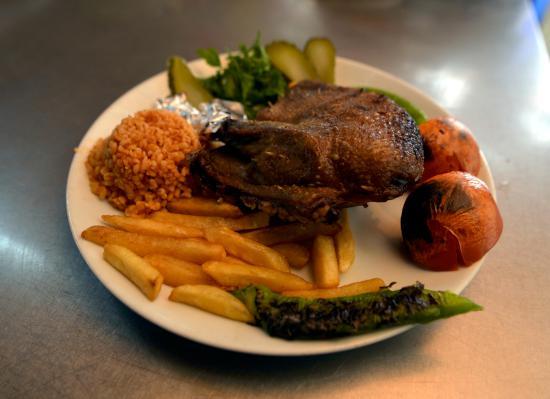
Ardahan Goose Meat (AA)
Ardahan goose meat was officially registered as a “geographical indication” by the Turkish Patent and Trademark Office on 22 June 2021. The registration was carried out on behalf of the Ardahan Chamber of Commerce and Industry, and the product is protected under its place of origin name. The geographical indication certificate guarantees that the product can only be produced within Ardahan province and its districts, using local production methods and under the region-specific environmental conditions. This registration aims to preserve the traditional production method, unique qualities, and regional identity of the product while preventing imitation.
Anadolu Ajansı. "Kars ve Ardahan'ın ramazan menüsü: Kaz eti." Accessed May 29, 2025. https://www.aa.com.tr/tr/ramazan-2017/kars-ve-ardahanin-ramazan-menusu-kaz-eti/842087
Pexels. "Kazın su kenarında kanatlarını açmasının yakın çekimi JPG." Accessed May 29, 2025. https://www.pexels.com/photo/close-up-of-goose-spreading-wings-by-water-29173262/
T.C. Ardahan Valiliği. "Kaz Yemeği." T.C. Ardahan Valiliği Web Sitesi. Accessed May 27, 2025. http://www.ardahan.gov.tr/kaz-yemegi
Turk Patent and Trademark Office. "Ardahan Kaz Eti." *Geographical Indications Portal.* Accessed May 29, 2025. Accessed June 15, 2025.
Çimen, Hürriyet. "Ardahan Kaz Eti." Türkiye Turizm Ansiklopedisi. Accessed May 27, 2025. https://turkiyeturizmansiklopedisi.com/ardahan-kaz-eti

Geographical Boundary | Ardahan Province | ||||||||
|---|---|---|---|---|---|---|---|---|---|
Product / Product Group(s) | Processed and unprocessed meat products | ||||||||
Registration Status | Geographical Indication | ||||||||
Applicant/Registrant(s) | Ardahan Chamber of Commerce and Industry | ||||||||
Registration Date | 24.01.2022 | ||||||||
Registration Number | 1008 | ||||||||
Production Method
Slaughtering and Processing
Distinguishing Characteristics
Geographical Indication Status