


This article was automatically translated from the original Turkish version.
+1 More
Xeriscape is a landscape design approach that prioritizes water conservation and ecological sustainability by minimizing water use. The term “Xeriscape,” widely used in the literature, is derived from the Greek word “xeros,” meaning dry.【1】 The concept first emerged in 1978 in the state of Colorado, United States, as a landscape design approach aimed at conserving water resources and the environment through minimal water use.【2】 The unsustainable global use of water resources, along with factors such as the greenhouse effect and climate change, has increased the importance of this approach as a water-efficient planning tool in urban areas. The primary goal of xeriscape is to minimize water consumption without compromising aesthetic concerns, promote the use of native plant species adapted to local conditions, and contribute to the preservation of ecological balance.【3】
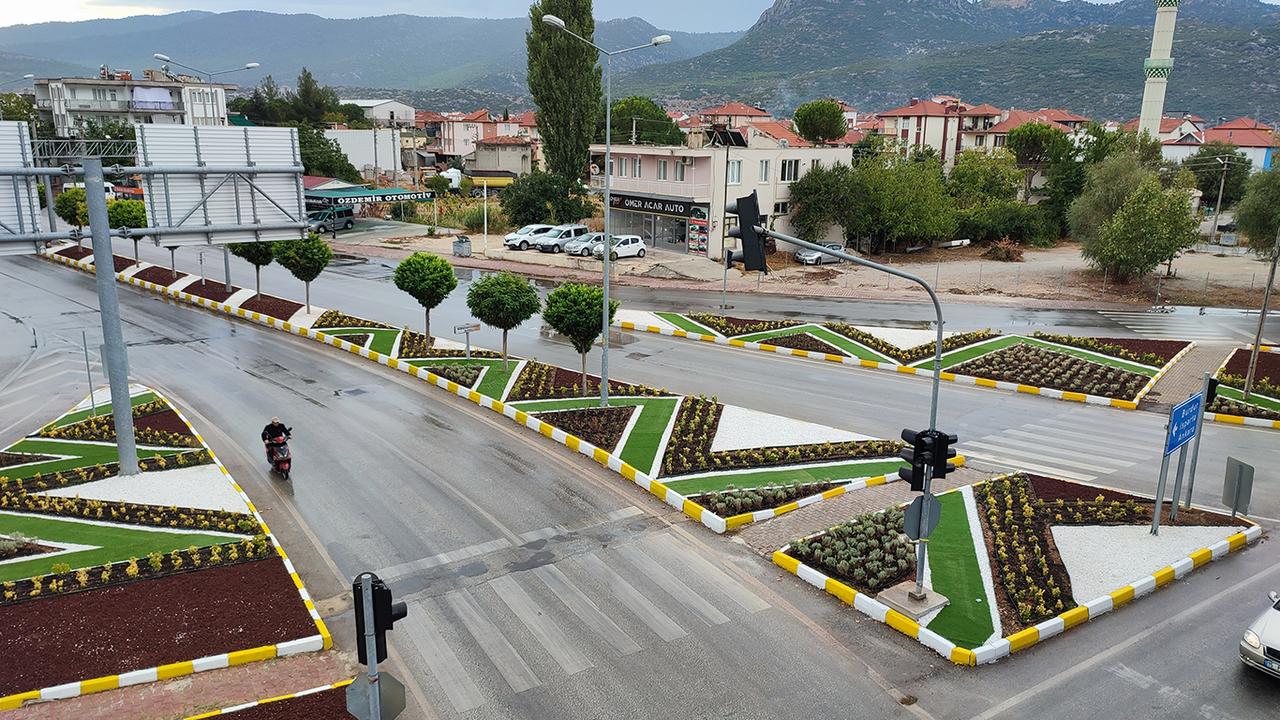
Example of Xeriscape (Anadolu Agency)
Xeriscape studies, unlike traditional landscape design, are addressed under subheadings such as “Water-Efficient Landscape Design,” “Rational Water Use,” and “Natural Landscape Management.” This approach is a discipline applicable not only in arid regions but across all green spaces, from residential gardens to urban parks, from highway verges to industrial zones. Xeriscape aims to maximize water efficiency by integrating with sustainable rainwater management, reuse of greywater, and green infrastructure systems (green roofs, rain gardens, permeable pavements).【4】
Visual Related to Xeriscape (Generated by Artificial Intelligence.)
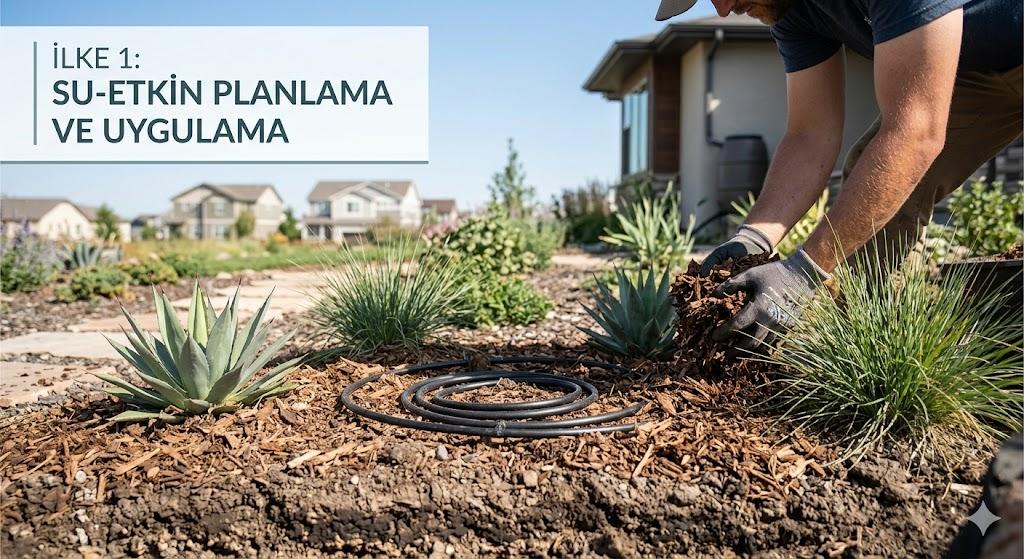
A successful xeriscape design is based on seven interrelated core implementation principles: appropriate planning and design, soil preparation, suitable plant selection, limitation of turf areas, efficient irrigation, mulching, and proper maintenance.【5】
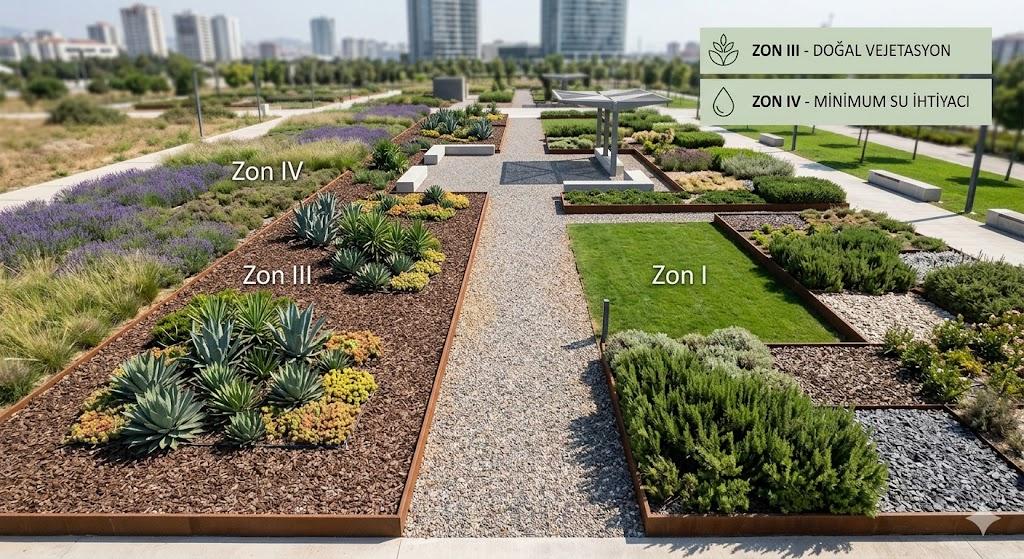
During the planning phase, data such as solar exposure, prevailing wind direction, topography, and existing vegetation are analyzed to establish water-use zones. In soil preparation, the soil’s pH, nutrient content, and water-holding capacity are assessed and improved with organic amendments. Well-drained, organically rich soil reduces irrigation needs by promoting deep root development. In plant selection, native species adapted to local vegetation and drought conditions are prioritized, as they have been found to be more resistant to diseases and pests and require less maintenance.
Visual of Water-Use Zones (Generated by Artificial Intelligence.)
In xeriscape design, plants are grouped into specific zones according to their water requirements:
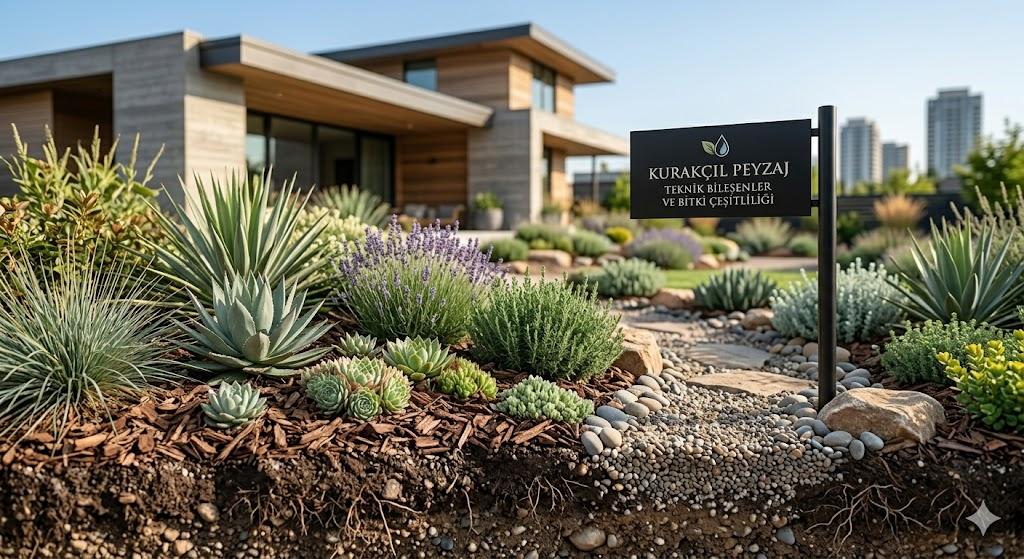
Plant materials include coniferous trees, broadleaf species, shrubs, groundcovers, geophytes, and succulents. In particular, succulent plants, with their fleshy and thick leaves, possess high water-storage capacity and show significant potential for use in Türkiye’s flora as groundcovers or border plants. Turf areas are recognized as the most water-intensive elements in landscape design; therefore, their surface area is minimized in xeriscape projects, and only drought-tolerant species such as Festuca arundinacea and Cynodon dactylon are selected for functional purposes.
Visual Related to Xeriscape (Generated by Artificial Intelligence.)
Mulch refers to organic materials (such as wood chips, pine needles, and leaves) or inorganic materials (such as gravel, rock, and marble fragments) applied to the soil surface to prevent moisture loss.【6】 Mulching helps maintain soil temperature, reduces evaporation, suppresses weed growth, and controls erosion.
The design of efficient irrigation systems aims to deliver water most effectively to the plant root zone. To minimize evaporation losses, irrigation is recommended during early morning or late evening hours. Where feasible, drip irrigation or automated systems with smart controllers are preferred. Maintenance, the final stage in ensuring the sustainability of xeriscape, includes timely pruning, fertilization, and system inspections.
Xeriscape applications can reduce water consumption by 30 to 60 percent compared to conventional designs, and up to 80 percent when turf areas are fully converted to this technique.【7】 Economically, labor, fertilizer, and pesticide costs are reduced by approximately 50 percent. Ecologically, xeriscape contributes to the mitigation of the urban heat island effect and the creation of habitats for wildlife.【8】 In this context, xeriscape is regarded as a fundamental strategy for the sustainable management of urban open green spaces.
Anadolu Ajansı. "Kurakçıl peyzaj düzenlemesiyle yıllık 25 bin ton su tasarrufu sağlanıyor." *Yeşilhat.* Accessed June 14, 2026. https://www.aa.com.tr/tr/yesilhat/iklim-degisikligi/-kurakcil-peyzaj-duzenlemesiyle-yillik-25-bin-ton-su-tasarrufu-saglaniyor/1818621
Ministry of Agriculture and Forestry, General Directorate of Water Management. "Kurakçıl Peyzaj Uygulamaları." Guide. (March 2026): 1-35. Accessed May 12, 2026. https://ttvkayserimtal.meb.k12.tr/meb_iys_dosyalar/38/14/971692/dosyalar/2026_03/69a94d7cd5add517707037_KASKSUVERMLL2.pdf?CHK=4af7775012eb94e510296f8199ab1c4e
Yüce, İlayda, and Elif Ebru Şişman. “Kentsel Alanlara Yönelik Kurakçıl Peyzaj Tasarım Önerisi: İstanbul – Silivri Sahil Parkı”. Türkiye Peyzaj Araştırmaları Dergisi 8, no. 2 (2025): 156-71. Accessed May 12, 2026. https://dergipark.org.tr/tr/pub/peyad/article/1543568
Çorbacı, Ömer Lütfü, and Murat Özyavuz. "Kentsel Açık Yeşil Alanlarda Kurakçıl Peyzaj (Xeriscape) Çalışmaları." In *Kentsel Yeşil Alanların Sürdürülebilir Yönetimi*, edited by K. İnce, pp. 109–171. Ankara: Iksad Publications, 2024. Accessed May 12, 2026. https://www.researchgate.net/publication/383282222_Kentsel_Acik_Yesil_Alanlarda_Kurakcil_Peyzaj_Xeriscape_Calismalari
Ünal Çilek, Müge. “KURAKÇIL PEYZAJ TASARIMININ YEDİ BASAMAĞI: ARİZONA EYALET ÜNİVERSİTESİ KAMPÜSÜ”. ArtGRID - Journal of Architecture Engineering and Fine Arts 4, no. 2 (2022): 222–39. Accessed May 12, 2026. https://doi.org/10.57165/artgrid.1202067
[1]
Ömer Lütfü Çorbacı and Murat Özyavuz, “Xeriscape Studies in Urban Open Green Spaces,” in Sustainable Management of Urban Green Spaces, ed. K. İnce (Ankara: Iksad Publications, 2024), p. 110, https://zenodo.org/records/12698789/files/Bolum%2005_%20rv%20Ömer%20Lütfü%20Çorbacı-Kurakçıl%20Peyzaj.pdf?download=1
[2]
Çorbacı and Özyavuz, “Xeriscape in Urban Open Green Spaces,” p. 110.
[3]
İlayda Yüce and Elif Ebru Şişman, “Xeriscape Design for Urban Areas,” Turkish Journal of Landscape Research 7, no. 2 (2024): p. 157, https://dergipark.org.tr/tr/pub/peyad/article/1543568
[4]
Çorbacı and Özyavuz, “Xeriscape in Urban Open Green Spaces,” p. 118.
[5]
Yüce and Şişman, “Xeriscape Design for Urban Areas,” p. 157.
[6]
Yüce and Şişman, “Xeriscape Design for Urban Areas,” p. 157.
[7]
Çorbacı and Özyavuz, “Xeriscape in Urban Open Green Spaces,” p. 112.
[8]
Çorbacı and Özyavuz, “Xeriscape in Urban Open Green Spaces,” p. 112.

Conceptual Framework and Application Areas
Core Principles of Planning and Implementation
Water-Use Zones and Plant Design
Technical Components: Mulching, Irrigation, and Maintenance
Ecological and Economic Benefits