


This article was automatically translated from the original Turkish version.
Artificial labor systems refer to production and service systems in which artificial intelligence, robotics, and automation technologies are integrated to replace or support human labor. These systems encompass not only the performance of physical tasks but also the delegation of cognitive processes such as decision-making, analysis, and response to machines. In this regard, artificial labor distinguishes itself from traditional automation by exhibiting adaptability and learning capabilities akin to human intelligence.
The concept has come to the forefront particularly after Industry 4.0, driven by digitalization and machine learning capabilities. However, its historical roots trace back to the earliest examples of automation. The mechanization process that began in the early 20th century with Taylorist production principles evolved through the introduction of CNC machines, programmable logic controllers (PLCs), and industrial robots. Artificial labor systems represent the final stage of this evolution, incorporating the dimensions of autonomy and cognitive capability.
The defining feature of these systems is the presence of artificial workers that analyze environmental data, detect errors, generate solutions, and collaborate with humans—rather than merely repeating pre-programmed task sequences. For instance, an artificial worker on an assembly line does not simply assemble parts; it analyzes the process when defects occur, identifies deviations from quality standards, and alerts relevant units.
The development of artificial labor systems depends on three core technological pillars: artificial intelligence software, robotic hardware, and big data analytics. This triad enables the system’s capabilities in decision-making, action execution, and learning. In this context, machines are empowered not only to perform mechanical tasks but also to undertake cognitive functions such as problem-solving, planning, and learning.
Historically, the idea of human-machine collaboration, first introduced in Japan’s Toyota Production System, has now become a reality through collaborative robot (cobot) systems. These cobots exemplify artificial workers capable of working alongside humans and taking over dangerous or repetitive tasks. This approach generates positive impacts across multiple domains including workplace safety, ergonomics, and efficiency.
To understand the evolution of artificial labor systems, it is also necessary to consider the advancement of hardware. Advanced components such as AI-enabled cameras, six-axis robotic arms, force sensors, and haptic feedback technologies have significantly enhanced the sensory and motor capabilities of these systems. As a result, machines now emerge that can not only execute predefined tasks but also adapt in real time to dynamic environmental conditions.
Today, artificial labor systems are applied across numerous sectors including automotive, electronics, food, textiles, and logistics. These applications not only accelerate production but also deliver environmental and economic benefits such as improved quality control, energy efficiency, and reduced resource waste. Moreover, during exceptional circumstances such as the pandemic, artificial workers ensured the continuity of critical production by minimizing human contact.
The widespread adoption of these systems has also triggered a major transformation in the world of work. The nature of blue-collar jobs has changed; while some professions have disappeared, new hybrid roles requiring specialized skills have emerged. For example, roles such as “technical operators” responsible for maintaining, monitoring, and programming artificial workers are now increasingly common.
The concept of artificial labor brings with it not only technical but also social, legal, and ethical debates. Issues surrounding decision-making processes, responsibility sharing, and human-machine interaction have generated new regulatory needs. Therefore, artificial labor systems must be addressed not merely as production tools but as a matter of social policy.
In conclusion, artificial labor systems represent a new paradigm in industrial production. These systems not only reduce production costs but also deliver multidimensional gains in speed, quality, sustainability, and adaptability. However, managing this transformation effectively requires a multi-layered approach encompassing both technical and social dimensions.
The feasibility of artificial labor systems is directly dependent on their underlying technological building blocks. These systems require the integration of numerous advanced technologies to emulate human functions such as perception, decision-making, movement, and learning. Fundamentally, these components can be grouped into four main categories: artificial intelligence algorithms, robotic hardware systems, sensing technologies, and data processing platforms.
Artificial intelligence (AI) serves as the “brain” of artificial workers. Through machine learning and deep learning algorithms, systems can learn from past experiences, adapt to new situations, and make complex decisions. For example, a robot assembling parts on a production line can, over time, statistically determine which sequence of movements is faster or more accurate and apply this optimization through its own algorithm. This capability is particularly evident in unsupervised learning and reinforcement learning methods.
Robotics hardware constitutes the physical embodiment of artificial workers. These systems vary widely and include multi-axis robotic arms, mobile platforms (AGVs—automated guided vehicles), cobots, and industrial exoskeletons. The key feature of these hardware components is their ability to respond in real time to sensor data, not merely follow pre-programmed instructions. In other words, their physical movements are not static but flexible and responsive to environmental variables.
Sensing technologies enable interaction between the system and its environment. Components such as image-processing cameras, depth sensors, LIDAR scanners, haptic feedback systems, and speech recognition modules allow artificial workers to analyze their surroundings. For instance, a robot performing quality control can detect surface defects at a micron level using high-resolution cameras and AI-powered analytical algorithms. This technology plays a crucial role in meeting critical quality standards in industries such as food, pharmaceuticals, and automotive.
Data processing and integration systems serve as the infrastructure that connects these technologies. Solutions such as cloud-based production platforms, edge computing systems, and digital twin applications enable real-time collection, analysis, and synchronization of production data across all system components. This allows artificial workers to operate not only individually but also in a system-wide optimized manner.
The advancement of these technologies has also led to cost reductions. For example, while the average cost of an industrial robotic arm in the 2010s was around $100,000, today’s cobot systems can cost as little as $15,000. This has made artificial labor systems accessible even to small and medium-sized enterprises.
Furthermore, open-source AI libraries (TensorFlow, PyTorch, OpenCV) and robotic operating systems (ROS) have enabled universities and entrepreneurs to test, customize, and develop these systems. This democratization process is accelerating the widespread adoption of the technology.
All these technological building blocks have transformed artificial labor from a theoretical concept into a practical and sustainable system. While engineering achievements have driven their development, the strategies and business approaches governing their implementation are equally decisive for the success of this transformation.
Artificial labor systems have extended beyond industrial automation to find applications across a wide range of sectors. Their core strength lies in their ability to handle not only repetitive physical tasks but also multifaceted responsibilities such as data-driven decision-making, quality control, maintenance, coordination, and even customer interaction. Their application spans from manufacturing to healthcare, logistics to the service industry.
Manufacturing is the most mature application area for artificial labor. In the automotive sector, robotic arms and cobots on assembly lines perform specific part-joining operations with high precision and repeatability. For example, automotive giants such as Ford and Tesla have long employed artificial labor systems in which thousands of robots operate in synchronized fashion on production lines. These systems increase production speed while significantly reducing human error rates.
In the electronics industry, artificial workers excel in operations requiring micron-level precision. Tasks such as semiconductor manufacturing, motherboard assembly, and placement of optical components are carried out by AI-assisted robots. Human intervention in these processes is both time-consuming and a source of potential error, whereas artificial workers ensure consistent and clean execution.
Logistics and warehouse management represent another rapidly growing field for artificial labor. Major logistics companies such as Amazon, Alibaba, and DHL deploy mobile robots as artificial workers within their warehouses. These robots handle order picking, inventory management, packaging, and shipment coordination. Thanks to real-time data integration, these systems determine the most efficient routes and task allocations and have evolved to operate safely alongside humans without collisions.
In healthcare, artificial labor manifests in applications such as nursing robots, surgical support systems, and automated drug delivery devices. Particularly during the pandemic, autonomous disinfection robots deployed in hospitals helped reduce infection transmission by minimizing human contact. Additionally, AI-assisted robotic surgical systems (e.g., the Da Vinci Surgical System) enable surgeons to perform complex operations with greater precision and safety.
Agriculture is a field where artificial labor is still emerging but holds significant potential. Agricultural robots can perform a variety of functions, from soil analysis and planting and irrigation to pest detection and harvesting. Powered by AI, these machines can monitor plant growth, determine optimal irrigation timing, and generate yield predictions. This is especially beneficial in regions with limited water resources, where efficiency gains are critical.
In the service sector, artificial workers appear in forms such as room-service robots in hotels, AI-powered order-taking systems in restaurants, and digital customer representatives in banks. These applications reduce operational costs while offering the potential to personalize customer experiences. For example, banking robots that provide recommendations based on user history deliver faster and more accurate solutions to customers.
In the energy sector, artificial labor is revolutionizing maintenance and fault detection. For instance, drones inspecting wind turbine blades use AI to analyze surface damage and optimize maintenance schedules. These systems protect human workers from the risks associated with operating in hazardous and hard-to-reach areas.
Applications of artificial labor in defense industries are highly advanced. Components such as unmanned ground vehicles, autonomous reconnaissance robots, and aerial support systems constitute complex systems capable of both decision-making and operational execution. The AI algorithms used in these applications perform tasks such as target recognition, risk analysis, and mission strategy formulation.
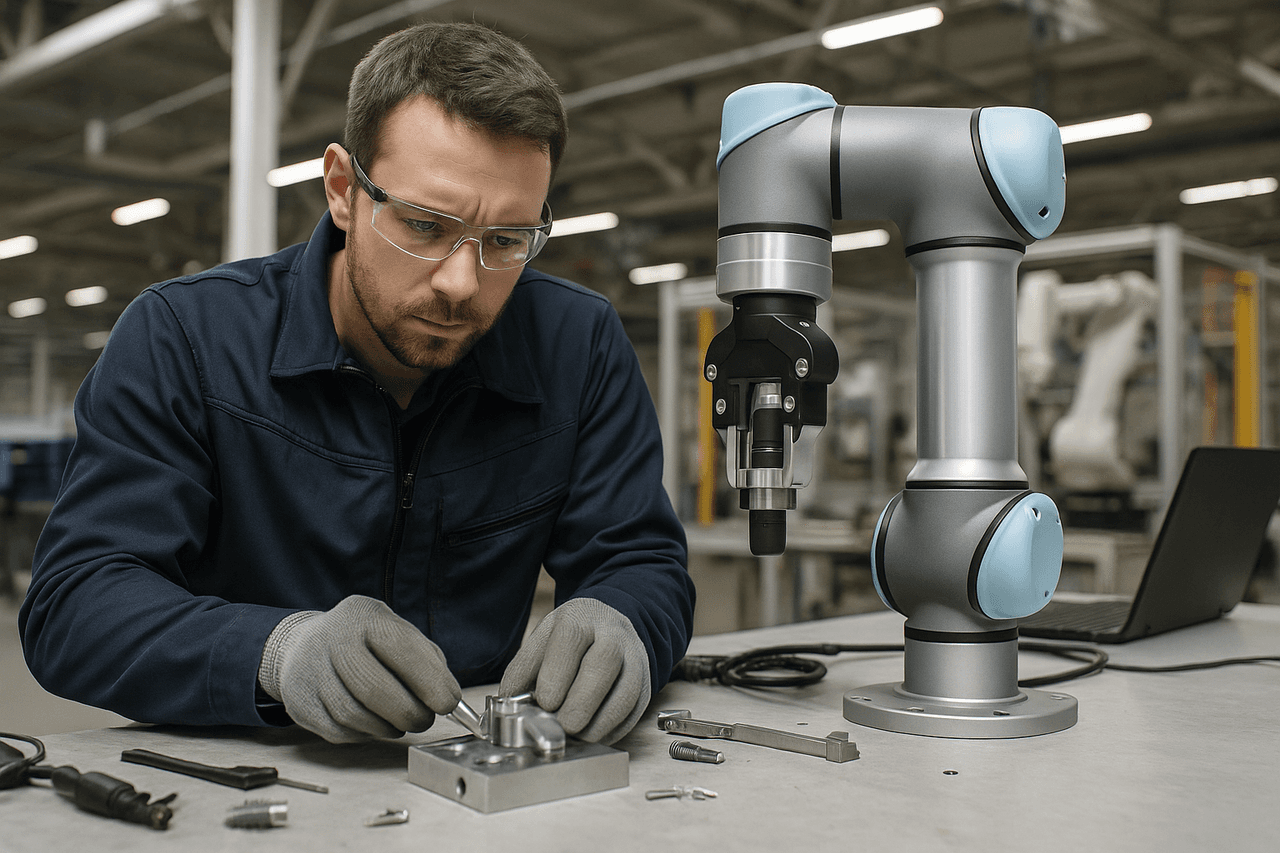
A typical example of an artificial labor system (generated by artificial intelligence.)
The proliferation of artificial labor systems has brought about not only a technological advancement but also a profound transformation in labor markets, socioeconomic structures, and production relationships. The partial or complete replacement of human labor with machines has long-term implications for employment, wage structures, the evolution of professions, social security systems, and education policies. Understanding these impacts requires evaluation not only from an engineering perspective but also through the lens of social sciences.
The most immediately noticeable effect is the qualitative shift in labor demand. As repetitive, low-skill tasks are increasingly performed more efficiently and accurately by artificial workers, the need for human labor in these areas is declining. However, this does not merely increase unemployment; it also creates new skill requirements. For instance, a worker previously employed as an operator on a production line may now be expected to possess knowledge of robot programming or data analysis.
At this point, the concept of “unemployment” is being redefined. While concerns exist that artificial labor systems cause job losses, many studies reveal that these technologies simultaneously generate new employment opportunities. There is growing demand for skilled technical personnel in areas such as the installation, maintenance, monitoring, and improvement of artificial labor systems. This has paved the way for the emergence of “new forms of employment” or “hybrid labor” models.
The socioeconomic impacts extend beyond employment. Advantages such as increased productivity, reduced costs, and improved quality control enhance corporate competitiveness, yet how these gains are distributed to workers remains a critical issue. Matters such as income equity, the sharing of value created by production, and the protection of social rights have become more complex in the context of artificial labor systems.
Another dimension of this transformation concerns its impact on union activities. Automation and artificial labor can weaken workers’ collective bargaining power, as employers may substitute human labor with artificial systems. This forces unions to undergo strategic transformation. In the new era, unions are expected to act not only on issues such as wages and working hours but also on “digital rights,” “data security,” and “algorithmic transparency.”
Educational systems must also adapt to this transformation. Traditional vocational schools and universities are developing programs aimed at equipping students with the cognitive and technical competencies required by artificial labor systems. Alongside STEM (science, technology, engineering, and mathematics) education, subjects such as algorithmic literacy, systems thinking, and human-machine interaction are being integrated into curricula.
Societal responses to this transformation vary by country. Developed nations are formulating national strategies to capitalize on the opportunities presented by this shift, while in developing countries, adoption is more limited due to cost and infrastructure constraints. However, in the long term, a global shift in production paradigms appears inevitable. This will reshape international competition, labor migration, and economic imbalances.
Moreover, there are significant psychological impacts. Environments where machines replace humans can negatively affect feelings of belonging, motivation, and job satisfaction. Examples of “artificial bosses”—where algorithms assume managerial functions in workplaces—may necessitate the revision of workplace ethical codes. The sense of exclusion from decision-making processes could increase potential workplace conflict.
The future of artificial labor systems lies not in fully autonomous machines but in hybrid systems where human intelligence and machine capabilities are jointly optimized. This approach embodies a vision of the future that goes beyond technological efficiency, incorporating dimensions of safety, ethics, and sustainability by redefining the nature of human-machine interaction. Even if humans no longer work directly on production lines, they will remain indispensable components of the system as the higher intelligence that trains, manages, and supervises machines.
Hybrid labor models combine the high speed and precision of artificial workers with human intuition and creativity. In these models, the artificial worker assumes physical tasks while the human operator analyzes its performance, sets task priorities, and intervenes when necessary. For example, software managing human-robot interaction on automotive assembly lines maximizes productivity by enabling real-time task sharing.
The success of these hybrid structures depends on the quality of human-machine adaptation. Artificial workers designed to collaborate with humans must be “reactive,” even if not empathetic. That is, they must move in a manner sensitive to the speed, motion, and proximity of nearby humans. In this context, the development of proximity sensors and haptic feedback systems enhances robots’ collision-avoidance and adaptive movement capabilities. Additionally, ergonomic design of systems is another critical parameter that reduces physical fatigue and accidents.
In the future, artificial labor systems may also assume managerial roles. Some companies are already testing algorithmic systems that manage shift rotations, break times, or quality scores. While these systems have the potential to improve workforce efficiency, their design must adhere to principles of transparency and accountability. Otherwise, workers may feel excluded from decision-making processes and suffer from decreased motivation.
Moreover, the future learning speed and flexibility of artificial workers will facilitate their transition across different sectors. Today’s artificial labor system designed solely for automotive manufacturing may tomorrow be deployed in food packaging and later in medical device production. This gives rise to the concept of a universal artificial worker core: a core software that can be expanded with different “skill modules” for various tasks, much like humans learn new jobs through education.
Significant roles in the future of human-machine adaptation will fall to cognitive ergonomics and user experience engineering. For humans to communicate intuitively with artificial systems, education and work processes must be rapidly adaptable. Technologies such as natural language processing (NLP), eye-tracking, and wearable interfaces are being developed to strengthen the connection between humans and these systems.
The future of artificial labor also necessitates the evolution of regulation. Issues currently undefined—such as “liability in machine errors,” “decision-making transparency,” and “ethical programming”—will become critical in future hybrid factories. In systems where artificial workers operate independently, it must be legally and ethically clarified at which point responsibility remains with the human and at which point it is delegated to the algorithm.
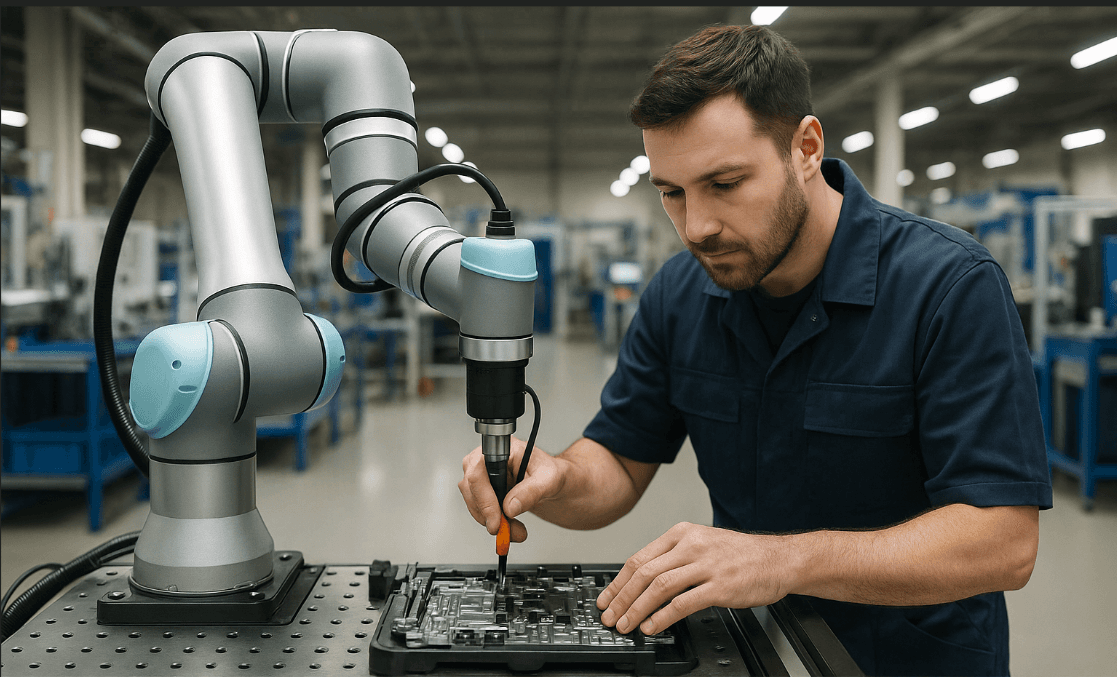
An advanced application of artificial labor systems (generated by artificial intelligence.)
Frey, Carl Benedikt, and Michael A. Osborne. "The Future of Employment: How Susceptible Are Jobs to Computerisation?" *Technological Forecasting and Social Change* 114 (2017): 254–280. https://www.sciencedirect.com/science/article/abs/pii/S0040162516302244
Kamble, Sachin, and Angappa Gunasekaran. "Industry 4.0 and Lean Manufacturing Practices for Sustainable Organisational Performance in Indian Manufacturing Companies." *International Journal of Production Economics* 231 (2021): 107871. https://doi.org/10.1016/j.ijpe.2020.107871
Lee, Jay, Behrad Bagheri, and Hung-An Kao. "A Cyber-Physical Systems Architecture for Industry 4.0-Based Manufacturing Systems." *Manufacturing Letters* 3 (2015): 18–23. https://www.sciencedirect.com/science/article/abs/pii/S221384631400025X
Lu, Yang. "Industry 4.0: A Survey on Technologies, Applications and Open Research Issues." *Journal of Industrial Information Integration* 6 (2017): 1–10. https://www.sciencedirect.com/science/article/abs/pii/S2452414X17300043
Tang, Tengfei, Hanliang Fang, Haiwei Luo, Yaqing Song, and Jun Zhang. "Type Synthesis, Unified Kinematic Analysis and Prototype Validation of a Family of Exechon Inspired Parallel Mechanisms for 5-Axis Hybrid Kinematic Machine Tools." *Mechanism and Machine Theory* 160 (2021): 104287. https://www.sciencedirect.com/science/article/abs/pii/S0736584521000648

No Discussion Added Yet
Start discussion for "Artificial Insemination Systems" article
Core Technologies Used in Artificial Labor
Application Areas of Artificial Labor Systems
Artificial Labor and Socioeconomic Transformation
The Future of Artificial Labor: Hybrid Systems and Human-Machine Adaptation Models