


This article was automatically translated from the original Turkish version.
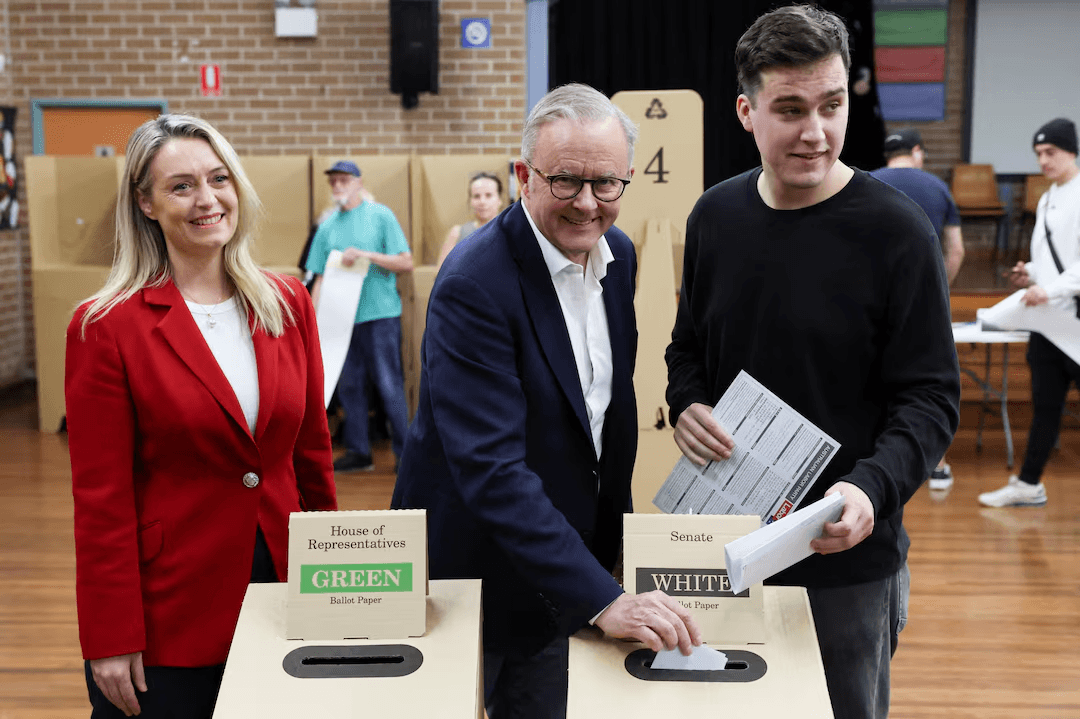
Australian Federal Elections (2025)
History | 2025-05-04 | ||||||||
|---|---|---|---|---|---|---|---|---|---|
Election Type | Federal General Election | ||||||||
Number Required for Parliamentary Majority | 76 seats | ||||||||
Voter Turnout Rate | over 90% | ||||||||
Australian Federal Elections (2025) were a general election held on 3 May 2025 to determine the members of the country’s House of Representatives. Following the election, the Australian Labor Party led by Anthony Albanese retained power for a second term and expanded its majority in parliament. Peter Dutton, leader of the Liberal-National Coalition the main opposition bloc, not only lost the general election but also lost his seat in the Dickson electorate, which he had represented for 24 years.
Representative Image of the Australian Federal Elections (generated by artificial intelligence.)
In Australia, federal elections are held every three years in accordance with constitutional provisions. The 2025 election was conducted on Saturday 3 May 2025, exactly three years after the previous election and in line with the constitutional schedule. Voters cast ballots for the 151 seats in the House of Representatives, the lower house of the Australian Parliament. To achieve a majority in the House of Representatives, a party or coalition must win at least 76 seats. The election was conducted under the principle of compulsory voting.
The federal election campaign lasted five weeks and focused on issues such as the cost of living, healthcare services, housing, environmental and energy policies, migration reforms, and the representation of Indigenous peoples.
Regarding the cost of living, rising prices for food, energy and transportation dominated the agenda. In healthcare, debates centered on general practitioner consultation fees and access barriers. Housing policies featured prominently in campaign statements, particularly concerning rental increases and homeownership conditions. In energy and environmental policy, assessments were made regarding the transition to renewable energy sources and mining activities.
The migration issue was addressed through the lenses of border security, labor migration and citizenship practices. Following the failed 2023 referendum on the “Voice to Parliament,” proposals concerning constitutional representation for Indigenous Australians were incorporated into the campaign.
According to preliminary results with 70.8 percent of votes counted on 3 May 2025, the Australian Labor Party won 85 seats, securing an outright majority in the House of Representatives. The party, which held 77 seats before the election, increased its tally by eight seats. The Liberal-National Coalition came in second with 36 seats; independent candidates won 10 seats and the Greens won 2 seats.
In terms of first-preference vote share, the Australian Labor Party received 34.8 percent of the vote. The Liberal-National Coalition recorded 32.1 percent. The Greens received 11.8 percent, One Nation 6.2 percent and Trumpet of Patriots 1.9 percent. The combined vote share of smaller parties and independent candidates under the “Other” category amounted to 13.2 percent.
Prime Minister Anthony Albanese, as leader of the Australian Labor Party, won a second term and secured a parliamentary majority for his party. Economic reform, strengthening healthcare services and environmental policy were key pledges in his campaign. In his post-election speech, he highlighted voters’ expectations regarding healthcare, housing and environmental issues.
Liberal Party leader Peter Dutton was defeated by Labor candidate Ali France in the Dickson electorate in Queensland. Dutton lost his seat in the electorate he had represented for 24 years. In his election night speech, he accepted responsibility for the electoral defeat and announced the initiation of a party renewal process.
In Australia, voting in federal elections is a legal obligation. Voter turnout in the 2025 election exceeded 90 percent. The Australian Electoral Commission (AEC) confirmed that the vast majority of registered voters cast their ballots on election day or in the days leading up to it. Early voting and postal voting were extensively utilized during the electoral process.
No electronic voting systems were used; all votes were collected via physical ballot papers in polling booths. The vote count was officially conducted by the AEC, with the majority of results announced by 5 May 2025. Final definitive results took several days to complete due to the preferential voting system.
Election outcomes varied across states. The Australian Labor Party won significant numbers of seats in New South Wales and Victoria. In Queensland, the Coalition suffered losses in several regions. In South Australia and Tasmania, the Labor Party emerged narrowly ahead. In Western Australia, the Labor Party maintained its advantage from the previous election.
In urban areas, the Labor Party and independent candidates achieved high vote shares. In regional and rural areas, the influence of the Coalition and parties such as One Nation persisted. In some traditional Liberal Party urban seats, “teal” independents were re-elected.
ABC News. "Federal Election 2025." ABC News Australia. Accessed May 5, 2025. https://www.abc.net.au/news/elections/federal-election-2025
Anadolu Ajansı. "Avustralya’da Halk Genel Seçim İçin Sandık Başında." Accessed May 5, 2025. https://www.aa.com.tr/tr/dunya/avustralyada-halk-genel-secim-icin-sandik-basinda/3555698
Anadolu Ajansı. “Avustralya, 3 Yıllık İşçi Partisi İktidarının Ardından Federal Seçimler İçin Yarın Sandık Başına Gidiyor.” Accessed May 5, 2025. https://www.aa.com.tr/tr/dunya/avustralya-3-yillik-isci-partisi-iktidarinin-ardindan-federal-secimler-icin-yarin-sandik-basina-gidiyor/3554800
BBC News. "Australia Election 2025: Key Seats and Battlegrounds." Accessed May 5, 2025. https://www.bbc.com/news/articles/c9djze015xlo
BBC News. “Live Updates: Australia Votes in 2025 Federal Election.” BBC News. Accessed May 5, 2025. https://www.bbc.com/news/articles/cvg7x1glvwdo
The Guardian. “Australian Election 2025.” Accessed May 5, 2025. https://www.theguardian.com/australia-news/australian-election-2025

Australian Federal Elections (2025)
History | 2025-05-04 | ||||||||
|---|---|---|---|---|---|---|---|---|---|
Election Type | Federal General Election | ||||||||
Number Required for Parliamentary Majority | 76 seats | ||||||||
Voter Turnout Rate | over 90% | ||||||||
No Discussion Added Yet
Start discussion for "Australian Federal Elections (2025)" article
Legal and Institutional Framework of the Election
Key Issues in the 2025 Election Campaign
Election Results and House of Representatives Composition
Voter Turnout and Voting Process
State-by-State Results