This article was automatically translated from the original Turkish version.
+2 More
Location | Sultanbeyli İstanbul | ||||||||
|---|---|---|---|---|---|---|---|---|---|
Area Covered | Approximately 26,000 m² | ||||||||
Restoration Date | 2010–2014 | ||||||||
Archaeological Excavations | Walls, towers, spiral staircases, gates, water systems, cisterns, church, shelter/living units, grain storage | ||||||||
Aydos Castle is a defensive structure dating from the Byzantine period, located within the boundaries of the Sultanbeyli district on the Anatolian side of Istanbul. Due to its strategic location, it served as an important military center during both the Byzantine and Ottoman periods. Through archaeological excavations and restoration efforts carried out in recent years, the castle has been brought to light and possesses a multilayered historical heritage linked to Byzantine architecture, Ottoman conquest narratives, and folk legends.
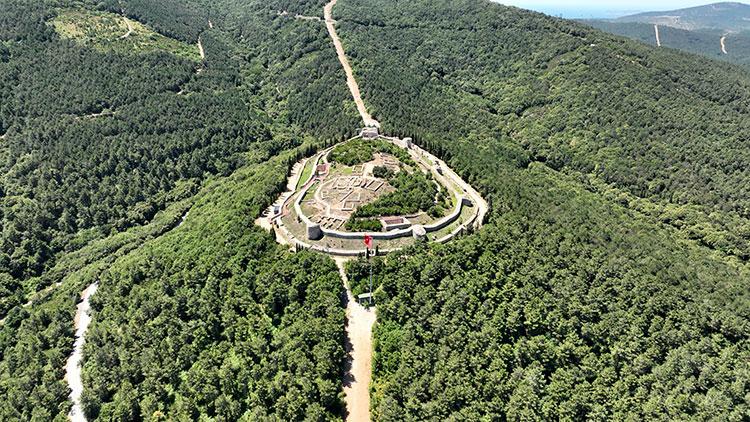
Aydos Castle is a defensive structure built during the Eastern Roman (Byzantine) period. It is situated on a hilltop 325 meters above sea level on Aydos Mountain, from which it takes its name, covering an area of approximately 26,000 square meters from its outer walls. It lies within the administrative boundaries of Sultanbeyli, about 36 kilometers east of central Istanbul and 8 kilometers north of the Sea of Marmara. The settlement is built on a topography that dominates the surrounding region.
The historical name of the structure is Aetos, which means “eagle” in Greek. Over time, the name evolved into Aydos.
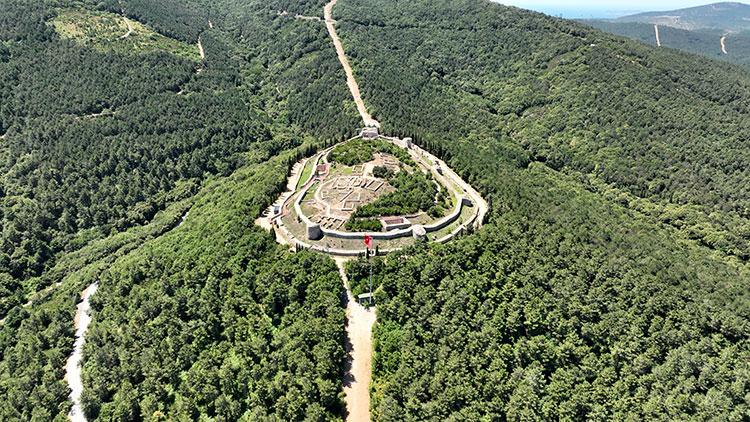
Aydos Castle (Anadolu Agency)
The castle is estimated to have been constructed between the 11th and 12th centuries during the Eastern Roman Empire. It was built to protect the borders of Constantinople and became the administrative center of the Aydos Tekfurlik.
Military activity increased in the region toward the end of the 13th century. After much of the Kocaeli Peninsula came under Ottoman control between 1326 and 1328, the border between the Byzantines and the Ottomans was established along the Aetos–Pentikion (modern-day Pendik) line. The castle’s role within the Byzantine defensive system is associated with a new defensive strategy based on major roads and river routes.
According to Âşık Paşazâde, Orhan Gazi appointed Abdurrahman Gazi, Akça Koca, and Konur Alp to lead the campaign to capture Aydos. The Ottoman forces first seized Semendra (Samandıra) Castle and then laid siege to Aydos. Early Ottoman sources recount that aid from within the castle, delivered via a letter sent by the tekfur’s daughter, combined with a night assault, contributed to the castle’s capture. After the conquest, it is noted that Abdurrahman Gazi transformed the castle into a raiding base, as its proximity to nearby settlements and transit routes made it a strategic outpost for Ottoman military operations.
Aydos Castle (Sultanbeyli Municipality)
Between 2010 and 2018, cleaning and excavation projects led by the Istanbul Archaeological Museums revealed walls, towers, staircases, gates, water systems, cisterns, a church, residential units, and grain storage facilities. In addition to Byzantine-era finds, a limited number of Ottoman and prehistoric artifacts were also recovered.
The castle has a total of twelve towers, six connected to the inner defensive wall and six to the outer defensive wall. The semi-circular towers were constructed using horasan mortar and local stone, with occasional brick usage. Tower No. I, which contains the original entrance, exhibits the Byzantine XIII–XIV century “cassette wall technique,” suggesting it may be a later addition. Parts of the tower’s staircases and traces of upper-level ledges have been preserved.
Cistern No. I, located to the north of the castle, is built with a brick-stone alternating pattern using horasan mortar; its interior surfaces were coated with waterproof plaster. Based on current conditions, its estimated capacity is approximately 300 cubic meters; water conduits have been identified at various points. The cistern to the east has a rectangular plan that narrows toward the south and has an estimated storage capacity of about 450 cubic meters. The foundations of the supporting pillars for its roof and the water conduits have been located in situ.
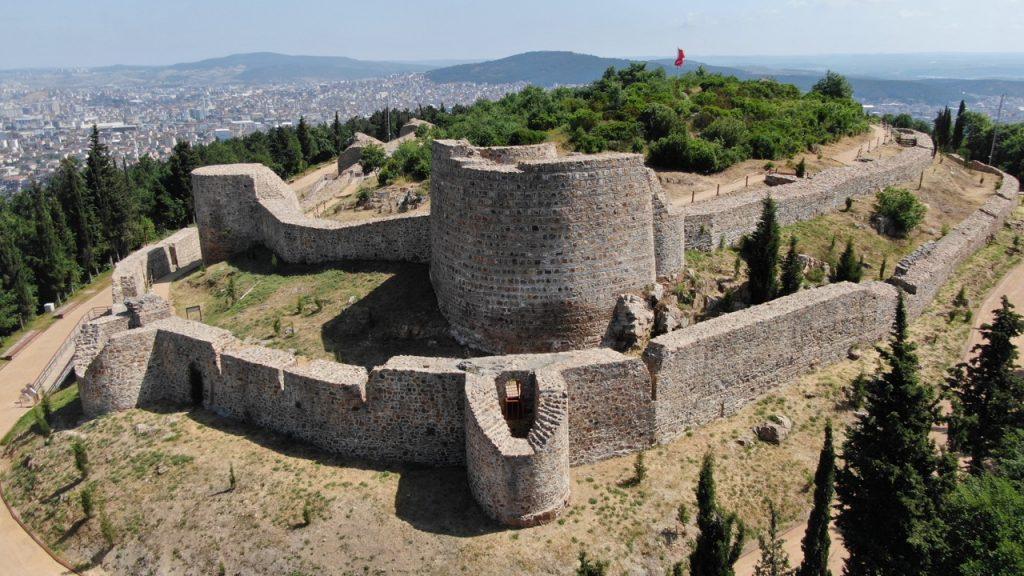
General View of Aydos Castle (Aydos Castle)
Excavations within the walls uncovered traces of a three-aisled church dating to the Middle Byzantine period. A chapel is attached to its northern side. A synthronon element has been identified in the apse. Fragments of parapet slabs and their supports (templon pillars), as well as parts of the ambon, were found in the bema area. Fresco fragments were detected on the interior surfaces of the apse, and columns, bases, and impost capitals were identified in the naos. The marble used is observed to originate from Prokonnesos (Marmara Island). Although the roof system has not been fully determined, a plausible reconstruction has been proposed based on existing data.
A structure located in the northeast, oriented north-south, measures 21.06 meters in length and 8.43 meters in width and consists of four adjacent rectangular compartments. The walls are built of rubble stone bonded with horasan mortar; door openings connecting the compartments have been identified. Carbonized remains of wheat and broad beans were found within the structure, and its layout shows similarities to Roman-era granaries. These findings suggest the building likely served as a storage or grain depot.
Restoration work at Aydos Castle began in 2010. Archaeological excavations, planning, and implementation related to the walls were completed between 2010 and 2014; the process concerning the internal architectural structures was finalized between 2015 and 2018. Landscape improvements were completed in 2022, and the site has been prepared for public visitation.
The conquest of Aydos is described in early Ottoman sources using the motif of a night assault aided by the tekfur’s daughter, who provided assistance from within. A miniature in Arifî’s “Osmannâme” depicts the tekfur’s daughter lowering her braided hair from the walls, allowing Abdurrahman Gazi to climb into the castle.
Doorway to History: Aydos Castle Documentary (Sultanbeyli Municipality)
Aydos Castle was constructed as a strategic frontier outpost within the Byzantine defensive system and acquired new military and cultural significance following its Ottoman conquest. Archaeological excavations have provided significant insights into Byzantine engineering and early settlement patterns in the region. Through restoration efforts, the castle’s original architectural elements have been revealed, establishing it as a site where historical and mythological narratives intersect. In this way, Aydos Castle stands as a tangible representation of Istanbul’s multilayered past, spanning from prehistory to the Ottoman era.
Anadolu Ajansı. “Cumhurbaşkanı Erdoğan, restorasyonu 12 yıl süren Aydos Kalesi'ni açacak”. Anadolu Ajansı, September 9, 2025. https://www.aa.com.tr/tr/gundem/cumhurbaskani-erdogan-restorasyonu-12-yil-suren-aydos-kalesini-acacak/2802953
Andı, Ömer Fatih. “Aydos Kalesi, Abdurrahman Gazi ve Rapunzel.” *Dünbilim Dergisi* 3 (2024): 68–71. Accessed October 9, 2025. https://www.academia.edu/126536507/Aydos_Kalesi_Abdurrahman_Gazi_ve_Rapunzel
Aydos Kalesi. "Fotoğraf Galerisi." Accessed October 9, 2025. https://aydoskalesi.com.tr/fotograf-galerisi/
Aydos Kalesi. "Kale Tarihi." Accessed October 9, 2025. https://aydoskalesi.com.tr/aydos-kalesi-hakkinda/
Aydos Kalesi. "Restorasyon Çalışmaları." Aydos Kalesi. Accessed October 9, 2025. https://aydoskalesi.com.tr/restorasyon-calismalari/
Sultanbeyli Kaymakamlığı. "Aydos Kalesi." Accessed October 9, 2025. http://www.sultanbeyli.gov.tr/aydos-kalesii
Sultanbeyli Municipality YouTube Channel. "Geçmişin izlerini barındıran atmosferiyle ilçemizin incisi Aydos Kalesi." YouTube, 2:36. Accessed October 9, 2025. https://www.youtube.com/watch?v=Daev2IjO0QY
Sultanbeyli Municipality YouTube Channel. "Tarihe Açılan Kapı: Aydos Kalesi Belgeseli." YouTube, 25:46. Accessed October 9, 2025. https://www.youtube.com/watch?v=mbZFrHuU5l4&t=423s
Sultanbeyli Municipality. "Aydos Kalesi." Sultanbeyli Municipality. Accessed October 9, 2025. https://www.sultanbeyli.bel.tr/proje/aydos-sosyal-tesisi/
İnalcık, Halil. “Osmanlı Sultanı Orhan, (1324-1362) Avrupa’da Yerleşme”. BELLETEN 73, no. 266 (April 2009): 77-108. Accessed October 9, 2025. https://dergipark.org.tr/en/pub/ttkbelleten/article/692269

Location | Sultanbeyli İstanbul | ||||||||
|---|---|---|---|---|---|---|---|---|---|
Area Covered | Approximately 26,000 m² | ||||||||
Restoration Date | 2010–2014 | ||||||||
Archaeological Excavations | Walls, towers, spiral staircases, gates, water systems, cisterns, church, shelter/living units, grain storage | ||||||||
Location
History
Byzantine Period
Ottoman Conquest and Aftermath
Archaeological Excavations
Architectural Structure
Walls and Towers
Cisterns
Church
Grain Storage Facility
Restoration
Literary and Mythological Context