


This article was automatically translated from the original Turkish version.
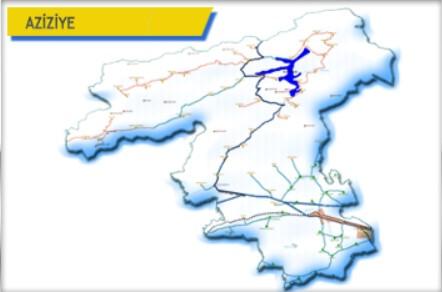
Aziziye (District)
Aziziye, Erzurum Central District
Area(s) | 1686 km² | ||||||||
|---|---|---|---|---|---|---|---|---|---|
Elevation(s) | 1812 metre | ||||||||
Establishment Date (District) | 1991 | ||||||||
Merger (Dadaşkent with Aziziye) | 2008 | ||||||||
Number of Villages in the District | 72 | ||||||||
District Governor | Muhammet TUGAY | ||||||||
Mayor(s) | Emrullah Akpunar | ||||||||
Located in the western part of Erzurum, the district of Aziziye, formerly known as Ilıca, is one of the largest districts of Erzurum with an area of approximately 1686 square kilometers. It lies at an elevation of 1812 meters above place. Ilıca, which gained district status in 1991, merged with the Dadaşkent neighborhood under Law No. 5747 on the Establishment of Districts Within Metropolitan Municipalities and adopted the name Aziziye, becoming one of Erzurum’s three center districts. The establishment of the Aziziye (Ilıca) Municipality Organization dates back to 1953. The district is also notable for its natural beauty and thermal springs.

Erzurum Ilıca (Source: Encyclopedia of Erzurum)
The earliest settlement area of Aziziye (Ilıca) lies between the fertile lands of the Karasu River and the Pulur Creek. Archaeological excavations conducted in Karaz (Kahramanlar Village) within this region have revealed that human habitation dates back to the 4000s BCE. Throughout history, Aziziye (Ilıca) came under the control of the Hurrians, Hayasa, the Kingdom of Azzi, and the Urartians (900–600 BCE), followed by invasions by the Scythians, Medes, and Persians. In 65 BCE, the region fell under the control of the Roman Empire and was used as a military camp between 1040 and 1063 CE by Ibrahim Yınal and Kutalmış, commanders of the Great Seljuk State, during their campaign to capture Erzurum. After the Battle of Manzikert, Ilıca came entirely under Turkish dominion.
Having suffered various occupations and invasions, Ilıca was captured by Russian forces under General Yudeniç during World War I. As the Russian army advanced and occupied Erzurum on 16 January 1916, it pursued the retreating Ottoman forces and seized Ilıca after intense fighting on the night of 16–17 February 1918. Russian military historian Korsun, in his work “The Erzurum Operation,” notes that “at 14:00 on 18 February, the 156th Elizavetplski Infantry Regiment’s vanguard units captured Ilıca.” Under Russian occupation, the population of Ilıca was forced to flee toward inland regions including Erzincan, Kayseri, Adana, Sivas, and Tokat like, despite the harsh conditions of the season. Many perished during this migration due to cold and starvation. The Turkish army under the command of Kazım Karabekir ended the occupation of Ilıca on 11 November 1918. In 1991, Ilıca gained district status and in 2008 merged with Dadaşkent to become Aziziye.
The district of Aziziye and its central villages are situated on the Erzurum Plain and the Daphan Plain. The Ovacık subdistrict to the north has a mountainous and rugged land structure. The total area of the district is 1686 km², with a municipal boundary area of approximately 300 km². The elevation is 1812 meters.
The significant rivers flowing through the district boundaries are as follows:
There are no natural lake within the district boundaries. However, a reservoir has been constructed near the Kuzgun Dam Lake and the Merkez Söğütlü village for irrigation purposes.
Aziziye district shares similar climatic characteristics with Erzurum province due to its proximity. It lies under the influence of a continental climate, with generally hot and dry summers and cold, snow snowy winters. Annual average temperatures are low. During winter months, temperatures frequently drop below zero and snow cover may remain permanent. Spring and autumn seasons are mild transitional periods.
As of 2024, the population of Aziziye district is 70,032, of which 37,660 are male and 32,372 are female. Males constitute 53.78% of the population and females 46.22%. The district’s population shows fluctuations within time due to factors such as migration from rural areas to the center and natural population growth.
The economy of Aziziye district is based on agriculture, animal husbandry, and especially thermal tourism. Agricultural activities are carried out in parts of the Erzurum Plain, with crops such as wheat and barley being cultivated. Animal husbandry is also a vital source of livelihood for the local population.
However, the district’s most significant economic potential lies in its thermal springs. The Aziziye (Ilıca) Thermal Springs are among Turkey’s leading thermal tourism centers. The thermal hotel facilities operated by the Aziziye Municipality make important contributions to regional and country tourism. Additionally, efforts are underway to enhance the potential for nature tourism by improving the surroundings of the Pulur Creek. The aim is to complement the success of Erzurum’s winter tourism centered on Palandöken with thermal tourism in Aziziye. Ongoing work seeks to increase the contribution of the district’s geothermal resources to the local and provincial economy.

Aziziye apartment hotels (Source: Aziziye Municipality)
Located approximately 18 km from the center of Erzurum, the Aziziye (Ilıca) Thermal Springs have undergone periodic maintenance since 1964 and were comprehensively renovated in 2005 to become a modern thermal facility facility. The complex includes an 86 bed capacity boutique hotel and 14 family cabins, offering three separate sections for men, women, and groups, along with sauna, Turkish bath, Finnish bath, a physiotherapy center, sports salon, and cafeteria. These facilities, managed by the Aziziye Municipality, have established themselves among Turkey’s prominent thermal tourism brands.
The waters of the Ilıca thermal springs are internationally renowned for their mineral content. The thermal waters have a total mineralization of 3535.8 mg/l, containing 4 mg/l fluoride, sodium, and bicarbonate. The outlet water temperature is 39.4 °C with a hardness of 38 French degrees. The water is clear in appearance, slightly yellow in color, odorless, and low in sediment. It is believed that these thermal waters have beneficial effects on disorders of the stomach, intestines, liver, gallbladder, nutrition, and rheumatic diseases.
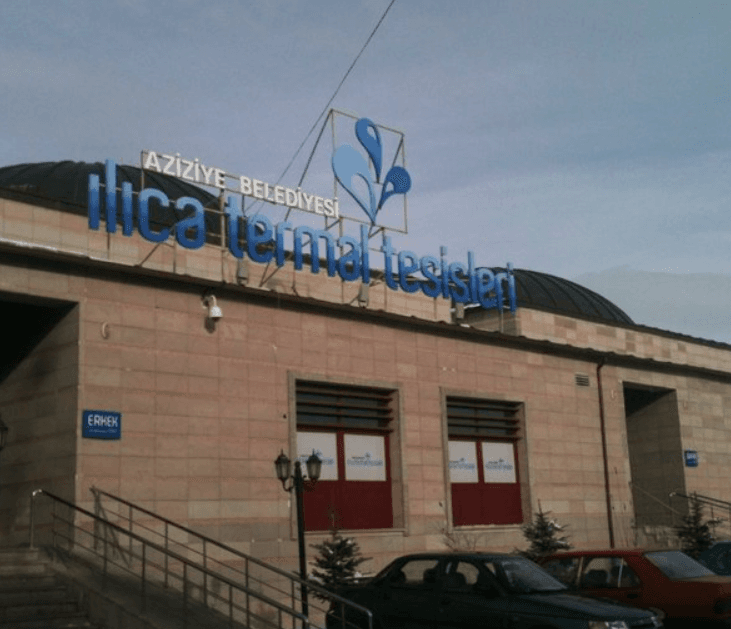
Aziziye Ilıca thermal facilities (Source: Aziziye district governorship)
Aziziye (Ilıca) District -Erzurum Ansiklopedi. Accessed April 17, 2025. http://erzurumansiklopedi.com/aziziye-ilica-ilcesi/
Aziziye - Kültür Portalı. Accessed April 17, 2025. https://erzurum.ktb.gov.tr/TR-56055/aziziye.html
Aziziye Belediyesi. "Aziziye'nin Yeni Apart Oteli Göz Kırpıyor." Accessed April 17, 2025. https://www.aziziye.bel.tr/haber/aziziye-nin-yeni-apart-oteli-göz-kırpıyor.html
Aziziye Belediyesi. Accessed April 17, 2025. https://www.aziziye.bel.tr/
Aziziye Kaymakamlığı. "Termal." Accessed April 17, 2025. http://www.aziziye.gov.tr/termal
Aziziye Kaymakamlığı. Accessed April 17, 2025. http://www.aziziye.gov.tr/
Aziziye Kaymakamlığı. “İlçemizin Tarihi.” Accessed April 17, 2025. http://www.aziziye.gov.tr/ilcemizintarihi
Erzurum Büyükşehir Municipality. "Aziziye." Accessed April 17, 2025. https://www.erzurum.bel.tr/AltIcerikDetay/1044/I/1006.html
Kuzeydoğu Anadolu Kalkınma Ajansı. “Aziziye'de Termal Turizm Gelişiyor.” Accessed April 17, 2025. https://kudaka.gov.tr/haber/aziziye-de-termal-turizm-gelisiyor/576
T.C. Erzurum Valiliği. Accessed April 17, 2025. http://www.erzurum.gov.tr/aziziye
Türkiye İstatistik Institute (TÜİK). Accessed April 17, 2025. https://www.tuik.gov.tr/

Aziziye (District)
Aziziye, Erzurum Central District
Area(s) | 1686 km² | ||||||||
|---|---|---|---|---|---|---|---|---|---|
Elevation(s) | 1812 metre | ||||||||
Establishment Date (District) | 1991 | ||||||||
Merger (Dadaşkent with Aziziye) | 2008 | ||||||||
Number of Villages in the District | 72 | ||||||||
District Governor | Muhammet TUGAY | ||||||||
Mayor(s) | Emrullah Akpunar | ||||||||
History
Geography
Climate
Population – Demographics
Economy
Tourism – Culture – Cuisine
Aziziye (Ilıca) Thermal Springs