

This article was automatically translated from the original Turkish version.
Location | between the African continent and the Arabian Peninsula | ||||||||
|---|---|---|---|---|---|---|---|---|---|
Commercial Importance | route used in the Europe–Asia maritime trade route | ||||||||
Physical Characteristics | its narrowest point is approximately 30 km, with two main passage channels due to Perim (Meyyun) Island | ||||||||
Coastal Regions | to the east Yemen, to the west Djibouti and Eritrea | ||||||||
Seas It Connects | Indian Ocean via the Red Sea and the Gulf of Aden | ||||||||
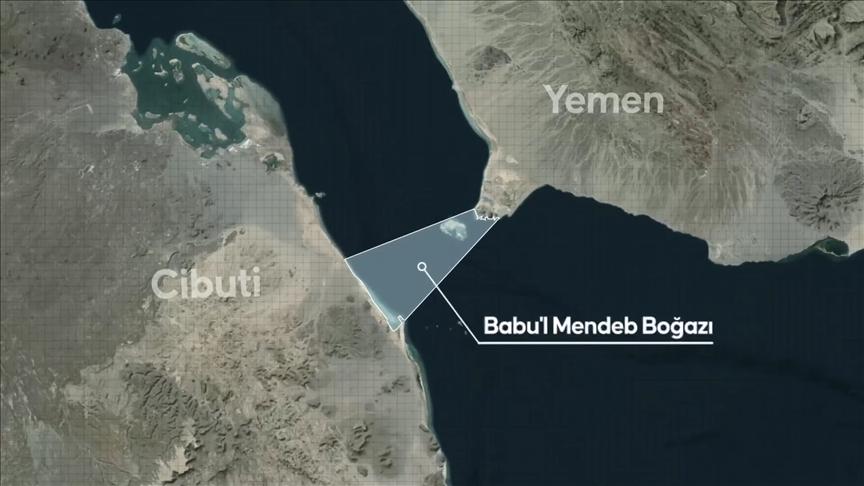
Babü'l Mendeb Strait is a waterway located between the African continent and the Arabian Peninsula, connecting the Red Sea to the Indian Ocean via the Gulf of Aden. It extends between Yemen to the east and the coasts of Djibouti and Eritrea to the west. The narrowest point of the strait is approximately 30 kilometers wide and is divided into two main navigation channels due to the presence of Perim (Meyyun) Island in its center. The eastern channel is narrower and shallower, while the western channel is wider and deeper, with the majority of maritime traffic passing through the latter. The term “Babü'l Mendeb” is of Arabic origin and means “Gate of Tears,” historically associated with the hazardous sea conditions in the region.
The Babü'l Mendeb Strait is a strategic waterway situated between the African continent and the Arabian Peninsula, linking the Red Sea to the Indian Ocean via the Gulf of Aden. To the east it lies between Yemen and to the west between the coasts of Djibouti and Eritrea.
The narrowest point of the strait is approximately 30 kilometers wide and is divided into two main navigation channels due to the presence of Perim (Meyyun) Island in its center. The eastern channel is narrower and shallower, while the western channel is wider and deeper, with the majority of international maritime traffic passing through the western channel.
The term “Babü'l Mendeb” is of Arabic origin and means “Gate of Tears.” This name is said to be linked to the dangerous maritime conditions, accidents, and loss of life that have occurred in the region throughout history.
The Babü'l Mendeb Strait is one of the key transit points in global maritime trade. It forms the southern entrance to the trade route that connects to the Mediterranean Sea via the Suez Canal and plays a crucial role in maintaining the continuity of sea transport between Europe and Asia.
A significant portion of global trade, particularly container shipping and energy shipments, passes through this route. Consequently, any disruption in the strait can lead to delays in trade flows, diversion to alternative routes, and increased costs.
The Cape of Good Hope route around southern Africa, as an alternative, is considered less advantageous in terms of both distance and cost, making the continued openness of Babü'l Mendeb vital for international trade.
The Babü'l Mendeb Strait is a strategic chokepoint for global energy transportation. A significant portion of oil and liquefied natural gas originating from the Persian Gulf reaches European and North American markets through this passage.
Some analyses【1】 indicate that this strait is among the most heavily used transit points in global oil transportation and that any interruption could cause significant fluctuations in energy markets.
If the strait were to close or become at risk, tankers would be forced to reroute around southern Africa, which would extend transit times and increase global energy prices.
The Babü'l Mendeb Strait holds a critical position not only economically but also militarily and geopolitically. Control over the strait means control over access to and from the Red Sea.
This situation has turned the region into a strategic arena of competition among global powers. Various international actors, led by the United States, maintain military presence in the region to ensure the security of maritime trade.
The prolonged civil war in Yemen and the presence of armed actors in the region directly impact the security of the strait. In particular, the capacity of the Houthis in Yemen to threaten maritime traffic is regarded as a significant risk factor for international shipping.

Babü'l Mendeb Strait. (Anadolu Ajansı)
Throughout history, the Babü'l Mendeb Strait has been not only a route for merchant vessels but also a key corridor for migration. Irregular migration flows from the Horn of Africa to Yemen have linked the strait to humanitarian crises.
These crossings are often made on rudimentary vessels under dangerous conditions, frequently resulting in loss of life. This underscores the continued relevance of the strait’s name, “Gate of Tears,” in the modern era.
The risks faced by migrants are recognized by international organizations and human rights groups as a regional humanitarian issue.
In 2026, amid escalating conflicts between Iran, the United States, and Israel, the Babü'l Mendeb Strait has once again become a central focus of global attention.
The possibility of Iranian-linked actors and the Houthis in Yemen closing the strait or disrupting maritime traffic has raised serious concerns in the international community. In this context, assessments have been made that the strait could become the second major chokepoint in global oil supply after the Strait of Hormuz.
As tensions in the region intensify, the possibility of commercial vessels altering their routes for security reasons has come to the fore, with concerns raised about the potential pressure this could exert on global logistics chains.
International actors emphasize the critical importance of keeping the strait open for the continuity of global trade and note that various military and diplomatic measures are being considered to ensure maritime security.
In recent times (2026), increased military activity around Babü'l Mendeb has brought the strait’s security risks into sharper focus. Threats to maritime trade, carried out using unmanned aerial vehicles and missile systems, have elevated the risk level in the region.
In this context, the security of the strait is regarded not merely as a regional but as a global issue. Assessments indicate that enhanced international cooperation and increased maritime security operations are necessary to ensure the continued openness of sea lanes.
ABC News (Australia). “Gate of Tears at Risk of Becoming Second Major Oil Bottleneck.” Accessed March 30, 2026. https://www.abc.net.au/news/2026-03-29/gate-of-tears-at-risk-of-becoming-second-major-oil-bottleneck/106508316
Al Jazeera. “A Yemeni’s Harrowing Journey Through the Gate of Tears.” Accessed March 30, 2026. https://www.aljazeera.com/features/2018/3/14/a-yemenis-harrowing-journey-through-the-gate-of-tears
Al Jazeera. “Houthis Open New Front in Iran War: Will Yemeni Group Block Bab al-Mandeb?” Accessed March 30, 2026. https://www.aljazeera.com/news/2026/3/29/houthis-open-new-front-in-iran-war-will-yemeni-group-block-bab-al-mandeb
Anadolu Ajansı. “Bab al-Mandeb Strait Faces Disruption Risk as Iran War Escalates.” Accessed March 30, 2026. https://www.aa.com.tr/en/middle-east/bab-al-mandeb-strait-faces-disruption-risk-as-iran-war-escalates/3884128
MEP Institute. “The Geopolitical Importance of Bab el-Mandeb Strait: A Strategic Gateway to Global Trade.” Accessed March 30, 2026. https://mepei.com/the-geopolitical-importance-of-bab-el-mandeb-strait-a-strategic-gateway-to-global-trade/
Middle East Monitor. “Closure of Bab al-Mandeb Likely Amid Iran-US War: Houthi Official.” Accessed March 30, 2026. https://www.middleeastmonitor.com/20260329-closure-of-bab-al-mandeb-likely-amid-iran-us-war-houthi-official/
New York Post. “Iran Threatens to Take Control of Strategic Bab al-Mandeb Strait.” Accessed March 30, 2026. https://nypost.com/2026/03/25/world-news/iran-threatens-to-take-control-of-strategic-bab-al-mandeb-strait-if-us-invades-kharg-island/
The Sunday Guardian. "Why Bab el-Mandeb Strait Matters." Accessed March 30, 2026. https://sundayguardianlive.com/world/why-bab-el-mandeb-strait-matters-iran-threats-possible-blockage-of-worlds-4th-largest-oil-route-after-strait-of-hormuz-if-us-escalates-strikes-know-distance-length-width-who-controls-this-strait-179264/
[1]
ABC News (Australia), “Gate of Tears at Risk of Becoming Second Major Oil Bottleneck,” last accessed: 31 March 2026, https://www.abc.net.au/news/2026-03-29/gate-of-tears-at-risk-of-becoming-second-major-oil-bottleneck/106508316


Location | between the African continent and the Arabian Peninsula | ||||||||
|---|---|---|---|---|---|---|---|---|---|
Commercial Importance | route used in the Europe–Asia maritime trade route | ||||||||
Physical Characteristics | its narrowest point is approximately 30 km, with two main passage channels due to Perim (Meyyun) Island | ||||||||
Coastal Regions | to the east Yemen, to the west Djibouti and Eritrea | ||||||||
Seas It Connects | Indian Ocean via the Red Sea and the Gulf of Aden | ||||||||
No Discussion Added Yet
Start discussion for "Bab el-Mandeb Strait" article
Geographical Location and Physical Characteristics
Role in the Global Trade System
Importance for Energy Supply Security
Geopolitical and Military Significance
Historical and Humanitarian Dimensions
Babü'l Mendeb in the Context of the 2026 Iran–United States–Israel Tensions
Security Risks and Current Dynamics