
This article was automatically translated from the original Turkish version.
Origin(s) | Türkiye | ||||||||
|---|---|---|---|---|---|---|---|---|---|
Developer(s) | Baykar Technology | ||||||||
Development Start Date | 2021 | ||||||||
First Flight Date | 14 December 2022 | ||||||||
First Formation Flights | Bayraktar AKINCI UCAV / TEKNOFEST 2023, F-16, SOLOTÜRK and Turkish Stars / 1 May 2023 | ||||||||
Serial Production Year | 2025 | ||||||||
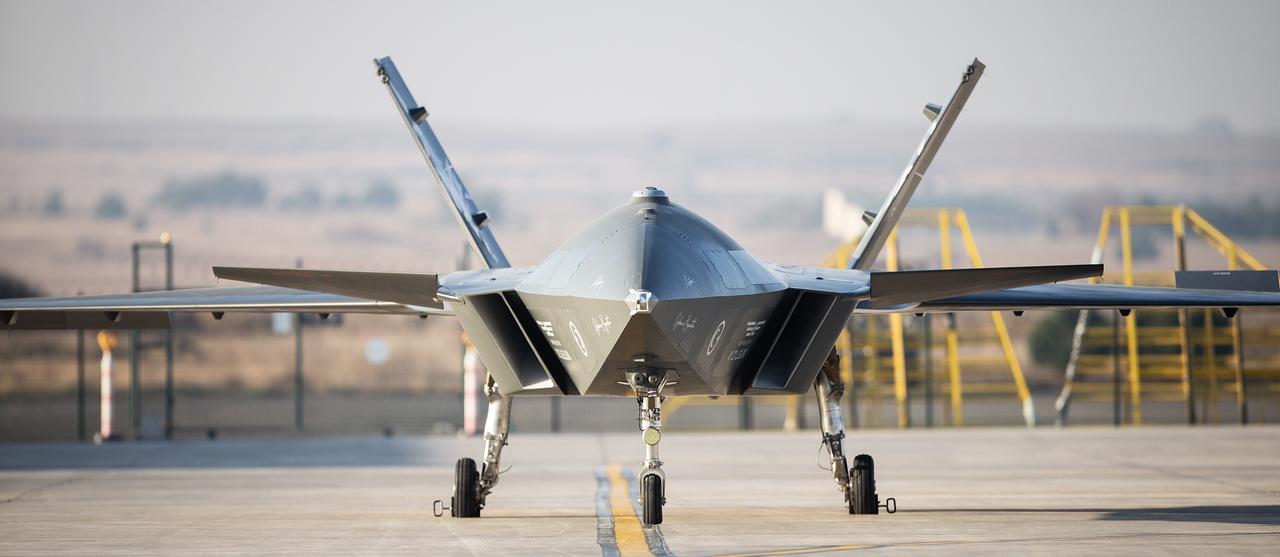
Bayraktar KIZILELMA is Türkiye’s first indigenous combat unmanned aerial vehicle (UCAV) project, currently under development by Baykar Teknoloji. It features a turbofan engine, low radar cross-section, and the capability to conduct air-to-air combat missions. Bayraktar KIZILELMA is regarded as one of the most critical defense industry projects in Türkiye, developed entirely with domestic and national resources.
The first flight of Bayraktar KIZILELMA was conducted on 14 December 2022. Three variants are planned: subsonic (below Mach 1), transonic (at Mach 1), and supersonic (above Mach 1). The Bayraktar KIZILELMA (MİUS) will be capable of operating from short-runway ships and will be able to strike designated targets using internally carried munitions.
On 26 September 2024, the production prototype of Bayraktar KIZILELMA was completed and entered advanced testing phases. Development continues, with various operational evaluations planned for the future.
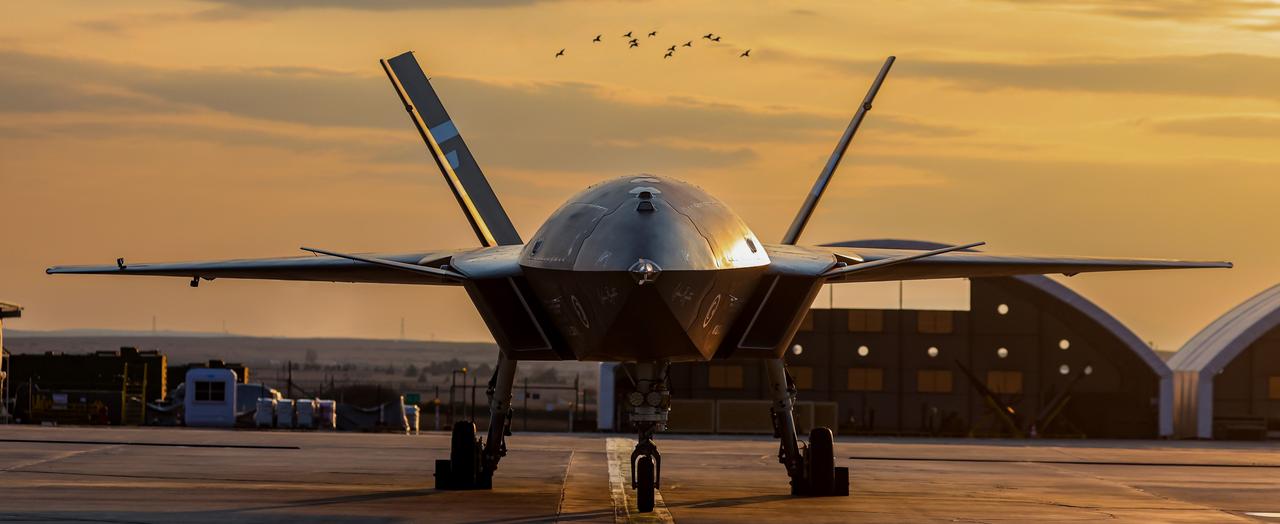
Bayraktar KIZILELMA (Baykar)
The conceptual design phase of the Muharip İnsansız Uçak Sistemi (MİUS) project, initiated with Baykar’s own capital, was first announced on 20 July 2021.【1】 On 12 March 2022, the first prototype of the Muharip İnsansız Uçak Sistemi (MİUS) entered the integration line and was officially introduced to the public under the name “KIZILELMA.”【2】 Bayraktar KIZILELMA conducted its first flight on 14 December 2022.【3】
System identification, low, medium, and high-altitude flights, high-speed maneuvers, and serial takeoff and landing tests were completed using the initial prototypes. On 20 April 2023, during its eighth test flight, Bayraktar KIZILELMA successfully executed high-speed flight and maneuver trials along with serial takeoff and landing tests.【4】 Bayraktar KIZILELMA completed its medium-altitude system identification test on 31 March 2023 and its high-altitude test flight on 16 June 2023.
During TEKNOFEST 2023, Bayraktar KIZILELMA conducted multiple flights alongside manned and unmanned platforms. As part of this, on 24 April for the first time, Bayraktar KIZILELMA performed a close formation flight with the Bayraktar AKINCI UCAV during a test flight in Çorlu.【5】 This flight, the first-ever close formation flight between two unmanned combat aircraft, entered aviation history. Throughout TEKNOFEST 2023, Bayraktar KIZILELMA also performed close formation flights daily with Bayraktar AKINCI and SoloTürk.
On the final day of TEKNOFEST 2023, 1 May, Bayraktar KIZILELMA executed, for the first time, a formation flight in a flight group concept with the F-16 fighter jet SoloTürk and the Turkish Stars, composed of F-5 jet aircraft.【6】
These flights were part of demonstrations involving coordinated operations between unmanned aerial vehicles and manned fighter jets.
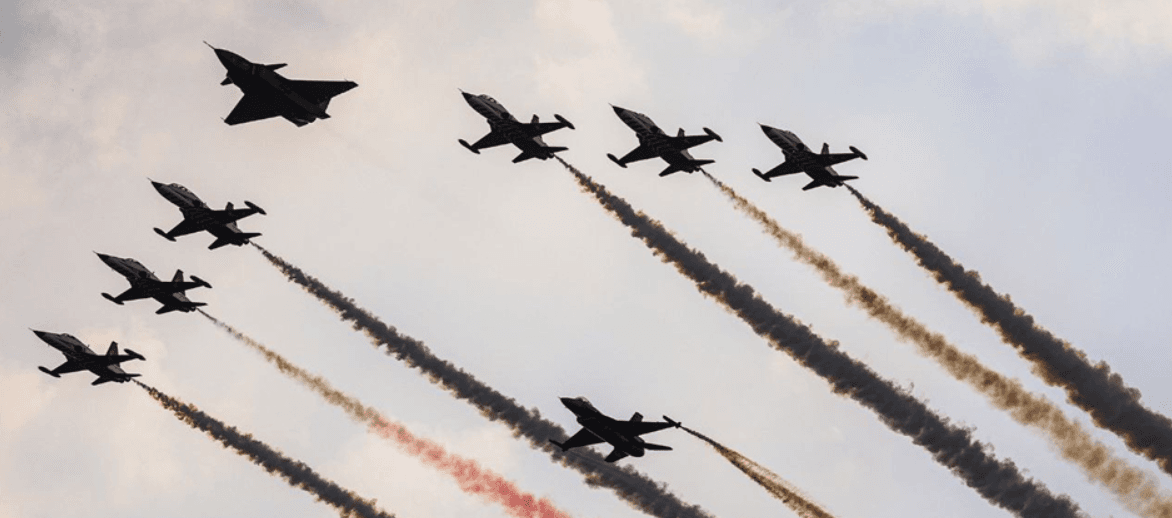
Bayraktar KIZILELMA, F-16 Savaş Jeti SoloTürk ve F-5 Jet Uçaklarından Oluşan Türk Yıldızlarının Gerçekleştirdiği İlk Defa Filo Konseptiyle İcra Edilen Formasyon Uçuşundan Bir Görüntü (Baykar)
The first afterburner engine ignition test of the Bayraktar KIZILELMA PT-3 production prototype was conducted in July 2024, and its first flight test was successfully completed on 25 September 2024.【7】 Based on data collected from the initial prototypes, significant modifications were made to the production prototype. Structural reinforcements were implemented in the airframe, and avionics systems were upgraded.
The integrated afterburner engine option was successfully tested during the development process.【8】 This engine configuration enabled Bayraktar KIZILELMA to approach Mach 1 speed and, thanks to its enhanced aerodynamic design, perform agile maneuvers at high velocities.
The Active Electronically Scanned Array (AESA) radar integrated into the production aircraft enhances situational awareness with a wide coverage area and high sensitivity. This advanced radar system will enable Bayraktar KIZILELMA to operate effectively in both air-to-air and air-to-ground missions across diverse operational scenarios.
Bayraktar KIZILELMA Üretim Prototipi İlk Uçuşu - (Baykar)
Bayraktar KIZILELMA successfully completed the Aircraft Carrier Takeoff and Maneuver System Definition Test on 15 March 2025, as scheduled.【9】 The production prototype, tail number TC-OZB3 PT3, took off from the AKINCI Flight Training and Test Center in Çorlu, Tekirdağ, using afterburner and successfully completed all system definition tasks and sharp maneuvers during the test flight.
Based on lessons learned from the initial prototypes, significant improvements were made to the production prototype. Structural enhancements were implemented alongside upgrades to the avionics architecture. The flight was successfully conducted with the integrated afterburner engine option.
Türkiye’s first indigenous combat unmanned aerial vehicle, Bayraktar KIZILELMA successfully completed its first munitions release test under its test program using TOLUN and TEBER-82 munitions. The tests were conducted on 8 October 2025 at the AKINCI Flight Training and Test Center in Çorlu, Tekirdağ.
The third prototype, PT-3, conducted two separate sorties during the test. In the first flight, the TOLUN munition developed by ASELSAN was fired and achieved a direct hit on the target. In the second sortie, the ROKETSAN-produced TEBER-82 Winged Guidance Kit was employed, and the target was successfully destroyed.
Bayraktar KIZILELMA PT-3 İlk Mühimmat Atış Testi - (Baykar)
On 17 November 2025, as part of its test program, Bayraktar KIZILELMA successfully integrated for the first time on an unmanned combat aircraft platform the locally developed, low-observable TOYGUN Electro-Optical Targeting System (EOTS), originally designed for fifth-generation manned fighter jets. With this system, Bayraktar KIZILELMA will be able to penetrate enemy airspace undetected by radar while preserving its low observability, detect and laser-designate targets, and conduct strikes using national munitions. With the first-ever integration of an internal EOTS architecture—previously seen only on fifth-generation fighter jets—Türkiye has joined the small group of nations possessing this capability.
TOYGUN is optimized for the unmanned combat concept. The system provides functions including wide-spectrum scanning for 360° situational awareness, high-resolution infrared imaging, long-range strategic target detection, and tracking of moving ground and maritime targets. Its autonomous capabilities are further enhanced by artificial intelligence-supported target tracking and automated target classification algorithms.
During two flight tests conducted at the AKINCI Flight Training and Test Center in Çorlu, the system’s performance in high-altitude and high-speed stable imaging, tracking of moving targets, and laser designation was verified. It was confirmed that the TOYGUN system operates seamlessly with KIZILELMA’s mission computer, maintains reliable data exchange under harsh environmental conditions, and meets all technical criteria for serial integration.
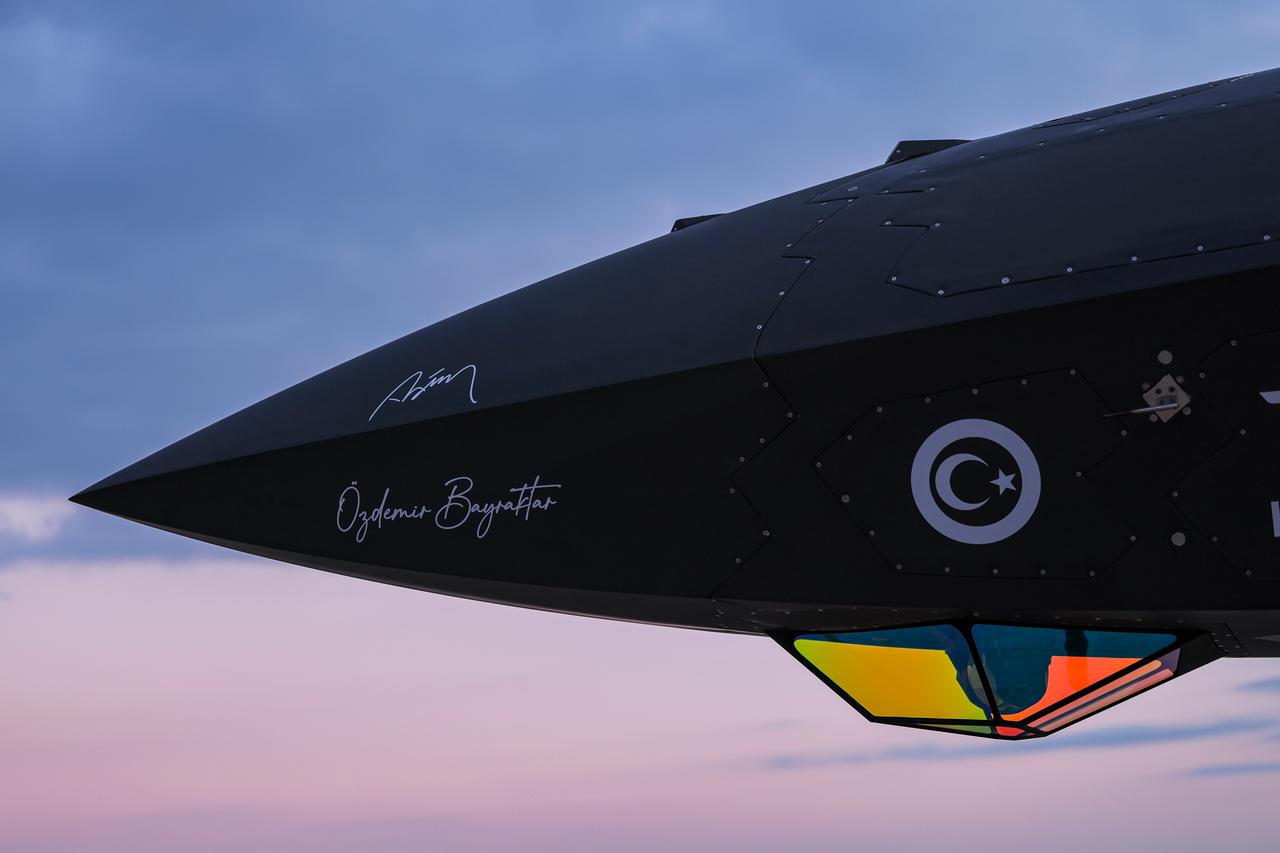
Bayraktar KIZILELMA'nın Gövde İçine Gömülü Toygun Elektro Optik Hedefleme Sistemi Entegrasyonu Gerçekleşti (Baykar)
As part of its ongoing test activities, Bayraktar KIZILELMA conducted flights with new-generation domestic payloads and munitions. The PT-5 prototype carried the GÖKDOĞAN beyond-visual-range air-to-air missile, the low-observable electro-optical targeting system TOYGUN, and the MURAD 100-A AESA radar.
During the flight with tail number TC-ÖZB5, Bayraktar KIZILELMA remained airborne for approximately one hour, executed various maneuvers, and successfully completed the test. The integration of the GÖKDOĞAN missile—with a range exceeding 65 km, an active radar seeker, and a high-explosive warhead—marks a significant step toward enabling the aircraft’s air-to-air engagement capability. This flight test also validated the platform’s sensor-munition integration, demonstrating the ASELSAN TOYGUN electro-optical targeting system’s (EOTS) ability to provide long-range detection and AI-assisted tracking through its internal architecture, and the MURAD 100-A AESA radar’s capabilities in electronic guidance and multi-target tracking.
On 20 November 2025, during a test flight, Bayraktar KIZILELMA executed an F-16 formation flight, MURAD AESA radar operations, and a simulated GÖKDOĞAN missile launch. The test included: evaluating coordination between manned and unmanned platforms during formation flight; assessing aerodynamic and avionics compatibility with the GÖKDOĞAN missile carried externally; and simultaneously testing the MURAD AESA radar’s detection, tracking, lock-on, and data transfer functions.
Two Turkish Air Force F-16 fighter jets participated in the test. One F-16 flew in close formation with Bayraktar KIZILELMA, while the other acted as the “target aircraft.” During the test, Bayraktar KIZILELMA, using its ASELSAN MURAD AESA radar, detected the F-16 target at a distance of 30 nautical miles and locked onto it. Subsequently, a simulated launch was conducted using the TÜBİTAK SAGE-developed GÖKDOĞAN Beyond-Visual-Range Air-to-Air Missile mounted under its wings. In the simulation, the target F-16 was successfully neutralized with a virtual hit.
Another key element of the test was validating the data-link infrastructure between the aircraft, radar, and munition. After locking onto the target, Bayraktar KIZILELMA continuously transmitted real-time target, position, and velocity data from the MURAD AESA radar to the GÖKDOĞAN missile. This confirmation demonstrates the platform’s operational beyond-visual-range (BVR) targeting data chain.
Bayraktar KIZILELMA conducted a flight lasting one hour and 45 minutes at an average altitude of 15,000 feet. The total flight time accumulated under its test program has exceeded 55 hours.
Bayraktar KIZILELMA F-16 Kol Uçuşu, GÖKDOĞAN Mühimmatı Bağlı Uçuş ve Murad AESA Radar Performans Testi - (Selçuk Bayraktar Resmi Youtube Kanalı)
On 29 November 2025, during a test over the Sinop coast, Bayraktar KIZILELMA successfully engaged and destroyed a jet-powered target using the ASELSAN MURAD AESA radar to detect the target and the TÜBİTAK SAGE-developed GÖKDOĞAN beyond-visual-range air-to-air missile to achieve a direct hit. This marked the first successful test in history where an unmanned combat aircraft destroyed a jet-powered target with an air-to-air missile.
F-16 fighter jets launched from the 5th Main Jet Base in Merzifon performed formation flights with KIZILELMA, while Bayraktar AKINCI provided surveillance support. During the engagement, the Commander of the Turkish Air Force, General Ziya Cemal Kadıoğlu; the Commander of the Combat Air Forces, General Rafet Dalkıran; ASELSAN’s General Manager Ahmet Akyol; and Baykar’s Board Chairman Selçuk Bayraktar observed the test from inside F-16 cockpits. The Director of the TÜBİTAK SAGE Institute, Kemal Topalömer, and ROKETSAN’s General Manager Murat İkinci were part of the monitoring team.
Critical mission systems including the MURAD AESA radar and TOYGUN electro-optical system have been successfully integrated onto KIZILELMA. With the successful GÖKDOĞAN missile test following earlier TOLUN and TEBER-82 tests, the platform’s air-to-air engagement capability has been confirmed. Baykar’s export data continues to strengthen its position in the global unmanned aerial vehicle market.
This historic test has revealed how future air combat concepts will evolve. Following the proven effectiveness of the Bayraktar TB2 in air-to-ground missions, Bayraktar KIZILELMA is now extending this impact to air-to-air operations. Thanks to its low radar cross-section and advanced sensors, KIZILELMA can detect enemy assets at much greater distances without being detected. This “see without being seen, strike without being struck” concept demonstrates that the platform is designed to achieve air superiority in aerial combat.
Bayraktar KIZILELMA Gökdoğan Füzesi Atış Testi (Baykar)
The Bayraktar KIZILELMA unmanned combat aircraft successfully completed a test flight for its intelligent swarm autonomy capability. Announced on 28 December 2025, the test involved two Bayraktar KIZILELMA prototypes operating simultaneously in the sky from the AKINCI Flight Training and Test Center in Çorlu.
During the test, the third prototype (PT3) and the fifth prototype (PT5) took off consecutively. The two unmanned combat aircraft, guided by intelligent swarm autonomy algorithms developed by Baykar, flew in coordinated formation, executing autonomous close formation flight as if controlled by an autonomous combat pilot. Thus, for the first time in aviation history, two unmanned combat aircraft performed autonomous close formation flight. This technological advancement transfers complex manned fighter jet missions to autonomous systems. This capability enables multiple unmanned platforms to operate under a single leader, autonomously adjusting their positions relative to each other to execute joint missions.
The flight test also evaluated one of the fundamental elements of modern air combat: the CAP (Combat Air Patrol) mission. The Bayraktar KIZILELMA prototypes conducted patrol flights along a predefined route under the guidance of swarm autonomy software. This confirmed the feasibility of conducting air defense missions using national unmanned combat aircraft in formation. In the future, patrol and interception missions traditionally performed by fighter jets to protect specific areas will be autonomously carried out by Bayraktar KIZILELMA formations.
Bayraktar KIZILELMA Otonom Yakın Kol Uçuşu Testi (Baykar)
Bayraktar KIZILELMA Basic Flight Performance Criteria Table (Baykar)
Designed as Türkiye’s first indigenous combat unmanned aerial vehicle, Bayraktar KIZILELMA can carry various payloads tailored to different mission types. These payloads have been developed to enhance mission flexibility and operational effectiveness. Bayraktar KIZILELMA has a total payload capacity of 1,500 kg. These payloads can be categorized into three main types: targeting, passive surveillance and search, AESA radar, electronic warfare and countermeasure systems, and munitions.
Bayraktar KIZILELMA’s cruise and maximum speed levels make it suitable for air-to-air combat. Thanks to its high speed and low radar cross-section, it can gain a tactical advantage against enemy air assets. Bayraktar KIZILELMA can perform missions such as interception of fast-moving threats or emergency close air support. Unlike conventional unmanned aerial vehicles, Bayraktar KIZILELMA can execute aggressive maneuvers like manned fighter jets and effectively engage aerial targets using indigenous air-to-air munitions.
Bayraktar KIZILELMA has been designed to operate from short-runway ships. This capability, developed to be compatible with platforms such as the TCG Anadolu currently undergoing sea trials, will significantly enhance its utility in overseas operations and expand its operational flexibility.
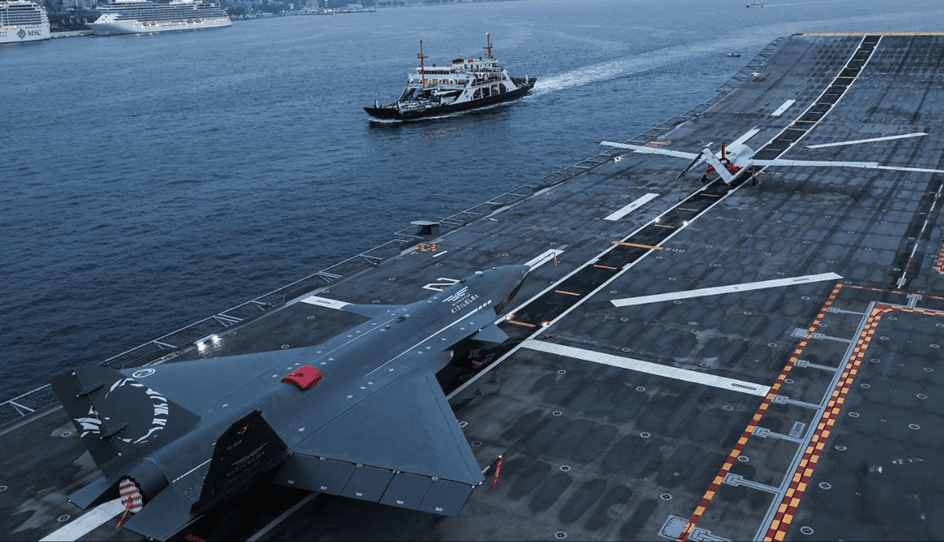
Bayraktar KIZILELMA'nın Kısa Pistli Gemilerden İniş-Kalkış Yapması Planlanıyor (Baykar)
Bayraktar KIZILELMA is an unmanned combat aircraft designed to enhance air power flexibility and effectiveness through artificial intelligence, swarm technology, and autonomous systems. These capabilities position it as a deterrent force in the airspace.
One of Bayraktar KIZILELMA’s most significant advanced features is its ability to operate alongside manned platforms to create a hybrid combat concept. The formation flight conducted on 1 May 2023 with the F-16, SoloTürk, and Turkish Stars was a major milestone demonstrating the feasibility of this concept.
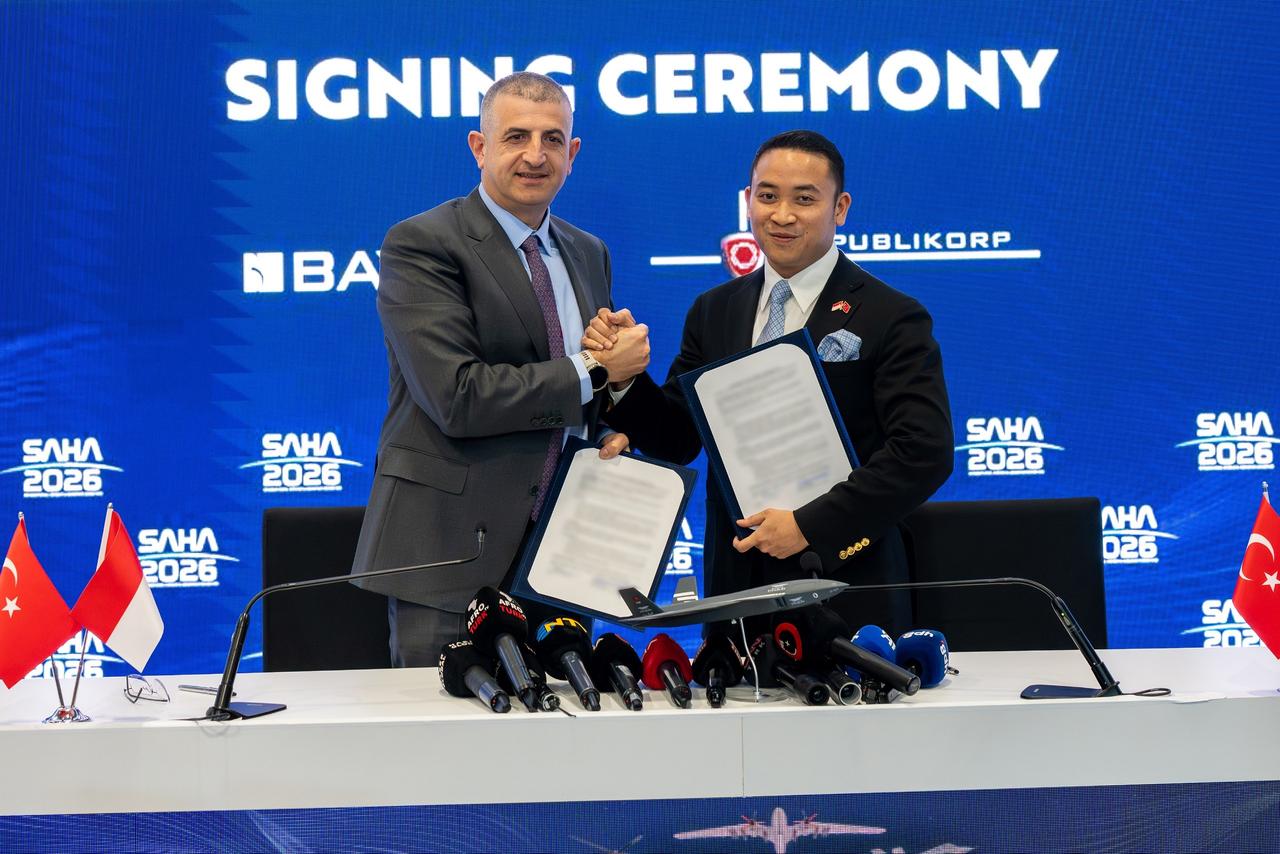
Baykar ile Endonezya merkezli PT Republik Aero Dirgantara (Republikorp) arasında Bayraktar KIZILELMA İnsansız Savaş Uçağı Çerçeve Anlaşması imzalanıyor, 6 Mayıs 2026 - (Baykar)
The first export framework agreement for the Bayraktar KIZILELMA unmanned combat aircraft was signed on 6 May 2026 between Baykar and Indonesia-based PT Republik Aero Dirgantara (Republikorp). The agreement was announced during a signing ceremony held at the SAHA 2026 International Defense, Aerospace and Space Industry Fair in Istanbul Fair Center.
Speaking at the fair, Haluk Bayraktar, Chairman of the SAHA Istanbul Board and General Manager of Baykar, stated that they had signed a historic agreement on behalf of Baykar. Highlighting that the Bayraktar TB2 is the most exported UAV system in its category, Bayraktar said: “Bayraktar KIZILELMA, the world’s first indigenous combat UCAV technology, made its first flight in 2022. Since then, intensive flight activities have continued. Last year, serial production activities were completed, and our goal this year is to deliver Bayraktar KIZILELMA to our national forces.”
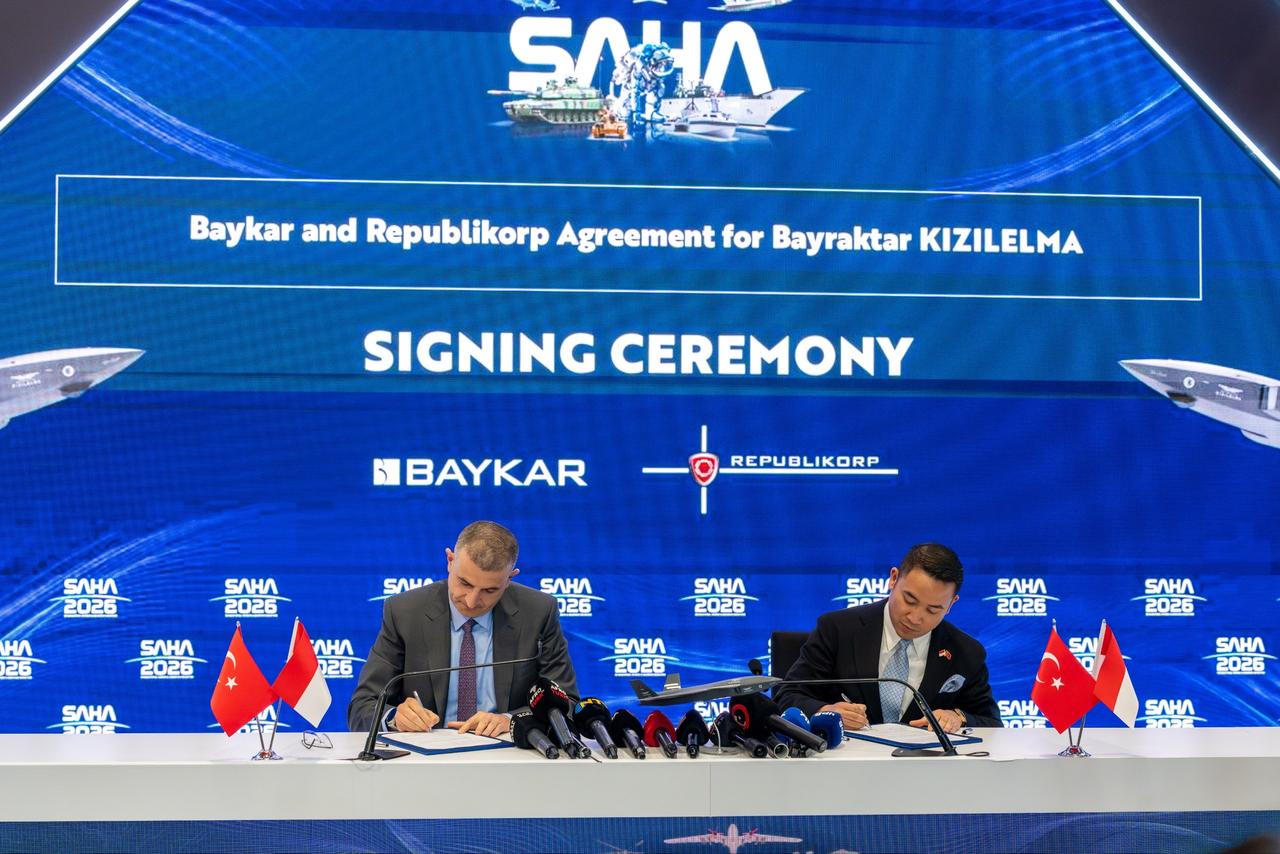
Baykar ile Endonezya merkezli PT Republik Aero Dirgantara (Republikorp) arasında Bayraktar KIZILELMA İnsansız Savaş Uçağı Çerçeve Anlaşması imzalanıyor, 6 Mayıs 2026 - (Baykar)
Emphasizing the historic significance of the agreement, Bayraktar continued: “For the first time, we have signed an export agreement for Bayraktar KIZILELMA. Therefore, we are proud on behalf of our country and our sister nation Indonesia. Through this agreement, our goal is to deliver a fleet of 12 Bayraktar KIZILELMA aircraft starting in 2028. Additionally, this agreement includes an optional provision for four additional fleets, totaling 48 aircraft.
This agreement covers not only the supply of systems but also the establishment of a local maintenance and production center in Indonesia. As you know, last year we signed contracts for Bayraktar AKINCI and Bayraktar TB2 with Indonesia. This makes KIZILELMA our third product type.
Norman Joesoef, Group Chairman of Republikorp expressed his satisfaction with the agreement and emphasized the strong desire of both institutions to continue their cooperation.
Anadolu Ajansı. "Selçuk Bayraktar: 2025’te 10’dan Fazla Kızılelma Üretmeyi Hedefliyoruz." Accessed May 15, 2025. https://www.aa.com.tr/tr/vg/video-galeri/selcuk-bayraktar-2025te-10dan-fazla-kizilelma-uretmeyi-hedefliyoruz-/401
Baykar Technologies. "Bayraktar #KIZILELMA PT-3 Test Uçuşu." YouTube, March 15, 2025. https://www.youtube.com/watch?v=N2XFEj2bzZg
Baykar Technologies. "Bayraktar #KIZILELMA | 8. Uçuş Testi." YouTube, April 20, 2023. https://www.youtube.com/watch?v=I7oVZmAeAF8
Baykar Technologies. "Dünyada Bir İlk: Bayraktar KIZILELMA ve Bayraktar AKINCI Formasyon Uçuşunda." YouTube video, 1:07. April 24, 2023. Accessed June 30, 2025. https://www.youtube.com/watch?v=HGY7oPCE_-w
Baykar Technologies. *Bayraktar KIZILELMA’nın Havacılık Tarihinde Bir İlk Olan Formasyon Uçuşları.* YouTube video. June 6, 2023. Accessed June 30, 2025. https://www.youtube.com/watch?v=xbYx_9cFYfw
Baykar Teknology. "Bayraktar KIZILELMA." Baykar Teknoloji. Accessed June 30, 2025. https://www.baykartech.com/tr/uav/bayraktar-kizilelma/
Baykar Teknoloji (@BaykarTech). Accessed July 2, 2025. https://x.com/BaykarTech/status/1502626795580968961
Baykar Teknoloji. "Bayraktar KIZILELMA Gökyüzüyle Buluştu." Accessed July 2, 2025. https://www.baykartech.com/tr/haberler/bayraktar-kizilelma-gokyuzuyle-bulustu/
Baykar Teknoloji. "Bayraktar KIZILELMA’s Production Prototype Successfully Completes First Flight Test." Accessed July 2, 2025. https://www.baykartech.com/tr/haberler/bayraktar-kizilelmanin-uretim-prototipi-ilk-ucus-testini-basariyla-tamamladi/
Baykar Teknoloji. "Türkiye’nin İlk İnsansız Muharip Savaş Uçağı Bayraktar KIZILELMA (MIUS) Entegrasyon Hattına Girdi." Baykar Teknoloji. Accessed July 2, 2025. https://www.baykartech.com/tr/press/turkiyenin-ilk-insansiz-muharip-savas-ucagi-bayraktar-KIZILELMA-mius-entegrasyon-hattina-girdi/#:~:text=%C4%B0LK%20KEZ%2020%20TEMMUZ'DA,kez%20bu%20tarihte%20ilan%20edilmi%C5%9Fti
Baykar. "Bayraktar KIZILELMA’dan İlk Atışta Tam İsabet." Baykar Teknoloji. Accessed October 9, 2025. https://baykartech.com/tr/haberler/bayraktar-kizilelmadan-ilk-atista-tam-isabet/
Bayraktar, Selçuk. “Bayraktar #KIZILELMA | Test Uçuşu.” YouTube Video. Accessed November 20, 2025. https://www.youtube.com/watch?v=OBqg5gG0FA4
Milliyet. "Haluk Bayraktar: Çok Büyük Anlaşmalara İmza Atıldı." Milliyet, April 24, 2024. https://www.milliyet.com.tr/ekonomi/haluk-bayraktar-cok-buyuk-anlasmalara-imza-atildi-7218706
Reuters. "Turkish Drone Maker Baykar to Invest $300 Mln to Develop Jet Engine, CEO Says." October 24, 2024. https://www.reuters.com/business/aerospace-defense/turkish-drone-maker-baykar-invest-300-mln-develop-jet-engine-ceo-says-2024-10-24
Selçuk Bayraktar (@Selcuk). “Bayraktar #KIZILELMA PT-3 Motor Çalıştırma Testi.” X, July 23, 2024. Accessed July 2, 2025. https://x.com/Selcuk/status/1815653604079898649
[1]
Baykar, “Türkiye’nin İlk İnsansız Muharip Savaş Uçağı Bayraktar KIZILELMA (MIUS) Entegrasyon Hattına Girdi,” Baykar Teknoloji, erişim 2 Temmuz 2025, https://www.baykartech.com/tr/press/turkiyenin-ilk-insansiz-muharip-savas-ucagi-bayraktar-KIZILELMA-mius-entegrasyon-hattina-girdi/#:~:text=%C4%B0LK%20KEZ%2020%20TEMMUZ'DA,kez%20bu%20tarihte%20ilan%20edilmi%C5%9Fti.
[2]
Baykar Teknoloji (@BaykarTech), 12 March 2022, Erişim 2 Temmuz 2025, https://x.com/BaykarTech/status/1502626795580968961.
[3]
Baykar, “Bayraktar KIZILELMA Gökyüzüyle Buluştu,” Baykar Teknoloji, erişim 2 Temmuz 2025, https://www.baykartech.com/tr/haberler/bayraktar-kizilelma-gokyuzuyle-bulustu/.
[4]
Baykar Technologies, “Bayraktar #KIZILELMA | 8. Uçuş Testi,” YouTube, 20 April 2023, https://www.youtube.com/watch?v=I7oVZmAeAF8.
[5]
Baykar Teknoloji. Dünyada Bir İlk: Bayraktar KIZILELMA ve Bayraktar AKINCI Formasyon Uçuşunda. YouTube videosu, 1:07. Yayınlanma 24 Nisan 2023. Erişim 30 Haziran 2025. https://www.youtube.com/watch?v=HGY7oPCE_-w.
[6]
Baykar Teknoloji. Bayraktar KIZILELMA'nın Havacılık Tarihinde Bir İlk Olan Formasyon Uçuşları. YouTube videosu, Yayınlanma 6 Haziran 2023. Erişim 30 Haziran 2025. https://www.youtube.com/watch?v=xbYx_9cFYfw.
[7]
Baykar Teknoloji. “Bayraktar KIZILELMA’nın Üretim Prototipi İlk Uçuş Testini Başarıyla Tamamladı.” Baykar Teknoloji. Erişim 2 Temmuz 2025. https://baykartech.com/tr/haberler/bayraktar-kizilelmanin-uretim-prototipi-ilk-ucus-testini-basariyla-tamamladi/
[8]
Selçuk Bayraktar (@Selcuk), “Bayraktar #KIZILELMA PT-3 Motor Çalıştırma Testi,” X , 23 July 2024, erişim 2 Temmuz 2025, https://x.com/Selcuk/status/1815653604079898649.
[9]
Baykar Technologies, “Bayraktar KIZILELMA, 15 Mart 2025,” YouTube, 15 March 2025, https://www.youtube.com/watch?v=N2XFEj2bzZg.

Origin(s) | Türkiye | ||||||||
|---|---|---|---|---|---|---|---|---|---|
Developer(s) | Baykar Technology | ||||||||
Development Start Date | 2021 | ||||||||
First Flight Date | 14 December 2022 | ||||||||
First Formation Flights | Bayraktar AKINCI UCAV / TEKNOFEST 2023, F-16, SOLOTÜRK and Turkish Stars / 1 May 2023 | ||||||||
Serial Production Year | 2025 | ||||||||
No Discussion Added Yet
Start discussion for "Bayraktar KIZILELMA" article
Development Process
Initial Flight Tests
2023 TEKNOFEST Istanbul Flights
Production Prototype
Aircraft Carrier Takeoff and Maneuver System Definition Test
First Munitions Release Test
Integration of TOYGUN Electro-Optical Targeting System (EOTS) (17 November 2025)
GÖKDOĞAN Munition Integration and EOTS–MURAD AESA Radar Performance Test (18 November 2025)
F-16 Formation Flight, MURAD AESA Radar, and Munition Simulation Test (20 November 2025)
World’s First: Unmanned Combat Aircraft Destroys Target with Air-to-Air Missile (29 November 2025)
Autonomous Formation Flight Test with Intelligent Swarm Autonomy (2025)
Technical Specifications
Basic Flight Performance Criteria
Payloads
Payload: Intelligence, Surveillance, and Reconnaissance
Payloads: Electronic Warfare and Countermeasure Systems
Payload: Munitions
Advanced Features
Air-to-Air Combat
Short-Runway Shipborne Operations
Swarm Technology
Integration of Unmanned and Manned Systems
Bayraktar KIZILELMA’s First Export Framework Agreement