

This article was automatically translated from the original Turkish version.
+1 More
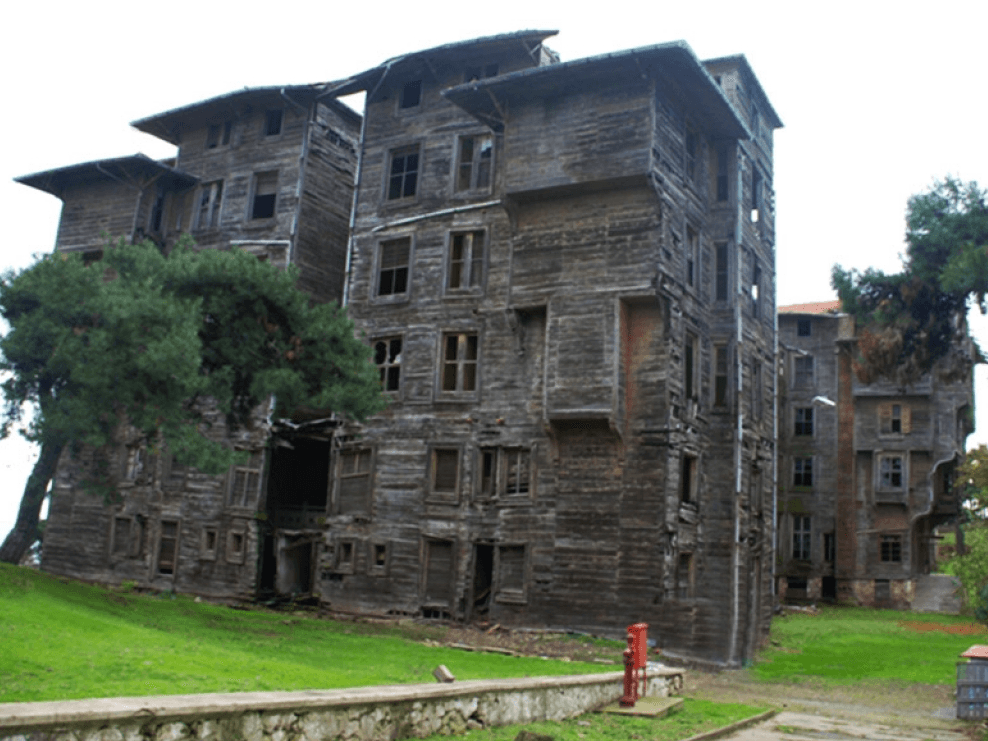
The Büyükada Greek Orphanage is a historic complex located on İsa Tepe, one of the highest points of Büyükada in the Princes’ Islands district of Istanbul. It is recognized as both the largest in Europe and one of the largest multi-story wooden structures in the world. The building consists of five main floors with a length of approximately 102–102.5 metres, a width of 25–35 metres, and a height of around 24 metres. It contains a total of 206 rooms, including a large kitchen, a library, and various educational spaces.
The building was constructed between 1898 and 1899 by a French company led by Count Maurice de Boscary, based on the design of Alexandre Vallaury. Initially intended to operate as a luxury hotel and casino under the name “Prinkipo Palace,” the project remained unfinished due to the inability to obtain the necessary permissions from the Ottoman authorities.
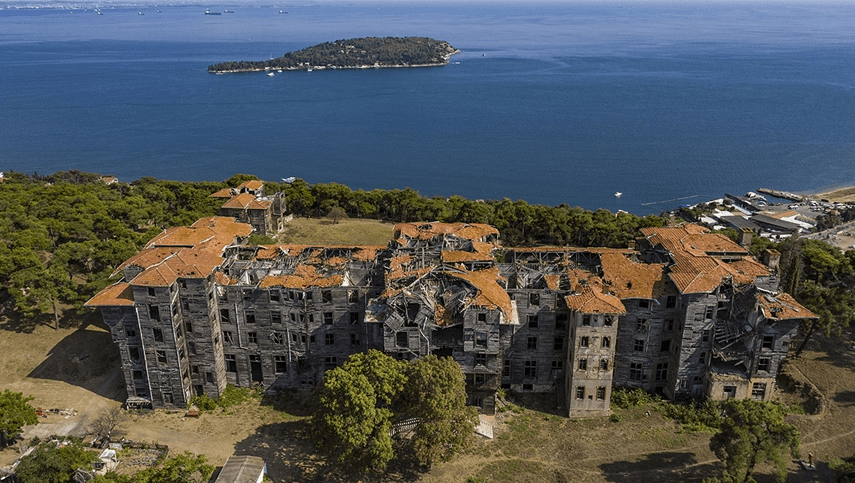
Büyükada Greek Orphanage (Anadolu Agency)
Following the incomplete construction, efforts began to find a new facility to replace the building of the Balıklı Greek Orphanage, which had been damaged in the 1894 earthquake. Patriarch Joachim III of the Greek Orthodox Church persuaded Eleni Zarifi, a prominent figure of the era, to purchase the structure for 3,700 Ottoman gold liras. Zarifi donated the building to the Patriarchate on the condition that it be used exclusively as an orphanage and that additional expenses be covered. The transfer was finalized in 1902, and the Greek Orphanage officially opened on 21 May 1903 with the approval of Sultan Abdülhamid II. Both Sultan Abdülhamid and Patriarch Joachim III attended the opening ceremony; by imperial decree, the orphanage was granted a daily allocation of 7.5 okkas of meat and sufficient quantities of bread.
The orphanage housed orphaned and destitute Greek children and also hosted primary and vocational schools along with various educational programs. Its staff included both Greek and Turkish teachers, as well as approximately 15 auxiliary personnel. By the early 20th century, the building had become one of the most significant institutions of the Greek community in Istanbul, both architecturally and socially.
During World War I, the orphanage was repurposed as the Kuleli Military High School. After the war, it resumed its function as an orphanage. The building continued to serve this role throughout the Republican period until 1964.
On 21 April 1964, the General Directorate of Foundations abruptly closed and sealed the building citing “fire hazard” as the reason. At the time, 177 children residing in the orphanage were quickly relocated to churches and monasteries on the island. The political context of the period, particularly the tensions in Cyprus and the crisis in Turkey-Greece relations in 1964, formed key contextual factors influencing this decision.
After its closure, the building was left unused and received no maintenance from 1964 onward. Over the years, fires, the 1999 Marmara Earthquake, harsh weather conditions, and roof damage have accelerated its deterioration. Holes in the roof allowed rainwater to penetrate, leading to loss of load-bearing capacity in wooden beams and increasing the risk of collapse on upper floors. Reports indicate that approximately 60 percent of the fourth floor has collapsed, with severe damage to the flooring and roof structure.
The Phanar Greek Orthodox Patriarchate lost all legal cases filed in Turkey seeking the return of ownership. In 2003, it appealed to the European Court of Human Rights. In 2007, the Patriarchate won the case and regained the building’s title deed on 29 November 2010.
In 2018, the building was included in Europa Nostra’s list of “Europe’s 7 Most Endangered Cultural Heritage Sites.” A technical and financial report prepared in 2019 recommended urgent intervention, specifically the repair of the roof and the future transformation of the building into functions such as an “Environmental Institute and Interfaith Dialogue Center.” The report estimated the project would take 4–5 years and cost at least 40 million euros.
Between 2020 and 2021, BİMTAŞ, a subsidiary of the Istanbul Metropolitan Municipality, conducted surveying, laser scanning, and digital documentation using unmanned aerial vehicles. The building remains in a severely damaged state and is at imminent risk of total collapse. Under the restoration project, emergency preventive measures, structural reinforcement, and long-term usage plans are currently under development.

No Discussion Added Yet
Start discussion for "Big Adalar Greek Orphanage" article
Construction Process and Architect
Transformation into an Orphanage
Function and Building Use
World War I and Its Aftermath
Closure Process (1964)
Ownership Dispute and ECtHR Ruling
Conservation Efforts and Europa Nostra Process
Current Status