

This article was automatically translated from the original Turkish version.
+2 More
Type(s) | Covered cistern | ||||||||
|---|---|---|---|---|---|---|---|---|---|
Location | Istanbul Historic Peninsula Fatih district | ||||||||
Current Use | Cultural and artistic activity area | ||||||||
Plan Type | Rectangular-shaped enclosed space | ||||||||
Purpose of Construction | To meet Istanbul's water needs | ||||||||
Binbirdirek Sarnıcı is one of the covered cisterns from the Byzantine period located in the Historic Peninsula of Istanbul.【1】 The structure was built to meet the city’s water needs and is among the surviving examples of Byzantine water architecture.【2】

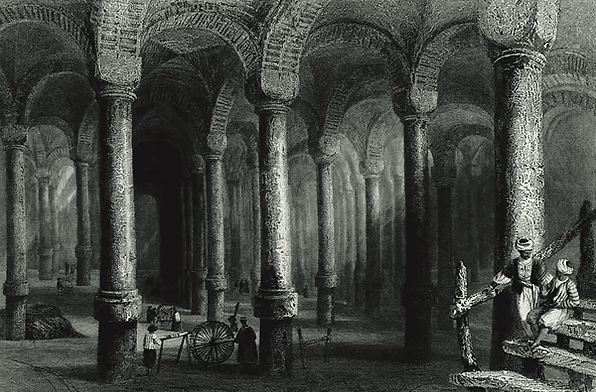
Interior Space and Column Arrangement of Binbirdirek Sarnıcı (Binbirdirek)
Binbirdirek Sarnıcı is located in the Fatih district of Istanbul, near Sultanahmet. The structure derives its name from the large number of columns within its interior.
It is generally accepted that Binbirdirek Sarnıcı was constructed during the Byzantine period, likely around the time of Justinian. The cistern is said to have been commissioned by a senator named Philoxenos and is situated southwest of the Hippodrome. Over time, as the water supply diminished, the structure was repurposed for various uses. Although its exact construction date is not definitively documented, it is dated to the era when the Byzantine Empire established an extensive water infrastructure in its capital, Constantinople. The Istanbul Encyclopedia emphasizes that the cistern was designed to meet the water needs of the imperial palace and public areas. In this context, Binbirdirek Sarnıcı is regarded as one of the planned and large-scale examples of Byzantine hydraulic engineering.
Changes in the city’s water distribution systems over time caused the cistern to lose its original function, after which it was used for different purposes in subsequent periods. The Istanbul Encyclopedia notes that during periods when the cistern was not filled with water, its interior was utilized for various purposes. This demonstrates that the structure remained part of urban life well beyond the Byzantine era.
Structural modifications and repairs carried out over the centuries have contributed to the long-term use of the cistern and enabled it to retain traces of different historical periods.【3】
Gevherli Hanım is portrayed as a figure known for her beauty and the mirror-adorned necklace she never removed. This narrative is linked to Gevherli Hatun, said to be the daughter of the Ottoman pasha Fazlı Paşa. According to legend, Gevherli Hatun lived in a palace located above the Binbirdirek Sarnıcı.【4】
The narrative continues that after becoming a widow following the deaths of three husbands who were pashas, Gevherli Hatun used her considerable wealth to write her own story. It is claimed that the palace she lived in eventually became a bazaar, while the Binbirdirek Sarnıcı beneath it was used as a secluded storage space for sacrificial victims. This tale is said to have been passed down orally through generations until the present day.【5】
The mirror necklace is one of the key elements of the Gevherli Hanım narrative and is associated with the section of the story said to have taken place within the Binbirdirek Sarnıcı. The mirror necklace is counted among the legendary elements connected to the cistern’s interior. Similarly, the so-called crown marks are also claimed to be present within the Binbirdirek Sarnıcı and are linked to these narratives. These stories are presented as integral components of the cistern’s historical identity and as elements that shape its place in cultural memory.【6】
Binbirdirek Sarnıcı has a rectangular plan. The columns within the interior are arranged as architectural elements supporting the vaulted ceiling. The internal dimensions of the structure are approximately 64 by 56 metres, and it contains 224 column capitals. These columns are aligned in fifteen rows, spaced about four metres apart. The current height of the columns is recorded as approximately ten metres, with their lower sections buried beneath the ground. The interior is covered by arches, and the columns are connected by these arches. To ensure ventilation and lighting, shafts have been opened in the interior.
Today, Binbirdirek Sarnıcı is used as a venue for cultural and artistic events. The structure is open to visitors and hosts various exhibitions and activities.
Binbirdirek Cistern. "İstanbul'un En Gizemli Yapısı BİNBİRDİREK SARNICI." *Binbirdirek Sarnıcı Resmî Web Sitesi.* Accessed December 22, 2025. https://www.binbirdirek.com.tr/
İstanbul Ansiklopedisi. "BİNBİRDİREK, BİNBİRDİREK SARNICI." *İA*. Accessed December 22, 2025.
[1]
Binbirdirek Sarnıcı, “İstanbul'un En Gizemli Yapısı BİNBİRDİREK SARNICI,” Binbirdirek Sarnıcı Resmî Web Sitesi, Access date: 22 December 2025, https://www.binbirdirek.com.tr/
[2]
İstanbul Ansiklopedisi, “BİNBİRDİREK, BİNBİRDİREK SARNICI,” İA, Access date: 22 December 2025, https://istanbulansiklopedisi.org/handle/rek/6931
[3]
İstanbul Ansiklopedisi, “BİNBİRDİREK, BİNBİRDİREK SARNICI,” İA, Access date: 22 December 2025, https://istanbulansiklopedisi.org/handle/rek/6931
[4]
Binbirdirek Sarnıcı, “İstanbul'un En Gizemli Yapısı BİNBİRDİREK SARNICI,” Binbirdirek Sarnıcı Resmî Web Sitesi, Access date: 22 December 2025, https://www.binbirdirek.com.tr/
[5]
Binbirdirek Sarnıcı, “İstanbul'un En Gizemli Yapısı BİNBİRDİREK SARNICI,” Binbirdirek Sarnıcı Resmî Web Sitesi, Access date: 22 December 2025, https://www.binbirdirek.com.tr/
[6]
Binbirdirek Sarnıcı, “İstanbul'un En Gizemli Yapısı BİNBİRDİREK SARNICI,” Binbirdirek Sarnıcı Resmî Web Sitesi, Access date: 22 December 2025, https://www.binbirdirek.com.tr/

Type(s) | Covered cistern | ||||||||
|---|---|---|---|---|---|---|---|---|---|
Location | Istanbul Historic Peninsula Fatih district | ||||||||
Current Use | Cultural and artistic activity area | ||||||||
Plan Type | Rectangular-shaped enclosed space | ||||||||
Purpose of Construction | To meet Istanbul's water needs | ||||||||
No Discussion Added Yet
Start discussion for "Binbirdirek Cistern" article
Historical Background
Gevherli Hanım
Mirror Necklace and Crown Marks
Architectural Features
Current Use