


This article was automatically translated from the original Turkish version.
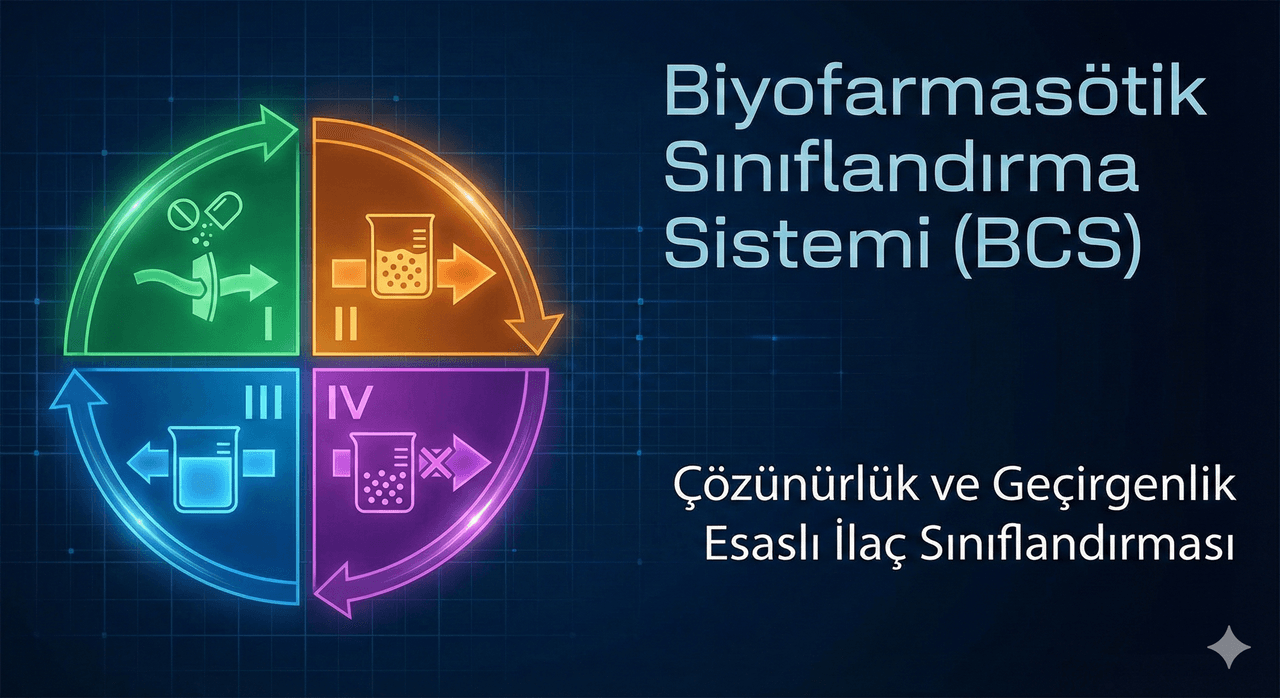
Biopharmaceutical Classification System
(Generated by artificial intelligence.)
Purpose(s) | Predicting bioavailability and guiding dosage form design | ||||||||
|---|---|---|---|---|---|---|---|---|---|
Class IV | Low solubility – Low permeability | ||||||||
Class III | High solubility – Low permeability | ||||||||
Class II | Low solubility – High permeability | ||||||||
Class I | High solubility – High permeability | ||||||||
BCS | Classification of drugs according to solubility and intestinal permeability | ||||||||
Biopharmaceutics Classification System (BCS), a scientific classification approach that evaluates active pharmaceutical ingredients based on their solubility and intestinal permeability characteristics into four main classes. The system provides a guiding framework for numerous steps in modern drug development, from formulation design through clinical stages to regulatory approval. The growing importance of in vitro biopharmaceutical criteria such as solubility, permeability, and dissolution rate of the dosage form has further highlighted the role of BCS in drug evaluation processes.
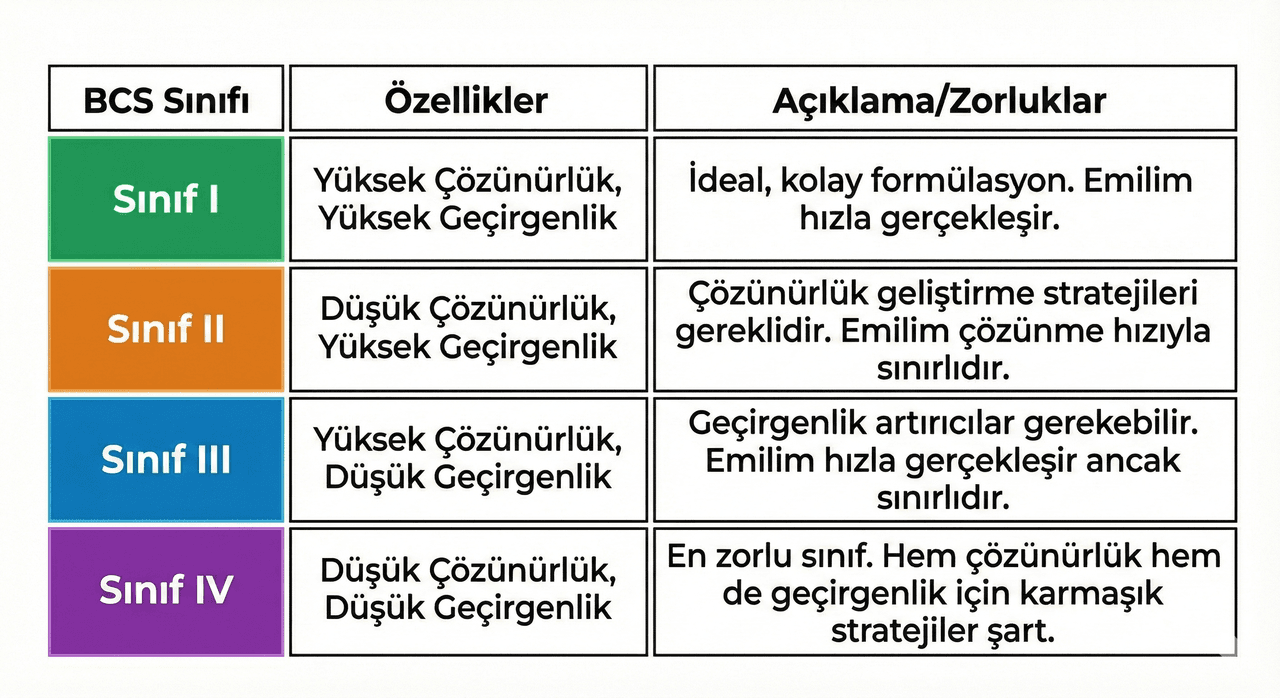
BCS Classification Table (Generated by Artificial Intelligence.)
BCS classifies active substances into four categories based on solubility and permeability properties:
This approach facilitates the prediction of active ingredient bioavailability behavior and serves as a fundamental evaluation step in the development of appropriate dosage forms.
Modern drug regulations, ethical concerns, and the goal of reducing human subject requirements have expanded the scope of in vitro assessments. Within this framework, parameters such as solubility, permeability, and dissolution rate determined in laboratory settings are accepted as alternative methods that can replace in vivo bioequivalence studies. Due to the high cost of clinical bioequivalence studies, regulatory authorities encourage reliance on in vitro assessments when appropriate conditions are met.
BCS serves as a primary reference for granting biowaivers from in vivo bioequivalence studies under specific conditions. Biowaiver applications are applicable to active substances with high solubility, high permeability, and rapid and similar dissolution profiles. For such applications to be valid, the methods used to assess solubility, permeability, and dissolution must be conducted in accordance with regulatory guidelines. However, the fact that some substances exhibit characteristics of multiple classes simultaneously, along with the limited consideration of carrier-mediated transport, food effects, and metabolic processes in the evaluation, continues to fuel debate regarding the biowaiver process.
The classification criteria of BCS may be insufficient to fully explain the absorption behavior of active substances, particularly those where carrier-mediated transport plays a prominent role. Some drugs exhibit different pharmacokinetic behaviors depending on food effects or metabolic properties, which may not always align with the current classification. This has highlighted the need for a more comprehensive evaluation system.
Sarısaltık Yaşın, Derya, and Zeynep Şafak Teksin. “Biyofarmasötik Sınıflandırma Sistemi: Uluslararası Kılavuzlar ve Ülkeler Bazında Değerlendirmeler.” *Journal of Literature Pharmacy Sciences* 7, no. 2 (2018): 160–174. Accessed November 27, 2025. https://www.turkiyeklinikleri.com/article/en-biyofarmasotik-siniflandirma-sistemi-uluslararasi-kilavuzlar-ve-ulkeler-bazinda-degerlendirmeler-82330.html
Şahin, Selma, and Nihan İzat. “Biyofarmasötik Sınıflandırma Sistemi.” *Türkiye Klinikleri Pharmacology-Special Topics* 9, no. 3 (2021): 95–102. Accessed November 27, 2025. https://www.turkiyeklinikleri.com/article/en-biyofarmasotik-siniflandirma-sistemi-97044.html

Biopharmaceutical Classification System
(Generated by artificial intelligence.)
Purpose(s) | Predicting bioavailability and guiding dosage form design | ||||||||
|---|---|---|---|---|---|---|---|---|---|
Class IV | Low solubility – Low permeability | ||||||||
Class III | High solubility – Low permeability | ||||||||
Class II | Low solubility – High permeability | ||||||||
Class I | High solubility – High permeability | ||||||||
BCS | Classification of drugs according to solubility and intestinal permeability | ||||||||
No Discussion Added Yet
Start discussion for "Biopharmaceutical Classification System" article
Classification Structure
Regulations and In Vitro Assessments
Biowaiver Approach
Limitations of the System