


This article was automatically translated from the original Turkish version.
+2 More
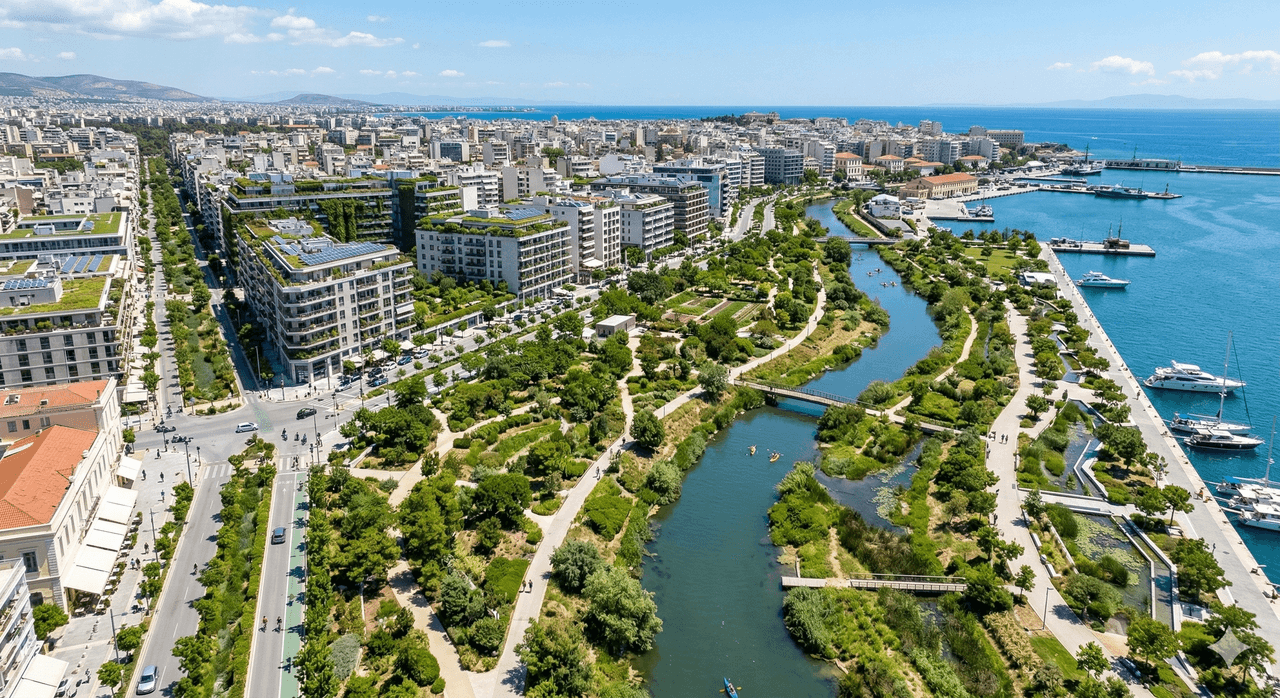
Mavi-Yeşil Altyapı
(Yapay Zeka Tarafından Üretildi)
Blue-Green Infrastructure is an ecological planning approach that integrates natural (blue and green) elements with the built environment to make rapidly growing cities, driven by population increase and urbanization, more resilient to climate change and sustainable. This approach is defined as a system that utilizes nature-based processes to restore the hydrological functions of urban landscapes, manage stormwater at its source, improve water quality, and enhance ecosystem services. In urban areas, blue elements represent water sources and hydrological functions, while green elements denote vegetation systems; the connection between these two systems ensures the preservation of the urban water cycle.

Blue-Green Infrastructure
(Generated by Artificial Intelligence)
In traditional urbanization models, gray infrastructure (concrete pipes, asphalt roads, underground sewer networks) aims to rapidly remove stormwater from cities, treating it as waste. However, the extensive impermeable surfaces in gray infrastructure prevent water from infiltrating the soil, increasing surface runoff and creating conditions for sudden urban flooding and water pollution. In contrast, blue-green infrastructure offers an alternative that treats water within its natural cycle. By leveraging natural retention and filtration functions, it complements or replaces the shortcomings of gray infrastructure, providing a more flexible, cost-effective, and long-lasting urban system.
Blue-green infrastructure elements are examined in two main categories according to the spatial structure of the city: natural systems and built green solutions. Natural components include rivers, lakes, coastal buffer zones, artificial and natural wetlands, and waterway restoration projects. Built components enhance the ecological functions of the urban environment and include green roofs, blue roofs, rain gardens, vegetated swales, tree trenches, permeable parking surfaces, and underground stormwater harvesting systems.
The system is also classified according to its operational mode and the scale at which it serves. Functionally, it includes “detention (delay) units” that store water on the surface and slow its flow into the sewer system, and “infiltration (percolation) units” that directly direct water into the ground. At the urban and regional scale, urban forests and wetlands are planned; at the building and private property scale, green facades, gardens, and local stormwater storage systems are integrated into the network.
Climate change and extreme weather events are causing serious capacity challenges in urban water management. Blue-green infrastructure delays stormwater drainage and significantly reduces surface runoff volumes by harnessing the natural retention capacity of vegetation and soil systems. This mechanism plays a critical buffering role in preventing sewer overflows and flood disasters during intense rainfall periods.

Stormwater Management
(Generated by Artificial Intelligence)
The water footprint is a sustainability indicator composed of three components: blue (surface/groundwater use), green (rainwater consumed), and gray (water volume required to assimilate pollution). Blue-green infrastructure practices reduce the city’s blue water footprint (demand for municipal water supply) by collecting and reusing green water (rainwater) for irrigation. Simultaneously, they purify stormwater by filtering pollutants through natural microorganisms and plant roots, directly reducing the city’s gray water footprint, which measures pollution load.
The urban heat island (UHI) effect, caused by artificial surfaces absorbing and trapping solar radiation, is effectively mitigated by blue-green infrastructure. Vegetation provides shading and performs evapotranspiration, reducing thermal stress. Measurements using Landsat 8 satellite imagery in İzmir Karşıyaka revealed that concrete areas devoid of vegetation reached surface temperatures of up to 46.66°C. In contrast, urban parks with extensive tree canopies and water features, such as 80th Anniversary Republic Park, achieved a strong park cooling intensity (PCI), lowering surface temperatures by up to 2.17°C within a 300-meter radius.【1】
Blue-green infrastructure networks preserve biodiversity by creating safe corridors for wildlife—particularly birds and pollinating insects—within urban areas. The carbon sequestration function, which captures atmospheric carbon dioxide and stores it in plant tissues and soil, is a cornerstone of climate change mitigation. Additionally, plant canopies filter particulate matter responsible for urban air pollution, improving air quality.
Nature-based solutions reduce the need for wastewater treatment plants and large-scale sewer construction, lowering municipal infrastructure expenditures. Green roofs integrated into buildings provide thermal insulation, significantly reducing residential heating and cooling costs. Moreover, by enhancing the aesthetic and ecological value of their surroundings, they directly increase real estate and land values, contributing to the urban economy.
Blue-green spaces facilitate urban residents’ access to outdoor exercise, walking, and recreational activities, supporting public physical health by reducing conditions such as obesity and cardiovascular diseases. These areas, which alleviate mental stress and maintain human connection with nature, strengthen social interaction among neighborhood residents, enhancing a sense of belonging and social cohesion.
In developed countries, blue-green infrastructure is central to macro-urban strategies.
In Türkiye, the concept of blue-green infrastructure is increasingly being integrated into urban master plans and administrative regulations. In 2017, the Urban Planning Council formally endorsed the promotion of nature-based infrastructure, and in 2021, amendments to the Building Regulation made the installation of "stormwater harvesting systems" mandatory in new constructions.【6】
The city of İzmir is implementing nature-based solutions at the local level through the EU-supported URBAN GreenUP project, including the creation of green corridors, reduction of urban carbon emissions, and flood prevention.【7】 Meanwhile, various analyses and strategy development processes are ongoing to assess the blue-green infrastructure potential of cities with different geographic characteristics, such as Erzurum with a cold climate and Antalya under a Mediterranean climate.【8】
Demircan, Neslihan, Ayşegül Aksu, and Ali Can Kuzulugil. “Mavi-Yeşil Altyapı Kapsamında Erzurum Kent Merkezinin Değerlendirilmesi.” *Bartın Orman Fakültesi Dergisi* 22, no. 2 (August 15, 2020): 409–421. Accessed March 9, 2026. https://dergipark.org.tr/en/download/article-file/1238207
Göksoy Sevinçli, Berfin, and Erdal Bayrakcı. “Kentsel Altyapının İklim Değişikliğine Karşı Dirençli Hale Getirilmesinde Yeşil Altyapı Çözümleri.” *Uluslararası Yönetim Akademisi Dergisi* 7, no. 4 (2024): 1001–1014. Accessed March 9, 2026. https://dergipark.org.tr/en/download/article-file/4292988
Parlak, Elif, and Meryem Atik. “Dünyadan ve Ülkemizden Mavi-Yeşil Altyapı Uygulamaları.” *PEYZAJ – Eğitim, Bilim, Kültür ve Sanat Dergisi* 2, no. 2 (December 28, 2020): 86–100. Accessed March 9, 2026. https://dergipark.org.tr/en/download/article-file/1213444
Yavuz, Elif Ela Nur, and Seda Örücü. “Mavi Yeşil Altyapılar ve Su Yönetimi.” Paper, *6th International Conference on Engineering and Applied Natural Sciences (ICEANS)*, Konya, Türkiye, June 23–24, 2025. Accessed March 9, 2026. https://www.researchgate.net/profile/Elif-Ela-Nur-Yavuz/publication/398860036
Yüksel, Ahsen Tuğçe, and Çiğdem Coşkun Hepcan. “Kentsel Yüzey Sıcaklığı ve Mavi-Yeşil Altyapı İlişkisi: Karşıyaka Örneği.” *Adnan Menderes Üniversitesi Ziraat Fakültesi Dergisi* 20, no. 1 (2023): 91–98. Accessed March 9, 2026. https://dergipark.org.tr/tr/download/article-file/2813454
Öztaş Karlı, Rukiye Gizem, and Mustafa Artar. “Kentsel Su Yönetiminde Araç Olarak Su Ayak İzi ve Mavi-Yeşil Altyapı.” *Ege Üniversitesi Ziraat Fakültesi Dergisi* 58, no. 1 (2021): 145–162. Accessed March 9, 2026. https://dergipark.org.tr/en/download/article-file/1481344
[1]
Yüksel, Ahsen Tuğçe and Çiğdem Coşkun Hepcan. "Urban Surface Temperature and the Relationship with Blue-Green Infrastructure: The Case of Karşıyaka." Adnan Menderes University Faculty of Agriculture Journal 20, no. 1 (2023): 91-98, accessed 9 March 2026, https://dergipark.org.tr/tr/download/article-file/2813454
[2]
Parlak, Elif and Meryem Atik. "Blue-Green Infrastructure Applications from Around the World and Our Country." PEYZAJ - Journal of Education, Science, Culture and Art 2, no. 2 (2020): 86-100, accessed 9 March 2026, https://dergipark.org.tr/en/download/article-file/1213444
[3]
Parlak, Elif and Meryem Atik. "Blue-Green Infrastructure Applications from Around the World and Our Country." PEYZAJ - Journal of Education, Science, Culture and Art 2, no. 2 (2020): 86-100, accessed 9 March 2026, https://dergipark.org.tr/en/download/article-file/1213444
[4]
Parlak, Elif and Meryem Atik. "Blue-Green Infrastructure Applications from Around the World and Our Country." PEYZAJ - Journal of Education, Science, Culture and Art 2, no. 2 (2020): 86-100, accessed 9 March 2026, https://dergipark.org.tr/en/download/article-file/1213444
[5]
Parlak, Elif and Meryem Atik. "Blue-Green Infrastructure Applications from Around the World and Our Country." PEYZAJ - Journal of Education, Science, Culture and Art 2, no. 2 (2020): 86-100, accessed 9 March 2026, https://dergipark.org.tr/en/download/article-file/1213444
[6]
Öztaş Karlı, Rukiye Gizem and Mustafa Artar. "Water Footprint and Blue-Green Infrastructure as Tools in Urban Water Management." Ege University Faculty of Agriculture Journal 58, no. 1 (2021): 145-162, accessed 9 March 2026, https://dergipark.org.tr/en/download/article-file/1481344
[7]
Parlak, Elif and Meryem Atik. "Blue-Green Infrastructure Applications from Around the World and Our Country." PEYZAJ - Journal of Education, Science, Culture and Art 2, no. 2 (2020): 86-100, accessed 9 March 2026, https://dergipark.org.tr/en/download/article-file/1213444
[8]
Demircan, Neslihan, Ayşegül Aksu and Ali Can Kuzulugil. "Assessment of Erzurum City Center within the Scope of Blue-Green Infrastructure." Bartın Faculty of Forestry Journal 22, no. 2 (2020): 409-421, accessed 9 March 2026, https://dergipark.org.tr/en/download/article-file/1238207

Mavi-Yeşil Altyapı
(Yapay Zeka Tarafından Üretildi)
No Discussion Added Yet
Start discussion for "Blue-Green Infrastructure" article
Concept and Key Characteristics of Blue-Green Infrastructure
Comparative Analysis with Gray Infrastructure
Components and Classification of Blue-Green Infrastructure
Natural and Built Components
Scale and Function-Based Classification
Urban Water Management and Water Footprint
Flood and Stormwater Management
Relationship with Water Footprint
Urban Heat Island Effect and Thermal Regulation
Contributions to Surface Temperature and Cooling Effects
Multifunctional Benefits of Blue-Green Infrastructure
Environmental and Ecological Benefits
Economic Benefits
Social and Cultural Benefits
Application Examples from Around the World and Türkiye
Global Implementation Strategies
Current Strategies and Examples in Türkiye