


This article was automatically translated from the original Turkish version.
+2 More
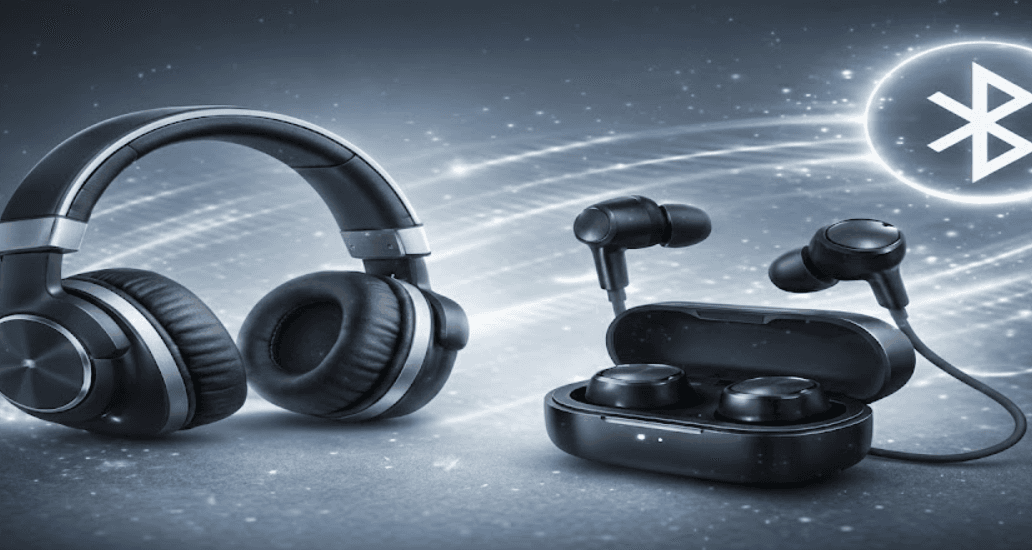
(Generated by Artificial Intelligence.)
Bluetooth headset
Application Area(s) | Music listening multimedia usage phone calls | ||||||||
|---|---|---|---|---|---|---|---|---|---|
Usage Status | Current and widespread | ||||||||
Limitation | Connection range and battery requirements | ||||||||
Connection Type | Wireless (Bluetooth pairing) | ||||||||
Basic Working Principle | Wireless transmission of digital audio data over short distances | ||||||||
Technology Used | Bluetooth | ||||||||
Bluetooth headset is an audio device that receives audio data generated by source devices such as smartphones, computers, and tablets via short-range wireless communication. These headsets enable audio transmission without the need for physical cable connections, using Bluetooth technology. Thanks to their wireless structure, audio transfer is carried out over a radio frequency connection established between devices.
The development of headset technology extends back to the early days of telephony. The first headset systems consisted of fixed, wired units used by telephone operators. Over time, these systems were adapted for individual use and became more compact and ergonomic with the widespread adoption of portable electronic devices.
In the 1990s, as demand for short-range wireless communication increased, Bluetooth technology was developed.【1】 This technology was designed as a wireless personal area network standard aimed at eliminating cable connections between portable devices. During its development, low power consumption and short range were established as core design principles.
The development of Bluetooth paralleled the growing popularity of mobile phones and portable electronic devices. In particular, eliminating the cable connection between mobile phones and headsets became one of the earliest applications of Bluetooth technology. As a result, wireless headsets were among the first consumer products to leverage Bluetooth’s audio transmission capabilities.
In subsequent years, the Bluetooth standard was technically enhanced, improving data transmission speed, energy efficiency, and interoperability between devices. Consequently, Bluetooth-enabled headsets became a common component of mobile communication technologies.
Bluetooth technology is a WPAN (Wireless Personal Area Network) standard that enables short-range wireless communication. This technology features low power consumption, a range of approximately 10 meters, and moderate data transmission speed.【2】
Bluetooth connections are established using radio waves in the 2.4 GHz ISM band. It is noted that the same frequency band is also used by microwave ovens and 802.11-based devices; this can lead to interference under certain conditions.【3】 Nevertheless, Bluetooth aims to provide reliable data transmission within personal areas due to its low-power design.
The audio transmission process in Bluetooth headsets works as follows:
Bluetooth devices communicate directly point-to-point without requiring infrastructure stations. Small networks established between devices are called “piconets,” and the combination of multiple piconets forms a “scatternet” structure.

Basic Working Principle (Generated by Artificial Intelligence)
In Bluetooth headsets, audio is converted by the source device into digital data. This digital audio data is transmitted to the headset in the form of data packets over a Bluetooth connection. The transmission process follows the communication protocols defined by Bluetooth technology.
Headset side receives the digital data, decodes it, and converts it back into an audio signal. The resulting audio signal is delivered to the user through the headset’s speakers.

Audio Transmission Process (Generated by Artificial Intelligence)
For wireless headsets to function, a pairing process must be completed between the headset and the source device. During this process, the headset broadcasts a signal that allows nearby Bluetooth-enabled devices to detect it. The source device recognizes the headset and establishes a connection upon user confirmation.
Once pairing is complete, the devices recognize each other and can automatically reconnect when within range during subsequent uses. During the connection, data transmission is managed according to Bluetooth communication protocols, ensuring continuous wireless audio transfer.

Connection and Pairing Process (Generated by Artificial Intelligence)
Bluetooth headsets are classified according to their design features and usage patterns. This classification is based primarily on the physical interaction between the user and the device rather than its internal technical structure.
Common types include in-ear, on-ear, and over-ear headsets. In-ear models are inserted directly into the ear canal, while on-ear and over-ear designs are positioned on or around the ear. All these designs encompass headset types that deliver audio via wireless communication technologies. The term “wireless headset” is also used to refer to these devices.

Headset Types (Generated by Artificial Intelligence)
The primary advantage of Bluetooth headsets is that they eliminate physical cable connections, providing users with greater freedom of movement. The wireless structure enables audio transmission within a defined range and offers practicality in daily use.
However, these headsets have certain technical limitations. Wireless communication is restricted to a specific range, and signal quality can be affected by environmental factors. Additionally, the need for a power source makes battery capacity a critical factor determining usage duration. This situation defines both the capabilities and technical constraints of Bluetooth-based wireless audio devices.
Accessed November 26, 2025.
Franklin, Curt., and Chris Pollette. “How Bluetooth Works.” *HowStuffWorks.* Accessed January 12, 2026. https://electronics.howstuffworks.com/bluetooth.htm.
Lai, Feng Chun. “An Investigation Analysis on Bluetooth Technology and Its Application Product: Headset.” A Final Report of the Three-Credit Course, Assumption University, 2004. Accessed January 30, 2026. https://repository.au.edu/server/api/core/bitstreams/c5e08d0b-5f44-47bf-8d23-075fd010c74f/content.
McClurken, Jeffrey W. "Headphones Documentary." History of Technology. Accessed February 19, 2026.
ScienceDirect. "Wireless Headset." *ScienceDirect Topics*. Accessed January 12, 2026. https://www.sciencedirect.com/topics/computer-science/wireless-headset.
Zeadally, Sherali, Farhan Siddiqui, and Zubair Baig. "25 Years of Bluetooth Technology." *Future Internet* 11, no. 9 (September 2019): 2–24. Accessed February 19, 2026. https://www.researchgate.net/publication/335709726_25_Years_of_Bluetooth_Technology
[1]
Sherali Zeadally, Farhan Siddiqui ve Zubair Baig, "25 Years of Bluetooth Technology," Future Internet 11, no. 9 (2019): syf 1-2, https://www.researchgate.net/publication/335709726_25_Years_of_Bluetooth_Technology
[2]
Feng Chun Lai, An Investigation Analysis on Bluetooth Technology and Its Application Product—Headset (Master’s final report, Assumption University, 2004), syf 4, https://repository.au.edu/server/api/core/bitstreams/c5e08d0b-5f44-47bf-8d23-075fd010c74f/content
[3]
Feng Chun Lai, An Investigation Analysis on Bluetooth Technology and Its Application Product—Headset (Master’s final report, Assumption University, 2004), syf 9-10, https://repository.au.edu/server/api/core/bitstreams/c5e08d0b-5f44-47bf-8d23-075fd010c74f/content

(Generated by Artificial Intelligence.)
Bluetooth headset
Application Area(s) | Music listening multimedia usage phone calls | ||||||||
|---|---|---|---|---|---|---|---|---|---|
Usage Status | Current and widespread | ||||||||
Limitation | Connection range and battery requirements | ||||||||
Connection Type | Wireless (Bluetooth pairing) | ||||||||
Basic Working Principle | Wireless transmission of digital audio data over short distances | ||||||||
Technology Used | Bluetooth | ||||||||
History
Basic Working Principle
Audio Transmission Process
Connection and Pairing Process
Headset Types
Advantages and Limitations