

This article was automatically translated from the original Turkish version.
Entry into Service | April 1986 | ||||||||
|---|---|---|---|---|---|---|---|---|---|
Length(s) | 17.73 m (including rotors) | ||||||||
Manufacturer(s) | Space & Security (1997–present) Boeing Defense McDonnell Douglas (1984–1997) Hughes Helicopters (1975–1984) | ||||||||
Height(s) | 3.87 m | ||||||||
Type(s) | Attack Helicopter | ||||||||
First Flight(s) | 30 September 1975 | ||||||||
Radar | AN/APG-78 Longbow Fire Control Radar | ||||||||
Rockets | Hydra 70 (70 mm) unguided or APKWS laser-guided rockets | ||||||||
Gun | 1 × 30 mm M230 Automatic Chain Gun (1200 rounds capacity) | ||||||||
Maximum Speed | 293 km/h (158 knots) | ||||||||
Loaded Weight | 8000 kg | ||||||||
Fuselage Length | 15.06 m | ||||||||
Crew | 2 (Pilot and Weapons System Operator) | ||||||||
Primary Users | Türkiye (List of related allied countries) Egypt Israel United Kingdom United States Army | ||||||||
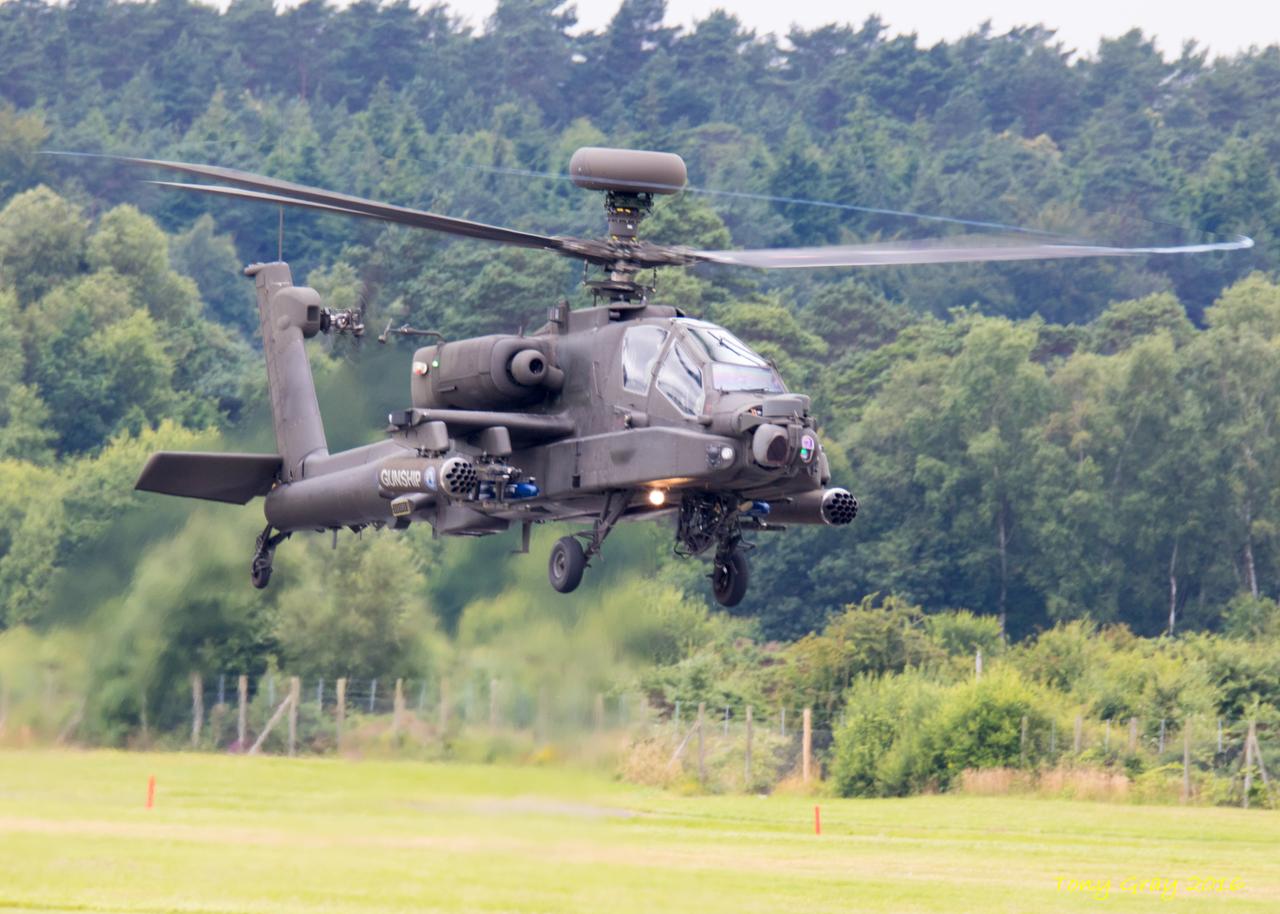
The AH-64 Apache, developed by Hughes Helicopters in accordance with the U.S. Army’s Advanced Attack Helicopter (AAH) program requirements, is a twin-turboshaft, tandem-seat aerial platform designed as the primary attack helicopter of the United States Army. Today, its production and modernization are carried out by Boeing. The platform, which made its first flight in 1975 and entered operational service in the early 1980s, features a high-survivability airframe constructed from both metallic alloys and fiber-reinforced composites. The core design doctrine of the Apache is to serve as a tank hunter and provide close air support against heavily armored units under all weather conditions and at night. It has been continuously modernized to meet the network-centric warfare demands of the modern battlefield. With over 5.3 million flight hours and more than 1.3 million combat hours, the Apache is recognized as one of the most operationally tested and battle-proven attack helicopters in aviation history.

Boeing AH-64 Apache (Clemens Vasters)
The design process of the AH-64 Apache began in 1972 under the U.S. Army’s Advanced Attack Helicopter program requirements. The prototype developed by Hughes Helicopters distinguished itself from competitors through superior structural durability and system redundancy. According to technical reports from NASA and the U.S. Army, the platform’s architecture is based on the engineering principles of “damage tolerance” and “safe-life.” This approach ensures that even if critical dynamic components are hit, the airframe maintains its structural integrity and can continue flight within operational limits.
The airframe design has been optimized through the strategic use of fiber-reinforced composite materials alongside metallic alloys. A key design requirement is that the main rotor blades must retain structural integrity and withstand impacts from 23 mm caliber projectiles. The helicopter’s power transmission system is mechanically configured to maintain functionality for at least 30 minutes even in the event of complete lubrication loss. The placement of the engines in isolated compartments on either side of the fuselage is a fundamental survivability feature that minimizes the risk of both power sources being disabled simultaneously by a single kinetic impact or fire.【1】
The aerodynamic development of the design was shaped by numerical modeling studies analyzing complex rotor-fuselage interactions and fatigue damage. Research conducted by the Massachusetts Institute of Technology (MIT) and NASA analyzed usage-based fatigue data from dynamic components to optimize the platform’s service life and maintenance intervals. The tandem cockpit configuration provides the crew with an extensive field of view, while the helicopter’s compact frontal profile reduces its visual and radar cross-section. The modern modular open systems architecture adopted in current variants enables the integration of next-generation sensors and autonomous systems without altering the physical airframe, aiming to sustain the design’s relevance through the 2060s.【2】.
The AH-64 Apache features an integrated suite of advanced avionics systems and sensor fusion architecture designed to maximize situational awareness and target acquisition on the battlefield. The foundation of these systems is the TADS/PNVS (Target Acquisition and Designation System / Pilot Night Vision Sensor), located on the nose of the helicopter, which enables the crew to conduct operations at night, in limited visibility, or under adverse weather conditions. According to technical documentation, this sensor suite operates in synchronization with the IHADSS (Integrated Helmet and Display Sighting System) integrated into the pilot’s helmet. This integration allows the pilot’s head movements to simultaneously and independently direct both the helicopter’s sensors and its 30 mm automatic cannon.

Boeing AH-64 Apache Technical Drawing (Generated by Artificial Intelligence)
One of the platform’s most distinctive avionics components is the AN/APG-78 Longbow millimeter-wave fire-control radar mounted atop the main rotor, particularly in the AH-64D and E variants. This radar system can simultaneously scan, detect, and automatically classify up to 128 targets, prioritizing the 16 highest-threat targets. Modeling studies supported by flight test data from Boeing and NASA have confirmed that the system’s data-processing capability enables precise engagement even under poor visibility conditions. The radar’s position allows the helicopter to conceal its fuselage behind cover while exposing only the radar unit, providing a tactical advantage for reconnaissance and targeting.【3】. With the modern AH-64E variant, the system architecture has been digitized to meet network-centric warfare requirements. The introduced MUM-T (Manned-Unmanned Teaming) capability enables the helicopter crew to receive real-time sensor data from unmanned aerial vehicles and control their weapon stations from the cockpit.
Digital recording systems that track usage-based fatigue data from aviation components integrate sensor inputs with mechanical health monitoring systems to support operational continuity through data-driven analysis. This sensor fusion has transformed the Apache from a mere attack platform into a command-and-control terminal capable of processing and distributing battlefield data.
The AH-64 Apache features a multi-layered weapon station architecture optimized for the roles of tank hunter and close air support. The platform’s primary fixed armament is the 30 mm M230 chain gun mounted beneath the fuselage. This system has a rate of fire of 600 to 650 rounds per minute and is supported by a magazine capacity of 1,200 rounds. Technical reports indicate that the M230 system synchronizes with the pilot’s helmet-mounted targeting unit (IHADSS), enabling automatic alignment of the gun barrel with the pilot’s line of sight.
The helicopter’s primary offensive power is provided by munitions carried on four weapon stations located under the wing pylons. The Apache’s most critical anti-tank weapon is the AGM-114 Hellfire missile, available in both laser- and radar-guided variants. The Apache can carry up to 16 Hellfire missiles on a single mission. Additionally, it can be equipped with Hydra 70 (70 mm) rocket systems for area suppression and engagement of unarmored targets. Modeling studies based on NASA flight test data have thoroughly analyzed the aerodynamic effects of these weapons during launch and confirmed the system’s high-precision strike capability.
As part of modernization programs, particularly with the AH-64E variant, the range and precision of the weapon systems have been enhanced. Integrated “Launched Effects” and advanced data links now allow munitions to be guided not only by the helicopter’s own sensors but also by targeting data received from other friendly units or UAVs. This network-centric architecture enables the weapon systems to engage targets beyond direct line-of-sight or hidden behind obstacles with high accuracy.
Boeing AH-64 Apache flight (Haci Productions)
The operational capability of the AH-64 Apache is based on a twin-engine propulsion system that delivers sustained power even under high-altitude and hot-weather conditions. The platform is equipped with two General Electric T700-GE-701 series engines (T700-GE-701D in modern variants). Each engine produces approximately 2,000 shaft horsepower, optimizing the helicopter’s total power output. The engines are mounted in isolated compartments on either side of the fuselage, mechanically minimizing the risk of both power sources being disabled simultaneously in the event of a hit.
The helicopter’s transmission system is responsible for transferring high-torque power from the engines to the main and tail rotors. According to technical engineering reports, the Apache’s powertrain is designed with “run-dry” capability, ensuring that the transmission can continue operating for at least 30 minutes even if lubrication is completely lost. The main rotor system features a four-blade configuration, aerodynamically optimized for high maneuverability and heavy-load capacity. NASA flight test data have confirmed that the rotor blades maintain structural integrity after impacts from 23 mm munitions.
In terms of performance parameters, the AH-64E variant has a primary mission weight of 15,075 pounds (approximately 6,838 kg) and a maximum takeoff weight of 23,000 pounds (approximately 10,433 kg). The platform achieves a maximum cruise speed exceeding 150 knots (approximately 279 km/h) at sea level and a climb rate of more than 2,800 feet per minute. The helicopter’s service ceiling is set at 20,000 feet (6,096 meters). These performance metrics provide a power reserve that enables the Apache to maintain its attack effectiveness in “high and hot” operational environments.【4】.
The operational history of the AH-64 Apache reflects a transition from Cold War-era doctrines to modern asymmetric warfare theaters. The initial variant, the AH-64A, entered U.S. Army service in 1986 and was positioned as the primary strike asset against potential armored threats in Europe. The platform’s first large-scale combat experience occurred during the 1991 Gulf War, where Apache helicopters played a critical role in destroying enemy radar sites, enabling safe initiation of air operations, and demonstrating high operational readiness.
The AH-64D Longbow variant, developed in the late 1990s, represents one of the most significant milestones in the helicopter’s digital transformation. The integration of millimeter-wave radar and digital data links transformed the Apache from a simple strike platform into a battlefield data-processing center. Operational data and usage-based fatigue analyses revealed that performance in “high and hot” climates such as Afghanistan and Iraq necessitated modernization of the engines and transmission systems. These findings laid the groundwork for the development of the current most advanced variant, the AH-64E Guardian.
Bayoumi, A., W. Ranson, L. Eisner, and L. E. Grant, "Cost and effectiveness analysis of the AH-64 and UH-60 on-board vibrations monitoring system," *2005 IEEE Aerospace Conference*, Big Sky, MT, USA, 2005, pp. 3921-3940, doi: 10.1109/AERO.2005.1559698.
Boeing. "AH-64 Apache." Accessed February 19, 2026. https://www.boeing.com/defense/military-rotorcraft/ah-64-apache
Gray, Tony CC. "Boeing AH-64 Apache" Flickr. July 15, 2016. Accessed February 19, 2026. https://www.flickr.com/photos/tonyccgray/28363190685/
Haci Productions. “Boeing AH-64 Apache Attack Helicopter.” YouTube. Accessed February 19, 2026. https://www.youtube.com/watch?v=pWCBdY605_c
Hunter, Donald. “Identification of aircrew tasks for using direct voice input (DVI) to reduce pilot workload in the AH-64D Apache Longbow”. Masters Theses, December 2003. Accessed February 19, 2026. https://trace.tennessee.edu/utk_gradthes/5239
Quine, John. *Boeing AH-64 Apache*. July 15, 2015. Flickr. Photograph. Accessed February 19, 2026. https://www.flickr.com/photos/john5554/21441790910/
Reddick, Harold K., Jr. *Safe-Life and Damage-Tolerant Design Approaches for Helicopter Structures*. Ft Eustis, Virginia: Applied Technology Laboratory, US Army Research and Technology Laboratories. https://ntrs.nasa.gov/citations/19830025690
Shanthakumaran, P., Terry Larchuk, Richard Christ, David Mittleider, and Eric Hitchcock. "Usage Based Fatigue Damage Calculation for AH-64 Apache Dynamic Components." Paper presented at the American Helicopter Society 66th Annual Forum, Phoenix, Arizona, May 11–13, 2010. https://web.mit.edu/hchin/Public/HAI/AHS_Papers/Usage%20Based%20Fatigue%20Damage%20Calculation%20for%20AH-64%20Apache%20Dynamic%20Components.pdf
Vasters, Clemens. "Boeing AH-64 Apache" Flickr. July 22, 2012. Accessed February 19, 2026. https://www.flickr.com/photos/clemensv/7626942780/
[1]
Shanthakumaran, P., Terry Larchuk, Richard Christ, David Mittleider, ve Eric Hitchcock. "Usage Based Fatigue Damage Calculation for AH-64 Apache Dynamic Components." The American Helicopter Society 66th Annual Forum'da sunulan bildiri, Phoenix, Arizona, 11-13 Mayıs 2010. https://web.mit.edu/hchin/Public/HAI/AHS_Papers/Usage%20Based%20Fatigue%20Damage%20Calculation%20for%20AH-64%20Apache%20Dynamic%20Components.pdf
[2]
Boeing. "AH-64 Apache" Erişim tarihi: 19 Şubat 2026. https://www.boeing.com/defense/military-rotorcraft/ah-64-apache.
[3]
Boeing. "AH-64 Apache" Erişim tarihi: 19 Şubat 2026. https://www.boeing.com/defense/military-rotorcraft/ah-64-apache.
[4]
Boeing. "AH-64 Apache" Erişim tarihi: 19 Şubat 2026. https://www.boeing.com/defense/military-rotorcraft/ah-64-apache.
Entry into Service | April 1986 | ||||||||
|---|---|---|---|---|---|---|---|---|---|
Length(s) | 17.73 m (including rotors) | ||||||||
Manufacturer(s) | Space & Security (1997–present) Boeing Defense McDonnell Douglas (1984–1997) Hughes Helicopters (1975–1984) | ||||||||
Height(s) | 3.87 m | ||||||||
Type(s) | Attack Helicopter | ||||||||
First Flight(s) | 30 September 1975 | ||||||||
Radar | AN/APG-78 Longbow Fire Control Radar | ||||||||
Rockets | Hydra 70 (70 mm) unguided or APKWS laser-guided rockets | ||||||||
Gun | 1 × 30 mm M230 Automatic Chain Gun (1200 rounds capacity) | ||||||||
Maximum Speed | 293 km/h (158 knots) | ||||||||
Loaded Weight | 8000 kg | ||||||||
Fuselage Length | 15.06 m | ||||||||
Crew | 2 (Pilot and Weapons System Operator) | ||||||||
Primary Users | Türkiye (List of related allied countries) Egypt Israel United Kingdom United States Army | ||||||||
No Discussion Added Yet
Start discussion for "Boeing AH-64 Apache" article
Design and Development
Avionics Systems and Sensor Technologies
Weapon Systems and Attack Capability
Powerplant and Performance Parameters
Operational History and Modernization Programs