


This article was automatically translated from the original Turkish version.
Saccharomyces cerevisiae
Scientific Name(s) | Saccharomyces cerevisiae | ||||||||
|---|---|---|---|---|---|---|---|---|---|
Genome Size | The total size is approximately 12-12.1 million base pairs (Mb) | ||||||||
Cell Type | Unicellular eukaryotic | ||||||||
Taxonomic Position | Kingdom: Fungi (Mushrooms) | ||||||||
Bread Yeast (Saccharomyces cerevisiae) is a unicellular fungal species that serves as a valuable model organism for fundamental research on eukaryotes and holds great importance for industrial applications.
Its cells have an elliptical shape, typically measuring about 5 to 10 micrometers in major diameter and approximately 5 micrometers in minor diameter. Its genome consists of approximately 12,068 kilobases of nuclear DNA organized into 16 chromosomes and it was the first eukaryotic organism to have its genome fully sequenced. S. cerevisiae can be found in nature in soil, on the leaves and stems of plants such as oak trees, and within the bodies of wild bees or Drosophila species. The organism prefers fermentation over respiration even under aerobic conditions, producing ethanol and adopting a life strategy known as “make-accumulate-consume.” This trait, known as the Crabtree effect, provides a competitive advantage under high sugar concentrations.
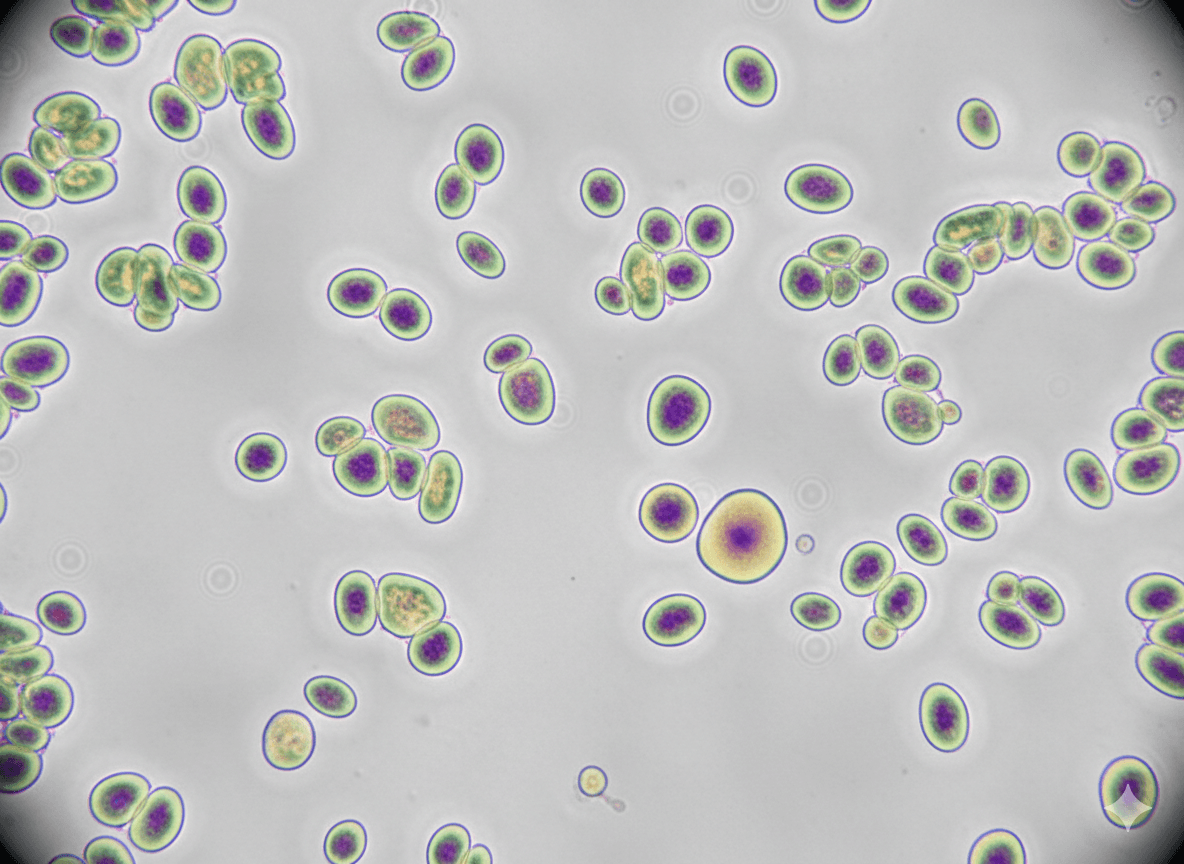
Microscopic Image of Saccharomyces cerevisiae (Generated by Artificial Intelligence)
S. cerevisiae genome contains approximately 6,000 genes, of which about 5,570 are estimated to code for proteins. Genomic analyses indicate that domesticated strains of this species originated from wild forests in East Asia, particularly in China and Taiwan. Wild strains isolated from these regions have been identified as the closest relatives to the ancestral populations of the global diversity of the species. Genetic diversity studies on industrial baking and brewing yeast strains have shown that approximately half of these strains are tetraploid (possessing four sets of chromosomes) or aneuploid (having an abnormal number of chromosomes), demonstrating that polyploidization events have played a role in their evolution. In addition, S. cerevisiae strains harbor, in addition to mitochondrial DNA, an extrachromosomal DNA element commonly referred to as the “2µm plasmid,” which contributes no phenotypic effect to the host.

Typical Features of S. cerevisiae (Generated by Artificial Intelligence)
S. cerevisiae is described as a facultative anaerobe but cannot grow under strictly anaerobic conditions because it absolutely requires oxygen for the biosynthesis of membrane fatty acids and sterols. Even in the presence of oxygen, it prefers fermentative metabolism when glucose is available in the environment. It converts glucose to pyruvate via glycolysis; pyruvate is then decarboxylated by pyruvate decarboxylase into acetaldehyde and carbon dioxide, and finally reduced to ethanol by alcohol dehydrogenase. During this process, yeast also produces secondary metabolites such as higher alcohols, esters, organic acids, and aldehydes in addition to ethanol and carbon dioxide.
S. cerevisiae is one of the most widely used model organisms for studying eukaryotic biological processes【1】. It is used to investigate processes such as aging, gene expression regulation, signal transduction, cell cycle, metabolism, and apoptosis. Approximately 30 percent of human disease-related genes have orthologs in the yeast proteome. Comparative proteomic analyses have revealed that protein sets involved in fundamental biological processes such as “DNA replication,” “Ribosome structure,” and “Proteasome” show higher similarity to those in animals including humans than to those in prokaryotes. This supports the view that S. cerevisiae is a suitable model for drawing inferences about human biology.
The diverse industrial uses of S. cerevisiae demonstrate that this microorganism is of major importance not only for technical efficiency but also for its capacity to direct biochemical processes that determine product characteristics. Within this general industrial framework, fermentation-based production systems represent the area where the metabolic flexibility of yeast is most prominently observed.
S. cerevisiae is the primary microorganism used in the production of wine, beer, and distilled spirits. In winemaking, it dominates fermentation due to its resilience to harsh conditions such as low pH, high sugar content, and the presence of sulfur dioxide.

Fermentation Process of Saccharomyces cerevisiae (Generated by Artificial Intelligence)
Yeast contributes to the “fermentation bouquet” of wine through the esters (fruity aromas) and higher alcohols it produces. In beer production, S. cerevisiae is used for “ale” type beers, while the hybrid S. pastorianus, derived from S. cerevisiae and S. eubayanus, is preferred for “lager” type beers. In the production of distilled spirits such as whiskey, rum, and tequila, suitable S. cerevisiae strains are employed to convert feedstocks such as grains, molasses, or agave into ethanol and aroma compounds.
In bread making, S. cerevisiae, known as “baker’s yeast,” ferments sugars in the dough to produce carbon dioxide gas. This gas causes the dough to rise and develop its porous structure. Commercial baker’s yeasts are selected based on their ability to rapidly produce CO2 and utilize maltose.
S. cerevisiae is the dominant microorganism in the bioethanol industry. It ferments sugars derived from sugarcane, corn, or lignocellulosic biomass to produce ethanol for fuel. Its high ethanol tolerance and resistance to acidic conditions are the main reasons for its preference in this process.
During cocoa bean fermentation, S. cerevisiae consumes sugars in the cocoa pulp, producing ethanol and aroma compounds. Additionally, its pectinolytic activity facilitates the breakdown of the fruit pulp and contributes to the development of fruity and floral notes that determine the final quality of chocolate.
Saccharomyces cerevisiae is a versatile model organism that plays a central role across a broad range of applications, from fundamental cellular biology research to food technology, energy production, and aroma chemistry. It is regarded as an indispensable microorganism in both scientific and industrial studies due to its physiological traits that enhance biotechnological process efficiency and its metabolic activities that define product quality. Current advances in genomics, synthetic biology, and industrial fermentation technologies hold the potential to further expand its applications by enabling the development of future strains with higher yield, greater robustness, and targeted functionality.
Al-Waili, Noori, Khelod Salom, and Ahmed A. Al-Ghamdi. "Analysis of Honey, Propolis, and Royal Jelly: Effects on Human Health and Clinical Applications." *Molecules* 17, no. 4 (2012): 505–535. https://pmc.ncbi.nlm.nih.gov/articles/PMC7099199/.
Cornman, R. Scott, Yan Ping Chen, Michael C. Schatz, Connor Lowman, and Jay S. Evans. "Genomic Analyses of the Microsporidian Nosema ceranae, an Emergent Pathogen of Honey Bees." *PLOS ONE* 4, no. 6 (2009): e1000466. https://journals.plos.org/plosone/article?id=10.1371/journal.pone.0016015.
El-Seedi, Hesham R., Shaden A. M. Khalifa, Aida Abd El-Wahed, Reiko Fazilatunnessa, et al. "Honey Bee Products: An Updated Review of Neurological Actions." *Molecules* 25, no. 10 (2020): 2428. https://pubmed.ncbi.nlm.nih.gov/33432360/.
Ozkirim, Asli, and Nevin Keskin. "The Effects of Propolis on the Nosema ceranae Infection in Honey Bees (Apis mellifera)." *Journal of Apiculture Science* 60, no. 2 (2016): 33–42. https://www.mdpi.com/2306-5710/2/4/30.
[1]
Hiren Karathia et al., "Saccharomyces cerevisiae as a Model Organism: A Comparative Study," PLOS ONE 6, no. 2 (2011): e16015,https://doi.org/10.1371/journal.pone.0016015.

Saccharomyces cerevisiae
Scientific Name(s) | Saccharomyces cerevisiae | ||||||||
|---|---|---|---|---|---|---|---|---|---|
Genome Size | The total size is approximately 12-12.1 million base pairs (Mb) | ||||||||
Cell Type | Unicellular eukaryotic | ||||||||
Taxonomic Position | Kingdom: Fungi (Mushrooms) | ||||||||
No Discussion Added Yet
Start discussion for "Bread Yeast (Saccharomyces cerevisiae)" article
Genome and Metabolic Properties
Genetics and Evolution
Physiology and Metabolism
Use as a Model Organism
Industrial Applications
Alcoholic Beverage Industry
Baking
Bioethanol Production
Chocolate Industry